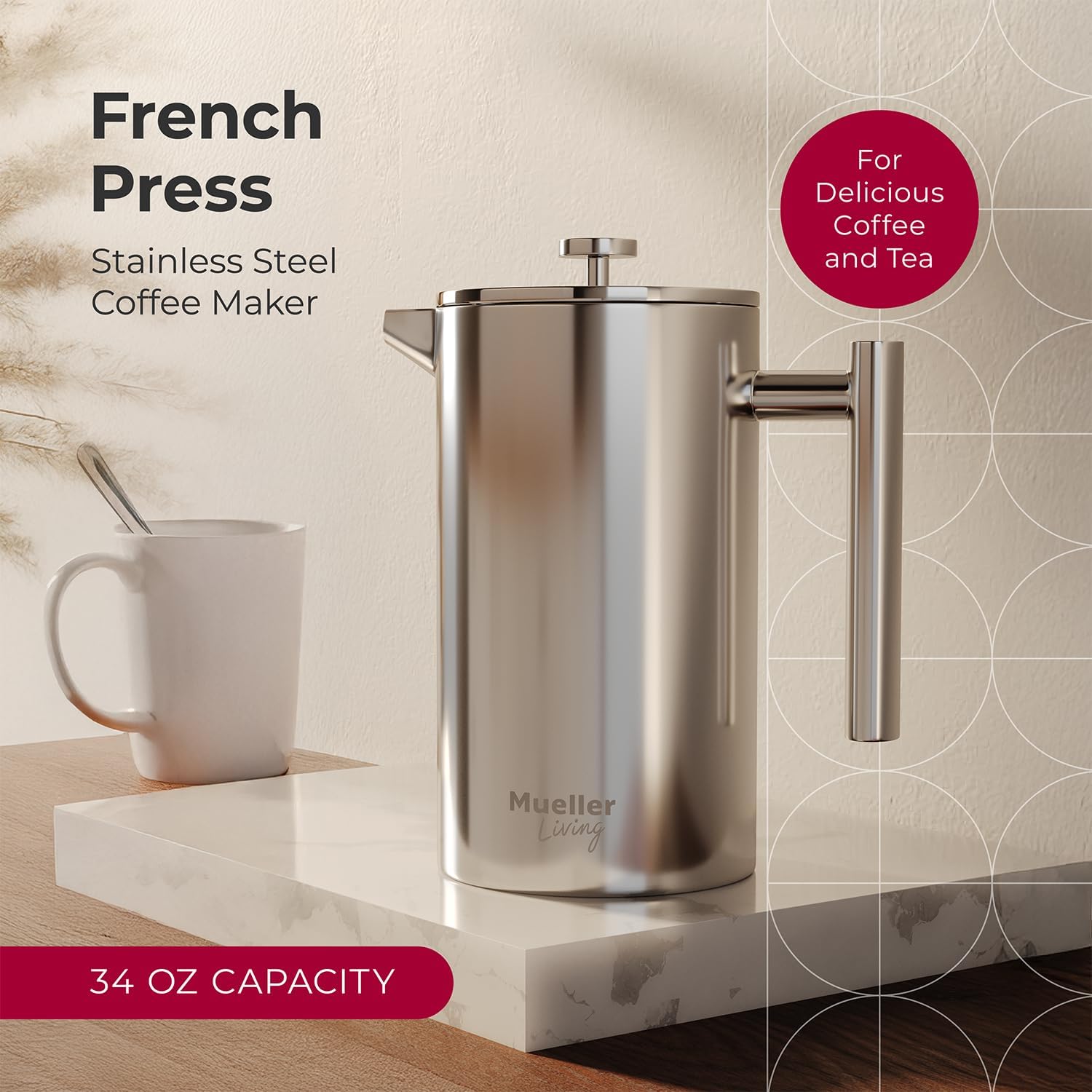
MuellerLiving 34oz Stainless French Press Hot Full Flavor
Selecting the Right French Press for Home and Travel
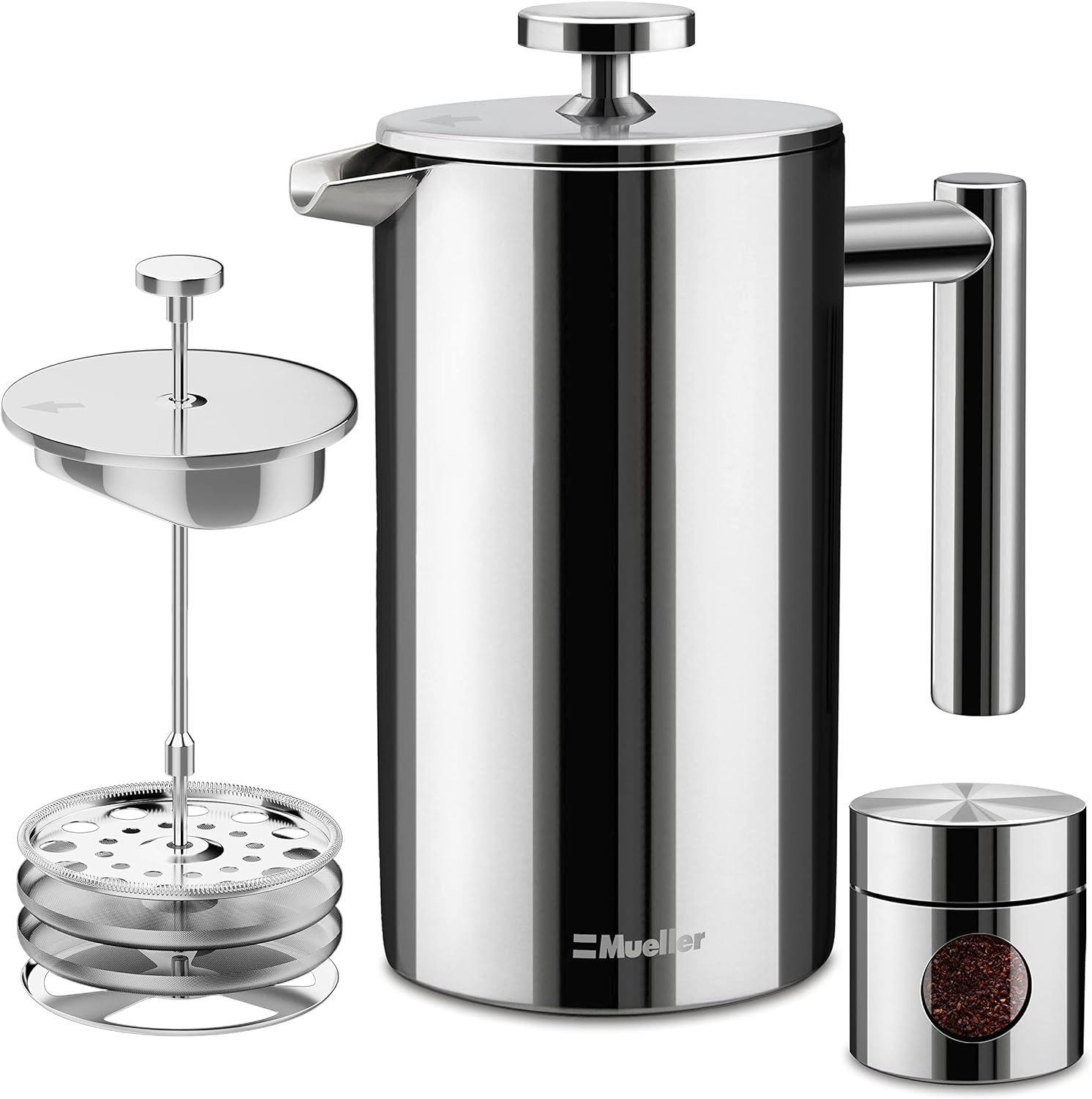
Choice of coffee and tea equipment affects extraction, temperature stability, and daily workflow. For home brewers, households, and travelers who prefer immersion brewing, a French press must balance materials, filtration, and heat retention to deliver consistent, full-bodied cups. This stainless steel, double-walled French press targets users who want robust flavor without fragile glass; the construction and four-level filtration seek to reduce sediment while preserving oils that contribute to body. Product characteristics such as carafe material, filter stack, and manual operation determine compatibility with coarse to medium-coarse grinds, influence brew ratios, and set expectations for cleaning and long-term durability. Selecting a press therefore depends on priorities: portability and heat retention, ease of maintenance, or the finest sediment control for cleaner cups. Understanding these factors helps match this model to intended use cases including daily home brewing, office service, and outdoor or camping scenarios.
Quick Overview
| Feature | Details |
|---|---|
| Product category | French press / immersion brewer |
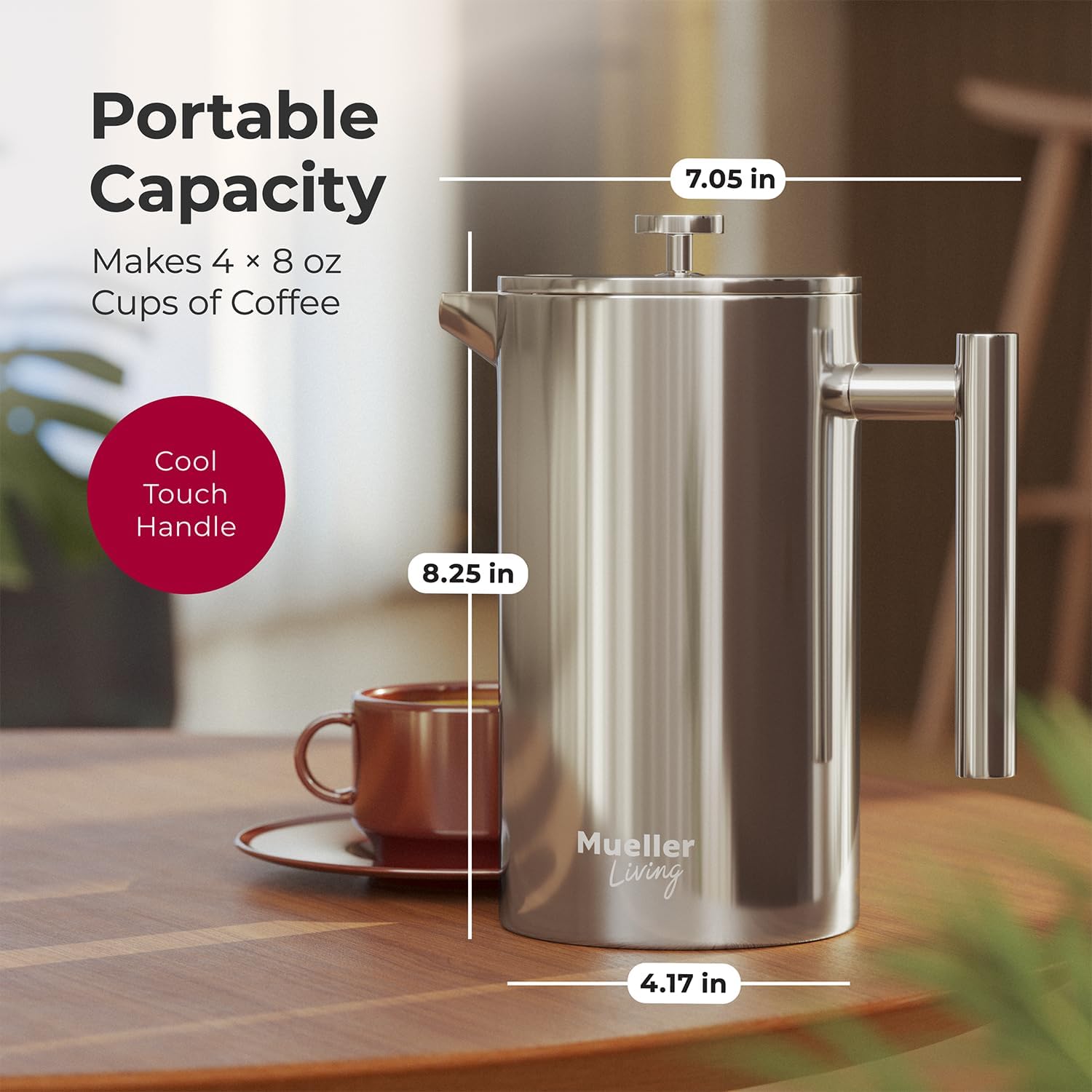
| Capacity & output | 34 oz (approximately 4 8-ounce servings) |
| Materials & construction | Double-walled 304 stainless steel carafe; stainless steel plunger and mesh filters; cool touch handle |
| Brewing system | Manual immersion; plunger and multi-part filter assembly |
| Filtration | 4-level filtration: coiled filter, two stainless steel screen filters, metal cross plate |
| Grind compatibility | Coarse to medium-coarse loose grounds |
| Intended users | Home brewers, small households, office or camping use |
| Intended use cases | Hot coffee, tea, cold brew concentrate; also keeps frothed milk warm |
| Cleaning & maintenance | Dishwasher safe; plunger disassembles for hand washing |
| Warranty / manufacturer | Mueller Austria manufacturer disclosure; standard packaging; model MU-SSHYDPRESS |
The features above combine to influence practical brewing outcomes: the 304 stainless carafe improves heat retention compared with single-walled glass presses, while the four-stage filter stack aims to limit suspended solids without removing oils that contribute to body. Manual immersion and a recommended four-minute steep align with common brew ratios for robust extraction, and dishwasher-safe components reduce maintenance time for regular use.

Build quality and long-term durability
The build prioritizes corrosion resistance and impact resilience through 304-grade stainless steel for the double-walled carafe and metal filter components. Double-wall construction not only aids heat retention but also eliminates a fragile glass vessel, reducing breakage risk during transport or camping. The listed cool-touch handle and stainless plunger components suggest concern for ergonomic daily use and thermal isolation; however, metal housings can transmit heat to external fittings if not specifically insulated. Rust-free claims are consistent with 304 stainless behavior when cared for properly, but long-term durability depends on maintenance of threaded or sealed joints in the plunger assembly and avoiding abrasive cleaners that can damage finishing. For users valuing reliability over decorative finishes, this construction is aligned with long-term use in varied environments.

Materials and corrosion resistance
304 stainless steel is a standard food-grade alloy that offers strong corrosion resistance in typical coffee and tea environments. It resists rust from normal exposure to water and hot beverages when rinsed and dried appropriately. The presence of multiple disassemblable metal parts—coiled filter, screen filters, and cross plate—creates potential crevices where residue and moisture can collect; attention to drying is necessary to avoid surface staining or mineral buildup. Welds, handle attachments, and seals are typical wear points over time; their construction quality and how often the unit is disassembled for cleaning will influence longevity. In environments with hard water, occasional descaling or vinegar rinses will help maintain metal surfaces.
Mechanical design and impact resistance
By eliminating a glass carafe, the design reduces fracture risk from drops or knocks during travel or outdoor use. The double-wall carafe also adds structural stiffness compared with thin single-wall options. The cool-touch handle indicates thermal isolation at the grip point, but the attachment method and its mechanical fasteners determine resistance to bending or loosening. The plunger assembly’s longevity depends on screw joints, rivets, or press fits used to secure screens; repeated use can loosen these if not well-made. For frequent transport, users should monitor fasteners and ensure filters remain seated to prevent operational issues and preserve a consistent seal during plunging.
Heat retention and temperature stability
Heat retention for immersion brewers is a function of starting water temperature, vessel thermal mass, and insulation. A double-walled 304 stainless carafe increases thermal resistance compared with single-walled glass presses, slowing conductive and convective heat loss and keeping brew temperature higher through steeping and serving periods. Higher retained temperature supports more complete extraction during a standard four-minute steep, particularly when coarse grounds are used. However, there is no active temperature control or internal heating; ambient conditions and preheating practices (pouring hot water into the carafe before brewing) still influence final extraction. For multi-cup service, heat retention prolongs serving time but eventual cooling will change perceived strength and acidity as the coffee equilibrates.
Insulation performance and practical effects
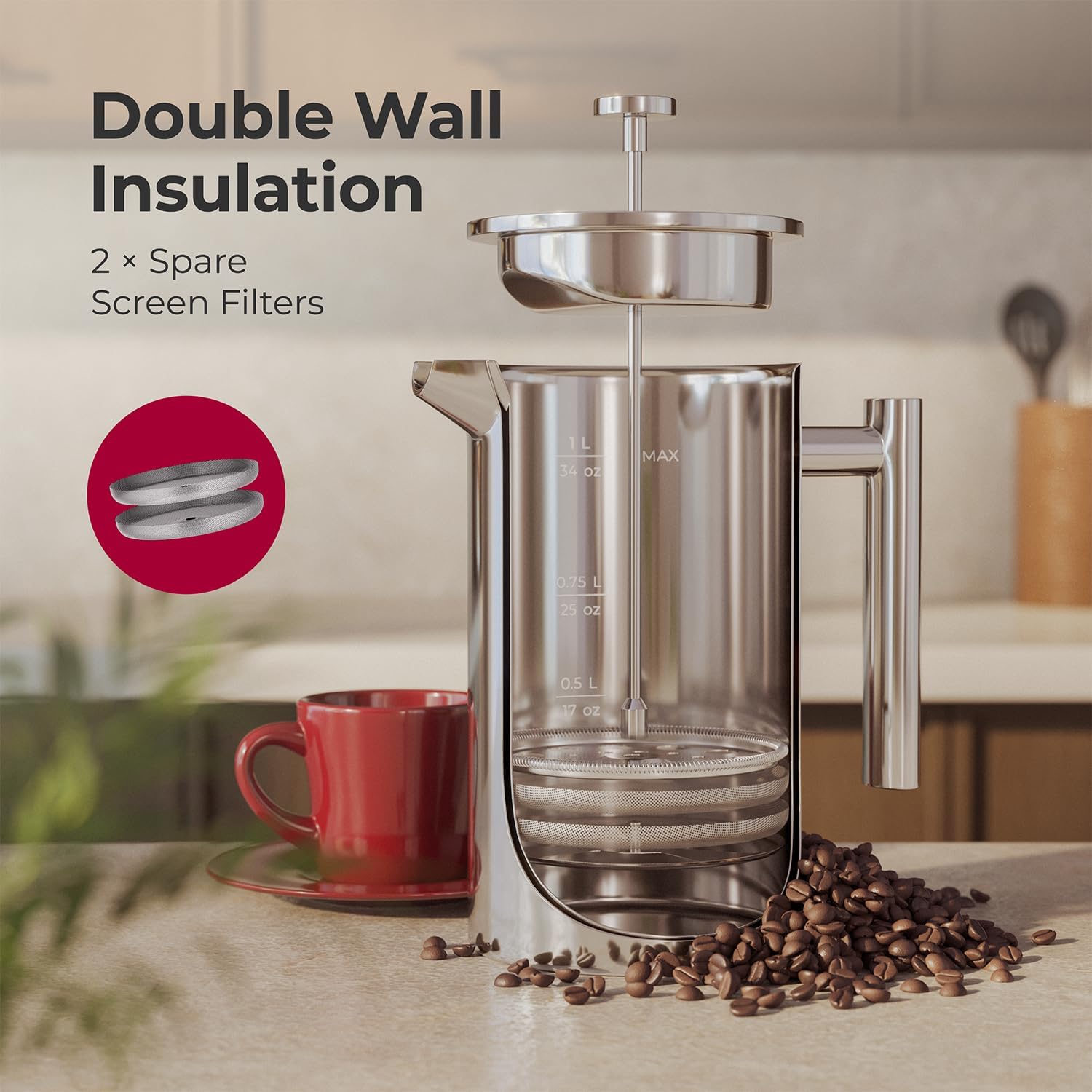
Double-wall stainless construction creates an insulating air gap that reduces heat transfer, which helps maintain extraction temperature during the four-minute immersion and extends serving window before significant cooling occurs. In practice, this translates to steadier extraction across the steep time, supporting fuller-bodied results when following recommended brew ratios. Preheating the carafe with hot water further reduces initial thermal loss, improving temperature stability. Users who serve multiple cups over 20–30 minutes will still see temperature decline, but the insulated carafe reduces the rate compared with glass presses, preserving flavor clarity and mouthfeel for longer.
Temperature and extraction considerations
Temperature stability affects solubility of coffee compounds during immersion. For coarse grinds common in French press brewing, water at or near 195–205°F (90–96°C) is typical for optimal extraction; double-walled insulation helps maintain those temperatures while steeping. Because the unit is manual with no active heating or pressure control, variables such as grind size, brew ratio, and initial water temperature play a primary role in extraction outcome. To avoid under-extraction, users should pair the press with a consistent coarse grind and follow stewardship like preheat and proper steep time. Over-steeping or very hot water can increase bitterness; insulated vessels make it easier to keep temperatures stable without overheating during repeat pours.
Filtration, brew consistency, and extraction quality
The four-level filtration stack—coiled filter, two stainless steel screens, and a metal cross plate—addresses a common trade-off in immersion brewing: retaining the oils that contribute to body while reducing undesirable suspended fines. Multiple stainless screens reduce visible sediment and slow the flow during plunging, which can change resistance and perceived extraction if grounds pack differently. Filtration does not replace the need for consistent coarse grind; finer particles still increase turbidity and can accelerate over-extraction. Brew consistency therefore depends on grind distribution, precise brew ratios, and how filters are assembled. The manual plunger system offers limited flow control compared with press systems that use valve-based flow regulation, so extraction is primarily governed by immersion time and grind size rather than pressure or flow modulation.
How the filter stack affects mouthfeel and clarity
A multi-component filter approach aims to capture smaller particles while allowing oils and larger colloids to pass, preserving body and aromatics associated with French press coffee. The coiled spring filter helps create a peripheral seal, while stacked screens provide finer mechanical filtration. This reduces the amount of suspended solids in the cup relative to a single-screen press but will not produce the clarity of paper-filtered brews. The resulting mouthfeel remains full-bodied with lower grit and sediment, assuming proper grind and careful plunging. Users seeking clean, low-clarity cups may still prefer paper-filter or pour-over methods, while this design targets a balance between body and tidiness.
Grind compatibility and extraction control
French press brewing favors a coarse, uniform grind to limit fines that increase turbidity and over-extraction. The four-level filter reduces sediment risk but cannot fully compensate for inconsistent grind particle size. Burr grinders with adjustable settings produce the most predictable results; blade grinders or inconsistent grinders increase the likelihood of fines and variable extraction. Brew ratios around 1:12 to 1:15 weight-based (coffee to water) are common starting points for full-bodied presses, with steep times typically near four minutes. Because the press lacks active pressure regulation, consistent results depend on controlling grind, dose, and steep time rather than on device adjustments.
Capacity, serving flexibility, and portability
The 34-ounce capacity positions the unit as a small multi-cup brewer suitable for 1–4 people depending on cup size. This capacity supports brewing a batch for households or an office setting without repeated brews, and the stainless construction reduces fragility for travel or camping. The manual operation and lack of electrical components make it inherently portable, while the cool-touch handle facilitates pouring when hot. However, double-walled stainless steel increases weight compared with glass and plastic alternatives; expressed item weight near 2.2 pounds reflects this trade-off. Capacity also influences extraction dynamics: scaling recipes requires proportionate dose adjustments to maintain consistent brew strength and extraction percentage across the full carafe volume.

Practical serving scenarios and recipe scaling
Within a 34-ounce carafe, common serving patterns include two to four standard 8-ounce cups or concentrated servings for thermoses. Scaling recipes for full-capacity brews involves proportional coffee dosing and consistent coarse grind to avoid under- or over-extraction. For single-serve or travel preparation, partial-volume brewing is also practical, but immersion time and slurry-to-water ratio must be adjusted accordingly. The absence of an internal reservoir or drip-stop means pouring practice affects heat loss; for longer serving intervals, decanting into a thermal carafe preserves temperature and flavor profile more effectively than leaving coffee in the press for extended periods.
Portability, weight, and field use
The rust-free stainless construction and manual operation suit outdoor and travel use where fragility and power access are concerns. The cool-touch handle and secure lid reduce spill risk during transport. The trade-off is added mass from double-wall steel compared with lightweight plastic or single-wall glass presses; this impacts pack weight for backpacking or extended travel. For car camping, office kitchens, and short trips where durability and heat retention are priorities, this model’s construction aligns well with practical portability requirements.
Cleaning, maintenance, and user workflow
Dishwasher-safe claims and an easily disassembled plunger and filter stack simplify routine maintenance for many users. Regular cleaning of the multi-part filter assembly is important to prevent oil buildup and trapped grounds, which can affect flavor and increase corrosion risk in crevices over time. The recommendation to clean the plunger after each use aligns with best practices for immersion brewers. While dishwasher compatibility eases workflow, repeated dishwasher cycles and high-heat drying may accelerate wear on any non-stainless fittings or coatings; hand washing and thorough drying will maximize longevity. Replacement parts are not always standardized across brands, so the ability to service the filter stack should be considered for long-term ownership.
Disassembly, dishwasher use, and routine care
The plunger’s multi-component nature supports deep cleaning: the coiled filter, screens, and cross plate can be taken apart to rinse trapped fines and oils. Dishwasher-safe labeling typically refers to the carafe and plunger parts, but frequent dishwasher cycles expose metal surfaces to detergents and high temperatures that can alter finishes or adhesives on non-metal components. Manual rinsing with warm water and mild detergent, followed by full air drying, reduces risk of trapped moisture and mineral deposits. For users with hard water, occasional descaling or vinegar rinses help prevent mineral buildup in both carafe and filter crevices.
Replacement parts and expected wear points
Filter screens and spring coils are subject to bending, deformation, or loosening after repeated assembly and cleaning; these are common wear points that determine long-term filtration performance. Handle attachments and stamped parts can loosen with frequent transport, and the seal between plunger and carafe lip can change as components age. Manufacturer availability of replacement screens or plunger assemblies affects long-term serviceability. When replacement parts are not readily available, owners may face gradual declines in filtration effectiveness and mechanical fit, so inspecting connections and screens regularly supports predictable performance.

Pros & Cons
Pros
- Durable, rust-resistant construction: The double-walled 304 stainless steel carafe significantly reduces the risk of breakage and corrosion compared with glass designs, making it a practical choice for travel, camping, or high-use home kitchens. The metal components align with manufacturer rust-free claims when maintained.
- Improved heat retention: The insulated carafe slows temperature loss during steeping and serving, which supports consistent extraction during a four-minute immersion and extends serving temperature compared with single-wall glass presses.
- Four-level filtration reduces sediment: The stacked coiled filter and dual screens plus cross plate aim to lower suspended fines while retaining oils that contribute to body, producing a fuller cup with less grit than many single-screen presses.
- Dishwasher-safe and disassemblable: User workflow benefits from parts that can be taken apart for thorough cleaning and rinsed in a dishwasher, reducing maintenance time for frequent brewers when recommended care is followed.
- Versatile use cases: Suitable for hot coffee, tea, cold brew concentrate, and keeping frothed milk warm, offering multi-purpose utility for households and small offices.
- Manual, electricity-free operation: The design is inherently portable and usable in settings without power, making it suitable for camping and travel where glass fragility and power requirements are concerns.
Cons
- Not a substitute for precise temperature control: Without active heating or temperature regulation, outcomes rely on user-controlled variables such as preheating, grind size, and steep time; users expecting exact temperature hold may prefer electrically heated options.
- Weight compared with lightweight options: Double-wall stainless steel increases mass relative to single-wall plastic or glass presses, which may be a disadvantage for ultralight backpacking or extended travel where pack weight matters.
- Filter parts are potential wear points: The multi-part filter stack improves clarity but introduces additional joints and screens that can loosen, deform, or trap residue; replacement parts availability and careful maintenance affect long-term filtration performance.
- Does not produce paper-filter clarity: While filtration reduces sediment, the press will still deliver fuller-bodied cups with some oils and micro-fines; users seeking very clear, bright cups may prefer pour-over with paper filters.
Final Verdict: Who This Product Is Best For (and Who Should Skip It)
This French press suits home brewers, small households, office environments, and car-camping users who prioritize durability and heat retention without reliance on electricity. The double-walled 304 stainless carafe and rust-resistant components make it a practical option for those seeking consistent, full-bodied immersion brews with reduced fragility compared with glass presses. The four-level filtration provides a middle ground between gritty, traditional press cups and the clarity of paper-filtered methods, appealing to users who want robust flavor with less sediment. Routine care—disassembling and cleaning the plunger and filters—will maintain performance and extend service life.
Those who should skip this model include coffee drinkers prioritizing absolute cup clarity, bright acidity, or precise temperature control via active heating systems. Ultralight backpackers who must minimize pack weight may prefer lighter plastic or single-wall options, and users unwilling to perform periodic disassembly and drying to prevent residue build-up might find the multi-part filter workflow burdensome. Overall, the product fits users seeking a durable, heat-retaining immersion brewer that balances body and reduced sediment for everyday and travel-forward brewing in 2026.

Frequently Asked Questions (FAQs)
What grind size works best with a stainless steel French press?
A coarse, uniform grind is best for French press immersion brewing because it minimizes fines that contribute to sediment and over-extraction. Burr grinders with a coarse setting produce a more consistent particle distribution than blade grinders. Consistent grind size, combined with a four-minute steep and appropriate brew ratio, helps achieve balanced extraction and reduced grit in the cup.
How does double-walled 304 stainless steel affect coffee temperature?
Double-walled 304 stainless steel provides an insulating air gap that slows conductive and convective heat loss compared with single-walled glass presses. This improves temperature stability during the recommended steep time and extends the serving window, helping support more complete extraction and preserving flavor for longer before noticeable cooling occurs.
Can the plunger and filters be washed in the dishwasher?
Manufacturer disclosures list the carafe and plunger components as dishwasher safe, and the filter stack is disassemblable for cleaning. Frequent dishwasher cycles expose metal surfaces to detergents and heat, which may affect finishes over time; hand washing and full air drying will reduce the risk of long-term wear in hard-water environments.
Will the four-level filter eliminate all sediment from French press coffee?
A multi-stage stainless steel filter stack reduces visible fines and suspended solids compared with single-screen presses, but it will not achieve the clarity of paper filters. Oils and micro-colloids that contribute to body will pass through, so the cup remains fuller-bodied while containing less grit—provided the grind is consistent and coarse.
Is this French press suitable for camping and travel?
The rust-resistant 304 stainless steel construction and manual operation make the unit well suited for car camping, travel, and locations without power, as it avoids the fragility of glass. However, double-wall stainless steel adds weight compared with lightweight plastic options, so packing choices should consider that trade-off for extended backpacking trips.
How should this press be maintained to ensure longevity?
Regular disassembly and rinsing of the plunger assembly will prevent oil buildup and trapped grounds that can impair filtration and encourage staining. Drying components fully after washing and occasionally descaling if hard water is present will help maintain surface quality. Inspecting filter screens and fasteners for deformation or loosening supports consistent long-term performance.