
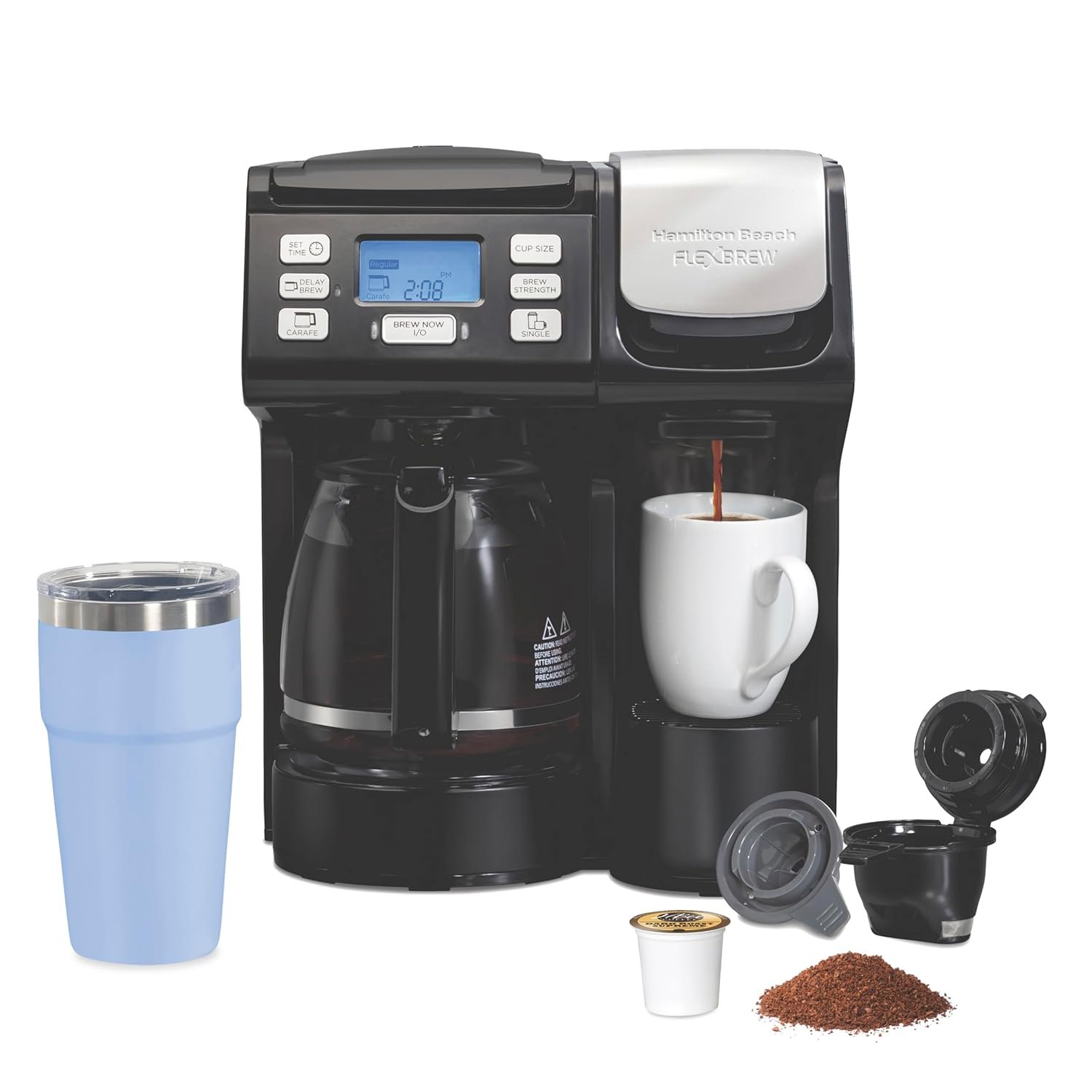
Why equipment choice matters for daily brewing
Selecting the right coffee equipment affects flavor, convenience, and household workflow. For many home brewers and small offices, a single machine that handles multiple brewing needs offers practical value: flexibility to serve a quick single cup with a pod or grounds while also producing a full 12-cup pot for groups. Equipment characteristics such as heating design, reservoir size, filter compatibility, and control layout directly influence extraction consistency, temperature stability, and cleaning frequency. The Hamilton Beach FlexBrew Trio positions itself as a hybrid solution that combines single-serve pod and ground brewing with a traditional drip carafe. Buyers who prioritize varied serving sizes, straightforward programming for scheduled brewing, and a removable reservoir for frequent single-serve use will find the platform relevant. Conversely, those seeking precise temperature management for specialty extraction, or pressure-based espresso performance, should consider the machine’s design limits before purchasing.
Quick Overview
| Feature | Details |
|---|---|
| Product category | Two-way drip coffee maker with single-serve and 12-cup carafe functions |
| Brewing methods | K-Cup-compatible single-serve pod; single-serve ground basket; 12-cup drip carafe with ground coffee |
| Capacity | 12-cup glass carafe; 56-ounce removable single-serve reservoir (up to ~7 single cups before refill) |
| Materials & construction | Glass carafe, plastic exterior and components, metallic finish accents; dishwasher-safe removable parts |
| Heating system | Standard electric drip heating element for carafe; expedited single-serve flow path designed for ~90-second pod brewing |
| Filter compatibility | K-Cup pods; single-serve reusable grounds basket; standard flat-bottom brew basket for carafe |
| Controls & features | Backlit programmable display for carafe, Easy-Touch programming, Select-a-Brew strength selection, Auto Pause & Pour |
| Best suited users | Households and small offices needing mixed single-serve and carafe outputs |
| Intended use cases | Daily home brewing, multi-user kitchens, travel mug fills, scheduled morning brew for carafe |
| Warranty | Refer to manufacturer for warranty details |
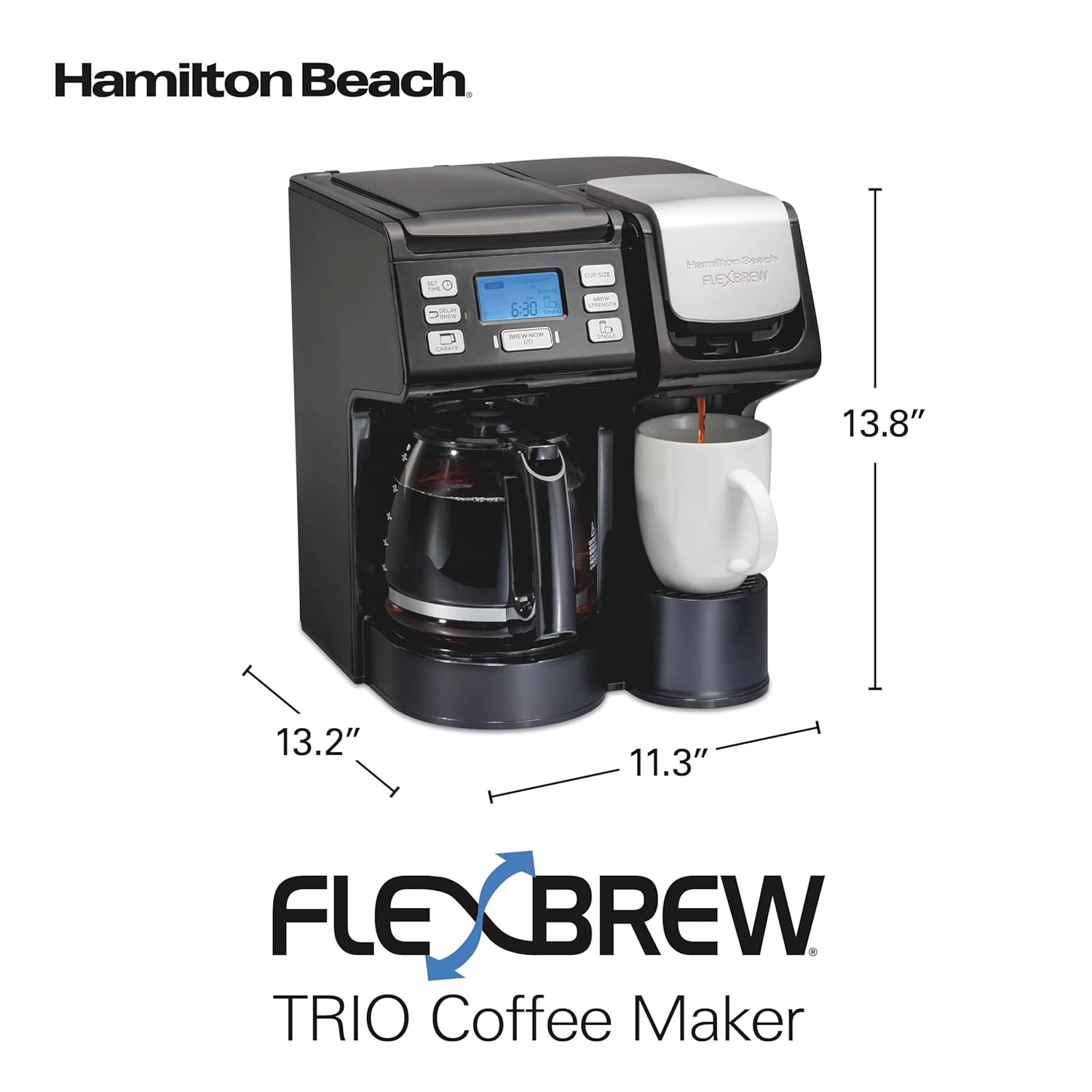
The table summarizes how the machine’s architecture balances versatility and simplicity. Having both a removable reservoir and a 12-cup carafe changes workflow: frequent single-serve use relies on the reservoir size and pod or ground options, while scheduled full-pot brewing depends on the programmable carafe controls. Material choices and dishwasher-safe parts influence cleaning frequency and long-term upkeep, and the heating design frames temperature behavior and extraction potential.
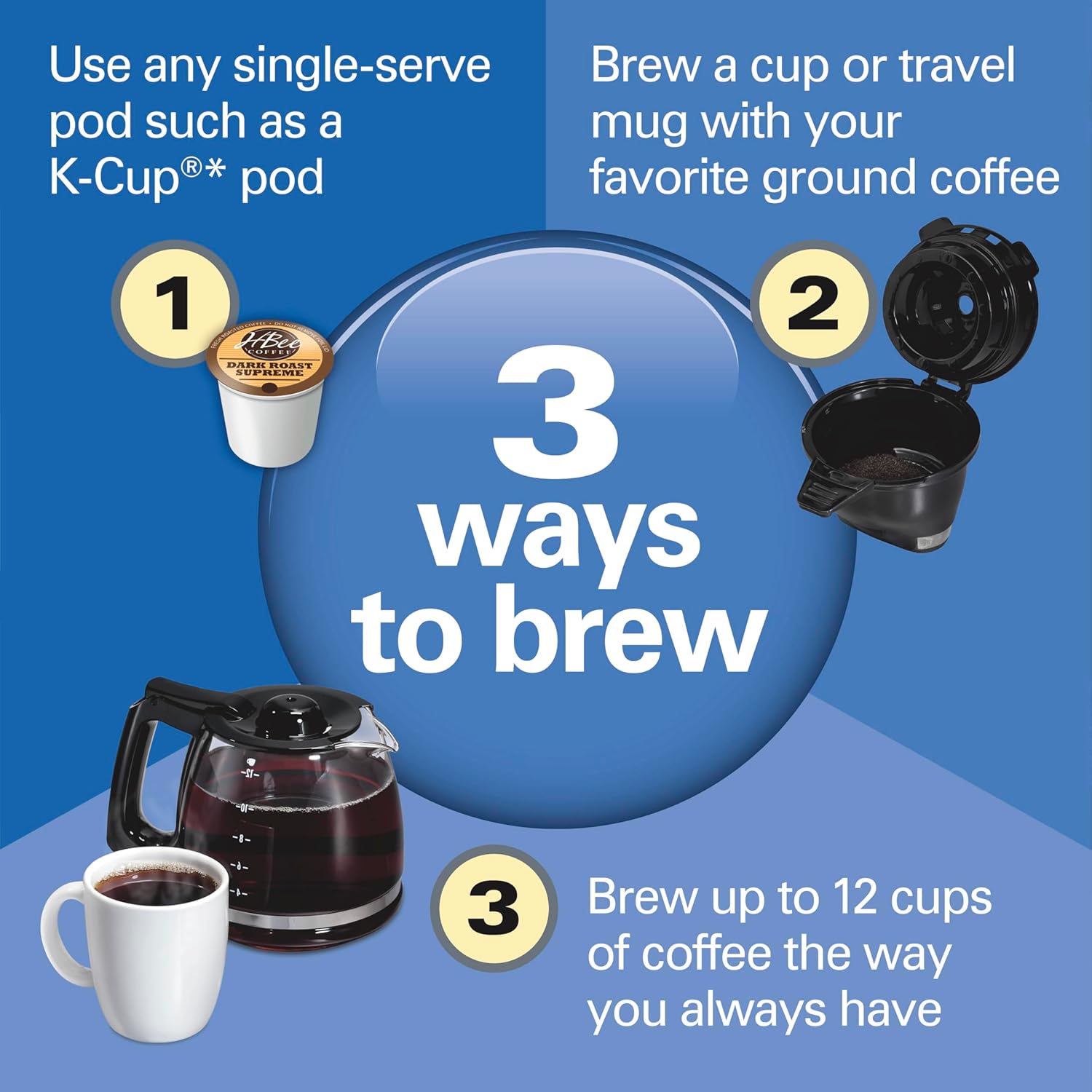
Brewing method compatibility
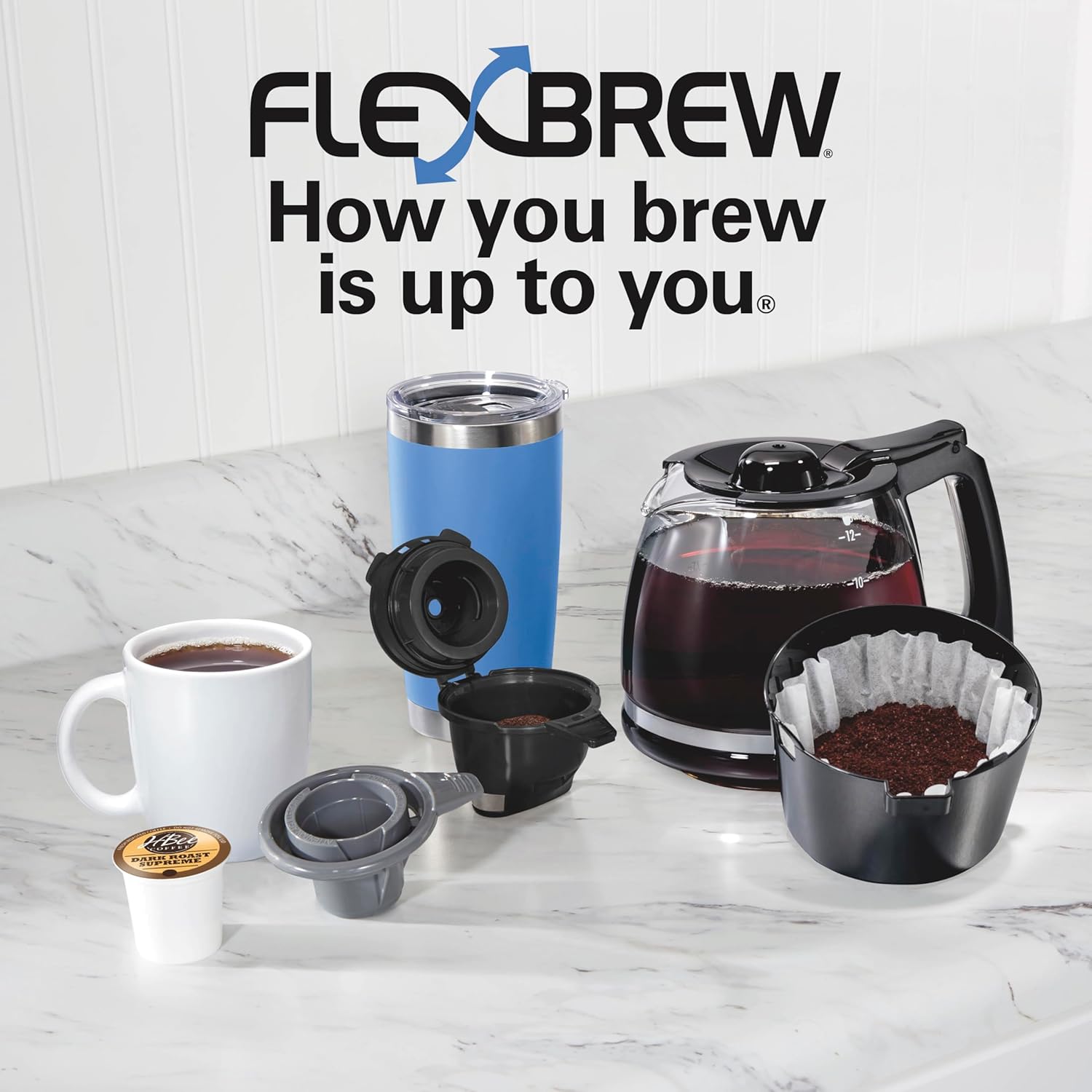
The FlexBrew Trio offers three distinct brewing pathways: K-Cup pod single-serve, ground coffee single-serve, and 12-cup carafe drip. This breadth accommodates users who switch between convenience pods and freshly ground coffee without multiple machines, though the extraction mechanics differ across paths. Pod brewing routes water quickly through a sealed capsule at lower dwell time, favoring convenience and consistent portioning but not the same contact time offered by a dedicated pour-over or press. Ground single-serve and carafe modes use drip extraction where water-to-coffee contact time, grind size, and brew ratio change final strength. Compatibility extends to K-Cup format and flat-bottom carafe filters, allowing common paper filters or reusable baskets; that flexibility suits households with varied preferences but does not substitute for pressure-based espresso extraction.
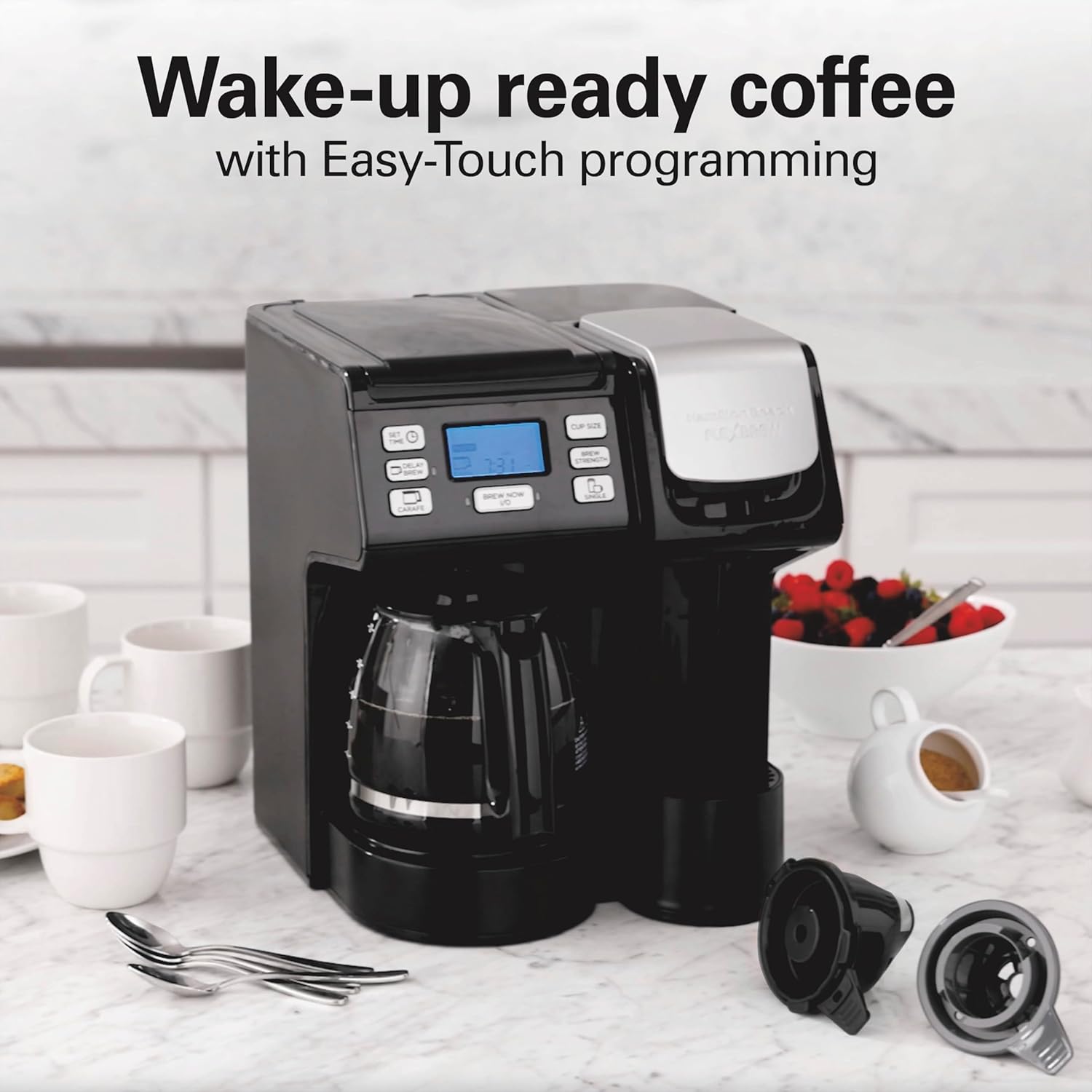
How pod and ground brewing differ in extraction
Pod brewing in this system relies on a predetermined capsule volume and a rapid water flow path designed for speed, which reduces contact time compared with a carafe or manual pour-over. As a result, the perceived strength and body are functions of pod composition and chosen single-serve size rather than grind adjustment. Ground single-serve and carafe modes permit some control over extraction via grind size and brew strength setting; coarser grinds favor faster flow with lighter extraction, while finer grinds increase resistance and extraction. Users should match grind profile to the chosen mode—medium-fine for single-serve ground baskets and medium for carafe drip—to approach balanced extraction and avoid under- or over-extraction.
When the Trio is suitable versus when it is not
The combined pod-and-ground approach is well-suited for multi-user environments where convenience and variety matter more than precision brewing. It supports quick, repeatable single servings and full pots for groups. However, those seeking temperature profiling, precise pour-over control, or espresso-level pressure should look to specialized equipment. The machine’s design favors throughput and ease, so specialty coffee drinkers who require exact water temperature regulation, variable flow rates, or extended immersion times will find its hybrid approach limiting for advanced extraction experimentation.
Ease of use and workflow complexity
The Trio’s interface and component layout are aimed at straightforward daily use with minimal setup. Features such as the removable 56-ounce reservoir reduce the need for frequent refilling during single-serve brewing, and the cup rest stores the single-serve pod holder or basket for quick swaps. The carafe side offers Easy-Touch programming and a backlit display for timed wake-up brewing, while Select-a-Brew strength options provide simple strength differentiation. Workflow generally splits into two parallel routines: a quick single-serve path for on-demand cups and a programmable path for full-pot needs. The machine’s button-driven controls and dishwasher-safe removable parts lower complexity, though switching between modes requires awareness of which brew basket is in place and occasional reorienting of parts for travel mug or carafe use.

Daily workflow for single-serve users
For single-serve users, the removable reservoir and fast brew time streamline repeated cups. Reservoir capacity supports multiple single servings before refill, and the removable cup rest accommodates travel mugs up to seven inches tall. The trade-offs include managing the storage of pod holders and ensuring the single-serve basket is clean and seated properly. A consistent routine—load pod or grounds, confirm reservoir level, select size, and brew—reduces operation time and simplifies morning tasks without the multi-step calibration required by manual pour-over or grinder-equipped setups.
Workflow for scheduled carafe brewing
Carafe-oriented users interact primarily with the programmable timer and the 12-cup brew basket. Easy-Touch programming enables set-and-forget operation for morning pot brewing, and Auto Pause & Pour allows mid-brew pouring. Preparation involves measuring grounds to desired brew ratio, selecting strength, and setting the timer as needed. This approach mirrors traditional drip workflows, but the convenience of combining both systems in one unit requires occasional coordination to avoid leaving single-serve components in place when intending to brew a full pot.
Temperature control and heat stability
Temperature behavior for the FlexBrew Trio follows typical consumer drip-maker patterns rather than high-end temperature-stable platforms. The carafe side relies on a domestic electric heating element and thermal path calibrated for pot-scale drip extraction, while single-serve flow geometry emphasizes speed to achieve a rapid 90-second pod brew. Temperature stability in drip cases is influenced by initial water temperature, heat loss in the shower head and brew basket, and retention on the hot plate beneath the glass carafe. The unit’s design does not include PID control or active temperature monitoring; achieved brew temperatures will be within consumer drip ranges suitable for everyday drinking but may vary with ambient conditions and reservoir fill level, affecting extraction and perceived flavor clarity.
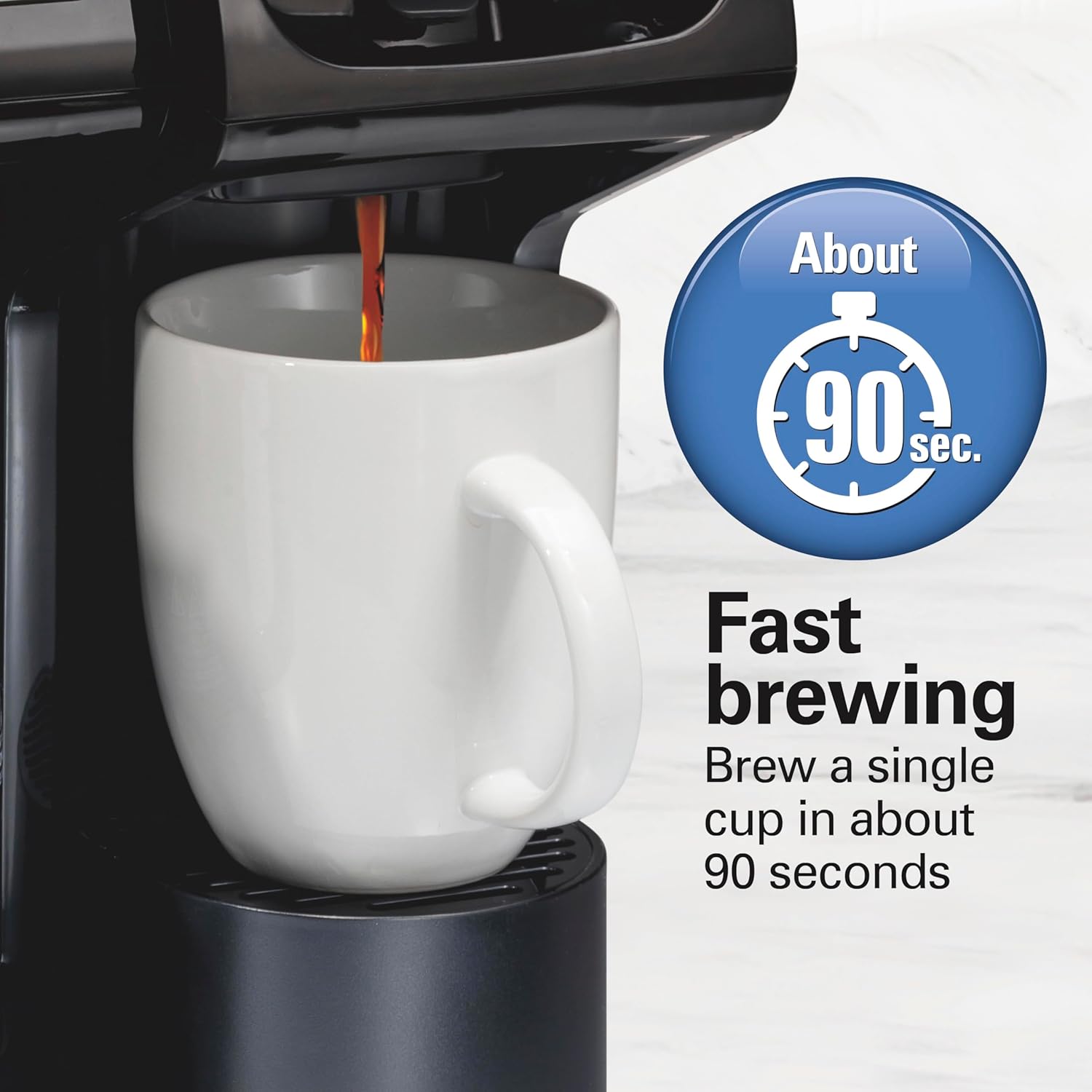
How temperature affects extraction in mixed-mode machines
Extraction efficiency correlates strongly with brew water temperature and contact time. In the Trio, the single-serve pathway’s faster flow reduces dwell time, making brew temperature and pod formulation more influential on strength and solubles extraction. For the carafe, consistent water distribution and near-optimal temperatures produce fuller extraction when matched with proper grind and brew ratio. Users seeking repeatable extraction should pre-warm the carafe area or use freshly heated water for grounds to minimize temperature drop, and use medium grind sizes for the carafe to balance flow and contact time.
Practical implications for everyday users
For most households, the Trio’s temperature profile delivers acceptable extraction and drinkable results across its modes. However, those aiming for peak clarity, acidity control, or bottomless flavor nuance may find variations when transitioning between pod and carafe modes. Routine maintenance—descaling and ensuring unobstructed flow paths—helps maintain thermal transfer efficiency and minimizes temperature inconsistency over time.
Brew consistency and extraction quality
Consistent extraction depends on repeatable water distribution, stable temperature, and predictable flow rate. The FlexBrew Trio standardizes portions via pod volumes and single-serve size selections, which supports consistent cup-to-cup beverage strength when using pods. Ground brewing introduces variables such as grind distribution, dosing, and tamping (for reusable baskets), so consistency improves when users standardize grind size and dose per chosen cup size. The carafe’s flat-bottom basket and shower dispersion pattern affect even saturation of grounds; paper filters moderate oils and fines for clearer cups. The Select-a-Brew strength selector offers a simple means to alter water-to-coffee ratio, but it does not substitute for grind or dose control in achieving professional-level extraction precision.
Tips for improving extraction quality with the Trio
Better extraction outcomes arise from matching grind size to brew pathway and stabilizing brew ratios. For single-serve grounds, slightly finer-than-drip grinds can compensate for shorter contact times, whereas carafe brewing favors medium grind. Consistent dosing—measured scoops or a kitchen scale—helps maintain repeatable strength, and using fresh, filtered water minimizes off-flavors and scale buildup. Regular descaling keeps flow passages clear, reducing channeling and ensuring uniform water distribution across the brew bed.
Limits to extraction precision in hybrid drip machines
Hybrid machines trade some control for convenience. The Trio lacks variable flow control, programmable temperature profiles, and pressure modulation, which are features found in specialty or prosumer equipment. Consequently, while it can produce satisfactory everyday coffee across pods and grounds, achieving the nuanced extraction control required for single-origin tasting or specialty espresso-style drinks will be constrained by the hardware design.
Capacity and serving flexibility
Capacity is a defining trait: a 12-cup glass carafe serves groups, while a 56-ounce removable reservoir supports multiple single-serve brews without refilling. Five single-serve size settings (6, 8, 10, 12, 14 ounces for grounds; 6, 8, 10 ounces for pods) and carafe programmability deliver usable portion control for households with divergent preferences. The removable cup rest enables travel-mug compatibility up to seven inches, and the storage compartment for the pod holder or brew basket improves organization. These specifications make the machine adaptable for morning family routines, office round-robin service, or alternating single and group use, though throughput for consecutive single serves depends on reservoir refill cadence and cooling time between back-to-back carafe cycles.
Serving scenarios best matched to the Trio
The design fits mixed-use kitchens where individuals require fast single cups and occasional full pots. It is effective for families with varied timing needs—one person can pull a single-serve while another schedules a pot. Small offices benefit from the removable reservoir and storage features that reduce interruptions. The range of size settings supports dose tailoring without adjustable grinders or manual pouring steps, simplifying multi-user consistency.
Considerations for high-volume use
For continuous, high-volume environments, the Trio’s reservoir and reheating cycles may limit sustained throughput. Repeated back-to-back carafe brews will require refill and cooldown intervals, and frequent single-serve demand can deplete the reservoir faster than top-fill machines with larger tanks. Users with consistently large serving requirements should compare commercial or larger-capacity models for uninterrupted service.
Cleaning and maintenance expectations
Materials and removable components influence cleaning routines. The Trio includes dishwasher-safe parts such as the brew basket, pod holder, and carafe, which simplifies daily cleaning. The removable reservoir allows periodic rinsing and prevents standing water when not in use. Standard maintenance also includes descaling the internal heating pathways on a schedule appropriate for local water hardness; this preserves flow rates and thermal transfer. Users should monitor seals, the pod piercing mechanism, and brew pathways for grounds or residue buildup. While plastic components are common in consumer hybrids and are engineered for durability, repeated dishwasher cycles can accelerate wear on latches and finishes over time, so hand-washing delicate parts may extend longevity.

Routine cleaning steps and frequency
Daily cleaning of removable baskets and the carafe is recommended to avoid stale oils and grounds. Weekly rinsing of the reservoir and wipe-down of exterior surfaces keeps the unit hygienic. Descaling intervals vary by water hardness but commonly occur every 2–3 months under moderate use; aggressive scaling can impede flow and harm heating efficiency. Adhering to manufacturer guidance for descaling agents and methods reduces risk to internal components.
Long-term maintenance considerations
Long-term reliability depends on upkeep. Regular descaling and attention to dishwasher safety for plastic parts reduce premature failure risk. User reports aggregated across similar models often note that seals and the pod pierce assembly may require attention after extended use, and replacing consumable items or servicing drip paths can restore performance. Keeping replacement parts accessible and following recommended service intervals helps maintain functional life.
Pros & Cons
Pros
- Versatile brewing modes: Combines K-Cup pod compatibility, single-serve grounds, and a 12-cup carafe, enabling households to switch between convenience and larger batch brewing without multiple machines. This flexibility serves varied user preferences and occasional entertaining.
- Fast single-serve brewing: The single-serve pathway is engineered to produce a pod cup in about 90 seconds, reducing wait time for on-demand coffee and improving morning workflow when speed matters.
- Large removable reservoir: A 56-ounce water tank reduces refill frequency for single-serve users and supports multiple cups before needing attention, which is practical for households and small office settings.
- Programmable carafe controls: Backlit Easy-Touch programming and a timer enable scheduled 12-cup brewing, supporting set-and-forget morning routines and predictable full-pot availability.
- Size and storage-friendly design: The removable cup rest accommodates tall travel mugs, and onboard storage for the pod holder or basket keeps accessories organized and ready for mode changes.
- Dishwasher-safe components: Many removable parts are dishwasher safe, simplifying routine cleaning and lowering the friction for maintenance tasks.
- Strength selection: Select-a-Brew regular and bold settings allow simple brewing strength adjustments without manual ratio changes, useful for casual strength preference tweaking.
- Widely available replacement parts: As a mainstream model, replacement carafes, baskets, and pod holders are commonly available, aiding long-term upkeep.
Cons
- Limited temperature controls: The unit lacks PID or advanced temperature management, which limits precision extraction and may produce variable results compared with higher-end drip systems.
- Not espresso-capable: As a drip hybrid, the machine cannot produce the pressure or crema associated with espresso machines, restricting it to drip-style coffee only.
- Plastic component wear: Extensive dishwasher use or heavy-duty daily cycles can accelerate wear on plastic latches and the pod piercing assembly, potentially requiring part replacement over years of heavy use.
- Throughput constraints for very high volumes: Although the reservoir is sizable, continuous commercial-level or very high home volume may expose refill and cooldown limitations compared with larger-capacity commercial brewers.
Final Verdict: Who This Product Is Best For (and Who Should Skip It)
The Hamilton Beach FlexBrew Trio is a pragmatic multi-use coffee maker for 2026 home kitchens and small offices that value both on-demand single servings and full-pot convenience from a single footprint. It excels for households with mixed preferences—pod consumers, occasional ground brewers, and hosts who need a 12-cup carafe—because it reduces appliance clutter and provides programmable scheduling plus a generous removable reservoir. The machine is best for users prioritizing flexibility, speed for single cups, and simple strength control rather than specialty extraction nuances.
Those who should consider alternative equipment include specialty coffee enthusiasts who require precise temperature control, baristas seeking espresso pressure and steam capability, and environments demanding continuous, high-volume brewing without refill interruptions. For everyday brewing needs where convenience, capacity, and mixed-format compatibility outweigh absolute extraction precision, the FlexBrew Trio represents a coherent compromise between functionality and usability.
Frequently Asked Questions (FAQs)
Can the FlexBrew Trio use both K-Cup pods and ground coffee in the single-serve side?
Yes. The single-serve side is compatible with K-Cup–style pods and includes a reusable grounds basket for loose coffee. Pod brewing follows a rapid flow path adapted for capsule volume, while the grounds basket allows dosing control; users should match grind size and dose to the selected single-serve size for balanced extraction.
How many single-serve cups can be brewed before refilling the reservoir?
The removable reservoir holds 56 ounces of water, which typically supports multiple single-serve cups—often around seven average-sized servings—before refill. Actual yield depends on chosen single-serve size and travel mug fills, so users should consider typical portion sizes when planning refill intervals.
Does the FlexBrew Trio maintain precise brew temperatures for optimal extraction?
The Trio uses a standard consumer drip heating system rather than advanced PID temperature control. It achieves temperatures suitable for everyday drip extraction, but temperature stability can vary with ambient conditions, reservoir volume, and scale buildup. Regular descaling and preheating practices improve thermal consistency.
Is the carafe side programmable for automatic morning brewing?
Yes. The carafe side includes an Easy-Touch programmable timer with a backlit display that allows scheduled full-pot brewing. This feature supports set-and-forget morning routines and can be paired with strength selections for consistent daily output.
What cleaning and maintenance routines are recommended for longevity?
Daily rinsing of removable baskets and cleaning of the carafe is recommended to prevent oil buildup. Regular descaling every 2–3 months—depending on water hardness—helps maintain flow and heating efficiency. Many removable components are dishwasher safe, but hand washing can prolong the life of plastic parts.
Who should avoid buying this hybrid two-way coffee maker?
Specialty coffee enthusiasts seeking precise temperature control, advanced extraction profiling, or pressure-based espresso performance should consider dedicated specialty equipment instead. Similarly, very high-volume commercial environments may outgrow the unit’s reservoir capacity and throughput capabilities.