
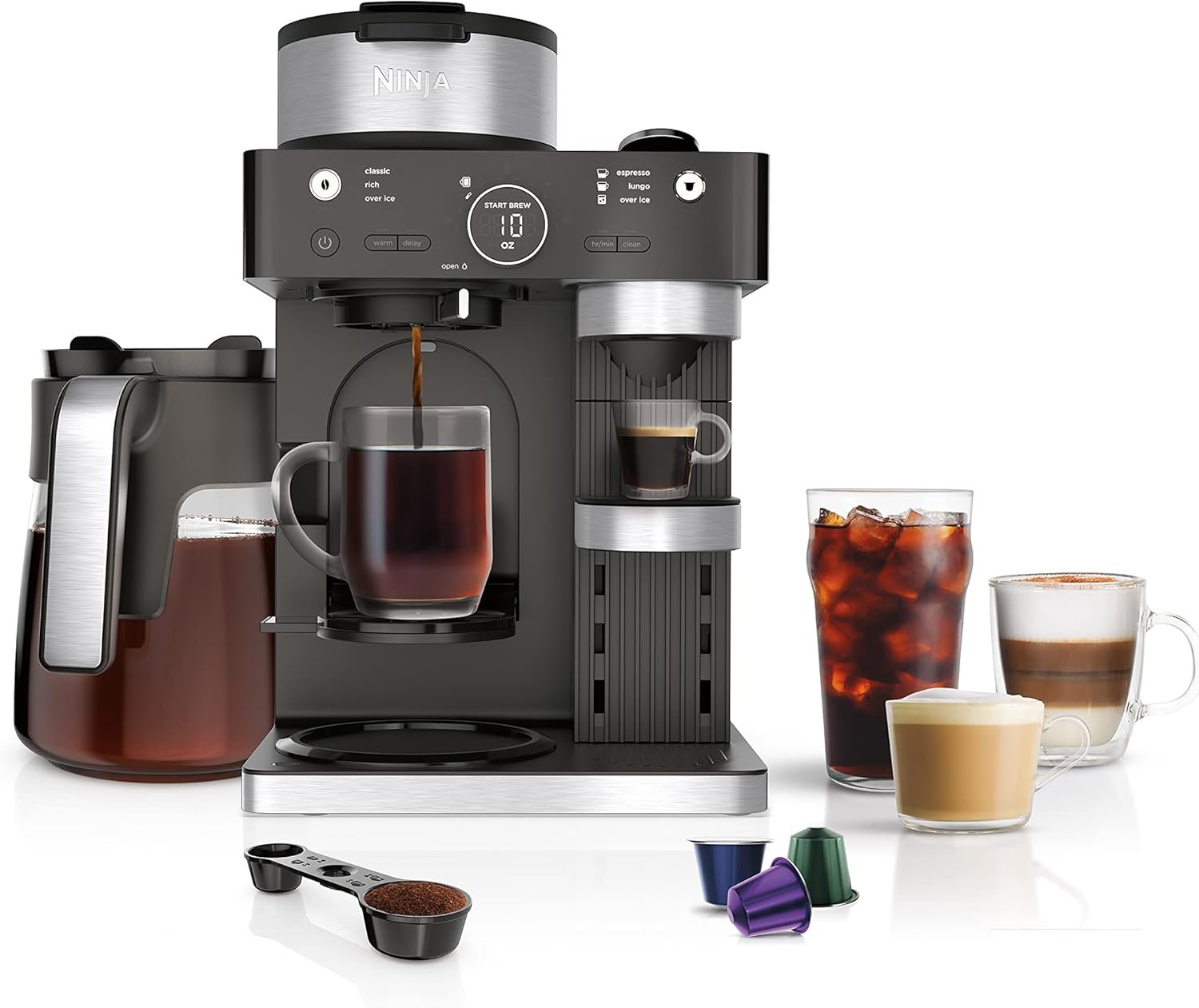
Why equipment choice matters for home espresso and coffee
Selecting the right home espresso and coffee system shapes drink quality, user workflow, and long-term satisfaction. For households balancing espresso shots, milk-based drinks, and larger brewed coffee batches, multi-function machines must reconcile pressure-based extraction with batch brewing thermodynamics. The Ninja CFN601 positions itself as a hybrid: a capsule espresso system that also handles coffee grounds and a 12-cup carafe. Decision factors include extraction pressure and temperature stability for crema and flavor clarity, compatibility with capsule formats and ground grind sizes, frothing performance for milk-based drinks, and reservoir and carafe capacity for entertaining. Materials and serviceability influence longevity and cleaning burden, while interface design affects daily workflow. Evaluating these characteristics against household habits — single-serve espresso shots, multiple cappuccinos per morning, or brewed coffee for a group — clarifies whether a 19-bar capsule-capable hybrid with a built-in frother is an efficient fit for a particular kitchen and routine.
Quick Overview
| Feature | Details |
|---|---|
| Product category and brewing method | Single-serve espresso system plus drip-style coffee brewer; accepts Nespresso Original capsules and ground coffee |
| Capacity and output | Single-serve espresso (1.35 oz), Lungo (3.75 oz), Over Ice (1 oz); coffee grounds brew sizes up to a 12-cup carafe |
| Materials and construction | Plastic exterior and internal components, removable water reservoir, glass carafe, dishwasher-safe parts |
| Heating / pressure system | 19-bar pump with temperature-controlled heating system (Barista Plus Technology) |
| Grind / filter compatibility | Ground coffee (filter basket) and Nespresso Original-compatible capsules |
| Best suited users | Households seeking capsule convenience and brewed coffee versatility |
| Intended use cases | Single-serve espresso and milk drinks, iced espresso, brew-then-serve carafe for groups |
| Warranty / support | Manufacturer warranty and support information available from Ninja |
The table summarizes how the CFN601 blends pressure-based capsule extraction with drip-style brewing. The presence of a 19-bar pump and temperature control targets espresso crema and extraction, while the 12-cup carafe and multiple brew size options increase serving flexibility. Materials and removable components affect heat transfer, user cleaning workflows, and long-term maintenance.

Brewing method compatibility and flexibility
The CFN601 is built for mixed-method kitchens where capsule espresso and ground-coffee brewing must coexist. Compatibility with Nespresso Original-style capsules provides access to widely available capsule blends and consistent dosing, while the grounds path accepts filtered-size grinds for classic drip and over-ice extraction. Brew-size options cover single espresso shots, longer lungos, single-serve over-ice portions, and drip outputs up to a 12-cup carafe; this breadth supports different brew ratios and extraction goals. When switching between capsules and grounds, internal flow paths and drain-back design determine residual flavors and required rinse cycles. The removable water reservoir and used-capsule bin facilitate rapid role changes. For buyers, compatibility implies observing grind size and dose control for grounds to match the machine’s flow rates and extraction windows.

Capsule use: dose consistency and flow characteristics
Capsule systems standardize dose and tamping variables, which shifts extraction control to temperature and flow rate. The CFN601’s Nespresso Original compatibility ensures consistent volume per capsule option: Espresso (1.35 oz), Lungo (3.75 oz) and Over Ice (1 oz). For espresso science, consistent head pressure from a 19-bar pump combined with an appropriate thermal profile improves crema formation and solubles extraction from a fixed dose. However, capsule brewing limits grind and dose adjustments, so flavor tuning relies mainly on capsule selection and machine temperature stability. Users seeking fine-grain extraction control will find capsule use convenient but less adjustable than dedicated grinder-and-portafilter setups.
Grounds brewing: grind size, filter type, and extraction windows
Ground-coffee brewing through the CFN601 uses a filter basket and adheres to drip/immersion extraction principles. Grind consistency and particle size distribution become primary levers for extraction: a medium grind tailored for pour-over or drip optimizes flow and contact time, while finer grounds can increase extraction but risk over-extraction and slower flow. The machine’s brew styles—Classic, Rich, and Over Ice—adjust saturation time and flow rates to influence total dissolved solids. For predictable results, standard brew ratios (roughly 1:15 to 1:18) and consistent water temperature improve balance. The carafe mode requires attention to grind and distribution to avoid under- or over-extraction across larger volumes.
Extraction performance: pressure, temperature, and crema
Extraction in hybrid machines depends on pump pressure, heating profile, and flow control. The CFN601 specifies a 19-bar pump and Barista Plus Technology that targets optimal temperature and pressure ranges for espresso-style shots. For espresso science, peak pump pressure is one component; actual extraction depends on pressure profile during the shot, pre-infusion stability, and water temperature at the puck. Higher boiler stability supports consistent solubles extraction and crema formation, while inadequate heat retention or thermal recovery can produce variability between consecutive shots. Flow control through capsule interface and internal valves shapes contact time and emulsion of oils. Buyers should note that manufacturer-specified bar ratings do not equate directly to professional lever or dual-boiler performance but indicate intent to reach pressures associated with espresso extraction.

Temperature stability and thermal recovery
Stable brew temperature is critical for reproducible extraction: small shifts in brew water temperature alter solubility of acids, sugars, and bitter compounds. The CFN601’s temperature-controlled heating system aims to deliver consistent temperatures across short brewing cycles, supporting both espresso capsules and drip modes. For multi-shot sessions or sequential carafe brews, reservoir size, heating element wattage, and thermal mass influence recovery time between uses. Users preparing milk-based drinks should consider steam or frother cycle heat transfer: repeated frothing can draw energy and lower available brew temperature if thermal recovery is slow. In practice, the best results emerge when machine thermal recovery aligns with user workflow and session pacing.
Pressure profile and crema formation
Pressure influences extraction kinetics and crema: an initial pre-infusion phase with gentle pressure promotes even wetting of the puck, while ramping to higher pressures extracts oils and creates stable crema. The CFN601’s 19-bar pump capability suggests the system can generate the pressures commonly associated with espresso; however, the actual pressure profile is governed by internal valves and capsule resistance. Capsule geometry and internal sealing also affect backpressure and flow rate. Crema formation will depend on capsule formulation and the interaction of pressure, temperature, and flow rate; therefore, crema quality can vary with capsule brand and shot volume selection.
Capacity, serving flexibility, and workflow implications
Capacity decisions hinge on typical serving patterns. The CFN601 combines single-serve espresso volumes with a 12-cup carafe, enabling single-shot workflows and group brewing in one footprint. The removable water reservoir simplifies refilling and can shorten downtime between uses, while the included used-capsule bin stores up to 20 capsules for batch convenience. Adjustable cup tray and travel-mug compatibility accommodate different cup heights. For entertaining, the ability to switch between espresso-based drinks and a full carafe reduces appliance proliferation. Workflow efficiency depends on user sequencing: preparing multiple milk drinks back-to-back may tax thermal recovery, and switching between capsule and grounds modes requires rinsing cycles to avoid cross-flavor contamination.

Single-serve throughput and multi-cup operations
Single-serve operations benefit from capsule dosing and short extraction cycles, enabling rapid turnaround for individual shots. When servicing multiple guests with espresso-based drinks, the frother’s capacity and the machine’s thermal recovery determine throughput. For larger groups needing brewed coffee, the carafe mode supports continuous pour-off and keeps coffee warm on the warming plate, though extended heat retention may affect flavor over time. The balance between single-serve speed and carafe flavor maintenance should guide expectations: machines optimized for both functions often trade specialized performance for versatility.
Storage, dimensions, and counter fit
The CFN601’s compact footprint (approximate dimensions: 12.21″D x 9.84″W x 14.96″H) and weight make it suitable for most kitchen counters. The fold-away frother reduces visual bulk, and an adjustable drip tray accommodates travel mugs up to 8 in. Removable water reservoir and used-capsule bin enable off-machine filling and emptying, which aids placement flexibility. Countertop real estate considerations include clearance for the frother and carafe, plus access for dishwasher-safe parts. Buyers with limited space should measure cabinet or shelf clearances to accommodate the claimed dimensions and routine access for cleaning and component removal.
Ease of use, controls, and daily maintenance workflow
User interface and operational flow influence daily ease more than raw specs. The CFN601 uses a touchscreen control panel with labeled brew-style options (Classic, Rich, Over Ice, Espresso, Lungo). Pre-programmed brew sizes and capsule-style modes reduce cognitive load for common profiles, while manual choices allow some customization. The fold-away frother streamlines milk texturing without a separate wand, but frother technique and milk temperature preferences still affect final beverage consistency. Dishwasher-safe components decrease cleaning friction; however, internal flow paths and valves require regular descale cycles depending on water hardness. Routine maintenance steps include emptying the used-capsule bin, wiping drip areas, descaling, and cleaning removable baskets to maintain sanitary operation and avoid flavor transfer between capsule and grounds modes.

Interface clarity and learning curve
Touchscreen selections and labeled brew styles are designed to reduce complexity, useful for multi-user households. Predefined volumes for capsules and grounds reduce setup time, though users seeking nuanced shot adjustment (flow rate, pressure profiling) will find limited granular control. The machine’s semi-automatic operation means start/stop actions remain simple, but transitioning between modes (capsule to grounds) adds procedural steps to avoid cross-contamination. For users valuing plug-and-play convenience, the CFN601’s presets will be advantageous; those requiring programmability for advanced extraction control may perceive a learning curve.
Cleaning rhythm and required maintenance tasks
Dishwasher-safe removable components, such as the drip tray and filter baskets, lower cleaning effort for external parts. The used-capsule bin simplifies capsule disposal and recycling logistics but requires periodic emptying. Internal water pathways and heating elements are subject to mineral scale; therefore, descaling intervals should follow local water hardness and manufacturer recommendations. Regular rinses after switching between capsule and grounds modes reduce flavor carryover. For households with heavy daily use, a scheduled maintenance checklist—reservoir rinsing, capsule bin emptying, drip-tray cleaning, and periodic descaling—preserves flow rates and hygienic performance.
Cleaning, durability, and long-term reliability considerations
Durability is a function of materials, component design, and maintenance regime. The CFN601 integrates plastic housings and removable plastic components with a glass carafe; these materials reduce weight but require attention to avoid wear from mechanical stress and heat cycling. Pump and heating elements are wear items influenced by duty cycle and water quality: frequent use and hard water increase scale and strain. Aggregated customer feedback for multi-function machines often cites long-term reliability dependent on adherence to descaling and filter maintenance. The presence of replaceable parts and dishwasher-safe components supports easier upkeep, yet repeated folding action on the frother and repeated capsule retrieval mechanisms may be points to monitor for wear over multi-year use.

Parts longevity and failure modes to anticipate
Common long-term stressors include scale buildup in the boiler and flow-restricting passages, seals and gaskets that degrade over time, and moving mechanisms (capsule ejection, frother hinge) that undergo mechanical fatigue. Plastic components in contact with heat can experience stress cracking if exposed to high thermal cycles without adequate cooldowns. Routine descaling and gentle cleaning methods mitigate many scale-related failures, while careful handling of movable parts reduces mechanical wear. For critical failures, availability of replacement parts and manufacturer support pathways influences repairability and total ownership cost.
Who should avoid the CFN601 on durability or functional grounds
Buyers whose primary need is commercial-level throughput, fully manual pressure profiling, or professional steam wands should consider more specialized equipment. Users expecting industrial-grade material construction (all-metal boilers, stainless steel casings) for heavy daily use in shared workspaces may find the CFN601 optimized more for domestic versatility than continuous commercial duty. Similarly, those requiring full control over grind, dose, and pressure curves for competitive-style espresso should select a dedicated espresso machine with a separate grinder and serviceable portafilter design.

Pros & Cons
Pros
- Versatile dual-path brewing: Offers both capsule-based espresso extraction and grounds-based brewing up to a 12-cup carafe, enabling households to serve single shots and larger groups without multiple machines. This flexibility supports varied routines from single morning espresso to entertaining guests.
- 19-bar pressure with temperature control: The specified pump pressure combined with Barista Plus temperature management targets crema formation and consistent extraction for capsule shots, improving perceived espresso quality relative to basic pod machines.
- Built-in fold-away frother: Integrated frothing simplifies the creation of cappuccinos and lattes without a separate steam wand, reducing countertop clutter while supporting milk-texturing needs for common home drinks.
- Adjustable cup tray and travel-mug compatibility: Accommodation of taller cups and travel mugs increases practical daily usability for commuters and households with diverse cupware.
- Removable water reservoir and used-capsule bin: The removable reservoir aids refilling workflow and cleaning, while the used-capsule bin stores up to 20 capsules for convenient emptying and recycling handling.
- Dishwasher-safe components: Several removable parts are dishwasher-safe, which reduces day-to-day cleaning friction and encourages regular sanitation of contact surfaces.
Cons
- Limited manual control over extraction variables: While presets simplify use, the machine offers limited granular control over pressure profiling and flow rate, which constrains advanced users who prioritize fine-tuning of shot parameters.
- Plastic construction and potential wear points: Extensive use of plastic in body and movable components can lead to wear over time, particularly on hinges and capsule mechanisms, necessitating careful handling and maintenance.
- Thermal recovery considerations for heavy use: For consecutive multi-shot milk drinks or high-throughput scenarios, thermal recovery time and boiler capacity may slow service, affecting temperature stability between drinks.
- Flavor carryover between modes: Switching between capsule and grounds brewing paths can cause residual flavors without diligent rinsing and maintenance, requiring attention to cleaning routines to preserve taste neutrality.
Final Verdict: Who This Product Is Best For (and Who Should Skip It)
The Ninja CFN601 suits households seeking a single compact appliance that spans capsule espresso convenience, milk-based drink capability, and larger batch brewed coffee for groups. Ideal users include mixed-use kitchens where some occupants prefer capsule convenience while others favor brewed carafes, or individuals who value an integrated frother and predefined brew styles to minimize daily complexity. The machine’s 19-bar pump and temperature control offer an approachable route to crema-bearing shots, and removable, dishwasher-safe components reduce routine cleaning friction. For social mornings that alternate between single-serve beverages and a carafe for guests, the CFN601’s versatility matches common domestic workflows in 2026.
It is less well-suited for users requiring full manual control over grind, dose, and pressure profiling, or for small commercial/high-throughput environments where stainless-steel construction, commercial boilers, and dedicated steam wands are priority features. Additionally, buyers who prefer fully adjustable espresso variables or who aim to build a high-end espresso setup with separate grinder and portafilter should consider dedicated machines tailored to those needs. For a broad audience seeking combined capsule and grounds flexibility with an integrated frother and straightforward maintenance, the CFN601 represents a practical mid-range hybrid option.

Frequently Asked Questions (FAQs)
Can the Ninja CFN601 use both Nespresso Original capsules and ground coffee?
Yes. The CFN601 accepts Nespresso Original-compatible capsules for single-serve espresso styles and also includes a grounds pathway with a filter basket for drip-style brewing. Capsule use standardizes dose and extraction volume, while ground brewing requires appropriate grind size and brew ratio to optimize extraction.
How does the CFN601 handle temperature stability for espresso shots and carafe brews?
The machine uses Barista Plus Technology with a temperature-controlled heating system designed to deliver consistent water temperature for espresso capsules and drip modes. Thermal recovery depends on use patterns and reservoir size; repeated frothing or consecutive shots can affect recovery time, so pacing between drinks influences stability.
Is the frother suitable for cappuccinos and lattes?
The built-in fold-away frother is designed to produce textured milk for cappuccinos, lattes, and similar milk-based drinks. Frothing performance will depend on milk type, temperature, and technique. For users requiring professional steam pressure and microfoam control, a dedicated steam wand on a higher-end machine may be preferred.
What maintenance is required to keep the CFN601 performing well?
Routine tasks include emptying and rinsing the used-capsule bin, cleaning removable drip tray and filter baskets (dishwasher-safe), descaling based on local water hardness, and periodic rinses when switching between capsules and grounds. Adhering to a maintenance schedule preserves flow rates and reduces flavor carryover.
How much coffee can the carafe brew and keep warm?
The CFN601 supports brewed coffee volumes up to a 12-cup carafe. A warming plate under the glass carafe maintains serving temperature for a limited time, but prolonged heat retention can alter brewed coffee flavor; serving promptly following brew is recommended for optimal taste.
Who should avoid buying the Ninja CFN601?
Consumers needing commercial-grade throughput, extensive manual control over pressure and flow, or professional-grade steam wands should consider alternative, dedicated equipment. Similarly, buyers prioritizing all-metal construction for heavy daily use may prefer more robust, serviceable machines.