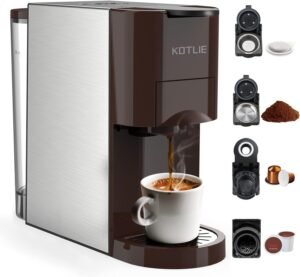
Kismile 15-Bar Espresso Machine with Grinder & Steam Wand

Overview: Why Equipment Choice Matters
Selecting the right espresso machine shapes daily brewing outcomes, workflow, and the long-term satisfaction of home espresso routines. For household users and aspiring home baristas who prioritize a balance of convenience and capability, equipment choice must address extraction control, thermal management, and milk-texturing capability. Semi-automatic machines with integrated grinders bridge convenience and freshness by reducing handling steps while preserving essential variables such as grind size, dose and tamp pressure. The machine examined here targets multi-cup households and latte drinkers who value on-demand grinding, steaming and the ability to switch between grounds and whole beans. Important considerations include whether the pump and heating system sustain consistent extraction pressure and temperature, whether the grinder delivers repeatable particle distribution across adjustments, and whether removable water and drip components reduce maintenance friction. These factors guide purchase decisions for users seeking espresso, Americanos, cappuccinos and lattes without requiring commercial-scale equipment or advanced maintenance regimes.
Quick Overview
| Feature | Details |
|---|---|
| Product category | Semi-automatic espresso machine with built-in grinder |
| Brewing method | Pump-driven espresso; steam wand for milk frothing; hot water function for Americanos |
| Capacity | 2.8-liter removable water tank; single- and double-shot filters included |
| Pressure & heating | 15-bar professional pump; 1500W motor; manufacturer-stated constant temperature system |
| Grinder | Built-in conical burr grinder with 30 adjustable grind settings; on-demand dosing to portafilter |
| Materials & finish | Metallic exterior finish; stainless steel steam wand; included metallic accessories and plastic removable tank |
| Usability features | Detachable water tank and drip tray, cup warmer, tamper with spoon, auto-clean function, single/double brew buttons |
| Best suited users | Home brewers, families, latte and cappuccino drinkers, entry-level enthusiasts |
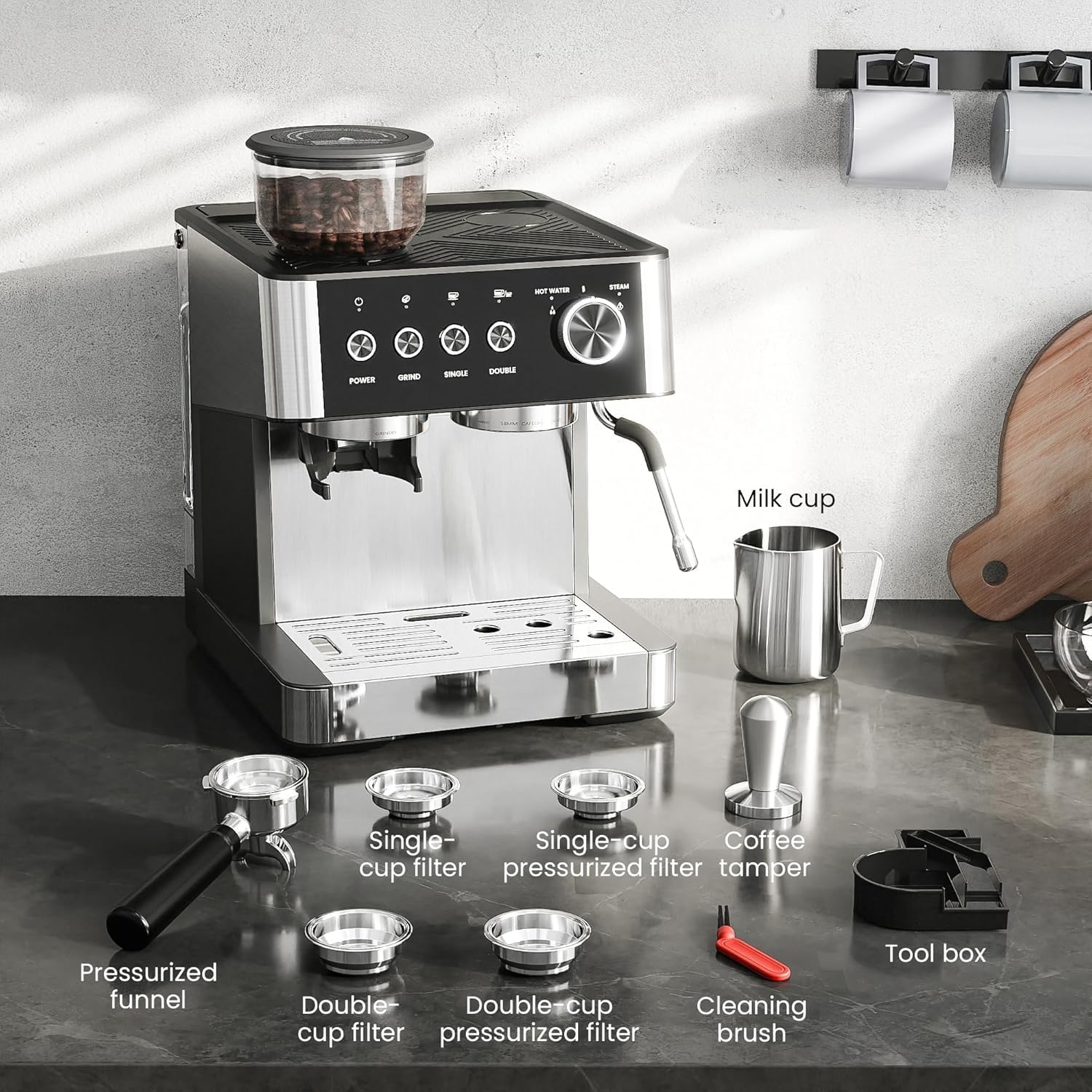
| Included components | Espresso machine, removable 2.8L water tank, single/double filters, pressurized funnel, tamper, manual |
| Warranty | Manufacturer warranty not specified in manufacturer disclosures |
These specifications inform real-world brewing by combining a high-pressure pump with on-demand grinding and a large removable water tank. The integrated grinder and 30-step adjustment range influence extraction flexibility, while the 15-bar pump and constant temperature claim affect pressure and thermal stability—both important for shot quality. Removable parts and a cup warmer improve daily usability and cleaning convenience for multi-user kitchens.

Brew and Extraction Quality
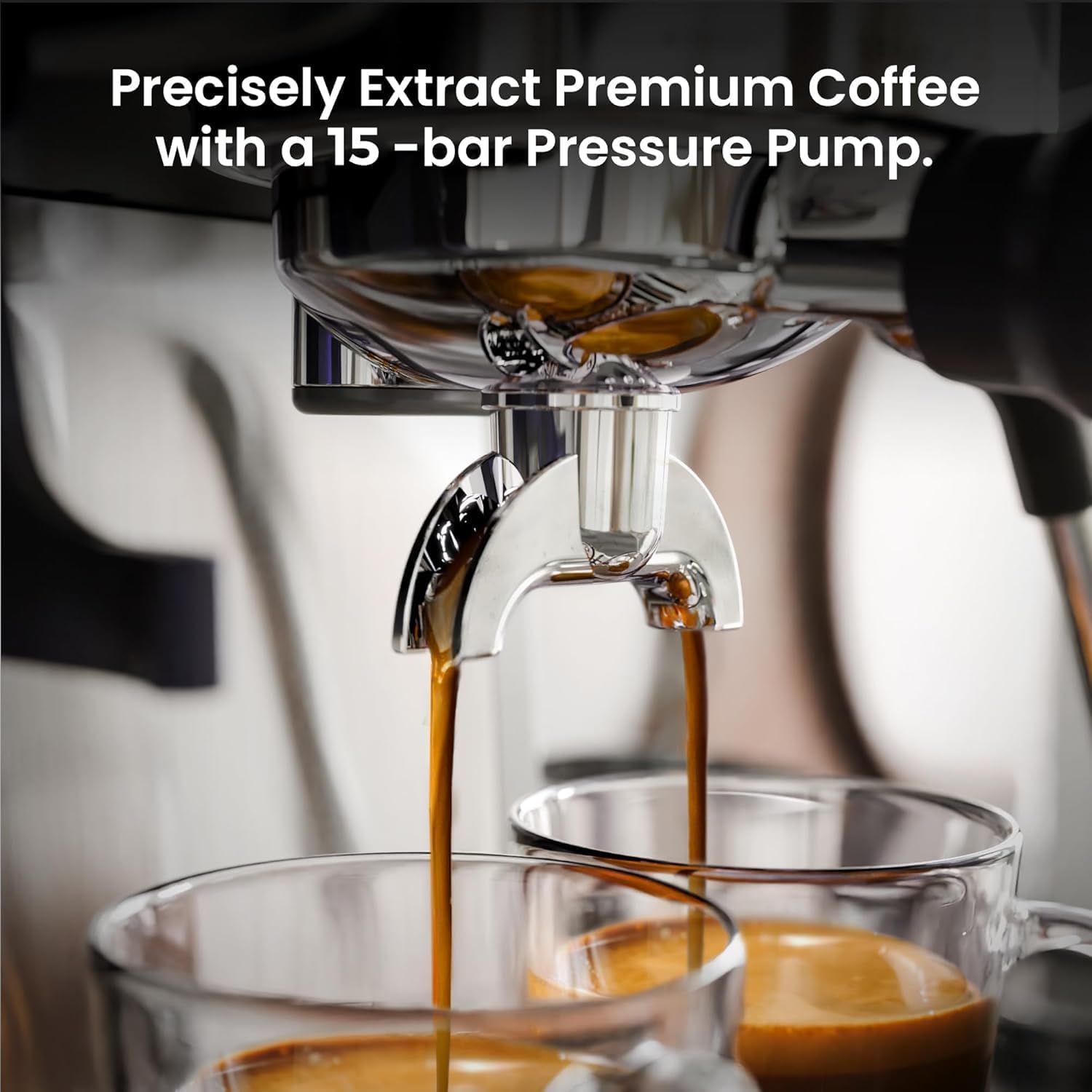
The machine’s extraction performance centers on a 15-bar pump and a constant temperature control claimed by the manufacturer, both of which shape pressure profile and brew temperature—two primary drivers of espresso extraction. For home espresso, consistent pressure during pre-infusion and extraction helps stabilize soluble extraction of oils and aromatics, while temperature consistency affects solubility of target compounds across roast levels. The combination of a pressurized funnel (included) and a portafilter allows use with both espresso grounds and the integrated grinder’s output, which mitigates channeling risk for beginners but limits advanced shot-shaping relative to non-pressurized baskets. For users aiming for balanced single- and double-shot extraction, the pump, grind control range and dosing all interact; correct grind, dose and tamp technique remain necessary to translate machine specs into repeatable cup quality.

Pressure behavior and pump implications
A 15-bar rating is a common marketing baseline for consumer units; actual extraction pressure at the puck commonly stabilizes near 9 bar when plumbing, losses and flow dynamics are considered. For home brewers, a strong pump provides headroom for quick pre-infusion and sustained flow against compacted grounds, but pressure consistency depends on pump quality, plumbing and the portafilter’s basket. When coupled with a pressurized funnel, lower-barista skill is required because the funnel helps maintain crema and compensates for minor grind or dose errors. Enthusiasts who want fine-tuned pressure profiling should note the absence of explicit variable pressure controls; pressure-related performance is therefore tied to pump design and portafilter resistance rather than a configurable electronic profile.
Portafilter, baskets and extraction consistency
Included single- and double-shot filters and a pressurized funnel impact extraction behavior. Pressurized baskets normalize flow for inconsistent grinds or tamping, producing stable crema and reducing channeling for novice users; however, they limit the ability to experiment with micro-adjustments that influence taste nuance. For consistent extraction, the built-in grinder’s repeatability and the ability to lock in dose into the portafilter are critical. Users targeting precision should expect to work within the machine’s pressurized design constraints or substitute non-pressurized baskets if the machine accepts them. Basket design, water dispersion and group head seal integrity are additional factors that affect puck saturation and uniformity during extraction.
Milk steaming and latte texture impact
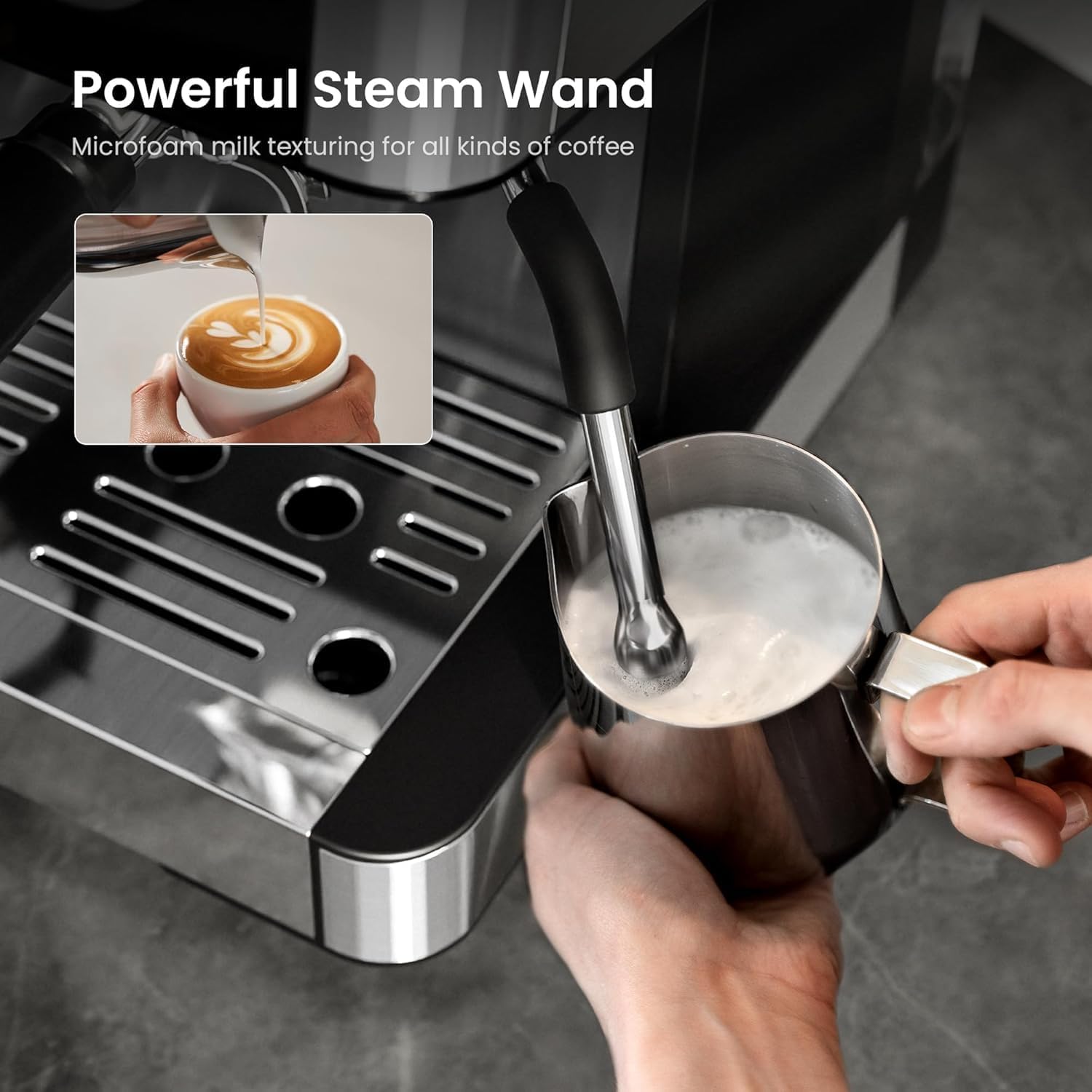
The stainless steel steam wand and an accessible steam control knob enable creation of textured milk for lattes and cappuccinos, but the steam performance depends on boiler capacity, steam pressure and wand design. Realistic home performance often presents a trade-off between steam power and heat recovery: stronger steam produces quicker microfoam but requires sufficient heating power and recovery time between steaming cycles. For households producing multiple milk drinks back-to-back, the 1500W motor and the machine’s heating architecture determine how quickly steam pressure recovers. The stainless steel wand allows manual texturing techniques for silky microfoam when paired with correct technique, but users should anticipate a learning curve to control milk temperature and texture consistently.
Grinder and Dose Control
An integrated conical burr grinder with 30 adjustable settings changes the workflow by delivering freshly ground coffee directly into the portafilter. Burr geometry and on-demand grinding reduce oxidative losses and preserve aroma compared to pre-ground coffee, but the grinder’s motor, burr material and chute design influence heat transfer, retention and fines production. A 30-step adjustment range offers reasonable granularity for adjusting between espresso and coarser settings for alternative uses; however, the absence of a dedicated dosing scale or volumetric dosing system means dosing consistency depends on grind time, grind distribution and the portafilter basket capacity. For users prioritizing precision, repeatable grind time and consistent tamping are essential. Noise, retention in the grinder chute and the ability to quickly switch between beans and pre-ground options also affect workflow in multi-user homes.

Conical burr specifics and particle distribution
Conical burrs typically produce a bimodal particle distribution favorable for espresso extraction, with a mix of fines and larger particles that contribute to body and crema. Burr material (often hardened steel in consumer units) and burr sharpness affect longevity and heat generation during grinding. An integrated, on-demand conical burr minimizes bean-to-brew time, which limits volatile loss, but the grind chute and dosing path can retain residual coffee that affects flavor switching between beans. For users who prioritize extraction control, understanding how adjustments affect both the median particle size and the fines percentage is important; this determines how changes in grind setting will alter flow rate and extraction yield under the machine’s pump and basket setup.
Grind settings, consistency and practical adjustments
Thirty adjustable grind settings provide a usable range for transitioning from espresso to coarser filter-style grinds; in practice, most home espresso recipes fall within a narrower subset of settings. Consistency across adjustments depends on burr alignment, motor torque and adjustment detents. Small incremental changes are necessary to dial in extraction time when moving between roast levels or beans. Since the machine relies on timed grind dosing rather than weight-based dosing, consistent grind time and stable hopper fill levels are crucial to maintain repeatable doses. For precision-oriented users, a separate scale to weigh doses remains advisable for accurate dose control and repeatable extraction.
Dosing workflow and integration with portafilter
The grinder deposits grounds into the portafilter, streamlining dose delivery and reducing transfer loss. This workflow is convenient but introduces variables such as grind retention in the chute and static that can affect dose uniformity. The included tamper and spoon provide a basic tamping solution; however, tamping technique, dose calibration and leveling influence puck resistance and ultimately extraction. For those seeking repeatability, consistent tamp pressure and occasional adjustment of grind time to compensate for changes in humidity or bean freshness will be necessary. The ability to use both beans and pre-ground input maintains flexibility for different user needs.
Temperature Control and Steam Performance
Thermal management is central to espresso quality because extraction kinetics and solubility of flavor compounds are temperature-sensitive. The manufacturer-stated constant temperature system aims to stabilize brew temperature for different roast degrees, which supports predictable extraction across light to dark roasts. Heating architecture—whether single boiler, thermoblock or dual system—is not specified, but 1500W power suggests a design capable of reasonable heat-up and steam recovery for domestic use. Cup warming and preheat elements contribute to thermal retention during shot pulling. For steaming, consistent steam pressure and heat recovery determine how quickly multiple milk drinks can be prepared with stable foam texture. Users should factor in heat-up time, recovery intervals and thermal mass when planning multi-drink service.
Intelligent temperature control and extraction implications
A constant temperature control system helps maintain stable water temperature at the puck, reducing shot-to-shot variability that can arise from ambient conditions and repeated steaming. Stable temperature supports consistent extraction yields and predictable flavor profiles; higher temperatures increase extraction rate and can emphasize body and bitterness, while lower temperatures favor acidity and brightness. In the absence of a disclosed PID controller or boiler type, temperature stability should be interpreted as a performance characteristic rather than an explicit technical guarantee. Users who prioritize micro-level temperature dialing may find the machine adequate for consistent home use but limited compared with machines offering programmable PID control or multi-boiler separation.
Heat-up behavior, cup warmer and recovery
A 1500W heating architecture typically enables moderate heat-up times and practical steam recovery for domestic environments. The integrated cup warmer and metallic exterior support heat retention by preheating cups and reducing thermal losses during extraction. For households making one or two milk-based drinks, recovery time is likely manageable; for multiple successive beverages, users should allow brief recovery intervals to sustain steam pressure and temperature. Heat distribution across the machine depends on internal thermal mass and insulation design; regular cleaning of group seals and steam components supports consistent thermal efficiency over time.
Steam wand performance and practical frothing notes
The stainless steel steam wand and manual control provide direct feedback for texturing milk, enabling both microfoam and more aerated foam styles based on angling and tip position. Steam performance depends on the machine’s ability to maintain steam pressure under load and the wand’s tip design. To achieve silky microfoam, users must control wand position, pitcher depth, and steaming time while monitoring milk temperature and expansion. For households making frequent milk drinks, the machine’s steam recovery, cleaning accessibility and wand durability are relevant; thorough purging and tip-cleaning after each use preserves steam flow characteristics and reduces buildup that can impair performance.
Usability, Capacity and Maintenance
Usability hinges on a balance of straightforward controls, accessible maintenance and adequate capacity for intended serving patterns. A 2.8-liter removable water tank suits households and light entertaining without constant refilling; the transparent design aids visible monitoring. Semi-automatic operation simplifies extraction control while keeping manual tamping and grind adjustments central to shot quality. Included accessories (tamper, single/double filters, pressurized funnel) reduce setup friction, and an auto-clean function claims to simplify maintenance tasks. Removable drip tray and tank components support washing and reduce mineral buildup risk. Durability considerations include exterior metallic finish, internal component quality and grinder burr longevity—factors that influence lifetime cost and reliability for daily use.
Water tank capacity and serving flexibility
A 2.8-liter removable tank provides enough volume for multiple daily drinks in a household setting, decreasing refill frequency for families or small offices. The removable form factor improves access for refills and descaling, and the transparent housing allows users to monitor water level visually. For prolonged periods of high-volume use, in-line water replenishment or an external water line may be preferable, but for typical home use this capacity balances convenience and countertop footprint. Hard-water regions should account for filtration needs and more frequent descaling to preserve heating and steam components.
Controls, workflow and included accessories
Simple control layout and dedicated single/double shot options streamline the typical home barista workflow: grind, dose, tamp, extract and steam. The built-in grinder reduces steps by delivering grounds directly to the portafilter, though retention and static can add minor cleanup steps. Included components—pressurized funnel, tamper, single/double filters—support immediate use out of the box. Users requiring advanced programmability or volumetric shot control should note that the semi-automatic design emphasizes manual input over automated profiling, which affects the level of user skill required to achieve consistent, repeatable results.
Cleaning, removable parts and long-term reliability
Removable water tank and drip tray simplify daily cleaning and reduce scale accumulation risks. The stainless steel steam wand can be wiped and purged to maintain performance; regular backflushing or descaling routines depend on water hardness and frequency of use. The metallic exterior and included components suggest reasonable build quality for consumer use, but grinder burr wear, pump longevity and group head seal maintenance determine long-term reliability. Access to replacement parts and manufacturer service policies—which are not specified—will influence ownership experience. Routine maintenance such as descaling, filter changes and wand cleaning will preserve extraction and steaming consistency over time.

Pros & Cons
Pros
- Integrated grinder with 30 settings improves freshness and flexibility. The conical burr on-demand design reduces time between grinding and brewing, preserving volatile aromatics while offering granular control across espresso grind ranges.
- 15-bar pump with 1500W power supports robust extraction and practical steam generation. Higher pump capacity provides pressure headroom for stable flow through compacted pucks and helps sustain steam performance for milk texturing.
- Large 2.8-liter removable water tank and detachable drip tray increase usability. This capacity suits family use and small gatherings while removable parts simplify refilling and cleaning routines.
- Stainless steel steam wand and cup warmer support milk-based drinks and thermal retention. The wand enables manual steaming techniques for textured milk; the cup warmer reduces heat loss during extraction.
- Semi-automatic controls strike a balance between automation and manual control. Single- and double-shot options combined with manual tamping offer flexibility for users learning dose and grind adjustments.
- Included accessories reduce initial setup friction. Single/double filters, a tamper, and pressurized funnel allow immediate use with grounds or beans and accommodate less-experienced users.
Cons
- Pressurized funnel and included pressurized components limit advanced shot shaping. While helpful for consistency, pressurized baskets restrict the ability to experiment with unpressurized extraction and nuanced flavor profiling.
- Dosing is time-based rather than weight-based. The grinder’s timed dosing can introduce variability unless users adopt consistent grind times or use a scale, which adds an extra step for precision-focused users.
- Manufacturer warranty and service information not specified. Lack of clear warranty disclosures may affect long-term ownership decisions where access to parts and service impacts reliability.
- Grinder retention and potential static can complicate bean switching. Residual grounds in the chute may require occasional cleaning to prevent flavor carryover between different beans.
- Steam recovery and continuous multi-drink service limited by domestic heating architecture. For frequent back-to-back milk drinks, users should expect modest recovery intervals to maintain consistent steam quality.
Final Verdict: Who This Product Is Best For (and Who Should Skip It)
This machine suits home brewers and households that value integrated convenience, fresh grinding and a capable steam wand for milk drinks without requiring commercial-grade hardware. It aligns with users who want an all-in-one semi-automatic solution: those who prepare daily espressos, lattes and Americanos, and who appreciate a removable water tank, cup warmer and accessible cleaning features. The built-in conical burr grinder and 30-step adjustments make it a practical choice for people who prioritize fresh beans and a compact workflow rather than fully manual, pro-level experimentation.
Users to avoid this model include advanced home baristas seeking programmable PID control, multi-boiler steam consistency, or unpressurized baskets for full spectrum extraction control. Similarly, high-volume commercial or café settings will outgrow domestic heating recovery and pump duty cycles. In 2026, this machine compares favorably to entry-level integrated-grinder machines by offering a strong feature set for households while reflecting the typical trade-offs between convenience and professional-level extraction control.
Frequently Asked Questions (FAQs)
How does the built-in grinder affect espresso freshness and workflow?
An integrated conical burr grinder reduces the time between grinding and extraction, which preserves volatile aroma compounds and minimizes oxidation. It streamlines workflow by delivering grounds directly into the portafilter, reducing transfer loss. However, timed dosing rather than weight-based dosing introduces a need for consistent grind time and tamping technique to maintain dose repeatability.
Does the 15-bar pump guarantee nine-bar extraction pressure at the puck?
A 15-bar pump provides system pressure capacity, but extraction pressure at the puck typically settles near nine bar in well-configured espresso systems. Real puck pressure depends on plumbing, basket resistance and flow dynamics; therefore, the 15-bar rating indicates pump capability rather than the exact pressure experienced within the coffee puck.
Is the machine suitable for making multiple milk drinks back-to-back?
The 1500W heating architecture and steam wand allow steaming and frothing for household milk drinks, but continuous multi-drink service will be limited by heat recovery time. For several successive milk-based beverages, brief recovery intervals are typically necessary to maintain steam pressure and consistent foam texture.
Can this espresso machine use pre-ground coffee as well as whole beans?
Yes, the machine accepts both grounds and beans. It includes a pressurized funnel and single/double filters for use with pre-ground coffee, maintaining flexibility for users who occasionally rely on pre-ground doses or switch between beans and grounds.
How easy is maintenance and cleaning for the Kismile machine?
Removable components such as the 2.8-liter water tank and drip tray simplify routine cleaning and refilling. The stainless steel steam wand should be purged and wiped after each use to prevent milk residue buildup. Regular descaling and cleaning of the group head area will help maintain extraction consistency and prolong component life.
Does the machine offer advanced temperature control like a PID?
The manufacturer describes a constant temperature system but does not specify a PID controller. Stable temperature control is claimed to aid extraction consistency, though users seeking programmable PID-level micro-adjustments should verify technical details or consider machines that explicitly list PID functionality.
Who should avoid purchasing this espresso machine?
This model is not ideal for advanced home baristas who require programmable temperature control, independent dual boilers or non-pressurized baskets for experimental extraction. It is also not recommended for high-volume commercial use where sustained steam output and heavy-duty duty cycles are required.