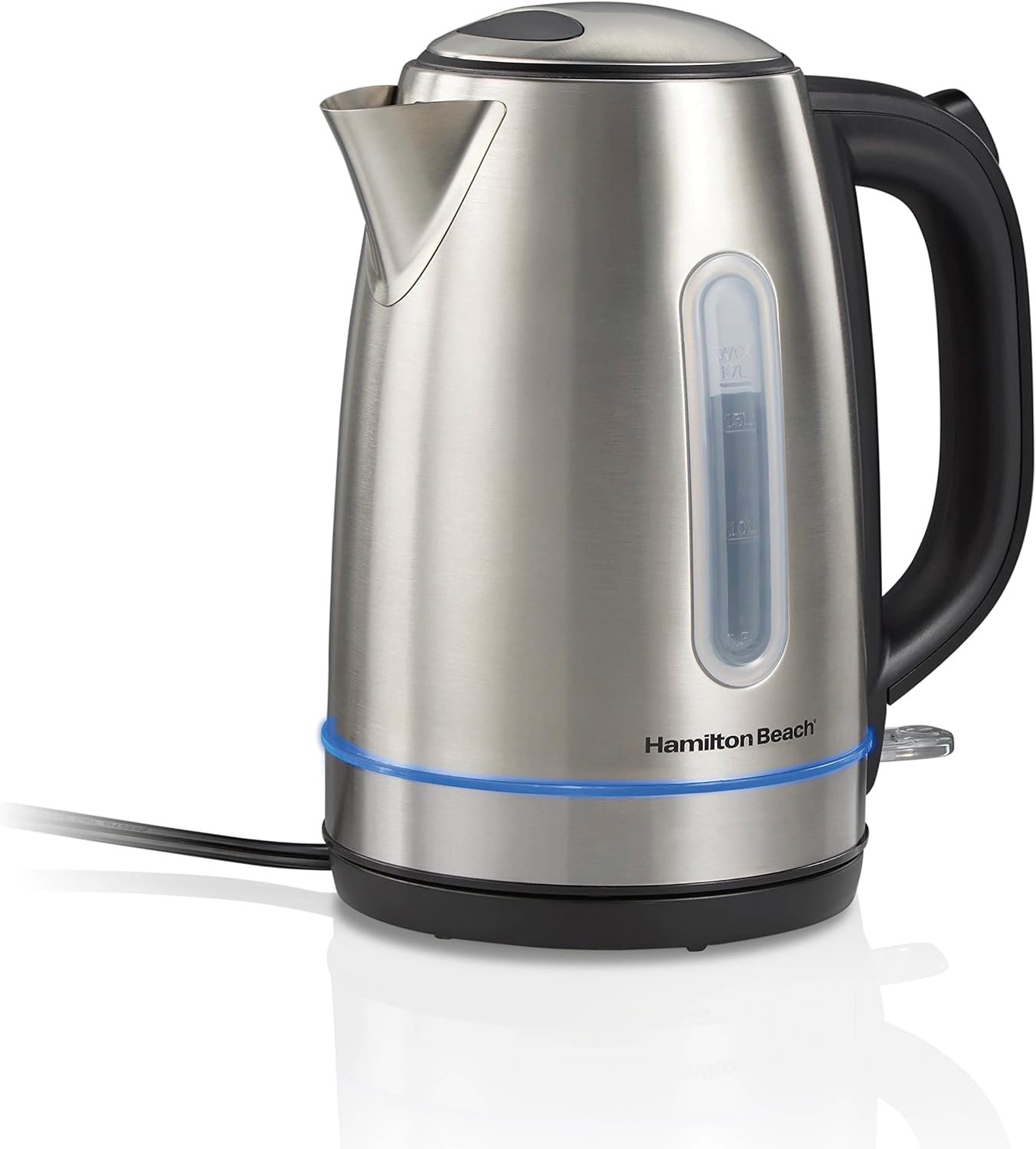
Hamilton Beach 1.7L Electric Kettle — Fast Boiling Choice
Why the right electric kettle matters for home brewing
Choosing the right electric kettle influences extraction control, temperature stability, and day-to-day workflow for home brewers and households. A kettle is the primary heat source for tea steeping, pour-over coffee blooming, and other hot-water needs; its boil speed, heat retention, pour ergonomics, and safety features determine whether a routine cup is reproducible and convenient. This Hamilton Beach 1.7 liter stainless steel model targets users who prioritize fast boiling, cordless serving, and straightforward operation. It is positioned for general household use, casual tea and coffee preparation, and quick hot-water tasks rather than precision temperature brewing. Understanding its heating power, auto-shutoff behavior, interior materials, and capacity helps match expectations for brew consistency, cleaning regimen, and integration with pour-over or immersion methods. Buyers seeking variable-temperature control or barista-level pour precision should note the kettle’s design focus on speed and safety rather than fine-grained thermal management.
Quick Overview
| Feature | Details |
|---|---|
| Product category | Electric tea kettle / water boiler |
| Capacity | 1.7 liters (approx. 7 cups) |
| Power & heating | 1500 watts rapid-boil heating element |
| Materials | Polished stainless steel interior and exterior |
| Safety features | Automatic shutoff, boil-dry protection |
| Serving design | Cordless 360-degree base for serving |
| Controls/Indicators | LED light ring shows heating status; water window |
| Best suited users | Households, casual tea drinkers, pour-over coffee users needing hot water quickly |
| Intended use cases | Steeping tea, pour-over/french press coffee prep, instant beverages, cooking/hot water needs |
| Warranty & care | Manufacturer guidance: hand wash, follow product care instructions |
The table summarizes core specifications that affect brewing outcomes and daily usability. Capacity determines how many servings can be prepared before reheating; stainless steel interiors resist staining and retain heat differently than glass; the 1500W element reduces boil time but does not provide variable temperature settings, affecting extraction-sensitive teas and coffees. Safety and cordless serving features target household convenience while requiring routine descaling and hand-wash care to maintain performance.

Brewing method compatibility and extraction quality
This kettle is a boil-first device intended to supply hot water for a wide range of brewing methods rather than deliver precise temperature control for specialty tea or single-origin coffee extraction. For steeped teas and herbal infusions that require distinct temperature profiles, the lack of adjustable presets means users must rely on cooling intervals or secondary vessels to reach target temperatures. For pour-over coffee workflows, the kettle delivers sufficient hot water for blooming and extraction when paired with scale and timing protocols, but pour precision depends on the spout design and user pouring technique. For immersion methods—French press or Aeropress—the kettle provides consistent starting water temperature for predictable extraction when standard brew ratios and dwell times are observed.

Tea steeping and temperature considerations
Different tea types require different temperatures: delicate greens and whites prefer 150–175°F, oolongs 175–195°F, and blacks and many herbals near 212°F. A boil-only kettle brings water to full boil; to reach lower target temperatures users must allow cooling time or decant to another vessel. Cooling by 15–40°F typically occurs within several minutes depending on room temperature and vessel material. For households prioritizing multiple tea types, consider allowing controlled cooling or using a thermometer. The stainless steel interior transfers and retains heat efficiently, so cooling times may be modest compared with insulated pitchers.
Pour-over and coffee extraction implications
Pour-over extraction relies on temperature stability during bloom and drawdown. This kettle’s rapid-boil capability provides the necessary hot water, but precision pouring for even saturation depends on spout geometry and steady hand technique; the product is not marketed as a gooseneck precision kettle. When used with a scale and timed pour protocol, water at or just-off boil can produce consistent extraction if allowed to cool to appropriate target ranges for specialty beans. Grind size, brew ratio, and pour rate remain primary levers for extraction; the kettle supplies the thermal energy rather than actively controlling extraction parameters.
Immersion methods and instant beverages
For French press, Aeropress, and instant beverages, a full-boil kettle is appropriate since these methods tolerate or require near-boiling temperatures. The 1.7 liter capacity accommodates multiple servings for small gatherings or sequential brews. For formula, soups, or cooking tasks, the quick boil shortens wait time. Users should follow recommended temperature and dilution guidelines for heat-sensitive preparations and monitor cooling where specific temperatures are required for delicate ingredients.
Temperature control and heat stability
Temperature management in this model is driven by a single heating element and safety cutoffs rather than variable setpoints; automatic shutoff halts heating when boiling is detected, and boil-dry protection prevents operation with insufficient water. The 1500W rating accelerates time to boil compared to lower-wattage kettles, but it does not maintain a setholding temperature after shutoff. Heat stability after boil depends on the stainless steel body’s thermal mass and ambient conditions; brewed water will cool at a predictable rate influenced by initial temperature, kettle geometry, and serving vessel. For routines that require specific mid-range temperatures, users must employ cooling intervals, secondary vessels, or external thermometers to hit and verify target ranges for optimal extraction and steeping.

Boil speed and heating element behavior
A 1500 watt element provides relatively fast heating, reducing time-to-boil for typical household volumes. Fast boiling conserves time but concentrates scale deposition where mineral content is high; regular descaling mitigates buildup that can insulate the element and reduce long-term efficiency. Rapid heating also increases the rate of dissolved gases exiting water, which affects coffee bloom behavior slightly; freshly boiled then rested water is often preferred to allow degassing and stabilize flavor extraction. The element type and its placement (internal concealed or exposed) influence cleaning routines and thermal response; manufacturer materials indicate a durable concealed element typical of household kettles.
Auto-shutoff, boil-dry protection, and safety thresholds
Auto-shutoff triggers when the kettle detects boiling conditions, reducing the risk of overboiling and limiting continuous heating. Boil-dry protection interrupts power if the kettle is heated without sufficient water, preventing element damage and overheating. These safety mechanisms prioritize household safety and longevity but mean the unit will not sustain a set temperature for long-term holding. For brewing that requires repeating pours over extended periods, reheating between sessions is necessary. The LED light ring provides visual confirmation of active heating, aiding workflow awareness during brewing sequences.
Heat retention and pour influence on extraction
Stainless steel construction supports faster heat transfer and modest heat retention compared with insulated or double-walled kettles. Water temperature will decline after shutoff; the rate of cooling affects extraction control especially for pour-over practices. Pouring technique and vessel selection will further influence temperature at the coffee bed: narrow, insulated servers retain heat better than open mugs. For extraction consistency, allow a short rest after boiling if lower temperatures are required, or use thermal servers to maintain elevated temperatures during multi-cup sessions.
Ease of use, workflow complexity, and capacity
Ease of use is centered on a simple on/off operation, LED heating indicator, water window for level checks, and a cordless 360-degree base that supports single-handed serving. The 1.7 liter capacity balances household needs—sufficient for several servings without being unwieldy—while remaining light enough to lift when full. Workflow complexity is low: fill, set on base, and press to start; the kettle then shuts off automatically. Integration with pour-over setups depends on pour control needs; this kettle is designed for all-purpose hot water delivery rather than fine pour-rate modulation. The polished stainless finish is visually neutral and matches many kitchen styles, and product dimensions fit common counter and storage spaces.

Cordless serving, ergonomics, and indicators
The cordless base enables 360-degree placement and straightforward pickup during service, reducing cord interference in multi-device workflows. The handle ergonomics and lid access affect single-hand operation, refilling, and cleaning; a well-balanced handle reduces wrist strain when pouring near full capacity. The LED light ring gives a visible status cue from multiple angles, aiding timing for steeping or bloom periods. The water window allows volumetric checks without opening the lid, supporting precise brew ratios and avoiding overfilling that could trigger boil-over.
Capacity, household fit, and serving flexibility
At 1.7 liters, the kettle accommodates multiple cups for family or small-group service, typically around six to seven standard servings depending on cup size. This capacity suits households that prepare coffee or tea for several people in quick succession, while still being compact enough for single-person kitchens. For high-volume use or commercial settings, repeated reheating cycles may be required; for single-serve specialty brews, a smaller precision kettle could offer quicker single-cup throughput and finer pour control. Capacity also affects heat-up time and energy use per session.
Workflow integration with brewing gear
The kettle pairs with pour-over drippers, French presses, and electric coffee makers as a hot-water source but does not offer integrated temperature presets or a gooseneck spout for micro-pouring. Combining the kettle with a separate gooseneck pourer, thermal server, or thermometer can enhance precision-driven workflows. For users using scales, timers, and calibrated grind settings, the kettle supplies the thermal input while those other tools manage brew ratios and extraction timing. Simplicity of operation supports daily routines with low cognitive overhead.
Cleaning and maintenance expectations
Cleaning and maintenance are central to preserving heating efficiency, flavor neutrality, and safe operation. The polished stainless steel interior resists staining and is non-porous, minimizing lingering flavors if rinsed and dried regularly. Manufacturer care instructions specify hand washing; the base and heating contacts must remain dry. Mineral buildup from hard water affects performance over time, so periodic descaling is recommended. The product’s internal element design and finish influence how easily limescale can be removed and how often maintenance cycles are required. Routine visual inspections of the water window and lid seals support safe operation.

Hand-wash care and material implications
Stainless steel interiors are durable and respond well to gentle scrubbing with non-abrasive cleaners; harsh abrasives may mar the polished finish. The product is intended for hand wash which means external surfaces and interior should be cleaned with a soft cloth and mild detergent, avoiding immersion of the base and electrical components. Keeping the lid and spout clear of residue preserves flow and prevents odors. Regular rinsing after use reduces mineral spotting and residue accumulation.
Descaling, mineral management, and water quality
Scale buildup occurs when mineral-rich water is boiled repeatedly; scale can form on the heating element or interior surfaces, reducing thermal transfer efficiency and potentially affecting boil time. Descaling using manufacturer-recommended solutions or mild acidic solutions (such as diluted citric acid or vinegar) at regular intervals removes limescale. Frequency depends on local water hardness and use intensity; areas with hard water will require more frequent maintenance. Filtering water prior to boiling reduces mineral load and extends intervals between descaling.
Durability signals and who should avoid this type of kettle
Durability is informed by stainless steel construction, the presence of thermal cutoffs, and the concealed heating element typical of domestic kettles. Recurrent customer feedback commonly notes longevity tied to descaling practices and avoiding dry-heating. Users requiring precision variable-temperature control, professional pour-over ergonomics, or insulated holding capability should consider alternate designs with temperature presets, gooseneck spouts, or double-wall construction. Those who prioritize rapid single-cup pour precision or long-term hot-water holding may find this kettle less suited to specialized brewing needs.

Pros & Cons
Pros
- Fast boil performance: The 1500W heating element substantially reduces time-to-boil compared to lower-wattage kettles, supporting quick preparation of tea and hot beverages. Reduced boil time expedites morning routines and small-batch cooking tasks.
- Generous 1.7L capacity: The capacity fits household needs for multi-cup service while remaining manageable to lift and pour for most users. It provides flexibility for making several servings without repeated reheating.
- Stainless steel interior: A food-grade stainless steel interior resists staining and off-flavors, is non-reactive, and supports straightforward cleaning when maintained properly. It also avoids the fragility of glass alternatives.
- Safety features: Built-in automatic shutoff and boil-dry protection reduce risks associated with unattended operation and element overheating, aligning with common home safety expectations.
- Cordless 360-degree base: The detachable base enables convenient serving from any angle and simplifies countertop placement during brewing routines. It improves ergonomics for single-handed pouring.
- LED heating indicator and water window: Visual indicators support timing for steeping and pour-over blooms and allow quick verification of water level without opening the lid.
Cons
- No variable temperature control: The kettle is a boil-only device with no presets, requiring users to cool boiled water for low-temperature teas or specialty coffee. This adds steps for temperature-sensitive brewing.
- Limited pour precision: The standard spout design does not provide the fine flow control of a gooseneck kettle, which can affect consistency for pour-over techniques that depend on precise pouring rates.
- Hand-wash only and descaling needs: Manufacturer guidance requires hand washing and periodic descaling, which adds maintenance chores, especially in hard-water areas where mineral buildup is faster.
- Heat retention is moderate: Single-walled stainless steel construction offers less long-term heat retention than insulated double-wall kettles, making it less ideal for long pours or holding during extended serving.
Final Verdict: Who This Product Is Best For (and Who Should Skip It)
This Hamilton Beach 1.7 liter stainless steel electric kettle is best for households and casual brewers who prioritize rapid boiling, straightforward operation, and safety features. It fits users who need reliable hot water for tea, French press or pour-over coffee preparation when paired with separate pour-control techniques, and general kitchen tasks like instant beverages and cooking. The cordless base, LED indicator, and water window streamline everyday workflows for multi-cup service without requiring specialized brewing skills.
This kettle is not the ideal choice for users who require precision temperature control, micro-pour flow for specialty pour-over routines, or insulated holding for prolonged serving. Specialty tea connoisseurs and baristas seeking integrated variable-temperature presets or gooseneck ergonomics should evaluate dedicated variable-temperature kettles. For general household use in 2026, this model offers a practical balance of speed, safety, and capacity, provided users accept manual temperature management and routine descaling for long-term performance.

Frequently Asked Questions (FAQs)
Can this kettle reach lower temperatures needed for delicate teas?
This kettle brings water to a full boil and does not include adjustable temperature settings. For delicate teas that require lower temperatures, allow boiled water to cool for several minutes or transfer boiled water to a secondary vessel to reach the target temperature. Using a thermometer or timing cooling intervals helps hit specific temperature ranges reliably.
Is the Hamilton Beach 1.7L kettle suitable for pour-over coffee brewing?
The kettle supplies sufficiently hot water for pour-over workflows, but it lacks a gooseneck spout and temperature presets. When paired with steady pouring technique, a scale, and timing protocols, it can be used for pour-over extraction. Users seeking very fine flow control should consider a dedicated gooseneck kettle.
How often should the kettle be descaled and how is that done?
Descale frequency depends on local water hardness and usage, typically every 1–3 months for hard-water areas. Descale by following manufacturer guidance—using diluted citric acid or vinegar solutions, heating briefly, letting solution sit to loosen scale, then rinsing thoroughly. Avoid immersing the base or electrical components during cleaning.
Does the kettle keep water hot after boiling?
This model shuts off automatically at boil and does not maintain a set holding temperature. Heat retention after shutoff is moderate due to stainless steel construction; for extended holding, transfer water to an insulated thermal server or reheat as needed.
Are there safety features to prevent damage from empty operation?
Yes. The kettle includes boil-dry protection that interrupts power if operated without sufficient water, and an automatic shutoff when boiling is detected. These features reduce the risk of element overheating and support safer household use.
Is the kettle dishwasher safe?
Manufacturer care instructions indicate hand washing for the kettle interior and exterior and avoiding immersion of the base and electrical components. Detach the kettle from the base for cleaning, rinse thoroughly, and use a soft cloth and mild detergent to avoid damaging the polished finish.
How many cups does the 1.7 liter capacity hold?
A 1.7 liter capacity typically yields about six to seven standard cup servings, depending on cup size. This makes the kettle suitable for small-group serving and multiple sequential brews in household settings.
Will mineral buildup affect the kettle’s boiling performance?
Yes. Mineral buildup from hard water can insulate the heating element and interior surfaces, potentially lengthening boil time and affecting efficiency. Regular descaling minimizes such effects and helps maintain consistent performance over time.