AMZCHEF Conical Burr Coffee Grinder, Anti-Static Burr Mill Review
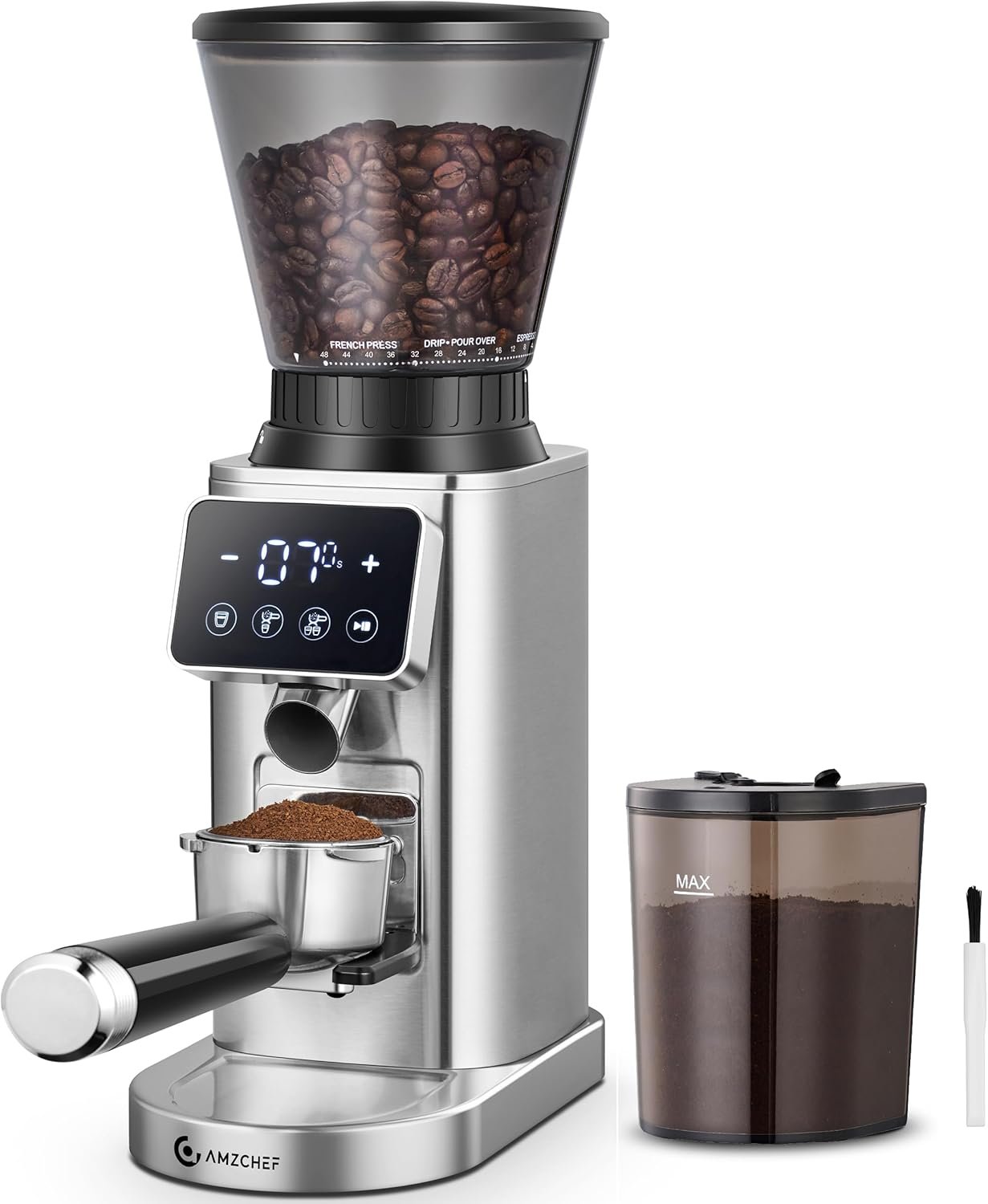
The AMZCHEF Conical Burr Coffee Grinder: A Modern Solution for Precision Brewing
For home brewers seeking consistent extraction and versatility in their coffee preparation, the AMZCHEF Conical Burr Coffee Grinder stands out as a high-performance option. This appliance combines 48 precise grind settings with a 40mm stainless steel conical burr system to accommodate a wide range of brewing methods, from espresso to cold brew. Its anti-static technology and intuitive touchscreen interface further enhance usability, making it a compelling choice for both casual coffee drinkers and enthusiasts looking to refine their brewing process. The grinder’s ability to maintain grind consistency across varying bean types and roast levels is particularly valuable for those aiming to replicate professional-grade results at home. While its size and weight may present challenges for compact spaces, the AMZCHEF model prioritizes precision and durability, offering a balance between functionality and long-term reliability. This review evaluates its performance across key brewing parameters, user experience, and compatibility with modern coffee preparation techniques.
Quick Overview
| Feature | Details |
|---|---|
| Product Category | Conical Burr Coffee Grinder |
| Brewing Compatibility | Espresso, Drip, French Press, Cold Brew, Pour Over |
| Capacity | 10.6 ounces of whole beans |
| Grind Settings | 48 adjustable options |
| Materials | Stainless steel burrs and housing |
| Design | Modern, metallic silver finish |
| Power | 150 watts, 120V AC |
| Included Accessories | Removable hopper, cleaning brush, grounds cup |
| Best Suited For | Home baristas, coffee enthusiasts, households with multiple brewing methods |
The AMZCHEF Conical Burr Coffee Grinder’s combination of precision engineering and user-friendly features makes it ideal for users prioritizing consistency in grind size and ease of operation. Its stainless steel construction ensures durability, while the anti-static design minimizes mess during grinding, improving overall workflow efficiency.

Grind Consistency and Brewing Method Compatibility
The AMZCHEF grinder’s 48 grind settings provide a granular level of control, allowing users to tailor their grind to specific brewing methods. This feature is critical for achieving optimal extraction, as the particle size directly influences how water interacts with coffee grounds. For example, finer grinds are essential for espresso extraction, where pressure and time are tightly controlled, while coarser settings are better suited for French press or cold brew methods that rely on slower, lower-pressure extraction. The 40mm conical burrs are designed to produce uniform particles, reducing the variability that can lead to under-extraction or over-extraction. However, the absence of a dedicated espresso grind setting may limit its appeal to users who prioritize ultra-fine consistency for high-pressure brewing. The grinder’s ability to maintain consistent output across different roast levels also supports its versatility, making it suitable for both light and dark roasts without significant adjustments.

Grind Setting Precision and Uniformity
The 48 grind settings enable precise adjustments that accommodate a wide range of brewing techniques. This level of granularity is particularly beneficial for users experimenting with different coffee profiles or adapting to specific brewing equipment requirements. The conical burr system ensures that each grind is evenly sized, which is crucial for achieving balanced extraction. However, the lack of a dedicated espresso grind may require users to manually fine-tune settings for optimal results, which could be a drawback for those seeking ultra-fine consistency.
Compatibility with Drip and Pour Over Methods
For drip coffee and pour-over enthusiasts, the AMZCHEF grinder’s ability to produce medium to coarse grinds is a significant advantage. These methods rely on even water flow through the coffee bed, which is supported by the uniform grind size. The 10.6-ounce hopper capacity ensures a steady supply of beans for multiple brews, reducing the need for frequent refills. The anti-static design also helps prevent clumping, ensuring smooth extraction during extended brewing sessions.
Cold Brew and French Press Adaptability
The grinder’s coarse settings are well-suited for cold brew and French press preparation, where larger particles are necessary to prevent over-extraction. The UV-blocking tint on the hopper helps preserve bean freshness, which is particularly important for cold brew methods that require extended steeping times. The trap door design further enhances usability by minimizing spills when removing the hopper for refilling.
Ease of Use and Workflow Efficiency
The AMZCHEF grinder’s smart touchscreen interface significantly streamlines the grinding process, offering an intuitive way to adjust settings and monitor progress. The ability to set precise grinding times up to 40 seconds with 0.5-second accuracy allows for fine-tuned control over the brewing process. This feature is especially useful for users who want to replicate specific extraction profiles or experiment with different grind sizes. The touchscreen also simplifies the selection of brewing quantities, eliminating the need for manual calculations. However, the learning curve associated with mastering the interface may initially slow down the workflow for less experienced users. The anti-static technology further enhances usability by reducing the mess associated with static electricity, making the grinding process more efficient and less disruptive.

Smart Touchscreen Control and Customization
The intuitive LED touchscreen enables users to select brewing quantities from 2 to 12 cups and set precise grinding times with 0.5-second increments. This level of customization is ideal for users who want to optimize their grinding process for specific brewing equipment or coffee varieties. The manual mode provides flexibility for users who prefer to start or stop grinding at their discretion, accommodating a range of workflow preferences.
Anti-Static Technology and User Experience
The built-in anti-static technology minimizes the cling and spills that can occur during grinding, making the process more hygienic and less disruptive. This feature is particularly beneficial for users who grind large quantities or work in environments where dust control is important. The stainless steel container also contributes to a cleaner grinding experience by preventing residue buildup and ensuring easy cleanup.
Large Hopper and Workflow Optimization
The 10.6-ounce removable hopper provides ample capacity for continuous grinding, reducing the frequency of refills. The UV-blocking tint helps preserve bean freshness, which is crucial for maintaining the quality of ground coffee over time. The trap door design simplifies the process of removing the hopper for refilling and cleaning, enhancing overall workflow efficiency.
Cleaning and Maintenance Considerations
The AMZCHEF Conical Burr Coffee Grinder is designed with user-friendly cleaning features that reduce the time and effort required for maintenance. The removable hopper and grounds cup allow for easy access to the grinding chamber, enabling thorough cleaning without disassembling the entire unit. The stainless steel construction is resistant to corrosion, making it easier to clean and maintain over time. However, the complexity of the touchscreen interface may require additional care during cleaning to prevent water damage. The absence of a dedicated auto-cleaning function means users must manually clean the unit after each use, which could be a drawback for those seeking a more automated maintenance process.

Removable Components and Accessibility
The hopper, grounds cup, and burr assembly are all removable, facilitating easy cleaning and reducing the risk of residue buildup. The stainless steel materials are easy to wipe down, making maintenance a straightforward task. This design choice is particularly advantageous for users who prioritize hygiene and want to prevent the accumulation of coffee oils and grounds.
Surface Materials and Cleaning Effort
The stainless steel housing and components are durable and resistant to staining, which simplifies the cleaning process. However, the touchscreen interface requires careful handling during cleaning to avoid damage from moisture or abrasive materials. Users should follow the manufacturer’s guidelines for cleaning to ensure the longevity of the unit.
Long-Term Maintenance and Durability
The grinder’s construction ensures that it can withstand regular use without significant wear, contributing to its long-term reliability. The absence of a dedicated auto-cleaning function means users must maintain a consistent cleaning routine to prevent clogs and ensure optimal performance. This design choice aligns with the product’s focus on precision and durability, making it suitable for users who prioritize maintenance over convenience.

Pros and Cons
Pros
- 48 Grind Settings: Offers extensive customization for different brewing methods, from espresso to cold brew. This allows users to experiment with various coffee profiles and adapt to specific brewing equipment requirements. The granularity of settings ensures that even minor adjustments can significantly impact the final cup.
- Stainless Steel Conical Burrs: Ensures uniform grind size, supporting consistent extraction and flavor profiles. The 40mm burrs are engineered to handle a wide range of bean types and roast levels, maintaining even particle distribution and reducing variability in extraction.
- Anti-Static Technology: Reduces mess and spills, improving usability and hygiene during grinding. This feature is especially beneficial for users who grind large quantities or work in environments where dust control is important, as it minimizes the risk of static-related clumping.
- Smart Touchscreen Interface: Provides precise control over grinding times and brewing quantities, enhancing user experience. The 0.5-second accuracy allows for fine-tuned adjustments, making it easier to replicate specific extraction profiles or experiment with different grind sizes.
- Large Hopper Capacity: Reduces the frequency of refills, making it suitable for high-volume use. The 10.6-ounce capacity ensures a steady supply of beans for multiple brews, reducing the need for frequent interruptions during grinding.
- UV-Blocking Hopper Tint: Helps preserve bean freshness, maintaining quality over time. The UV-blocking tint on the hopper protects beans from light exposure, which can degrade their flavor and aroma, especially for cold brew methods that require extended steeping.
- Durable Stainless Steel Construction: Ensures longevity and resistance to corrosion, simplifying maintenance. The stainless steel housing and components are resistant to staining and wear, making them easy to clean and maintain over time.
Cons
- Heavier Weight: May be less convenient for users with limited space or mobility. The 2.46-kilogram weight makes the grinder less portable and could be a drawback for users with small kitchens or those who need to move it frequently.
- Touchscreen Complexity: Requires a learning curve, which could slow down workflow for less experienced users. The touchscreen interface, while intuitive, may take time to master, particularly for users unfamiliar with digital controls in coffee equipment.
- No Dedicated Espresso Grind Setting: May necessitate manual adjustments for optimal espresso extraction. While the 48 settings provide flexibility, the absence of a dedicated espresso grind could require users to manually fine-tune settings, which may be less efficient for high-pressure brewing.
- Manual Cleaning Required: Lacks an auto-cleaning function, increasing maintenance effort. Users must manually clean the unit after each use, which could be a drawback for those seeking a more automated maintenance process.
- Larger Size: May not fit in compact kitchens or portable brewing setups. The larger footprint of the grinder may be a limitation for users with limited counter space or those who prefer compact, portable equipment.
Final Verdict: Who This Product Is Best For (and Who Should Skip It)
The AMZCHEF Conical Burr Coffee Grinder is an excellent choice for home baristas and coffee enthusiasts who prioritize precision and versatility in their brewing process. Its 48 grind settings and stainless steel burrs support a wide range of brewing methods, from espresso to cold brew, making it a valuable tool for users experimenting with different coffee profiles. The anti-static technology and smart touchscreen interface enhance usability, while the large hopper capacity ensures efficiency during extended grinding sessions. However, its heavier weight and larger size may make it less suitable for users with limited space or those seeking a more compact solution. Additionally, the lack of a dedicated espresso grind setting could be a drawback for users who rely on ultra-fine consistency for high-pressure brewing. Overall, the AMZCHEF grinder excels in delivering consistent results and ease of use, making it a strong contender for those who value precision and adaptability in their coffee preparation.
Frequently Asked Questions (FAQs)
What are the key features of the AMZCHEF Conical Burr Coffee Grinder?
The AMZCHEF Conical Burr Coffee Grinder features 48 grind settings, 40mm stainless steel conical burrs, an anti-static design, and a smart touchscreen interface for precise control. It also includes a large 10.6-ounce hopper with UV-blocking tint to preserve bean freshness.
How does the AMZCHEF grinder handle different brewing methods?
The AMZCHEF grinder’s 48 grind settings allow it to adapt to various brewing methods, including espresso, drip, French press, cold brew, and pour over. The uniform grind size produced by the conical burrs supports optimal extraction for each technique.
Is the AMZCHEF grinder suitable for cold brew and French press?
Yes, the AMZCHEF grinder’s coarse grind settings are ideal for cold brew and French press preparation. The UV-blocking hopper helps maintain bean freshness, and the trap door design minimizes spills during refilling.
undefined
The AMZCHEF grinder’s consistent grind output is compatible with a range of roast levels, from light to dark. This versatility allows users to maintain balanced extraction without significant adjustments to grind settings.
What is the maintenance like for the AMZCHEF coffee grinder?
The AMZCHEF grinder’s removable hopper, grounds cup, and burr assembly make cleaning straightforward. However, the touchscreen interface requires careful handling during cleaning to avoid damage, and manual cleaning is necessary for optimal maintenance.
Who should avoid the AMZCHEF Conical Burr Coffee Grinder?
Users with limited kitchen space or those seeking a compact solution may find the AMZCHEF grinder too large. Additionally, those prioritizing ultra-fine espresso consistency may need to manually adjust settings, which could be a drawback for some.
What are the advantages of the AMZCHEF grinder’s touchscreen interface?
The touchscreen allows precise control over grinding times and brewing quantities, offering flexibility for users who want to optimize their grinding process. The manual mode provides additional customization options for different brewing preferences.
How does the anti-static technology benefit the user?
The anti-static design reduces cling and spills during grinding, making the process cleaner and more efficient. This feature is particularly beneficial for users grinding large quantities or working in environments where dust control is important.