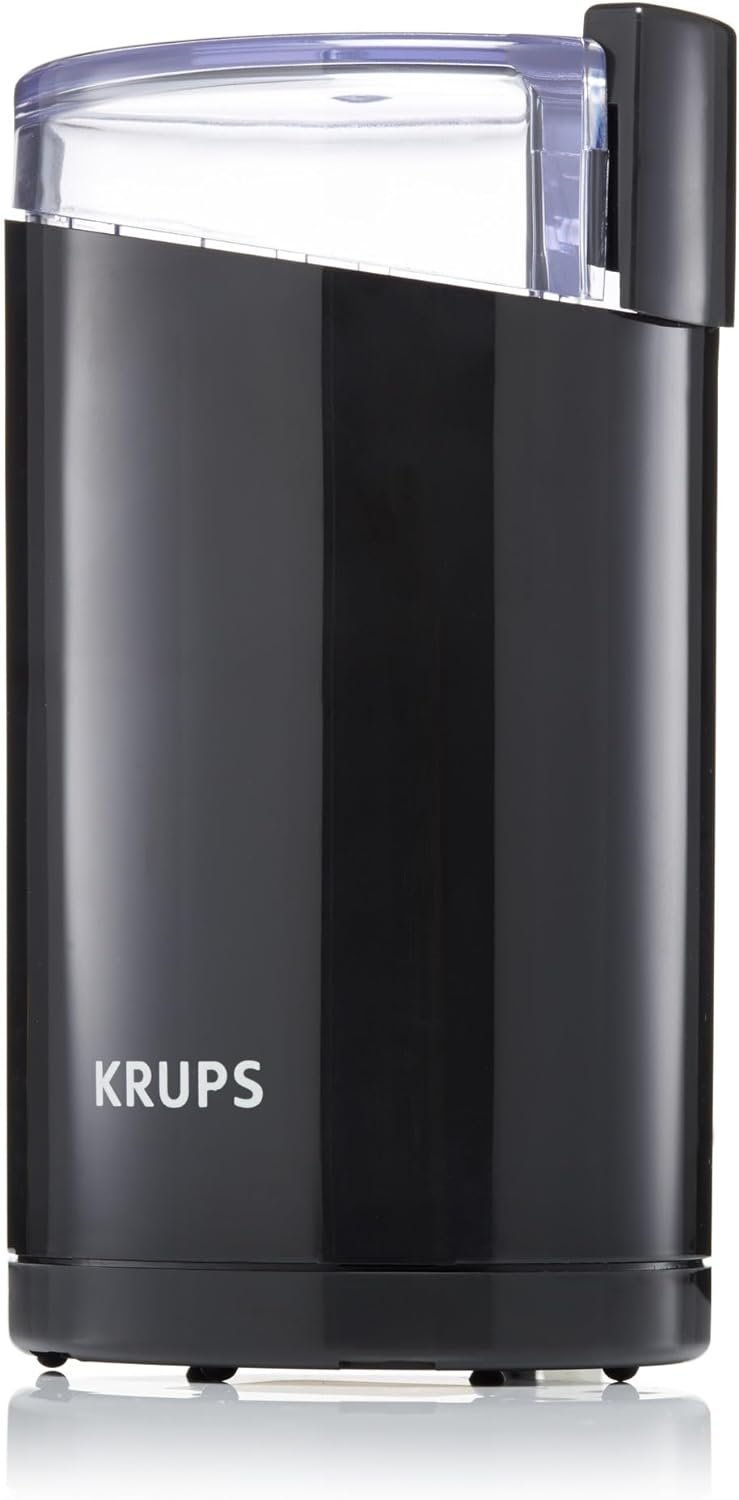
KRUPS 3oz Precision Grinder | Consistent Fresh Grinds Now
Why the right grinder matters for home brewing
Choosing the right grinder is one of the most important equipment decisions for home coffee and culinary preparation because particle size and uniformity directly affect extraction, aroma, and flavor clarity. Consumers and casual home baristas prioritizing fresh-ground coffee, quick workflow, and multi-use capability often select compact electric grinders that balance convenience with consistent results. The KRUPS blade-style Precision electric grinder is presented as a compact, one-touch option with a 3 oz capacity and 200W motor suited to households or light office use. Evaluating this model requires attention to grind distribution characteristics of blade designs, capacity relative to brew ratios, motor heat management, and cross-use for spices and nuts. Understanding these factors helps match the grinder to specific brewing methods—such as French press, drip, pour-over, and cold brew—while recognizing limitations for pressure-based espresso. This overview frames how durability, cleaning effort, and operational simplicity influence daily usability and long-term value for different user profiles.
Quick Overview
| Feature | Details |
|---|---|
| Product category | Electric blade coffee and spice grinder |
| Motor power | 200W motor |
| Capacity | 3 oz (approx. 85 g) hopper / grinding chamber |
| Blade material | Stainless steel blades |
| Operation | One-touch button; lid-activated safety interlock |
| Materials & finish | Plastic housing; black finish; stainless steel grinding chamber/blades |
| Dimensions & weight | 4.02″L x 3.86″W x 8.23″H; 1.76 pounds |
| Voltage | 240 Volts (manufacturer listing) |
| Suitable uses | Coffee beans, spices, herbs, nuts, small grains |
| Style | Blade grinder (not burr) |
| Manufacturer | Krups North America Inc.; model F20342 |
| Warranty | Manufacturer warranty information not specified in product listing |
The table summarizes the core specifications that affect grind performance and usability: a blade grinder with a 200W motor and small 3 oz capacity favors rapid, one-touch operation and multi-purpose use. Stainless steel blades and a compact chassis reduce footprint, while the lid interlock and single-button control influence safety and ease of workflow. These specifics indicate a unit optimized for convenience and small-batch grinding rather than micrometer-level grind adjustments for high-pressure espresso extraction.

Brewing method compatibility and intended use cases
As a blade grinder, the KRUPS Precision is functionally aligned with brewing methods that tolerate wider particle distributions and benefit from fresh aromatic compounds released at grind time. French press, cold brew, standard drip coffee makers, and many pour-over setups accommodate coarser, less uniform grinds where the dominant extraction variables are contact time and brew ratio rather than narrow particle distribution. For fine, pressure-driven methods such as true espresso, consistent micro-particle sizing and narrow distribution are critical; blade grinders typically struggle to provide that control. For culinary uses—spices, herbs, and nuts—the unit’s design supports short bursts for chopping or pulverizing; however, cross-contamination considerations and the need for thorough cleaning between uses should be factored into use-case decisions.

Suitable brew methods and expected results
The grinder’s output is most compatible with full-immersion and gravity-drip methods that use coarser settings or are tolerant of mixed particle sizes. For French press and cold brew, larger average particle size and a broader distribution have minimal negative impact when longer brew times and higher brew ratios are used to compensate. For drip and standard pour-over, slightly shorter grinding bursts can produce a medium grind acceptable for many home filters, though repeatability is limited. The unit’s one-touch operation and grind-time control allow general adjustment across methods, but outcomes rely on consistent timing and dosing rather than precise mechanical settings or calibrated adjustments.
Limitations for espresso and pressure-based extraction
Espresso requires uniform particle size and tightly controlled dosing to create even water flow and predictable pressure dynamics through a compact puck. Blade grinders produce a wide spectrum of fines and coarse fragments which can cause channeling, over-extraction of fines, and under-extraction of large particles. These distribution attributes reduce the ability to dial-in espresso parameters like brew ratio and extraction yield consistently. For users intending to pursue pressure-based brewing regularly, a conical or flat burr grinder with stepless or indexed adjustments is typically recommended to achieve the repeatability and control needed for reliable espresso shots.
Culinary versatility and cross-use considerations
The unit’s capacity to handle spices, herbs, and small amounts of nuts expands its utility beyond coffee; stainless steel blades and a sealed grinding chamber support coarse chopping and pulverizing tasks. However, flavor transfer between coffee and spices can persist if the chamber is not cleaned thoroughly between uses. For frequent multi-purpose use, separate grinding batches for coffee and culinary ingredients or dedicated devices are advisable to avoid aroma carryover. Users should also consider particle retention in crevices and the need for a small brush to clear residuals after each use.
Grind consistency and extraction quality
Particle size distribution is the primary determinant of extraction balance, and the KRUPS Precision’s blade design produces a heterogeneous mix of particle sizes that affects how water extracts soluble compounds. Uniform particle size narrows the variance in extraction rates, producing clearer flavor profiles and more predictable extraction yields. With a blade grinder, the operator instead controls average particle size by adjusting grind time and pulse technique; longer runs reduce mean particle size but increase fines. Understanding how these variables interact with brew ratio and contact time enables reasonable extraction control for many home methods but limits precision for advanced brewing approaches that rely on tight particle distributions.

Blade grinder particle distribution explained
Blade grinders cut and pulverize by blunt force, creating a distribution that includes both fines and larger fragments. Unlike burr grinders that shear beans between two surfaces, blades throw beans against chamber walls, producing irregular fragments. This heterogeneity increases the presence of fines, which extract quickly and can dominate cup bitterness or over-extraction if not balanced by coarser particles. The result is an extraction curve with competing fast- and slow-extracting fractions, making consistent sensory results more dependent on controlled dosing, repeatable grind timing, and careful brew parameter adjustments rather than mechanical grind setting.
How grind uniformity affects extraction and flavor
Extraction chemistry is sensitive to surface area: fines increase exposed surface and accelerate extraction, while coarse particles extract slower. In practice, mixed particle distributions from blade grinders can lead to uneven extraction where aromatic volatiles are lost more rapidly or bitterness concentrates from the fines. For brewing methods with longer contact times (cold brew, French press), the impact can be mitigated because the brew recipe relies on longer extraction to balance solubles. For shorter contact methods (espresso, short pour-over), the mixed distribution creates more pronounced variability in cup clarity and sweetness.
Practical techniques to improve consistency with a blade grinder
Tactical operator techniques can help narrow variability: pulse grinding with brief intervals reduces heat buildup and allows visual and auditory cues to judge particle size; shaking the chamber between pulses redistributes beans for more even cutting; using consistent dosing and timed pulses provides repeatability. Weighing beans and noting exact grind seconds can help translate subjective grind preferences into reproducible steps. While these techniques do not convert a blade grinder into a burr grinder, they improve predictability enough for many casual brewers and culinary users.
Capacity, dosing, and serving flexibility
The listed 3 oz (approximately 85 g) capacity positions this machine for small-batch grinding—enough to cover multiple mugs or a modest social gathering when ground in a single session. Matching capacity to intended output depends on brew ratio: standard drip and pour-over ratios of 1:15 to 1:17 will assign different bean weights per cup than denser immersion methods. For households that prepare single-serve or two-cup sessions, the compact capacity minimizes waste while allowing quick batch grinding for multiple servings. Users who frequently prepare larger communal batches or who prefer to grind for extended storage should consider the trade-off between convenience of a single large batch and the freshness advantages of smaller, just-in-time grinding.

What 3 oz capacity means in practice
A 3 oz chamber can accommodate small-to-moderate batch sizes, but the usable operational volume is slightly less when accounting for headspace and the need to avoid overfilling for efficient blade action. Filling the chamber to a moderate level ensures blades have room to create turbulence and adequate cutting action; overfilling reduces effectiveness and increases uneven particle generation. For repeatable dosing, measuring beans by weight and respecting the chamber’s fill line supports consistent results across sessions, particularly when multiple cups are intended from a single grind cycle.
Batch grinding strategies for group servings
For preparing several cups at once, batching with multiple short pulses tends to be preferable to a single prolonged run due to reduced heat accumulation and more controllable particle breakdown. Grinding multiple smaller batches and combining grounds yields more uniform particle distribution than one extended session at full chamber capacity. When timing is essential—such as morning routines—preparing measured doses then grinding immediately before brewing provides the freshness advantage while minimizing workflow disruption.
Storage, dosing, and freshness recommendations
Ground coffee loses volatile aromatics rapidly; therefore, grinding directly before brewing yields the most vibrant flavors. If batching is necessary, storing grounds in airtight, opaque containers in a cool, dry place reduces oxidation and light exposure but will not fully preserve peak freshness. For culinary uses, labeling containers after grinding spices or nuts helps prevent cross-use errors. Employing a consistent dose weight per cup and tracking grind time in seconds supports reproducible extraction across brewing sessions.
Ease of use, workflow integration, and safety
Operational simplicity is central to the KRUPS Precision’s design: a single-button control and lid-activated safety interlock make it accessible for users seeking minimal setup and straightforward operation. The one-touch design reduces steps in the brewing workflow while offering manual grind-time control rather than mechanical grind settings. This approach benefits users who prioritize quick, repeatable steps and those who prefer tactile control through timing rather than mechanical adjustment. However, workflow speed trades off with precision; repeated timing discipline is required to approach consistent grind outcomes across sessions.

One-touch operation, timing control, and repeatability
A single-button interface simplifies operation to place beans, secure the lid, and press to grind. Grind size is controlled by the operator through incremental increases in grind duration. For repeatability, timing protocols—recording the number of seconds used for a given dose—are effective. This timing-based approach is intuitive for casual routines but lacks the indexed reference points of burr grinders, so it relies more heavily on user discipline and measurement to reproduce previous settings.
Safety features and handling considerations
The lid-activated safety interlock prevents blade operation unless the lid is secured, reducing the risk of accidental blade exposure and limiting spills during use. The stainless steel chamber and blade assembly are robust but sharp; users should avoid reaching into the chamber while connected to power. The compact footprint and stable base reduce the chance of tip-over events, but loading and unloading should be performed on a flat, stable surface. Observing manufacturer cleaning and maintenance recommendations will preserve both safety and performance over time.
Integration into daily routines and workflow trade-offs
The grinder’s compact size and rapid one-touch cycles make it easy to incorporate into a morning routine where speed and convenience outweigh micro-level grind control. For households that prioritize a streamlined process—measure beans, grind by seconds, brew—this model enhances workflow efficiency. Conversely, users seeking fine-grained control for specialty recipes or those who routinely switch between brewing styles may find the timing-based adjustments require more effort to maintain consistent results across methods.
Cleaning, heat management, materials, and long-term reliability
Practical maintenance and component materials determine long-term reliability and user satisfaction. The KRUPS Precision’s stainless steel blades and grinding chamber are durable against corrosion and support straightforward debris removal, while the plastic exterior keeps the unit lightweight. Heat management is a relevant consideration: short, pulsed grinding reduces thermal transfer to coffee oils and preserves volatile aroma compounds. Electrical motor wear, shaft connections, and blade attachment integrity are primary determinants of lifespan, especially under frequent use. Regular cleaning of the chamber and lid, along with occasional inspection of blade sharpness and motor sound, supports operational longevity.
Cleaning expectations and maintenance routine
Routine cleaning involves emptying residual grounds, brushing the chamber with a small brush, and wiping the removable lid. Because the blade assembly is not intended to be submerged or disassembled by the user in most designs, avoiding water ingress into motorized components is essential. For spice use, removing and wiping the chamber immediately after grinding reduces flavor transfer. Occasional deep cleaning with a dry rice pulse to abrade trapped particles, followed by thorough brushing and wiping, can help clear stubborn residues without risking moisture damage.
Heat generation, retention, and effects on beans
Blade grinders create heat through mechanical friction; extended continuous operation raises chamber temperature and can accelerate volatile loss from coffee grounds. Short pulse grinding and allowing brief cooling intervals between cycles limit temperature rise and preserve more aromatic volatiles. In culinary contexts, heat can also slightly alter oil release from nuts or spices, so managing duration and pulses is important to maintain intended flavor profiles. The relatively small motor and short-duty cycles typical for a 3 oz chamber minimize sustained heat buildup during normal home use.
Build materials and indicators of long-term reliability
Stainless steel blades and a metal-reinforced shaft resist wear compared with lower-quality materials. The plastic housing reduces weight but requires durable snap fits and stable motor mounts to prevent wobble over time. Indicators of potential longevity include consistent motor noise without grinding vibrations, secure lid interlock engagement, and maintained blade sharpness. Users who plan high-frequency or heavy-duty grinding should consider commercial-grade or burr alternatives designed for greater daily duty cycles.
Pros & Cons
Pros
- Compact, space-saving footprint accommodates small kitchens and limited counter space. The small form factor and light weight make storage and placement flexible without sacrificing basic grinding capability.
- One-touch operation simplifies the workflow for quick morning routines. A single-button interface and lid safety interlock reduce steps and lower the learning curve for casual users.
- Versatile multi-use capability for coffee, spices, herbs, and nuts. Stainless steel blades handle a range of dry culinary tasks, expanding usefulness beyond coffee alone.
- 200W motor provides sufficient power for short grind bursts. The motor supports efficient particle breakdown for typical home batches within the specified capacity.
- 3 oz capacity offers practical small-batch grinding for households and small offices. This capacity is convenient for preparing multiple servings without frequent reloads.
- Stainless steel blade construction resists corrosion and supports routine cleaning. Metal blades maintain cutting edge characteristics better than low-grade alloys when used appropriately.
- Lid-activated safety feature reduces the risk of accidental operation. This mechanism prevents the blades from spinning unless the lid is securely in place, improving user safety.
Cons
- Blade-style grinding produces a wide particle size distribution, limiting extraction precision for espresso and other pressure-sensitive methods. Users seeking micro-adjustments and narrow distributions will find burr grinders more appropriate.
- Timing-based grind control lacks indexed settings, making repeatability more dependent on disciplined measurement and consistent technique. This can increase user effort when switching between brew methods.
- Potential for flavor carryover when switching between coffee and spices. Thorough cleaning between different ingredient types is necessary to avoid unwanted aroma transfer.
- Small capacity may be insufficient for frequent large-batch preparation without multiple cycles and additional handling. For heavy entertaining or larger groups, a larger-capacity grinder may be more practical.
Final Verdict: Who This Product Is Best For (and Who Should Skip It)
The KRUPS Precision 3 oz blade grinder is best suited for casual home brewers and culinary hobbyists who prioritize convenience, compact size, and multi-function capability. It aligns with users who brew full-immersion methods like French press or prepare drip/pour-over in small batches and who value rapid one-touch operation and minimal counter footprint. The grinder’s stainless steel blades, lid safety interlock, and modest 200W motor support regular household use for coffee, spices, and occasional nut-chopping tasks, provided the operator accepts timing-based grind control and routine cleaning to manage flavor transfer.
This product is less appropriate for users seeking precision grind control for pressure-based espresso, professional baristas, or heavy daily grinders that demand narrow particle distribution and indexed grind adjustment. For households that require frequent large-batch grinding or who rotate regularly between coffee and culinary ingredients without cleaning, a larger-capacity or dedicated device may offer better long-term fit. Evaluated against similar compact blade grinders, this KRUPS model offers reliable convenience, but buyers prioritizing extraction accuracy and micrometer-level adjustments should consider burr-style alternatives.
Frequently Asked Questions (FAQs)
What brewing methods work best with a blade grinder like the KRUPS Precision?
Blade grinders produce a broader mix of fines and coarser particles, which suits full-immersion methods (French press) and longer-contact extractions (cold brew) as well as many drip and pour-over routines where slight variability is acceptable. For short, pressure-based extractions such as espresso, a burr grinder with narrow particle distribution and precise adjustments is typically recommended to achieve consistent puck behavior and predictable extraction.
How should grind time be adjusted to change particle size on this grinder?
Grind size with a blade grinder is controlled by run time and pulse technique: shorter bursts reduce average surface area, producing coarser grounds, while longer runs increase the quantity of fines and generate a finer mean particle size. For repeatability, measure beans by weight and record exact grind seconds and pulse pattern. Pulsing in short intervals also minimizes heat buildup and improves operator control over particle outcomes.
Is the KRUPS Precision suitable for grinding spices and nuts as well as coffee?
The stainless steel blades and compact grinding chamber are designed to handle dry spices, herbs, and small quantities of nuts in addition to coffee beans. To avoid flavor transfer and preserve intended aromas, clean the chamber thoroughly between different ingredient types; wiping, brushing, and short dry pulses with an inert grain can help clear residues without introducing moisture.
Can this grinder deliver espresso-level grind consistency?
Blade grinders are generally not capable of delivering the uniform particle size distribution required for reliable espresso extraction. The mixture of fines and larger fragments typical of blade designs increases the risk of channeling and uneven extraction under high pressure. For espresso-focused users, a conical or flat burr grinder with stepless or finely indexed adjustments is a better choice for consistent results.
How should the KRUPS grinder be cleaned to maintain performance?
Daily maintenance includes emptying grounds, brushing the grinding chamber, and wiping the lid and exterior. For spice use, immediate cleaning prevents aroma carryover. Avoid immersing the motorized base in water; use a dry or lightly damp cloth for the lid and exterior. Periodic short pulses with uncooked rice, followed by thorough brushing, can help remove trapped particles without introducing moisture to motor components.
Does short grinding increase heat and affect coffee aroma?
Extended continuous grinding increases frictional heat in the chamber, which can accelerate the loss of volatile aromatics and slightly alter oils on coffee or nuts. Using short pulses and allowing brief cooling intervals reduces temperature rise, preserving more volatile compounds and maintaining intended flavor profiles. For routine home use, the small chamber and short grind durations typically limit significant heat accumulation.
What are indicators that the grinder may be nearing the end of its service life?
Signs of declining performance include inconsistent motor speed, increased vibration or wobble, unusual noise, deteriorating lid interlock engagement, and visible blade dulling. If grind times lengthen for the same perceived output or if the motor struggles under normal loads, those are practical indicators to evaluate warranty options or consider replacement. Regular cleaning and proper duty cycles help extend service life.