

Why the Right Electric Kettle Matters for Coffee & Tea
Choice of an electric kettle affects extraction, flavor clarity, and brewing workflow for home coffee and tea preparation. For pour-over coffee and many tea styles, water temperature and purity directly influence solubility of aromatic compounds and tannins; an appliance that minimizes off-flavors while delivering repeatable heat improves consistency across brews. Home brewers, small households, and light entertaining scenarios require a balance of capacity, speed, and ease of maintenance. Materials such as borosilicate glass and stainless steel interact differently with water chemistry, and the presence or absence of plastic contact surfaces matters for perceived taste purity. Controls, lid design, pouring precision, and safety features determine daily usability and integration with manual brew methods. The Cosori electric glass kettle positions itself as a mid-size, fast-boiling unit with a no-plastic-water-path claim, a Strix thermostat for automatic shutoff, and a wide mouth for cleaning—attributes that align with common priorities for coffee and tea-focused home users.
Quick Overview
| Feature | Details |
|---|---|
| Product category and brewing method | Electric glass kettle suitable for boiling water for pour-over, drip preheating, steeping tea, and instant preparations |
| Capacity and output | 1.7 liter (approx. multiple cups), 1500W rapid heating element |
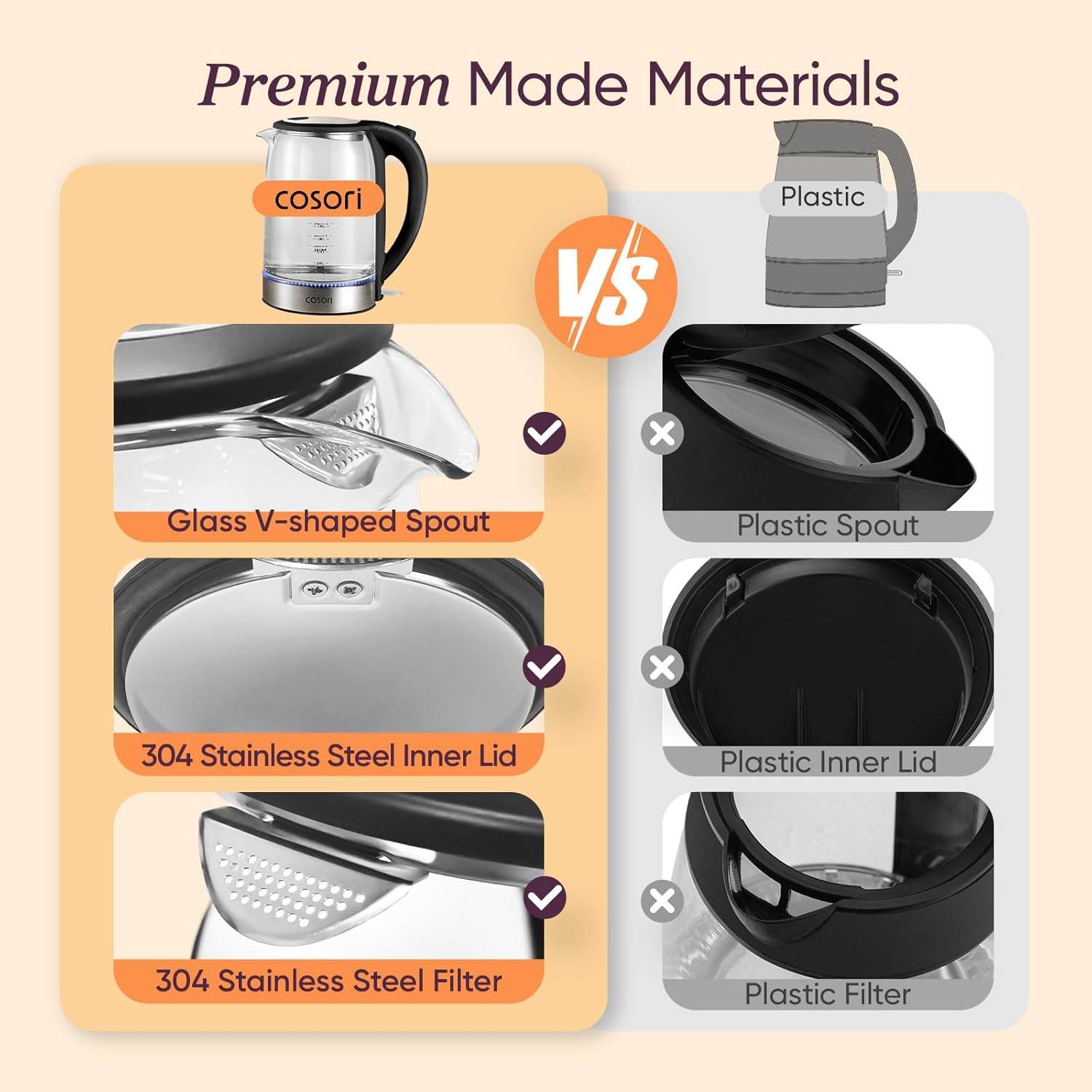
| Materials and construction | Borosilicate glass body, stainless steel heating plate and filter, no plastic contact with water according to manufacturer |
| Heating and control system | 1500W concealed heating element with Strix thermostat for automatic shutoff and boil-dry protection |
| Filter and spout | Stainless steel mesh filter and precision pour spout designed to reduce splashing |
| Best suited users | Home brewers, tea enthusiasts, pour-over coffee users, small households |
| Intended use cases | Heating water for tea, pour-over coffee, instant beverages, quick meals |
| Warranty and safety features | Auto shutoff, boil-dry prevention, cool-touch handle; warranty details per manufacturer documentation |
These specifications influence brewing results and usability by combining rapid heat-up time with a glass contact surface to preserve flavor neutrality, while Strix-based controls add a layer of temperature safety and repeatability. Capacity and spout design determine suitability for single-serve pour-over workflows or multi-cup needs, and a wide-mouth lid simplifies descaling and filter maintenance for long-term performance.

Brewing Method Compatibility and Extraction Outcomes
The kettle’s 1.7 liter capacity and open, precision spout are compatible with a range of manual brew methods, particularly pour-over and immersion techniques where controlled pouring and temperature stability matter. For pour-over brews, a steady, splash-reducing stream supports more even bed saturation and consistent flow rate, which helps maintain targeted extraction percentages. For French press and other immersion methods, full-coverage pouring and sufficient capacity for multiple servings allow correct brew ratios to be achieved without reheating interruptions. Tea steeping benefits from a neutral contact surface—borosilicate glass—with reduced risk of residual flavors from plastics, preserving the volatile aromatics that define delicate teas. The kettle’s rapid heating and mid-sized capacity also support quick reboils for continuous brewing sessions in small households.

Pour-over and Drip Coffee Compatibility
Pour-over techniques rely on predictable water flow, temperature, and the ability to pace pour rates to control extraction. The Cosori kettle’s precision spout and cool-touch handle are designed to support a controllable stream, which aids manual flow regulation during bloom and subsequent pours. Stable boiling followed by a brief cooldown period is typical before starting a pour-over to reach the optimal extractive temperature range; therefore, rapid heat-up reduces wait time but requires awareness of temperature lag between boil and ideal pour temperature. For drip coffee machines that require preheating or hand-pouring rinse, the kettle’s capacity and heat output accommodate common workflows used by home brewers.
Tea Brewing and Delicate Leaf Considerations
Tea steeping often depends on precise target temperatures and quick transitions between heat and steep times. Glass as a contact material minimizes flavor transfer, supporting clarity for green, white, and oolong teas that are sensitive to high temperatures and off-notes. While this kettle does not provide variable temperature presets, the combination of rapid boil and visual cues (LED) allows users to manually time water cooling to target ranges. For leaf teas requiring lower temperatures, manual temperature control methods—such as brief cooldown or transferring to a preheated vessel—remain necessary to reach recommended infusion temperatures without relying on preset thermostats.
Other Uses: Instant Beverages, Quick Meals, and Preheat Tasks
Beyond specialty brewing, a 1.7 liter, 1500W glass kettle suits general household needs like instant meals, rehydrating foods, and heating water for sanitation tasks. The wide mouth and full-open lid facilitate adding ingredients or rapid filling for multiple uses. For tasks requiring near-boil temperatures, automatic shutoff and boil-dry protection reduce risk when attention shifts during meal preparation. Users seeking repeated short-interval boils should consider heat retention characteristics of glass versus insulated alternatives, as glass typically allows faster cooling and may prompt additional reheating for successive uses.
Temperature Control, Heat Stability, and Extraction Science
Temperature control is a primary determinant of extraction quality for both coffee and tea; target ranges and stability affect solubility of acids, sugars, and bitter compounds. This kettle uses a concealed 1500W heating element paired with a Strix thermostat for automatic shutoff at boil, delivering rapid heat-up and consistent shutoff behavior. However, the unit does not include adjustable temperature presets, which places the onus on the user to manage cooling to reach specific infusion ranges. Heat retention is moderate for borosilicate glass—faster than insulated steel but slower heat transfer compared with thin-walled kettles—so timing between boil and pour affects achievable brew temperature. For precise extraction control in pour-over coffee or delicate tea, combining rapid boil with measured cooldown intervals or a separate thermometer yields repeatable results.
Boil Speed, Heat Source, and Practical Temperature Management
A 1500W element yields comparatively fast boiling for domestic electrical kettles, reducing time-to-boil for single-serve and multi-cup scenarios. Rapid boiling reduces overall workflow time but can overshoot temperatures desired for certain tea styles or pour-over protocols. Because the kettle’s control system centers on a Strix thermostat shutoff at boil rather than variable temperature control, practical temperature management relies on measured cooldown time or transferring boiled water into pre-warmed vessels to stabilize temperature. For precise brews, pairing the kettle with a thermal carafe or using a small thermometer helps align water temperature to the optimal range for target beverages.
Temperature Stability, Cooling Curves, and Impact on Extraction
Bor osilicate glass offers predictable thermal behavior: relatively low thermal shock and neutral interaction with water, but less insulation than double-walled or vacuum designs. Cooling curves from boiling to common brew temperatures occur faster with glass, meaning that extraction-relevant temperature windows are shorter and timing becomes more critical for consistent results. In pour-over coffee, even small temperature shifts influence soluble yield and perceived balance; for tea, overshooting can extract excessive tannins. Users prioritizing tight temperature control should apply timed cooling or supplemental devices for temperature stabilization when exact degrees are required.
Role of Thermostat Accuracy and Safety in Repeatability
A Strix thermostat is an industry-accepted control known for reliable detection of boiling and boil-dry conditions, supporting repeatable shutoff and safety. While it does not supply intermediate temperature setpoints, consistent shutoff behavior at boil reduces variability in initial conditions for post-boil cooling strategies. For repeatable extraction workflows where the same cooldown interval yields target temperatures, the predictable shutoff point contributes to consistent initial thermal energy and therefore helps users standardize their brewing protocols over time.
Ease of Use, Lid & Pouring Design, and Workflow Integration
Ease of use hinges on lid mechanics, spout geometry, handle ergonomics, and interface indicators. This Cosori model features a dual-angle lid: a splash-reducing, partial-open position activated by a one-touch button and a full-open angle for filling and cleaning. A cool-touch handle and a precision spout support safer, more controlled pouring which aids manual pour-over techniques. The illuminated LED ring provides a clear visual indicator of active heating. The kettle docks onto a power base and includes boil-dry protection and automatic shutoff; that combination simplifies daily operation while requiring users to manage temperature targets manually. For households where multiple short boils occur, the single-button lid and full lift access reduce friction in rapid refill situations.
Lid Mechanics and Filling Workflow
A dual-angle lid balances splash control during near-boil conditions with full access for cleaning and filling. Partial opening helps prevent sudden displacement of steam and reduces splatter during topping up, improving safety and reducing the risk of accidental scalding. Full open mode permits wide-mouth access for descaling tools or brushes, simplifying maintenance—a key workflow advantage for households using hard water where scale accumulation is more likely. The one-touch mechanism supports quick action but relies on mechanical hinges that should be inspected as part of routine care for signs of wear.
Pouring Precision and Handle Ergonomics
A precision spout and cool-touch handle enable controlled pours that are important for pour-over brew pacing and minimizing spills around drippers or small carafes. Handle ergonomics influence wrist angle and pour steadiness, with insulated materials improving user comfort during continuous pours. While glass vessels may transmit some heat to external surfaces, the design intent of the cool-touch handle mitigates thermal transfer, allowing safer handling during active use. Spout shape and mesh filter placement also affect drip control and particle retention while pouring.
Base, Cord Management, and Daily Storage
A detachable power base provides rotational docking and cord storage options common to countertop kettles. Stability of the base and quality of the electrical connector influence both user confidence and long-term reliability. For storage and daily use, the ability to remove the kettle from its base and carry it by a single hand is useful when transporting hot water to multiple brewing stations. Cord length and base design should be considered relative to kitchen layout to minimize awkward positioning during repeated boiling cycles.
Cleaning, Maintenance, and Water Quality Effects
Long-term performance depends on cleaning accessibility, material resistance to scale, and filtration. A wide mouth and large-angle lid make internal access straightforward for manual descaling, scrubbing, and inspection. Borosilicate glass resists staining and does not interact chemically with water, supporting taste neutrality, but mineral deposits from hard water can form on the heating plate and glass interior over time. The inclusion of a stainless steel mesh filter reduces particulate flow into poured beverages but requires periodic cleaning to avoid flow reduction. Routine maintenance and water treatment strategies—such as periodic descaling and using filtered water—preserve heating efficiency and reduce the likelihood of deposits affecting temperature transfer or valve mechanisms.
Wide-Mouth Cleaning and Accessibility
Wide-mouth openings allow brushes and cleaning tools to reach corners of the kettle body and the rim of the heating chamber. Full-lid opening enables visual inspection for scale buildup and facilitates removal of lodged minerals or debris, improving sanitation and longevity. From a practical standpoint, ease of cleaning shortens maintenance cycles and limits the accumulation of residues that can alter flavor or impede thermal transfer. Manufacturer guidance for hand washing aligns with glass cookware care; dishwashers are typically discouraged to prevent accidental damage to electrical or polished elements.
Scale Management and Filter Care
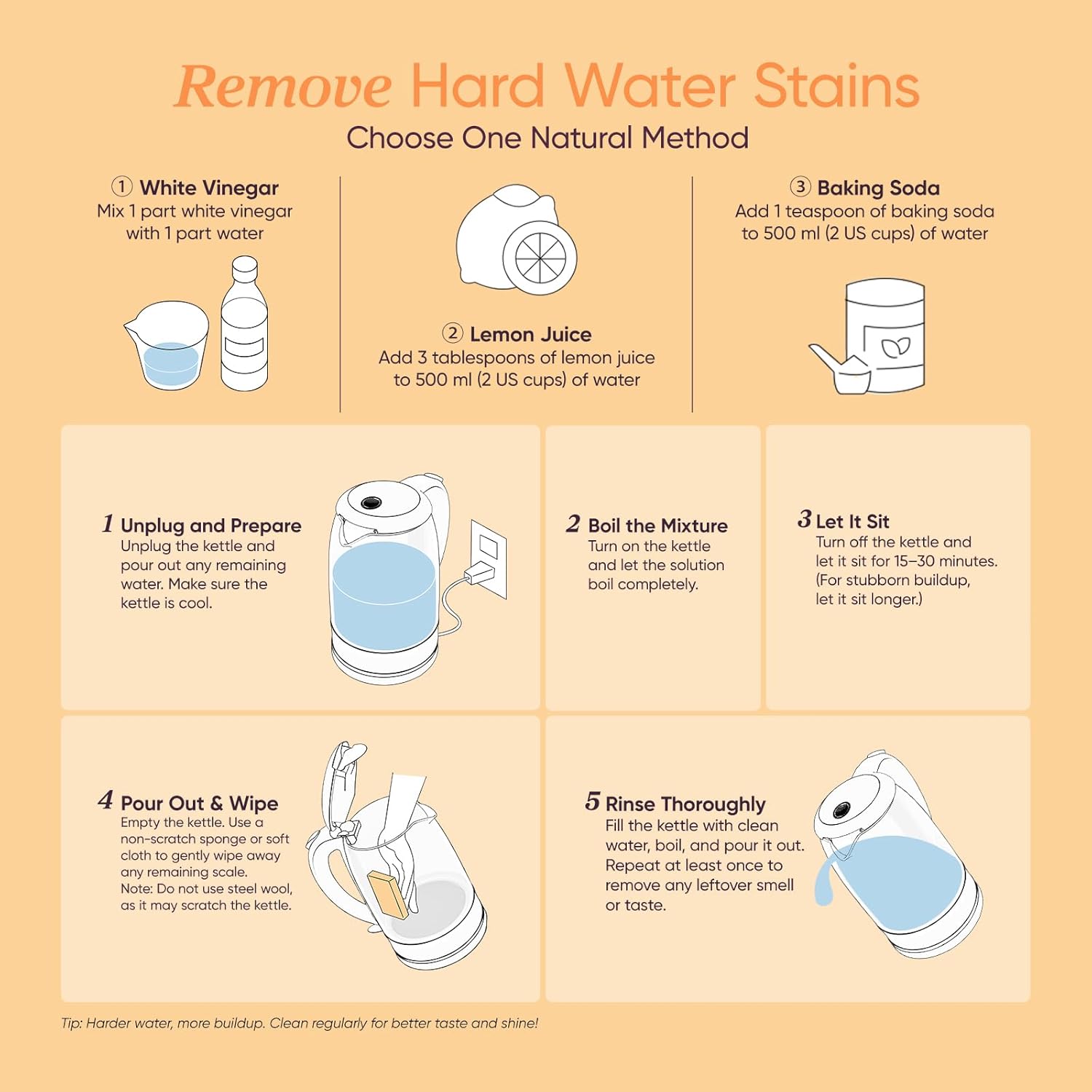
Hard-water minerals precipitate on heated surfaces, particularly on concealed heating plates, where deposits can insulate the element and lengthen boil times. Regular descaling using food-safe agents or vinegar solutions restores thermal conduction and maintains efficiency. The stainless steel mesh filter captures scale flakes and particulates at the spout; routine rinsing prevents clogging and maintains a clean pour. Users in areas with high mineral content may prefer periodic replacement cycles or water softening to reduce maintenance frequency.
Glass Durability, Staining, and Long-Term Appearance
Borosilicate glass offers improved thermal shock resistance compared with standard soda-lime glass, reducing risk from rapid temperature changes. However, glass remains susceptible to chips or cracks from impact, and repeated thermal cycling can stress seals over long periods. Cosmetic staining from tannins or mineral films can be removed with targeted cleaning, but persistent residue may require more aggressive descaling. Attention to handling and storage reduces mechanical risk, while routine cleaning preserves visual clarity and perceived cleanliness.
Capacity, Build Quality, and Durability Expectations
Capacity and materials determine serving flexibility and expected lifespan. A 1.7 liter volume supports multi-cup use for small households or multiple single-serve brews during a single session. The combination of borosilicate glass, stainless steel filter, and a Strix thermostat suggests manufacturer emphasis on minimizing plastic contact with water and relying on recognized control components for safety. Build quality factors include the integrity of the lid hinge, seal interfaces between glass and base, and the finish on the heating plate where scale accumulates. Aggregated customer feedback themes for glass electric kettles often highlight fast boil times and clean taste, tempered by occasional concerns about glass fragility or lid mechanism durability; these patterns align with material trade-offs between flavor neutrality and impact resistance.

Serving Flexibility and Household Fit
A 1.7 liter capacity covers common needs such as multiple pour-over servings, kettle-based tea service for a household, or preparing hot water for cooking tasks. For single-serve specialty coffee routines, the capacity reduces refill frequency when making several cups, but for larger gatherings larger-capacity or multiple-kettle strategies may be preferable. The weight and dimensions influence countertop footprint and storage; this model’s compact height and moderate base diameter fit most kitchen spaces while providing adequate volume for routine home use.
Materials, Seals, and Mechanical Components
Key material choices—borosilicate glass body and stainless steel in the water path—prioritize flavor neutrality and corrosion resistance. The presence of a Strix thermostat underscores standard industry safety and control practices. Mechanical components such as the one-touch lid latch, hinge, and the base’s electrical connector are wear points that determine long-term reliability; routine inspection of these parts and adherence to hand-wash care guidance support lifespan. Manufacturers commonly provide warranty information that clarifies coverage for defects, making it important to consult official documentation for repair or replacement policies.
Durability Trade-offs and Common Failure Modes
Glass kettles trade improved taste neutrality for increased sensitivity to impact and thermal shock compared with insulated metal alternatives. Common long-term issues reported with glass electric kettles in aggregated feedback include scale accumulation affecting heating efficiency, wear in lid hinges, and occasional base connector faults. Proper maintenance—regular descaling, gentle handling, and avoiding sudden temperature extremes—mitigates many failure modes. For users prioritizing maximum impact resistance or heavy daily commercial use, alternative stainless steel or insulated models may offer better durability at the cost of direct glass contact.

Pros & Cons
Pros
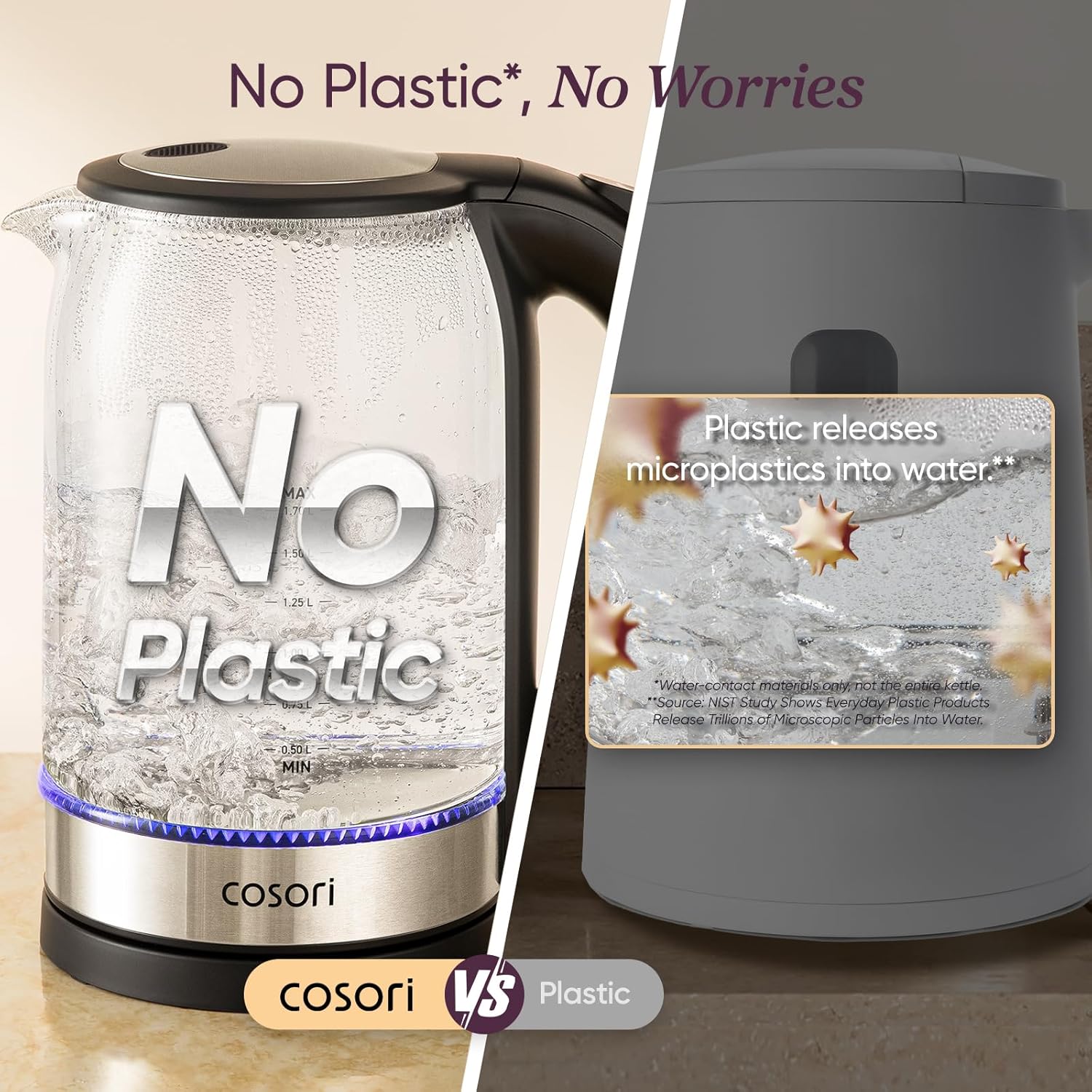
- No plastic contact with water: The borosilicate glass interior and stainless steel water path reduce potential flavor transfer associated with plastic components, preserving the volatile aromatics important to tea and pour-over coffee. This material choice supports perceived taste clarity and simplifies post-use odor control.
- Fast 1500W heating element: A higher-wattage concealed element shortens time-to-boil, improving workflow efficiency for single-serve and small-batch brewing. Faster heat-up enables quicker turnaround between brews, which is useful during morning routines.
- Wide mouth and dual-angle lid: The large opening and full-angle lid facilitate thorough cleaning and descaling, while the partial-open splash position improves safety during near-boil topping. Easier access reduces maintenance barriers and supports long-term hygiene.
- Strix thermostat with safety features: An industry-standard thermostat provides reliable automatic shutoff and boil-dry protection, supporting predictable shutoff behavior and reducing risk during unattended operations.
- Precision spout and cool-touch handle: Spout geometry and an insulated handle support controlled pouring for manual brew methods and reduce the likelihood of spills or burns during use.
- Stainless steel filter included: A removable mesh filter captures particulates and reduces sediment in poured water, benefiting clarity for tea and aiding cleaner pours for pour-over coffee.
Cons
- No variable temperature presets: The absence of adjustable temperature settings requires manual cooldown or additional tools to reach non-boiling target temperatures, which can complicate precise tea and specialty coffee workflows.
- Glass fragility relative to metal kettles: While borosilicate improves thermal performance, glass remains more vulnerable to impacts and may show wear or chips over time; handling care and proper storage are necessary to reduce breakage risk.
- Potential for scale accumulation: Users in hard-water areas will need routine descaling to maintain heating efficiency and prevent deposits on the concealed heating plate; this adds maintenance time compared with some sealed or filtered systems.
- Dependence on base and hinge mechanics: Long-term reliability is influenced by the power base connector and lid hinge, which are wear points; these components may require inspection or service over extended use.
Final Verdict: Who This Product Is Best For (and Who Should Skip It)
The Cosori electric glass kettle is best suited to home brewers and tea enthusiasts who prioritize flavor neutrality, visual clarity, and a rapid-boil workflow. Its borosilicate construction and stainless steel water path minimize plastic contact with water, which aligns with users who are sensitive to taste transfer and want a kettle that supports pour-over coffee and delicate tea infusions. The 1.7 liter capacity fits small households and multi-cup sessions, while the precision spout and cool-touch handle support controlled pouring for manual brewing methods. For those who value quick access to boiled water and straightforward cleaning via a wide mouth, the design addresses common home-brewing needs.
Households or users who require precise temperature control without manual cooldown, very high-impact durability, or commercial-grade continuous use should consider alternatives with variable temperature presets or insulated stainless-steel construction. Regular maintenance for scale removal and attention to hinge and base connectors are practical considerations for long-term reliability. Compared with similar electric kettles available in 2026, this model emphasizes taste-preserving materials and a fast, user-friendly boil cycle—features that make it a practical choice for domestic coffee and tea preparation when combined with simple temperature management techniques.
Frequently Asked Questions (FAQs)
Can this kettle be used for pour-over coffee brewing?
Yes. The kettle’s precision spout and controlled pour geometry support manual pour-over techniques by enabling a steady, splash-reducing stream. Because it lacks adjustable temperature presets, achieving specific extraction temperatures typically involves boiling then allowing a short cooldown or transferring boiled water into a preheated vessel to reach the preferred brewing range for pour-over coffee.
How does the lack of plastic contact affect taste and safety?
Materials impact perceived flavor: a borosilicate glass body and stainless steel water path reduce the chance of flavor transfer associated with plastic components, preserving aroma and taste clarity for delicate teas and pour-over coffee. From a safety perspective, using durable glass and stainless steel in the water path minimizes exposure to plastic at high temperatures, though glass still requires careful handling to avoid chips or cracks.
Is there a variable temperature control for tea and specialty coffee?
No. The kettle uses a Strix thermostat that provides automatic shutoff at boil and boil-dry protection but does not offer adjustable temperature presets. Users seeking sub-boil target temperatures must apply manual cooldown intervals or use an external thermometer to achieve the required infusion temperatures for specific tea types or specialty coffee.
What maintenance is required to prevent scale buildup?
Regular descaling is recommended, especially in hard-water areas. The wide mouth and removable stainless steel mesh filter simplify cleaning and allow access for vinegar- or citric-acid-based descaling solutions. Routine rinsing of the filter and wiping the heating plate preserve thermal transfer efficiency and reduce the likelihood of longer boil times caused by mineral deposits.
How suitable is this kettle for household or entertaining use?
With a 1.7 liter capacity and a 1500W heating element, the kettle is suitable for small households and light entertaining where multiple cups are needed over short intervals. For larger gatherings or continuous heavy use, a higher-capacity or more heavily insulated kettle may be preferable to reduce reboil frequency and improve heat retention between servings.
Is the glass durable and safe for repeated heating cycles?
Borosilicate glass offers good thermal shock resistance and is designed to withstand repeated heating cycles better than standard glass types. However, glass remains more vulnerable to mechanical impact than metal alternatives, so careful handling, avoiding sudden temperature shocks, and routine inspection for chips or cracks are important for safe long-term use.
Does the kettle include a safety thermostat and boil-dry protection?
Yes. The kettle uses a Strix thermostat—an industry-recognized control system—that provides reliable automatic shutoff at boil and boil-dry protection. These features reduce the risk of overheating when water levels are low and support repeatable shutoff behavior, contributing to safe everyday operation.
Can the kettle be used with hard water without issues?
Hard water can lead to mineral scale on the heating plate and inside the body over time, which may lengthen boil times and affect appearance. Regular descaling and use of filtered water help mitigate buildup. The wide mouth and removable filter make maintenance more manageable, but users in very hard-water regions should plan for more frequent cleaning.