
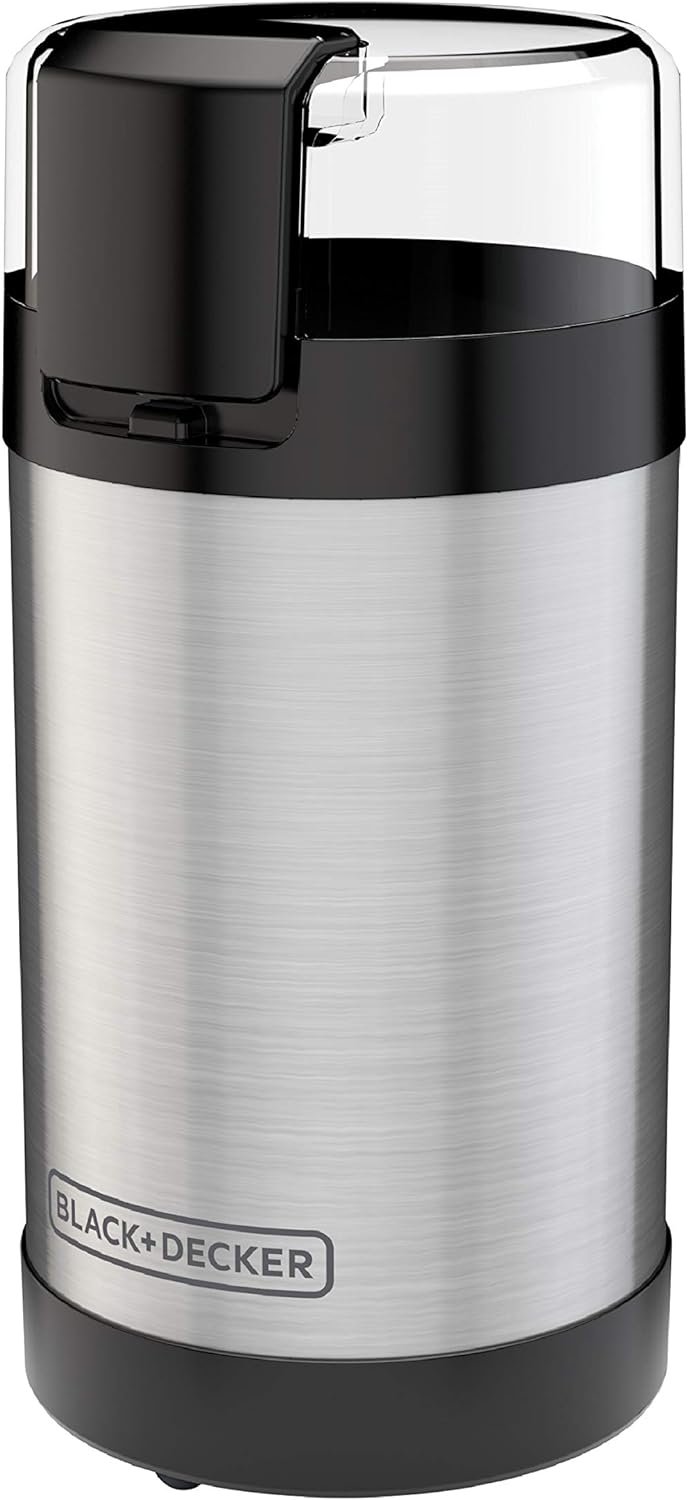
Selecting a coffee grinder affects extraction, flavor clarity, and daily workflow more than many home brewers realize. For small-batch household use, a compact electric blade grinder such as the BLACK+DECKER One Touch targets convenience and quick preparation rather than precision micrometric adjustments. Home brewers and casual enthusiasts who prioritize speed, minimal steps, and multi-use capability (spices, grains, herbs) will find the feature set relevant. The grinder’s stainless steel blades and bowl, one-touch push-button, and lid-lock safety emphasize ease of use and basic safety compliance. Understanding how these attributes interact with grind uniformity, particle size distribution, and dose control helps buyers align expectations with actual extraction outcomes across drip, single-cup, and coarse methods like French press. This write-up focuses on objective product attributes, material and design implications, and typical user workflows to help prospective buyers decide whether a small-capacity blade grinder meets their brewing needs.
Quick Overview
| Feature | Details |
|---|---|
| Product category and brewing method | Electric blade coffee grinder; suitable for drip, single-cup, and coarse methods (French press) when used for small batches |
| Capacity and output | 2/3 cup (approximate volume for small-batch grinding) |
| Materials and construction | Stainless steel blades and stainless steel grinding bowl; plastic housing (stainless steel finish) |
| Motor and power | 150 Watts (nominal motor power) |
| Controls and safety | One-touch push-button control; lid-locking safety feature that enables motor only when lid is locked |
| Grind compatibility | Blade grind with variable duration-based control; not a burr grinder (no discrete grind settings) |
| Electrical | 120 Volts (designed for standard US mains) |
| Size and weight | Compact footprint (3.5″L x 3.4″W x 7.28″H); item weight about 1.43 pounds |
| Best suited users | Households and casual brewers wanting small-batch, quick grinding and multi-use capability (spices, herbs) |
| Intended use cases | Quick daily grinding for 1–3 cups, spice/herb processing, occasional grains |
| Warranty and manufacturer | Manufacturer: Black+Decker; warranty information not specified in supplied product details |
The table summarizes how the grinder’s small capacity, blade mechanism, and stainless steel components affect everyday use: the design favors rapid, intermittent grinding for single-cup or small-pot routines, while the blade mechanism produces more mixed particle sizes than burr systems, which influences extraction and clarity for different brew methods.

Grind quality and extraction implications
The blade-style mechanism and stainless steel bowl determine particle-size distribution and how that distribution affects extraction. Blade grinders rely on blade speed and grinding time to reduce particle size, creating a broader spread of fines and coarse fragments compared with burr grinders that produce a tighter, bimodal or unimodal distribution. Broader particle distribution can increase soluble extraction variance, changing perceived strength and clarity; shorter grind times favor coarser average sizes and less surface-area-driven overextraction, while longer pulses increase fines and risk of overextraction for sensitive brews. For recipes with forgiving extraction windows (drip, single-cup pods, and coarse French press), careful dosage and consistent timing can yield acceptable results, but connoisseurs seeking precise control for espresso or pour-over may find the lack of discrete grind steps limiting.

Blade vs. burr: what the mechanism means for extraction
Blade grinders use high-speed cutting to fracture beans, producing irregular particle shapes and a wide distribution from fines to chunks. That distribution increases surface area variance, which accelerates extraction of some particles while leaving others under-extracted. In practical terms, this can make achieving a balanced cup more dependent on conservative brew ratios, coarser average grinds, and shorter contact times. The stainless steel blades and bowl help reduce food-surface reactions and are durable, but they do not replace the grind uniformity advantages of conical or flat burr systems. For brew methods that are tolerant of mixed particle sizes—e.g., steep-and-filter or single-cup systems—a blade grinder can be a pragmatic choice.
Grind consistency, dosing, and controlling extraction
Because the grinder lacks calibrated grind steps, dosing and timing become the primary variables for controlling extraction. Consistent dosing using a scale and repeated, timed pulses will yield more repeatable results than guessing by eye. For a drip machine or pour-over, aiming for shorter pulses and finer tuning of brew ratio can offset particle variance; for French press, coarser, shorter bursts reduce fines and sediment. The stainless steel bowl limits static cling and eases transfer of grounds to a filter or press, which helps maintain dose consistency and reduces leftover retention between uses.
Brewing method compatibility and realistic expectations
Blade grinders work best where absolute particle uniformity is not mandatory: coarse French press, general drip machines, and single-serve brewers that use paper or mesh filters. For methods demanding tight particle distribution and low fines—espresso, specialty pour-over recipes, and manual extraction with narrow contact times—a burr grinder is recommended. The One Touch’s strength is rapid small-batch preparation; users should expect to manage grind time and brew ratios to compensate for particle spread rather than rely on precise mechanical settings.
Capacity, serving flexibility, and workflow fit
Capacity and serving flexibility influence how this grinder integrates into daily routines. The quoted 2/3 cup capacity supports single-cup to small-pot brewing, making it suitable for individuals or couples rather than larger households entertaining multiple guests. Small capacity shortens the time between grinding cycles and reduces storage of residual grounds, which favors frequent, fresh grinding. The compact footprint and lightweight construction support countertop storage or occasional cabinet use, and the stainless steel bowl reduces clumping from oils on beans. However, multiple sequential batches for larger servings require repeated operation, which increases handling time and may heat the motor slightly during extended use. For those who brew 1–3 cups per cycle and value a quick, low-friction workflow, the capacity and form factor match that workflow.

Batch size and serving scenarios
The 2/3 cup nominal capacity aligns with small-batch grinding strategies—one to three standard coffee servings depending on grind coarseness and dose. For coarse grinds used in French press, that capacity will yield fewer servings per cycle than for fine grinds, which are denser in volume. Planning by weight rather than volume yields more predictable results; measuring ground weight post-grind helps standardize recipe scaling and reduces the need for repeated runs when brewing multiple cups.
Workflow complexity when brewing multiple servings
When multiple servings are required, workflow introduces repeated pulsing, transfer of grounds, and occasional cooling periods for the motor. The one-touch control simplifies each run but does not automate dose measurement or grind consistency across cycles beyond user timing. Repeated batches increase handling steps and the chance for dosing variance; batching beans by pre-weighing portions and using a consistent pulse routine improves repeatability and reduces per-batch overhead.
Grind retention and storage considerations
Blade grinders typically have low internal pathways and therefore low static and retention compared with some burr models. The stainless steel bowl minimizes grounds adherence, making it easier to empty and clean between uses. Low retention supports freshness and straightforward transition between coffee and spice grinding, but users should still clear residuals to avoid flavor cross-contamination when switching between ingredients.
Ease of use, cleaning, and maintenance
Ease of use centers on the One Touch push-button control and lid-lock safety. The single-button operation reduces complexity for quick morning routines, while the safety interlock limits accidental motor engagement. Cleaning expectations are straightforward: the stainless steel bowl and blades can be wiped out or rinsed, and the compact size makes thorough manual cleaning feasible. However, because the blades are fixed, in-depth cleaning around the blade hub can require careful handling. Regular removal of residual oils and particles maintains flavor neutrality when switching between coffee and spices. The grinder’s small footprint and simple controls lower the learning curve for non-technical users.

Control simplicity and workflow implications
A single push-button encourages fast, repeatable usage: press to run, release to stop, and repeat as needed to adjust coarseness by time. This simplicity benefits low-friction workflows but places the burden of repeatability on user timing and dosing. For households that prefer minimal controls and fast operation, a one-button grinder reduces decision fatigue. For users who want discrete grind settings or micro-adjustments, the time-based single-button approach is less accommodating.
Cleaning steps and recommended maintenance cadence
Maintenance consists of emptying grounds after each use, wiping the bowl and blades with a dry brush or cloth, and occasional gentle rinsing followed by full drying to prevent corrosion. For users who grind spices occasionally, deeper cleaning between ingredient types is advisable to prevent flavor carryover. Periodic inspection of the lid-locking mechanism and wipe-downs of the exterior housing keep the unit functional and hygienic over time.
Noise, speed, and daily convenience
The 150-watt motor provides quick reduction of beans with short cycles; this yields speed advantages for busy routines but also produces typical blade grinder noise and vibration. For early-morning usage, the rapid grind cycles reduce total noise exposure compared with longer burr grind cycles; however, the sound profile will still be noticeable in quiet environments. The trade-off is acceptable for users prioritizing speed and compactness over whisper-quiet operation.
Durability, materials, and safety considerations
Materials and construction inform expected longevity and daily safety. Stainless steel blades and bowl offer corrosion resistance and mechanical strength for repeated use, and a relatively low item weight supports portability. The lid-locking safety feature prevents motor operation without a secure lid, mitigating accidental activation risks. The 150-watt motor and compact housing are appropriate for intermittent, small-batch use rather than continuous heavy-duty commercial operation. For long-term reliability, keeping the unit free of debris, avoiding prolonged continuous runs, and following recommended usage patterns will minimize motor strain. Customers should consider warranty details and brand reputation for post-purchase support.

Build materials and components breakdown
Stainless steel blades and an inner stainless steel bowl resist staining and are easy to clean, which supports durability and food safety. The outer housing uses a stainless-style finish likely coupled with plastic structural components typical of compact home appliances. The motor rating and blade thickness suggest the grinder is engineered for routine home use rather than industrial throughput; this influences lifespan expectations under frequent heavy use.
Safety features and electrical considerations
The integrated lid-lock safety disables motor engagement unless the lid is secure, reducing risk of spills or contact with moving blades. The unit operates on typical US mains voltage (120 volts); safe electrical practice dictates following manufacturer instructions, using grounded outlets as intended, and avoiding prolonged continuous operation to prevent overheating. The compact form factor reduces torque loads on internal drive components compared with larger grinders.
Long-term reliability and typical failure modes
Common longevity factors for blade grinders include blade dulling, motor wear from repeated extended runs, and degradation of plastic components around sealing interfaces. Regular cleaning and short, intermittent run cycles limit heat buildup and motor stress, which helps extend service life. While stainless steel blades hold up well to routine use, they do not maintain cutting-edge sharpness indefinitely and can be affected by grinding hard non-coffee items frequently.

Pros & Cons
Pros
- Compact small-batch capacity and footprint. The 2/3 cup capacity and compact dimensions support small households, apartments, and limited-countertop space, enabling quick morning grinding without occupying much room.
- Stainless steel blades and bowl. These materials resist staining and corrosion, simplify cleaning, and reduce flavor retention compared with plastic-only grinding surfaces.
- One-touch push-button control. Simple timed pulsing enables quick operation and low workflow complexity for users who prefer minimal controls and fast preparation.
- Lid-locking safety feature. The interlock prevents blade operation unless the lid is secured, reducing the risk of accidental activation and spills.
- Multi-use capability. The grinder is suitable for coffee beans, herbs, spices, and small quantities of grains, offering versatility for kitchens that value multi-function appliances.
- Fast grind cycles for single-serve routines. The 150-watt motor reduces whole-bean to ground in short bursts, which benefits time-sensitive morning workflows.
- Low retention design. The stainless steel bowl and simple internal pathway make it easier to empty and clean, reducing grounds waste and flavor carryover.
- Recognized brand and accessible replacement parts. Black+Decker’s market presence tends to make parts and customer support relatively accessible compared with lesser-known brands.
Cons
- Inconsistent particle-size distribution versus burr grinders. The blade mechanism inherently produces a wider particle spread, which complicates precise extraction control for sensitive methods like espresso or specialty pour-over.
- Small capacity limits serving flexibility. Repeated runs are necessary for larger households or entertaining, increasing workflow steps and motor duty cycles.
- Limited grind control granularity. Time-based one-touch operation lacks the discrete grind settings and micro-adjustments offered by burr machines, constraining repeatable fine-tuning.
- Potential for motor heat buildup with repeated batches. Extended continuous use can increase motor temperature, so the device is best for intermittent short cycles rather than long continuous grinding.
Final Verdict: Who This Product Is Best For (and Who Should Skip It)
The BLACK+DECKER One Touch Coffee Grinder suits home brewers who prioritize convenience, multi-function utility, and compact form factor over precision grind control. It fits small households, apartment kitchens, and consumers who prepare one to three cups per session, or who want a single convenient appliance for coffee, spices, and small-grain tasks. The stainless steel bowl and blades reduce cleanup friction and improve durability for everyday, casual use. Buyers who value speed and a minimal workflow will appreciate the one-touch operation and safety interlock.
This grinder is not recommended for users who demand precise particle uniformity or are focused on specialty extraction methods in 2026—particularly espresso or high-precision pour-over routines—because the blade mechanism cannot match burr-based grinders for narrow particle-size distributions. Large households, coffee enthusiasts seeking micro-adjustments, and those who brew frequently for many guests should consider a higher-capacity burr grinder. For its intended role—quick, small-batch grinding with straightforward maintenance—the One Touch represents a practical, budget-conscious option within the entry-level electric blade grinder category.

Frequently Asked Questions (FAQs)
Can a blade grinder like this produce consistent grounds for French press?
A blade grinder can produce grounds suitable for French press by using short, controlled pulses to aim for a coarser average particle size. However, blade grinding creates a wider particle-size distribution with more fines than burr grinders, which can increase sediment and variability. For acceptable results, use conservative grind times, measure dose by weight, and allow settling or filtering adjustments to manage clarity.
Is the stainless steel bowl better than plastic for flavor and durability?
Stainless steel bowls reduce static cling and are less porous than plastic, which helps limit flavor staining and odor retention. The material resists corrosion and simplifies cleaning, which supports durability and neutral flavor transfer when switching between coffee and spices. Proper drying after rinsing prevents any surface corrosion risks over long-term use.
How does grind time affect brew strength and extraction with a blade grinder?
Grind time controls average particle size: shorter times yield coarser particles and less surface area for extraction, while longer times create finer particles and more fines, increasing extraction rate. Because blade grinders produce mixed particle sizes, adjusting brew ratio and contact time alongside grind time is essential to avoid under- or over-extraction.
Is this grinder safe to use for herbs and spices as well as coffee?
The grinder’s stainless steel blades and bowl are suitable for herbs and spices, but flavor cross-contamination is likely if the same unit is used for both without thorough cleaning. Wiping and rinsing between ingredient types, and occasional deep cleaning, reduce flavor carryover. The lid-lock safety feature prevents motor operation when the lid is not secured.
Will repeated small batches overheat the motor?
Intermittent short pulses are the designed use case and generally avoid motor stress. Repeated continuous runs without pauses can increase motor temperature and accelerate wear; allowing short cooling intervals between batches mitigates heat buildup and supports longevity. The 150-watt rating is appropriate for typical household duty cycles rather than sustained commercial throughput.
Is this grinder suitable for espresso preparation?
No. Espresso requires a narrow particle-size distribution and high consistency that blade grinders cannot reliably deliver. Burr grinders with adjustable grind settings are recommended for espresso to achieve the fine, uniform grind and repeatable dosing needed for controlled pressure-based extraction.
How easy is cleaning the blade and bowl assembly?
Cleaning is straightforward: emptying the stainless bowl, brushing out residual grounds, and wiping blades and interior surfaces are typically sufficient. Periodic gentle rinsing followed by thorough drying keeps the unit sanitary. Careful handling is required around the sharp blades to avoid injury during cleaning.