Ollygrin BG702S-PG Burr Grinder — Precision & Capacity Guide
Why grinder choice matters for home brewing
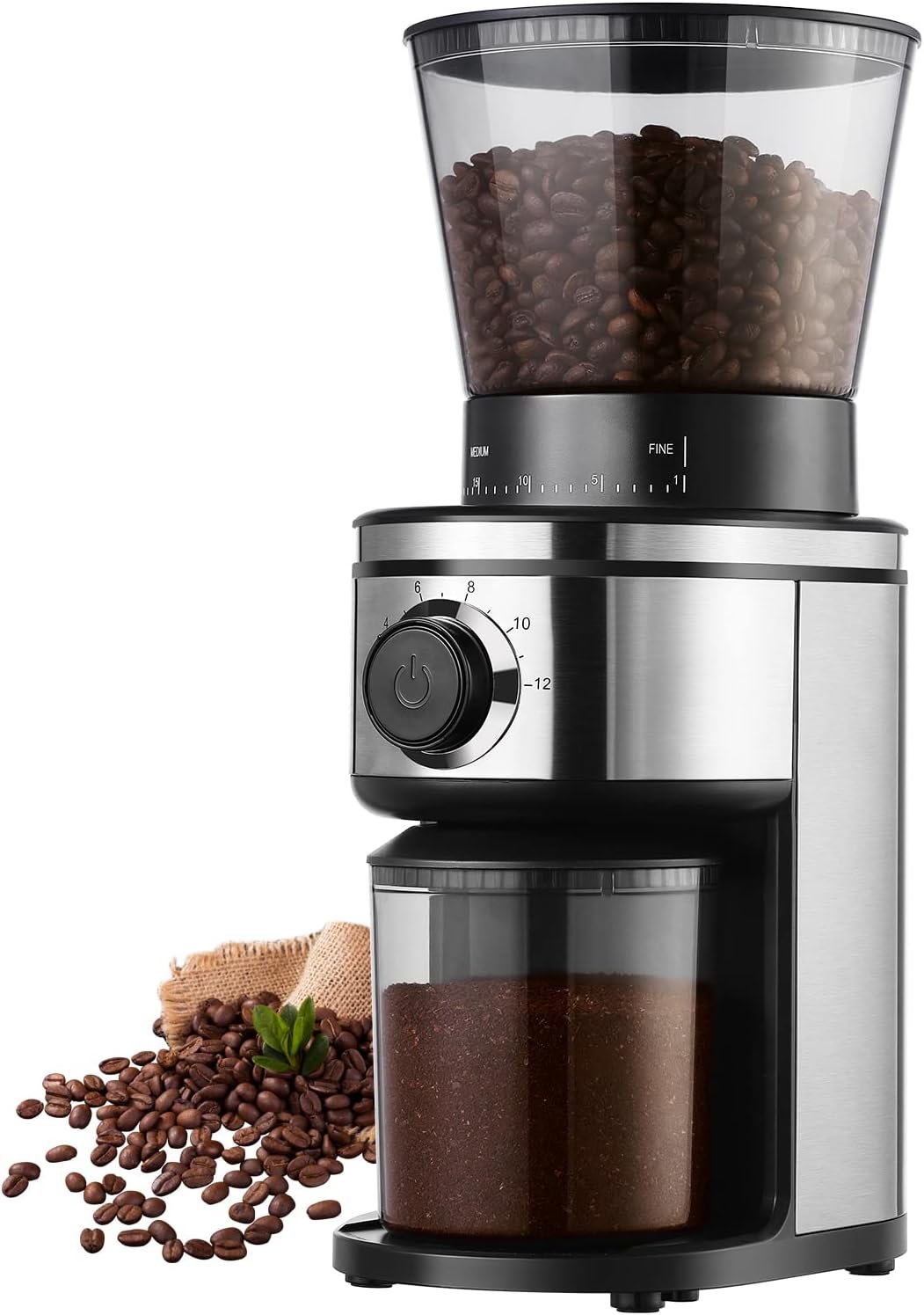
Choosing the right grinder is a primary determinant of brew quality for home coffee drinkers. Grind particle distribution drives extraction rate, affects flavor clarity, and interacts directly with brew method and brew ratio. For households and small-scale enthusiasts, a grinder must balance adjustable particle size, thermal management and throughput with straightforward workflow and maintainability. The Ollygrin BG702S-PG presents a set of specifications that target home use: a 40-millimeter stainless steel conical burr set, 30 indexed grind settings, a gear-reduction motor for slower rotary speed, and a 10-ounce bean hopper with an auto-lock. These characteristics suggest design choices focused on offering a wide grind range and protecting bean aromatics by minimizing heat from friction. Decision factors for potential buyers include whether the grind range and step resolution match intended brew methods, whether the machine’s capacity and dosing match serving needs, and how cleaning, safety features, and build materials align with expected longevity in a household environment.
Quick Overview
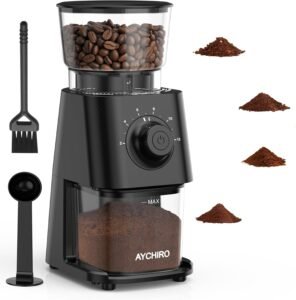
| Feature | Details |
|---|---|
| Product category | Electric conical burr coffee grinder (home use) |
| Model / Color | Ollygrin BG702S-PG (silver & black) |
| Burrs | 40 mm stainless steel conical burrs |
| Grind settings | 30 adjustable grind settings (ultra-fine to coarse) |
| Hopper capacity | 10 ounces (whole beans) |
| Cup settings | Adjustable 2–12 cup selector |
| Motor / Heat design | Gear-reduction motor; low-speed grinding to reduce heat |
| Safety features | Friction clutch; thermal/overheat protection; auto-locking hopper |
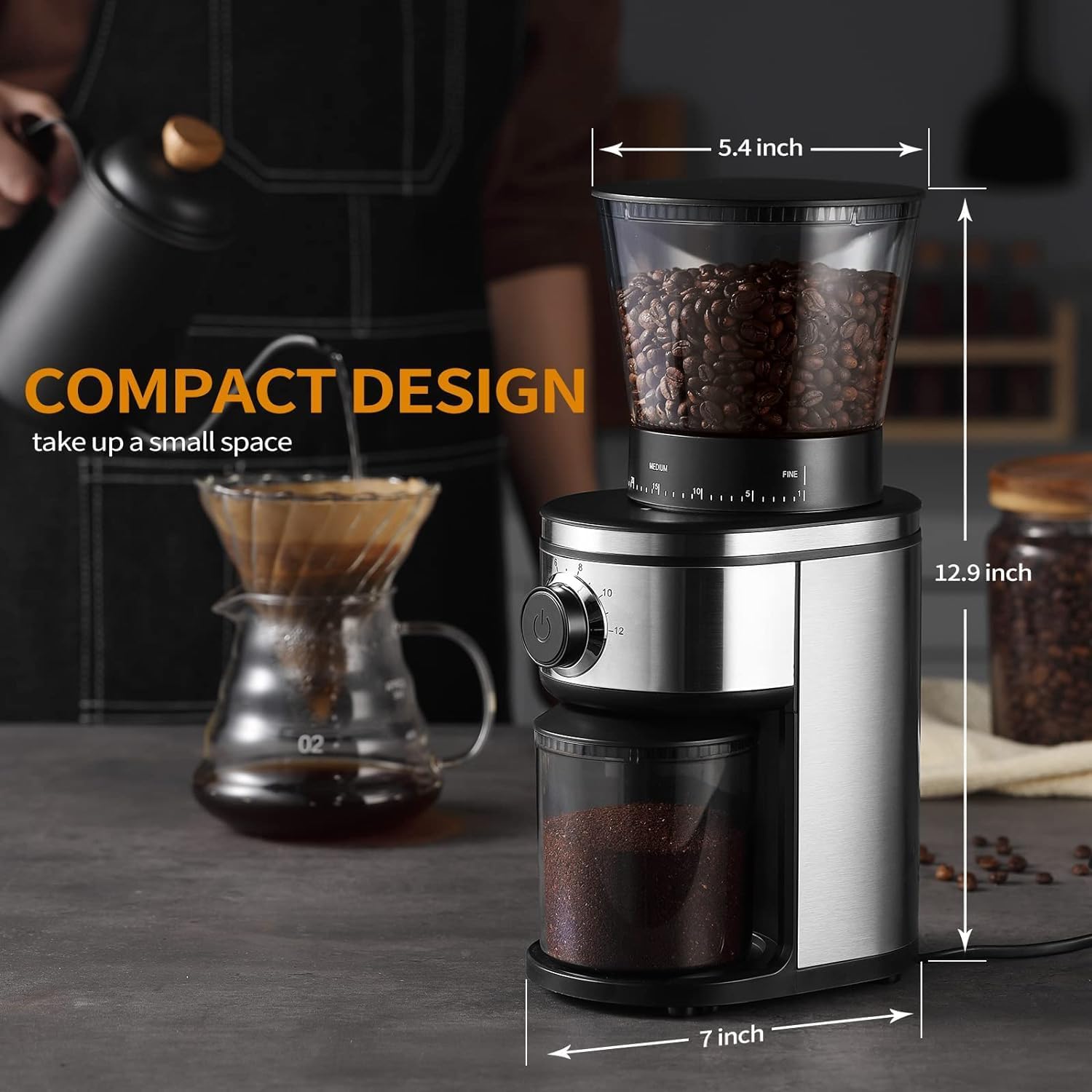
| Materials & weight | Stainless steel components; 4.4 pounds; compact footprint (5.4″L x 7″W x 12″H) |
| Intended users | Home brewers, households, small gatherings |
The table distills how key specifications translate to daily use: the 40 mm conical burrs and 30 settings support a broad range of grind sizes for espresso through French press, while the gear-reduction motor and small footprint prioritize low-heat operation and counter space. Capacity and cup-selector features aim to match single-serve routines and small groups, but users should consider dosing workflow, burr accessibility for cleaning, and the grinder’s adjustment resolution for very precise brewing techniques.
Brewing method compatibility
The grinder’s technical profile targets compatibility across common home brew methods by pairing a 40 mm conical burr set with 30 indexed settings and a wide adjustment range. Conical burrs of this diameter typically create a bimodal but controllable particle distribution that works acceptably for drip, pour-over, and immersion methods when combined with careful recipe adjustments. The 30-step indexing provides enough granularity for coarse-to-medium adjustments, and the upper end of the range is suited for French press or cold brew coarse grinds. For espresso or extremely fine Turkish-style grinds, the effectiveness depends on the fineness limit of the adjustment mechanism and the consistency at the finest settings; grinders with smaller burrs or dedicated espresso-level micro-adjustments often produce the most repeatable results for concentrated extraction methods.

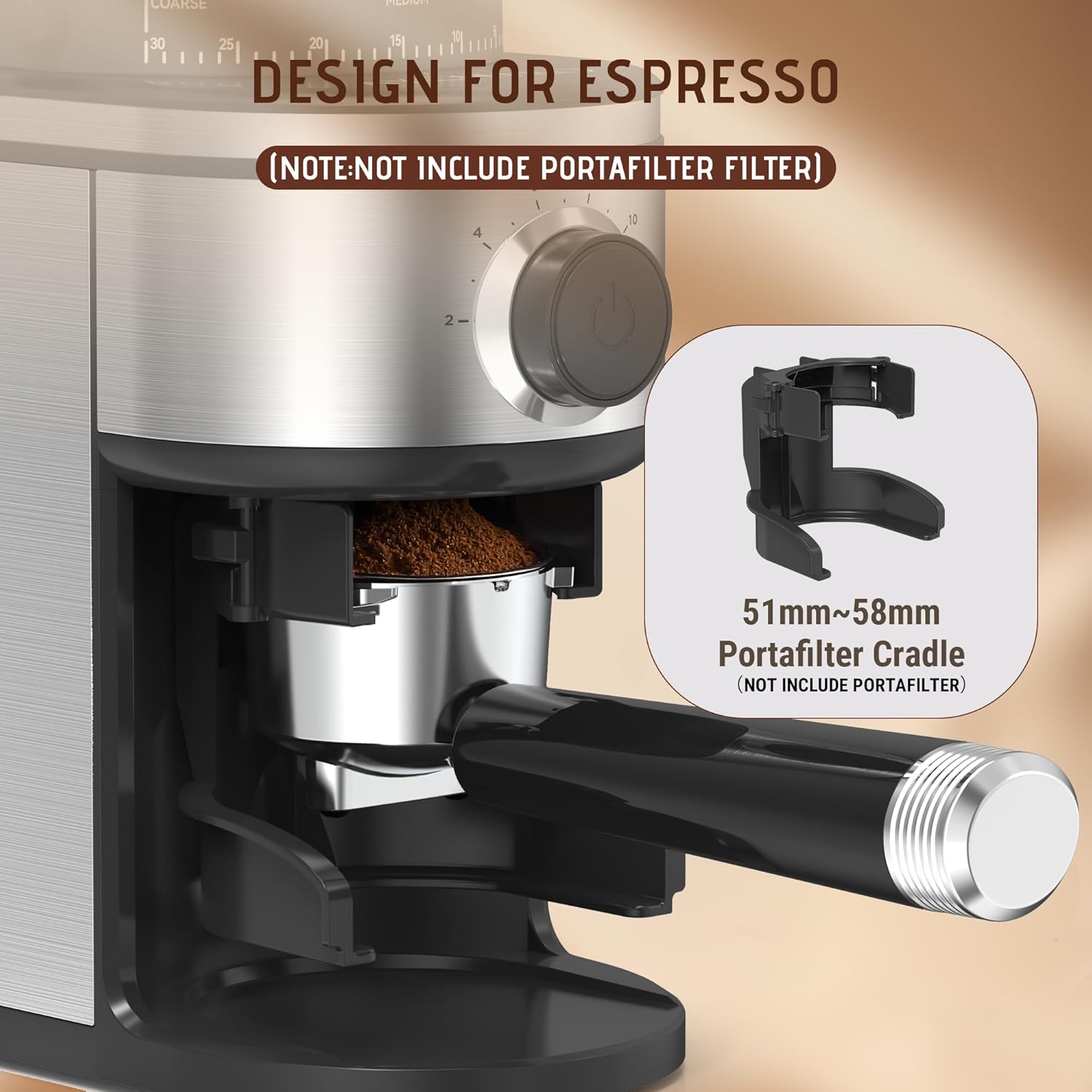
Espresso and fine grind suitability
The 40 mm stainless steel conical burrs and 30-step adjustment offer a pathway to fine grinds, but the precision required for high-pressure espresso extraction favors grinders with micro-adjustment mechanisms and very stable burr alignment. The Ollygrin’s indexed steps will enable dialed-in changes, yet the stepped system may introduce larger jumps between settings than those found on dedicated espresso grinders with stepless micrometers. For home users extracting shorter shots, careful dose control and repetitive shot-timing can partly compensate for stepped adjustments, but achieving peak consistency for pressure-profiled espresso or competitive settings typically requires equipment designed specifically for espresso.
Pour-over, drip, and manual brews
Pour-over and drip methods benefit strongly from consistent medium to medium-coarse particle sizes; the Ollygrin’s conical geometry tends to produce sufficient uniformity for clarity and balanced extraction. The 30 settings provide fine enough increments to adjust flow rate and contact time for common pour-over devices and automatic drip machines. Because pour-over extraction is sensitive to particle fines and harmonic distribution, combining increment adjustments with controlled grind-to-brew ratio and consistent pouring technique will deliver the best results. The lower grinding speed from the gear-reduction motor also helps preserve bean aromatics by minimizing friction heat that can accelerate volatile loss.
French press and coarse grind performance
Coarser settings for immersion methods rely on larger particle sizes and minimized fines to avoid over-extraction and excessive sediment. The Ollygrin’s adjustment range includes coarser positions suitable for French press and cold brew, and a 10-ounce hopper supports batching for multiple servings. However, conical burrs commonly produce some fines at coarser settings, so filtration and agitation strategies will influence perceived clarity. For coarse-brew fans, pairing the grinder’s coarser settings with settling time, gentle plunging technique, or paper filtration (for hybrid methods) reduces sediment and yields cleaner cups.
Grind consistency and extraction quality
Grind consistency is foundational to stable extraction and flavor clarity, and the Ollygrin specification focuses on uniform particle production through 40 mm conical stainless steel burrs and a stepped 30-setting system. Burr diameter and profile shape influence particle distribution: larger burrs typically offer more uniform grind across throughput, while conical geometry favors a balance between fines control and throughput. The stepped 30 settings provide repeatable stops to return to preferred settings for different brew methods, which simplifies workflow for households switching between methods. However, stepped adjustments may produce coarser increments than stepless systems, which can be a limitation for brewers who require micro-tuning for borderline recipes or very narrow extraction windows.

Burr geometry and material effects
Stainless steel conical burrs are durable and maintain cutting edges under normal home use; the 40 mm diameter sits in a range that balances particle uniformity with a compact form factor. Steel burrs conduct and dissipate heat differently than ceramic alternatives but are less brittle and more resistant to chipping when foreign particles are present. Burr profile and alignment also influence particle shape and fines production—conical profiles often yield a slightly wider particle distribution than flat burrs, which can translate to a different mouthfeel and extraction dynamic. Regular cleaning and correct reassembly preserve burr alignment and grinding uniformity over time.
Stepped adjustments vs stepless tuning
The 30-step indexed adjustment system simplifies reproducible settings for multiple brew types and reduces the learning curve for casual users. Stepped systems are convenient for returning to known settings; however, they can create larger incremental jumps that limit micro-adjustments necessary for narrowly tuned espresso or specialized recipes. For drip, pour-over, and immersion methods, the indexed steps are typically adequate, but users aiming for very tight extraction control may find a stepless grinder or one with finer indexing preferable. In practice, dose consistency, distribution techniques, and water-control play an equally important role in final extraction.
Influence on extraction and flavor clarity
Particle-size distribution directly affects soluble extraction: a narrower distribution produces more uniform extraction and clearer flavor separation, while a broader distribution can yield fuller body but muddled notes. The conical 40 mm burrs aim to find a middle ground, enabling balanced cups across multiple methods. Reduced friction heat from lower rotational speeds helps retain volatile aromatics, supporting brighter, more nuanced cups. To maximize extraction quality, pairing appropriate grind settings with controlled brew ratios and consistent temperature and agitation protocols will yield more predictable outcomes than relying on grind adjustments alone.
Heat management and motor design
Thermal control during grinding affects volatile retention and can alter perceived cup brightness and aroma. The Ollygrin BG702S-PG uses a gear-reduction motor designed to slow burr rotation, which reduces frictional heat generation and limits temperature rise in the grinding chamber. Lower-speed grinding generally preserves bean oils and aromatics compared with high-RPM consumer blade systems. The product also lists built-in overheating protection to protect the motor during extended use, and a friction clutch intended to prevent gear damage from foreign objects. These design elements are aligned with industry principles that prioritize low-heat throughput and protected motor life for home grinders used intermittently or for small batch runs.
Gear-reduction motor: benefits and trade-offs
Gear-reduction motors convert higher motor RPM to lower burr speed, producing slower cutting action and less heat per unit of ground coffee. This helps maintain aromatic compounds and reduces the chance of thermal degradation during longer grind cycles. The trade-offs include potentially increased noise from gearing and slightly slower throughput versus high-RPM direct-drive systems. For home users who grind beans for single or small multi-cup batches, the slower grind speed is often acceptable and beneficial for flavor retention. Throughput expectations should match typical household use rather than commercial high-output requirements.
Overheat protection and friction clutch functions
The thermal cut-off or overheat protection prevents motor damage during continuous or heavy-duty grinding sessions by interrupting operation until temperatures stabilize, which extends motor life. The friction clutch adds mechanical protection by allowing slippage if a hard foreign object enters the burrs, preventing stripped gears or seized motors. These safety features are common in consumer grinders and provide safeguard layers that reduce repair likelihood and increase long-term reliability when compared to units lacking such protections.
Operational noise and vibration considerations
Although specific decibel ratings are not provided, gear-reduction systems and the physical mass of 40 mm burrs can generate perceptible vibration and mechanical sound. For household settings, intermittent grinding for single-cup use should produce acceptable noise levels, while grinding for large batches may be more noticeable. Vibration isolation and a stable counter surface reduce perceived noise and prevent movement during operation; placement and scheduling can mitigate disturbance in shared living spaces.
Capacity, workflow, cleaning and long-term reliability
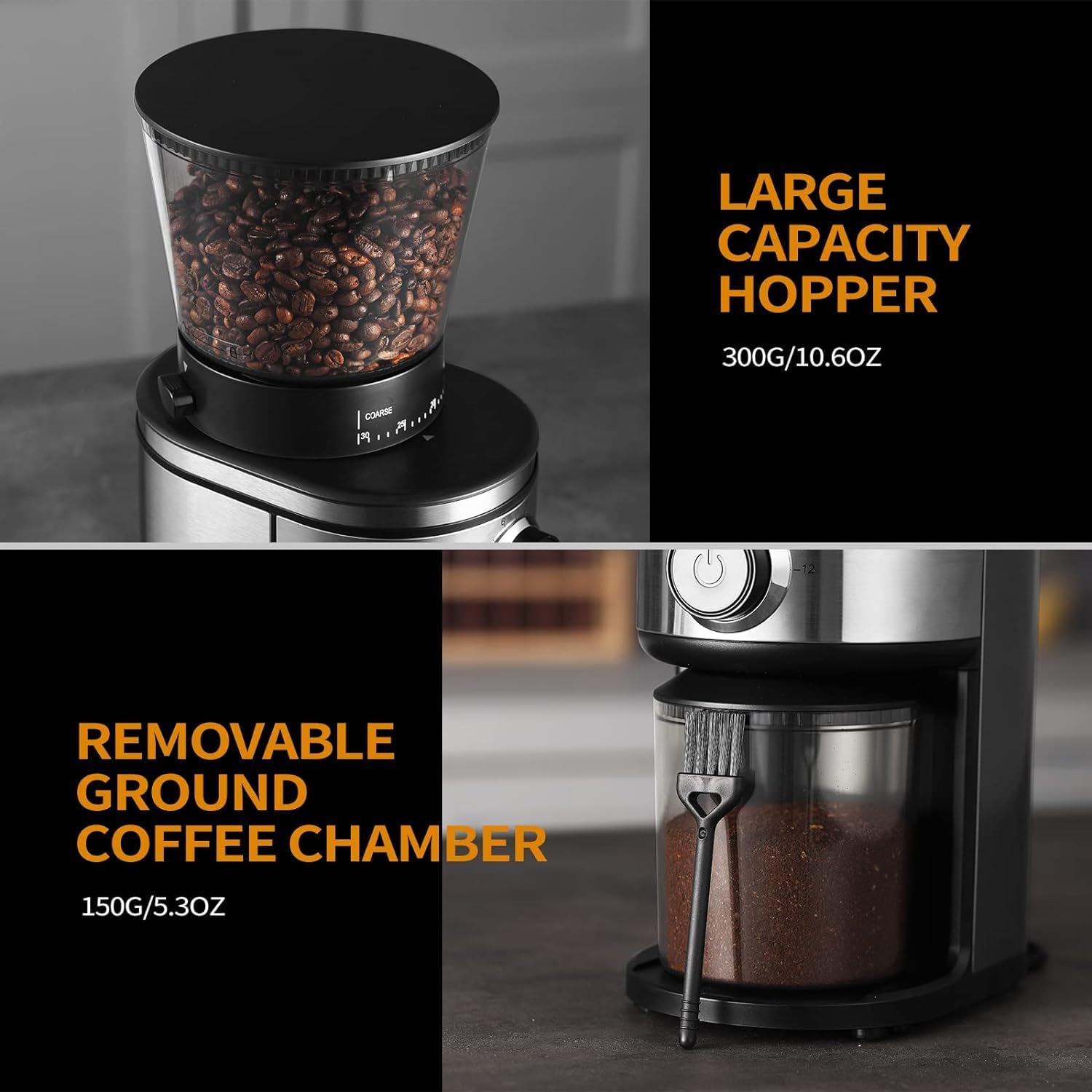
Capacity and workflow considerations shape daily usability: a 10-ounce hopper supports multiple servings without frequent refilling, while the 2–12 cup selector and rotary one-button operation aim to streamline dosing for casual users. Cleaning access is a critical workflow element—features such as an upper burr lift-off and included brush indicate attention to serviceability, making periodic removal of retained grounds feasible. Durability is supported by stainless steel burrs and the inclusion of safety mechanisms (clutch and thermal protection), but longevity also depends on maintenance frequency, avoidance of contaminants, and careful handling during disassembly. Buyers should weigh capacity needs against desired dosing precision and frequency of cleaning for optimal long-term performance.
Hopper capacity, dosing and serving flexibility
A 10-ounce bean hopper stores enough beans for several brew cycles and supports households that brew multiple cups per day. The 2–12 cup selector provides a simplified volumetric approach to output rather than weight-based dosing; this suits casual routines but lacks scale-level precision preferred by enthusiasts who dose by grams. For reliable consistency, users relying on cup counts should monitor bean age and grind retention between runs. For those who require gram-accurate dosing, combining the grinder with a separate scale for grounds is a practical workflow adaptation.
Cleaning, burr access and maintenance expectations
The grinder’s upper burr lift-off design and included brush meet common manufacturer guidance for routine maintenance: periodic removal of retained grounds, moderate vacuuming, and occasional deeper cleaning maintain particle distribution and prevent stale-oil buildup. Stainless steel surfaces are easy to wipe, but internal crevices require regular attention to avoid flavor transfer. The presence of a removable hopper and auto-locking mechanism simplifies emptying and storage, but users should follow recommended schedules for disassembly to preserve alignment and prevent excessive wear.
Materials, wear points and long-term reliability
Stainless steel burrs are resilient to normal wear and tolerate some adverse conditions better than ceramic burrs with respect to brittleness. Wear points to monitor include burr edge dulling over time, plastic or gearbox elements subject to stress under heavy loads, and seals or bushings that may degrade with frequent disassembly. The friction clutch and thermal protection decrease the risk of catastrophic failure from jammed material or thermal overload, improving the prospects for long-term use in a home environment when coupled with routine maintenance and careful operation.

Pros & Cons
Pros
- Broad grind range and indexed control: The 30 adjustable settings cover ultra-fine to coarse grinds, allowing use across pour-over, drip, immersion, and some fine-extraction applications. The indexed stops make returning to preferred settings straightforward for mixed-method households.
- Durable conical burrs: The 40 mm stainless steel burrs combine durability with reasonable grind consistency, supporting extended home use and resistance to chipping from incidental foreign particles.
- Low-heat design: Gear-reduction motor strategy reduces rotational speed and friction heat, which helps preserve volatile aromatics and supports clearer flavor profiles compared with high-speed blade systems.
- Safety features: Friction clutch and built-in overheating protection protect internal gears and the motor, reducing the risk of mechanical damage and increasing potential longevity.
- Practical capacity: A 10-ounce hopper accommodates multiple servings without constant refilling, and the 2–12 cup selector provides quick, user-friendly output options for casual routines.
- Serviceability: Upper burr lift-off and included cleaning brush enable routine maintenance and removal of retained grounds, which aids consistency and prevents stale buildup.
Cons
- Stepped adjustment limits micro-tuning: The 30-step indexed system simplifies repeatability but may not provide the fine incremental changes needed for precision espresso or narrowly tuned recipes, where stepless tuning is preferred.
- Cup-based output lacks gram precision: The 2–12 cup selector is convenient for casual users but does not replace a scale-based dosing workflow required by enthusiasts demanding exact extraction control.
- Potential for fines at coarser settings: Conical burr geometry can generate measurable fines at coarse settings, which may affect clarity for immersion methods unless settling or filtration strategies are applied.
- Throughput and noise trade-offs: Gear-reduction motors reduce heat but can result in slower grinding speed and perceptible mechanical noise compared with some high-RPM direct-drive designs, which may affect large-batch users.
Final Verdict: Who This Product Is Best For (and Who Should Skip It)
The Ollygrin BG702S-PG conical burr grinder is tailored to home brewers seeking a versatile grinder that balances grind range, capacity, and safeguards. Its 40 mm stainless steel burrs, 30-step indexing and 10-ounce hopper make it well-suited for households that prepare a mix of pour-over, drip, and immersion brews, and for users who value a lower-heat grind cycle to protect bean aromatics. The included safety systems and serviceable burr access match common home maintenance expectations and support steady long-term use when routines are followed.
This grinder is less appropriate for users whose primary focus is high-precision espresso or professional-level consistency. Competitive espresso work often requires stepless micro-adjustment, higher-resolution dosing, and professional-grade burr sets or motor assemblies. High-volume users who require rapid throughput may find the slower gear-reduction approach limiting. Overall, the Ollygrin fits the needs of small households and casual enthusiasts prioritizing versatility, aroma preservation, and user-friendly maintenance over boutique espresso-grade micro-adjustability.
Frequently Asked Questions (FAQs)
Is the Ollygrin BG702S-PG suitable for espresso at home?
The Ollygrin BG702S-PG offers a pathway to finer grinds through 30 indexed settings and 40 mm conical burrs, which can produce espresso-style grounds. However, stepped indexing can limit micro-adjustment precision compared with stepless specialty grinders. For consistent, high-precision espresso, machines and grinders designed with fine-stepless adjustment and café-grade burrs typically yield more repeatable results.
How does the gear-reduction motor affect grind temperature and flavor?
A gear-reduction motor reduces burr rotational speed, which lowers frictional heat during grinding and helps preserve volatile aromatics in the beans. This design choice supports brighter, more nuanced flavor retention compared with high-RPM blade grinders. Reduced thermal transfer is beneficial for household users grinding small to moderate batches.
Can the grinder handle multiple cups or medium gatherings?
The 10-ounce hopper and 2–12 cup selector provide practical capacity for multiple servings, making the grinder suitable for households and small gatherings. Throughput is oriented toward home use; for frequent large-batch grinding, users should account for slower grind cycles due to the low-speed gear-reduction motor and the need for occasional cool-down periods.
What cleaning and maintenance does the Ollygrin require?
Routine maintenance includes emptying and wiping the hopper, brushing retained grounds from the upper burr and grinder chamber, and periodic deeper cleaning following disassembly of the removable upper burr. The included brush and lift-off burr design facilitate access. Regular cleaning preserves grind consistency and prevents stale-oil buildup that can affect flavor.
Are there safety features to protect the motor and gears?
Yes. The Ollygrin lists a friction clutch to prevent damage if a hard object enters the burrs and built-in overheating protection to interrupt operation under excessive thermal load. These protections reduce the risk of mechanical damage and extend the unit’s operational life under normal home-use conditions.
How consistent are the grind results for pour-over and French press?
The 40 mm conical burrs and 30-step adjustment produce a balance of particle uniformity suitable for pour-over and drip methods, while delivering coarse settings adequate for French press. Conical burrs can generate some fines at coarse settings, so immersion brews may benefit from settling or filtration strategies to improve clarity.
Does the grinder require a scale for accurate dosing?
The grinder includes a 2–12 cup selector for volumetric output but does not provide weight-based dosing. Users seeking precise extraction control and repeatability are advised to use a separate scale for grounds. Combining scale-based dosing with consistent settings improves extraction consistency across sessions.