Amazon Basics Electric Coffee Grinder Review — Fit & Grind
Why Grinder Choice Matters for Home Brewing
Selecting a grinder shapes the extraction pathway for every cup prepared at home. Grind particle size distribution, heat transfer during grinding, and capacity directly influence brew ratios, contact time, and ultimately perceived balance and clarity. For households and casual home brewers seeking simple workflows, a compact electric blade grinder offers speed and versatility but introduces trade-offs in particle uniformity compared with burr systems. Understanding these trade-offs helps match the appliance to intended brewing methods — drip, pour-over, French press, or espresso — and sets expectations for post-grind adjustments like dose, grind time, and agitation. This review uses product specifications, construction details, and common user feedback to explain how the Amazon Basics Electric Coffee Grinder’s materials, capacity, and blade-based design will perform for typical home brewing needs without implying hands-on testing.
Quick Overview
| Feature | Details |
|---|---|
| Product category | Electric blade coffee grinder for home use |
| Grinding method | Heavy-duty stainless steel blade (blade grinder) |
| Capacity | 2.1 ounces (approximate bean capacity) |
| Speed claim | 30 grams ground in about 10 seconds for drip-sized volume (manufacturer disclosure) |
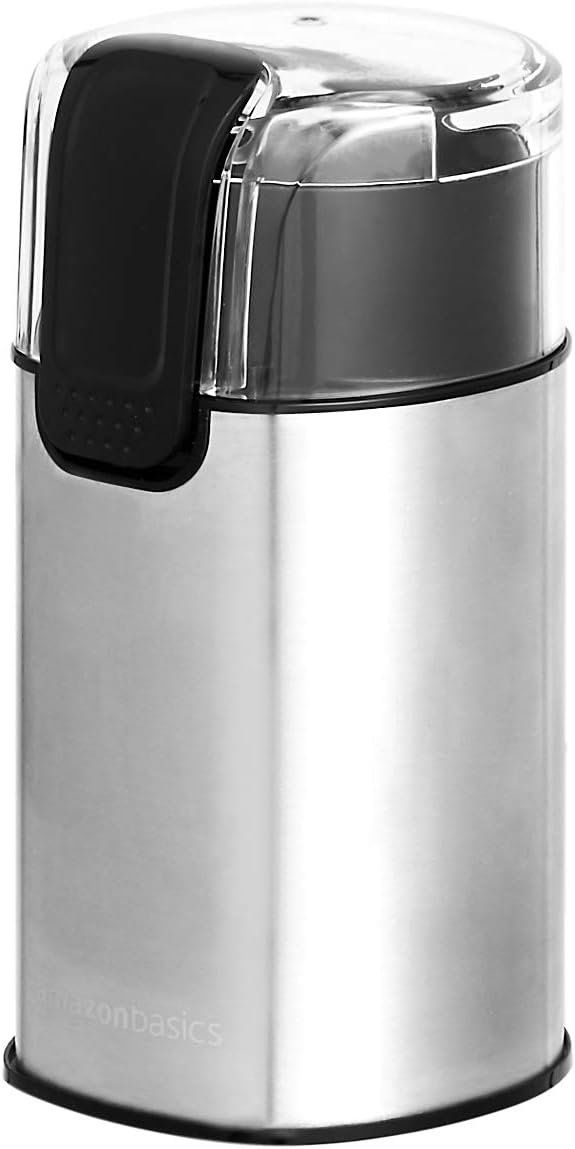
| Materials & construction | Stainless steel body and blade, clear safety lid |
| Power | 120 Volts (US operation) |
| Dimensions & weight | ~3.72″L x 3.5″W x 6.9″H; 1.54 pounds |
| Recommended uses | Coffee beans, herbs, spices, grains, nuts |
| Best suited users | Casual home brewers, households needing quick small-batch grinding |
The listed specifications indicate a compact, multipurpose blade grinder designed for small batches. Capacity and blade design favor quick preparation for one to a few servings, while stainless steel components offer basic corrosion resistance. The clear safety lid supports visual control during short grind cycles. These factors together suggest a unit optimized for convenience rather than precision-size control required by high-extraction brewing like espresso.

Brewing Method Compatibility
The Amazon Basics blade grinder aligns with common home brewing setups that tolerate broader particle distributions, such as drip coffee makers, press pots, and some immersion methods. Blade grinders chop beans with high-speed rotating blades, producing a range of particle sizes from fines to coarse fragments; this distribution interacts differently with brewing methods that rely on uniform flow and extraction. Pour-over and drip brewers can often accommodate slightly irregular grinds by adjusting dose, grind duration, or brew time. Immersion methods like French press are more forgiving of mixed particle sizes because extended contact time reduces the impact of small fines on perceived extraction. Conversely, espresso and other pressure-driven methods depend on narrow particle distributions to develop even resistance and consistent crema, making blade grinders generally unsuitable for those objectives.

Drip, Pour-Over and Automatic Brewers
Drip machines and many pour-over setups function with a range of particle sizes because the paper or metal filter and controlled water flow moderate channeling and extraction differences. With a blade grinder, the presence of both fines and larger fragments tends to speed extraction of smaller particles while larger ones extract more slowly, which can produce a cup that needs minor adjustments to grind time, dose, or water temperature to optimize clarity and balance. For pour-over specifically, using shorter pulse bursts and sieving larger fragments can help, while drip brewers typically handle the natural distribution with fewer workflow changes. The grinder’s quick cycle claim offers convenience for daily routines where speed is prioritized.
Not Ideal for Espresso or Turkish Coffee
Espresso demands a consistently narrow particle distribution to create uniform resistance under pressure; this grinder’s blade mechanism and lack of grind size control make achieving that distribution unlikely. The same applies to Turkish-style coffee, which requires extremely fine, uniform powder that blade grinders are not designed to produce. For pressure-based extraction, burr grinders with adjustable settings provide the necessary particle uniformity and repeatability. Buyers intending to pursue espresso or similar high-pressure preparations should consider appliances designed for micrometer-level grind adjustments rather than a blade system intended for coarse to medium grinds.
Grind Consistency and Extraction Quality
Grind consistency drives extraction kinetics: uniform particles yield predictable surface area exposure, enabling controlled dissolution of solubles and reproducible flavor balance. The Amazon Basics grinder uses a high-speed stainless steel blade that fragments beans rather than cutting them between two calibrated surfaces; this method inherently produces a wide particle size distribution, including fines that can over-extract and larger shards that under-extract. Extraction quality with such a profile relies on compensating adjustments — coarser target, shorter brew time, or altered agitation — depending on the brewing method. While this grinder can produce a beverage suitable for everyday consumption, precision-centric enthusiasts will notice variability in clarity, body, and bitterness relative to burr-grinder outcomes that optimize even extraction.

Blade Grinder Particle Profile
Blade grinders create a bimodal particle distribution characterized by a mix of fine dust and larger fragments. The rotational shear and impact produce irregular shapes and sizes rather than the uniform flakes or pellets produced by burr sets. This heterogeneity affects surface-area-to-volume ratios across particles, causing mixed extraction rates in a single brew. For methods sensitive to flow and pressure, such heterogeneity produces channeling, uneven resistance, and inconsistent extraction. For coarser, immersion-focused methods, the profile is less detrimental because longer contact time means the extraction differences among particles average out more effectively, though some sediment and muddiness can still occur.
How Particle Distribution Affects Extraction
Extraction is driven by mass transfer from coffee solids to water; particle size controls diffusion distance and surface area. Fines extract rapidly and can push a cup toward over-extraction and bitterness if not balanced by proportionally more under-extracted larger particles that contribute sourness or thinness. Achieving balanced extraction with mixed particle sizes requires adjusting brew ratio, temperature, and contact time to minimize extremes. Temperature stability and consistent agitation mitigate some inconsistencies by equalizing extraction across particle sizes, but intrinsic variability from blade grinding means repeatable, high-clarity results are more challenging than with burr grinders designed for narrow particle distributions.
Capacity, Workflow, and Ease of Use
Capacity and user workflow define how conveniently a grinder integrates into routine brewing. The stated capacity of about 2.1 ounces supports single- to small multi-cup preparations, making the unit appropriate for individuals, couples, or households that prepare one brew at a time. Compact dimensions and a one-button operation reduce complexity and speed up the morning routine, while the clear safety lid provides simple visual feedback to stop when the desired particle size is reached. However, the lack of stepped grind settings or precise timers means repeatability depends on operator control of pulse duration and visual inspection. For users prioritizing a low-friction workflow over granular grind-size tuning, the design is effective; for those requiring exact portioning for multiple simultaneous servings, larger-capacity or adjustable burr systems are more suitable.

Daily Capacity and Serving Flexibility
With a 2.1-ounce capacity, the grinder accommodates doses for one to three standard 8-ounce cups depending on roast density and desired strength. This fits routines where small batches are preferred or when single-serve freshness is prioritized. Larger households or those routinely preparing multiple pots will find the need to grind in several cycles, which impacts workflow and increases cumulative heat exposure to the beans. The compact size also limits the ability to grind whole-batch quantities for storage without multiple passes. For users who value freshest-possible grounds for single-brew servings, the capacity aligns well; for batch preparation, a higher-capacity alternative may be more efficient.
Controls, Safety Features, and Speed
Manufacturer disclosures emphasize a simple, single-action control and a clear safety lid for visual monitoring during operation. The high-speed blade enables rapid particle reduction; the claimed ten-second grind for a small dose demonstrates the appliance’s speed advantage for quick brewing cycles. Safety interlocks and lid visibility reduce the risk of operating the device with the cover off and allow users to stop grinding when the desired coarseness is achieved. The trade-off is control precision: without variable speed or stepped grind settings, achieving consistent outcomes requires repeated short bursts and user judgment. For straightforward, time-sensitive routines, the simplicity can be a benefit; for precision-dependent workflows, the limited controls may be a constraint.
Heat, Temperature, and Flavor Stability
Temperature behavior during grinding affects volatile aromatic retention and the chemical composition of the ground coffee. High-speed blade grinders convert mechanical energy into heat, which can raise bean temperature during rapid or multiple consecutive cycles. Elevated temperatures accelerate the loss of volatile aroma compounds and can slightly alter oil behavior on particle surfaces, impacting perceived flavor and crema formation where applicable. Because the Amazon Basics model is compact and designed for short, small-batch grinding, typical use patterns that favor brief pulses and intermittent cooling intervals can limit thermal buildup. Nonetheless, for maximal aromatic preservation, strategies that reduce frictional heating and maintain cooler bean temperatures are important when using high-speed blade designs.

Heat Buildup in Blade Grinding
Mechanical energy converted into heat is a function of blade speed, friction, and grinding duration. Blade grinders operate at higher tip speeds than many consumer burr grinders, increasing the potential for heat generation during sustained operation. The small capacity and rapid grind claim imply short cycle durations for typical doses, which mitigates prolonged exposure to heat. However, grinding multiple consecutive batches or attempting to grind large quantities in one run increases thermal transfer into the grounds, which can accelerate volatile loss and affect extraction character by slightly changing particle surfaces. Consumers aiming to minimize temperature effects should adopt short pulse techniques and allow brief cooling intervals for the device and beans between cycles.
Strategies to Preserve Aromatics and Control Temperature
To limit heat-related flavor changes, several practical approaches align with general coffee science: grind only what is needed immediately, use short pulse bursts rather than continuous runs, and allow a brief pause between cycles to dissipate heat. Cooling the grinder housing by intermittent pauses reduces cumulative thermal transfer into subsequent batches. Adjusting grind time to favor slightly coarser targets offsets the potential for over-extraction from produced fines. For households grinding repeatedly, selecting a separate burr grinder with lower tip speed or using chilled beans can provide additional thermal control, but within the blade-grinder paradigm, attention to grind duration and frequency is the most effective mitigation.
Cleaning, Maintenance, and Durability
Cleaning routine and materials inform longevity and hygiene. The Amazon Basics unit uses stainless steel for both the housing and blade assembly, which provides basic corrosion resistance and ease of wiping residues from external and internal surfaces. The clear lid simplifies inspection for trapped grounds. Regular removal of residual oils and particles prevents flavor carryover, while occasional deeper cleaning maintains consistent performance. Since blade grinders have fewer removable precision components than burr units, maintenance centers on wiping the chamber, carefully cleaning the blade assembly, and ensuring that the safety lid and motor vents remain free of obstruction. Aggregated user feedback typically emphasizes the importance of routine cleaning to limit stale oil buildup and to preserve operational reliability.

Cleaning and Maintenance Expectations
Routine cleaning involves emptying residual grounds after each use, wiping the chamber and lid with a dry or slightly damp cloth, and ensuring no moisture remains against metal parts. For herb and spice use, more thorough cleaning may be required to avoid cross-flavor contamination; this can include brief runs with rice or coarse salt to dislodge oils followed by full removal of residues. The sealed motor housing avoids immersion in water, so cleaning focuses on accessible surfaces only. Periodic inspection of the blade and lid for deformation or wear is advisable; if blades dull or the lid seal degrades, performance and safety can be affected. Users should consult manufacturer guidance for disassembly limits and safe cleaning methods.
Materials, Build Quality, and Longevity
Stainless steel construction offers durability advantages over plastic components, providing impact resistance and reduced susceptibility to staining from oils. The heavy-duty blade described in product disclosures indicates a focus on robust cutting elements, though blade grinders naturally experience wear over time. Motor longevity correlates with heat management and duty cycle: short bursts and avoidance of continuous heavy loads support longer life, while repeated large-batch grinding can stress the motor. Aggregated customer reviews and the unit’s bestseller rank within its category suggest acceptable reliability for typical home use, but long-term durability expectations should align with the appliance’s positioning as an entry-level, convenience-focused grinder rather than a commercial-grade device.
Pros & Cons
Pros
- Compact and easy to store: The small footprint and lightweight design make the grinder well suited to kitchens with limited counter space and for users who value quick storage after use. Its size facilitates single-serve grinding without occupying significant storage.
- Fast small-batch performance: High-speed blade operation enables rapid reduction of beans to grounds in short cycles, catering to time-sensitive morning routines and single-cup preparations where speed is prioritized over precision.
- Multipurpose capability: Manufacturer guidance and product materials indicate suitability for coffee beans, herbs, spices, grains, and nuts, making it a flexible appliance for multiple kitchen tasks beyond coffee grinding.
- Stainless steel construction: Metal body and blade components provide improved resistance to corrosion and staining compared with lower-grade plastics, contributing to a more durable finish and easier surface cleaning.
- Clear safety lid: Visual monitoring during short pulse cycles helps avoid over-grinding and supports simple user control without digital timers or complicated settings.
- Simple operation: One-button functionality reduces workflow complexity and lowers the learning curve for new users or those seeking minimal setup.
- Accessible replacement and purchase information: Widely available product listing and common ASIN identifiers facilitate parts lookup and consumer support interactions under standard manufacturer channels.
Cons
- Inconsistent particle size: The blade mechanism inherently produces a broad particle distribution, which limits extraction control and results in variability compared with burr grinders. This impacts clarity and repeatability for precision-focused brewing.
- Small capacity for batch brewing: The ~2.1-ounce chamber requires multiple cycles for larger servings, increasing cumulative grind time and potential heat exposure when preparing multiple pots.
- Limited grind control: Absence of stepped grind settings or adjustable burrs forces reliance on visual timing and pulse technique for repeatability, which can frustrate users seeking precise, reproducible grind sizes.
- Heat buildup potential: High-speed operation can raise bean and ground temperatures during extended use, accelerating aromatic loss if large batches are ground in continuous runs.
Final Verdict: Who This Product Is Best For (and Who Should Skip It)
The Amazon Basics Electric Coffee Grinder is best suited to casual home brewers, single-cup preparers, and households seeking a compact, multipurpose appliance for quick small-batch grinding. Its stainless steel blade and compact capacity align with needs for rapid convenience and occasional grinding of coffee, spices, and herbs. Users who prioritize simplicity, storage efficiency, and speed will find the straightforward one-button operation and clear safety lid helpful for integrating into daily routines without complex settings.
This grinder is not recommended for espresso-focused enthusiasts, high-volume households that grind full pots in a single session, or consumers seeking narrow particle distributions for precision extraction. For those users, a burr grinder with adjustable settings and larger capacity will deliver superior repeatability, temperature control, and extraction consistency. As a convenience-focused entry-level appliance, the Amazon Basics unit performs the intended role within the trade-offs inherent to blade grinding designs.
Frequently Asked Questions (FAQs)
Is a blade grinder suitable for drip coffee and pour-over brewing?
Blade grinders can be used for drip and many pour-over brews because these methods tolerate a range of particle sizes. However, blade grinding produces a mixture of fines and larger fragments that may require adjustments to dose, grind time, and water flow to achieve optimal clarity. Short pulse grinding and visual monitoring can help manage coarseness, but burr grinders deliver more consistent particle distributions for repeatable pour-over results.
Can this grinder produce espresso-quality grounds?
Producing espresso-quality grounds typically requires a narrow and uniform particle distribution, which is best achieved by burr grinders with adjustable settings. Blade grinders fragment beans rather than grinding them to uniform sizes, so achieving the precise resistance and extraction consistency needed for espresso is unlikely. For pressure-based espresso extraction, an adjustable burr grinder is the recommended option.
How much coffee can be ground in a single cycle?
Manufacturer specifications list a capacity of approximately 2.1 ounces for the grinding chamber. This supports single-cup to small multi-cup portions depending on dose and desired strength. Preparing larger quantities will require multiple cycles, which can increase total grinding time and may raise internal temperatures if performed consecutively without pauses.
What cleaning is required to prevent flavor carryover?
Routine cleaning includes emptying residual grounds after each use and wiping the chamber and lid with a dry or lightly damp cloth. For herbal or spice use, additional cleaning like brief runs with an inert carrier (e.g., rice) to dislodge oils, followed by thorough wiping, helps prevent cross-flavor contamination. Avoid immersing the motorized base in water and follow manufacturer guidance for safe cleaning practices.
Does the stainless steel construction improve longevity?
Stainless steel components offer improved resistance to corrosion, staining, and surface wear compared with many plastics, which can contribute to more durable external and internal surfaces. While stainless steel enhances robustness, mechanical wear of blades and motor strain depend on usage patterns; short, intermittent cycles and avoiding continuous heavy loads support longer operational life.
How does heat from grinding affect flavor?
High-speed grinding converts mechanical energy into heat, which can elevate bean and ground temperatures during sustained operation. Increased temperature accelerates the loss of volatile aroma compounds and can alter perceived flavor. Mitigation includes short pulse bursts, grinding only the needed dose, and allowing pauses between cycles to reduce cumulative heat transfer into the grounds.
Who should consider alternatives to this grinder?
Consumers who prioritize precise, repeatable grind settings—such as espresso enthusiasts or professional-style brew methods—should consider burr grinders with adjustable settings. Likewise, high-volume households that grind large quantities regularly may prefer higher-capacity machines designed for continuous duty. Alternatives provide narrower particle distributions, stepped adjustments, and often better heat management for precision extraction.