Amazon Basics Glass Electric Kettle — Fast Boil, Home
Why choosing the right kettle matters for home brewers
Selection of an electric kettle shapes the fundamentals of both tea and coffee preparation at home. Water temperature, speed of boil, material interaction with water, and safety systems influence extraction, aroma release, and ease of routine brewing. For households that prepare multiple cups per session or switch between fragile teas and pour-over coffee, a kettle that heats quickly, resists off-flavors, and shuts off reliably reduces variability in brew outcomes. The Amazon Basics Glass Electric Kettle targets everyday users who prioritize fast boil times, visible water levels, and straightforward operation. Its glass carafe and stainless-steel elements alter heat transfer and retention compared with all-metal designs, while the inclusion of a Strix thermostat reflects a widely recognized approach to precise shut-off control. Understanding how those features align with brewing methods and maintenance expectations helps determine whether this kettle supports consistent extraction across tea types and basic coffee techniques, or whether a variable-temperature model is a better long-term choice.
Quick Overview
| Feature | Details |
|---|---|
| Product category and brewing method | Electric kettle for boiling water; suitable for tea, instant beverages, and basic pour-over or French press workflows |
| Capacity and output | 1.7 liter capacity; 1500W heating element for relatively fast boil times |
| Materials and construction | Glass carafe with plastic and stainless-steel components; BPA-free water-contact materials |
| Heating and safety system | 1500W concealed heating element with Strix thermostat, automatic shut-off, and boil-dry protection |
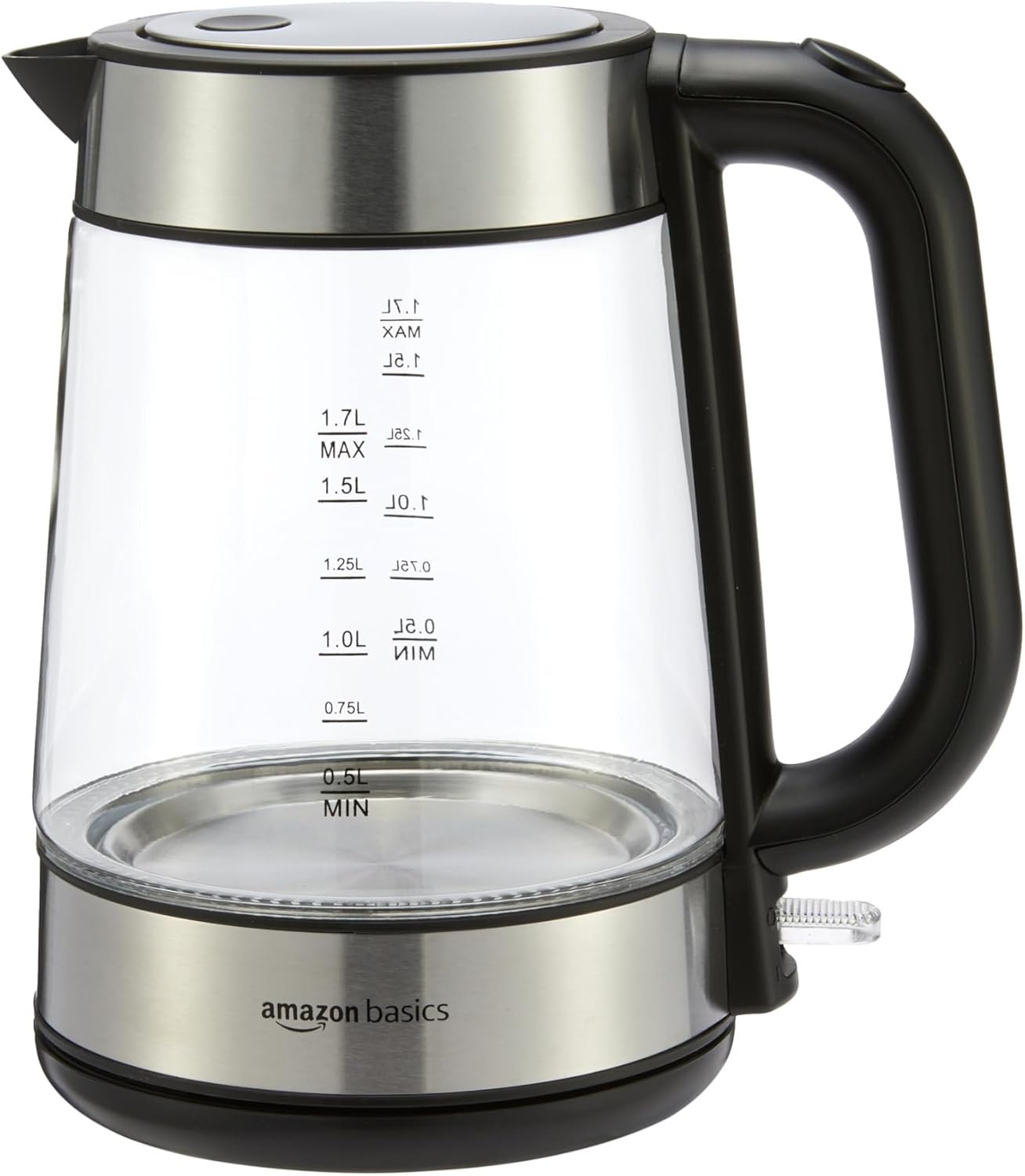
| Filter and spout | Built-in spout design; wide opening for filling and cleaning; water level indicator on carafe |
| Best suited users | Households, casual tea drinkers, basic pour-over and French press coffee users, buyers seeking visible water level and simple operation |
| Intended use cases | Boiling water for tea kettles, steeping tea, pour-over preheating, instant beverages, and basic brewing tasks |
| Included components and care | Kettle and kettle bottom (power base); handle stays cool to the touch; hand wash and wipe clean recommended |
This summary isolates the specifications that most directly affect brewing and usability: glass construction and a 1.7 liter capacity influence heat retention and serving size, the 1500W element defines heat-up speed, and Strix thermostat plus boil-dry protection manage safety. Those elements together create a straightforward tool for hot-water tasks but do not provide variable-temperature control needed for precise tea varietals or specialty coffee extraction.

Brewing method compatibility
The kettle’s primary decision factor is whether boiling-only water delivery fits the intended brewing methods. For robust techniques that accept near-100°C water—such as black tea steeping, French press coffee, and quick pour-over preheating—this kettle provides the required thermal input and a large enough batch size for multiple servings. Sensitive green and white teas, along with many specialty coffee brewing recipes that call for 85–95°C, are less well-served because the product lacks adjustable temperature settings or a hold function; water will reach boiling and the Strix thermostat will cut power once boiling is detected. Users relying on precise temperature staging or low-temperature infusion will need either a thermometer and time-managed cooldown method or a dedicated variable-temperature kettle to meet repeatable extraction targets without overshooting sensitive compounds in tea or coffee.

Tea types and steeping compatibility
The design favors steeping workflows that require boiled water or near-boil start temperatures. For robust black teas, oolong infusions that tolerate hotter starts, and herbal tisanes, boiling water from a glass carafe is appropriate and will encourage full flavor and tannin extraction. Delicate green and white teas commonly require lower temperatures to avoid vegetal bitterness and muted aroma; those will need cooling from the boil to reach optimal steeping ranges. Lacking a built-in temperature selection or hold mode, the kettle requires users to rely on passive cooling, pour-off techniques, or separate temperature-measurement tools to align water temperature with delicate steeping recommendations.
Coffee workflows (pour-over, French press, instant)
For foundation-level coffee workflows, the kettle supports French press and many pour-over approaches by delivering near-boil water quickly and in adequate volume for multiple cups. The 1.7 liter capacity accommodates several 300–500 milliliter brewing batches, while the wide opening simplifies refilling for sequential pours. Precision-focused pour-over recipes that require specific temperature control or slower pour timing benefit from kettles with temperature presets or narrow gooseneck spouts; this model’s spout geometry and lack of temperature control will still work for basic pour-over routines, but achieving repeatable extraction targets depends on user technique, timing, and external temperature measurement rather than on kettle-driven control.
Temperature control and heat stability
Temperature management is a central buyer consideration when targeting consistent extraction. This Amazon Basics kettle uses a 1500W concealed heating element to reach boil quickly and a Strix thermostat to detect boiling and trigger automatic shut-off. The appliance does not offer variable-temperature presets, precise hold functions, or active temperature regulation after shut-off; therefore, heat stability is limited to the thermal properties of the glass carafe and residual heat behavior. Glass tends to lose heat faster than double-walled or insulated stainless-steel designs, so brewed water will cool more rapidly after boiling. For users requiring narrow temperature bands for tea varietals or specialty coffee extraction, external temperature checks or staged cooling will be necessary to maintain repeatable brew temperatures.

Role of the Strix thermostat and safety cut-off
The Strix thermostat is a common control component known for reliable boil detection and accurate shut-off behavior. In practice, that translates to consistent termination of heating at or near the boiling point, which reduces the risk of overheating beyond steam-boil conditions. The included boil-dry protection prevents operation without sufficient water, protecting the heating element from damage. These systems do not maintain setpoint temperatures; they prioritize safety and end-of-heat detection rather than temperature precision. For users prioritizing stability for steeping tea or moderating pour-over extraction, the thermostat provides safe operation but not active thermal management.
Heat retention and implications for workflows
Glass carafes promote visual clarity but have lower insulating performance than double-walled or insulated stainless steel. That results in faster temperature drop after shut-off, meaning sequential brews may require reheating or faster execution to keep water near desired temperatures. A 1.7 liter capacity allows larger batches so a single boil can serve multiple cups without reheating, but cooling between pours will be more pronounced than in insulated kettles. For workflows where a steady hold temperature is important—such as multiple back-to-back pour-overs or long steeping periods—expect more rapid decline in water temperature and plan brewing steps accordingly.
Ease of use and everyday workflow
Operational simplicity influences adoption and daily workflow efficiency. The product emphasizes rapid boil capability, a wide fill opening for easier water handling, a visible water level indicator for measuring, and a handle designed to stay cool for comfortable pouring. The illuminated boil indicator provides a visual cue during heating. The included kettle bottom (power base) is part of the package and supports placement on a countertop without tethering the carafe. The design choices favor users who prefer a straightforward plug-and-boil routine rather than stepped brewing sequences with temperature profiles. Ease-of-use benefits are balanced by the absence of temperature presets and potential handling considerations related to glass weight once filled to capacity.

Filling, pouring, and measurement workflow
The wide opening simplifies filling from the tap and allows access for cleaning implements or descaling brushes, while the water level indicator enables users to align volume with brew ratios before heating. The cool-touch handle reduces the need for mitts when pouring, and the illuminated element provides a clear in-progress signal. Without variable heat controls, workflow for precision applications must include manual cooling or transfer into pre-warmed vessels to reach target temperatures. For everyday tea and quick coffee tasks, these ergonomics reduce friction and support repeatable, efficient preparation.
Portability, base, and countertop placement
The kettle ships with its power base (listed as kettle bottom), enabling placement on a flat surface and connection to mains power without additional assembly. Weight when filled is a practical consideration: a full 1.7 liter carafe is heavier to lift and pour than smaller kettles, so countertop clearance and stable placement are important. Users seeking dedicated gooseneck pour control or compact travel kettles should evaluate whether the size and spout profile align with the intended brewing technique and kitchen storage arrangements.
Capacity and serving flexibility
Capacity determines single-batch serving count and how often reheating is required. At 1.7 liters, the kettle supports multiple standard servings for households, making it suitable for families, small gatherings, or multiple sequential cups during a morning routine. The volume supports common coffee brew ratios—for example, a 1:15 to 1:17 coffee-to-water ratio for batch pour-over—while still allowing extra for rinses or pre-wetting filters. However, full-capacity boils will take longer than partial fills and the glass carafe’s thermal dynamics mean larger volumes retain heat longer than smaller amounts; this becomes a trade-off between desired serving count and desired access to water at specific temperatures for delicate brewing tasks.

Matching capacity to brew ratios and serving counts
A 1.7 liter capacity translates to roughly five to seven standard 8-ounce servings, depending on cup size, which is convenient for multitask mornings or guests. For pour-over batching, the capacity allows larger single-batch pours that minimize reheating interruptions. Conversely, small single-serve brewing benefits less from large capacity: heating a partial fill is faster but loses some efficiency in the kettle’s overall energy use. Users planning to brew one to two cups at a time should consider the balance between convenience and the effort or waste associated with heating a fraction of the total capacity.
Practical considerations for sequential brewing
When preparing multiple consecutive brews, capacity reduces the need to reboil between cups, but the lack of a keep-warm function means water temperature will gradually decline. For continuous service across an hour or more, periodic reheats will be necessary to maintain optimal steeping temperatures. The wide opening and visual level gauge make topping up straightforward, but users aiming for tightly controlled sequential extractions should plan pour timing or accept a degree of thermal drift across servings.
Cleaning, maintenance, and long-term care
Material choice and access features determine cleaning ease and limescale management. The glass carafe and wide opening support visual inspection for mineral scale and allow access for manual scrubbing or descaling solutions. Because the kettle operates by boiling natural water, scale accumulation is a common long-term maintenance expectation in hard-water areas; routine descaling helps preserve heating efficiency and prevents off-flavors. Water-contact materials are listed as 100% BPA-free, which reduces concerns about plastic leachates where plastic components exist, but structural points—like the spout mesh, lid fit, and base seal—require periodic attention to preserve performance and hygiene.
Descaling and interior cleaning procedures
Regular descaling using manufacturer-recommended agents or common household descalers (citric acid or vinegar solutions, when appropriate) will mitigate scale buildup and maintain heating efficiency. The wide mouth eases access for brushes and sponges; however, submerging the base is not advised because the electrical components live in the included kettle bottom. Hand washing and wiping down exterior surfaces are recommended. Users in high-mineral regions should expect to descale more frequently to avoid performance decline or premature component wear due to scale on the concealed heating element.
Glass care and breakage considerations
Glass carafes offer visual benefit but require careful handling to avoid chipping or cracking, particularly at stress points near the spout or rim. Sudden thermal shock—pouring freezing-cold water into a hot carafe or moving a full hot carafe onto a cold surface—can increase breakage risk. The product lists a glass finish type and instructs hand wash and wipe clean; therefore, gentle handling during cleaning and storage will preserve longevity. Replacement parts or warranty coverage are governed by manufacturer policy, so buyers should confirm support options when prioritizing long-term resilience.
Durability, materials, and reliability features
Long-term reliability is influenced by construction materials, control components, and typical user maintenance. The combination of glass carafe, stainless-steel elements, and plastic components balances durability and cost-effectiveness. The presence of a Strix thermostat is a notable reliability signal because Strix devices are widely used for their robust detection and shut-off performance. Boil-dry protection guards the heating element against damage if operated with low water levels. Nonetheless, plastics attached to handles or spouts may show wear over time with repeated heating cycles, and glass remains vulnerable to impact. Regular descaling and careful handling support longer service life; users should consider the balance between visual glass benefits and the mechanical durability of alternative all-metal or insulated designs.
Common longevity themes and recurring issues
Aggregated user feedback for similar glass electric kettles typically highlights fast initial performance and satisfaction with safety cut-offs, alongside recurring themes such as mineral scale buildup, occasional lid or spout alignment concerns, and sensitivity of glass to impact. Maintenance frequency in harder water areas often correlates with longevity of the heating element and interior surfaces. The Strix thermostat and boil-dry protection reduce the risk of catastrophic failure, but normal wear of plastic seals and external finishes may require replacement or extra care over time.
Safety features and material interactions
Safety features—automatic shut-off on boil detection and boil-dry protection—are key to reducing misuse-related damage. BPA-free water-contact materials address chemical safety concerns where plastics touch hot water. Stainless-steel contact points reduce corrosion risk, while glass avoids metal taste transfer in many cases. Safety remains a function of correct operational use, routine maintenance, and avoidance of mechanical impact to the carafe.
Pros & Cons
Pros
- Rapid heating performance driven by a 1500W concealed element enables quick boiling, reducing wait times for multiple cups and supporting efficient morning workflows. The power level is appropriate for typical household mains supply and provides predictable time-to-boil when starting from tap temperature.
- Strix thermostat and boil-dry protection provide reliable end-of-boil detection and safety cut-off, lowering the risk of overheating and protecting the heating element from operation without sufficient water.
- Glass carafe construction delivers full visibility of water level and clarity of water condition, aiding measurement accuracy and allowing easy visual checks for limescale or impurities before brewing.
- 1.7 liter capacity supports multiple servings per boil, making the kettle suitable for families, small groups, or sequential brewing without repeated reboils for each cup.
- Wide opening simplifies filling, access for cleaning, and manual descaling, improving convenience compared with narrow-neck kettles that restrict interior access.
- BPA-free water-contact materials reduce concerns about plastic chemical exposure when heating water for beverages and contribute to perceived safety for potable use.
- Cool-touch handle and illuminated boil indicator enhance daily usability, offering comfortable pouring and clear feedback during operation without complex controls.
Cons
- No variable-temperature control or hold function limits suitability for delicate tea varietals and specialty coffee brewing that require temperatures below boiling or precise temperature staging; users must cool boiled water manually for those applications.
- Glass construction, while visually transparent, is more susceptible to impact damage than stainless-steel alternatives and requires careful handling during use and cleaning to avoid chips or cracks.
- Heat retention is weaker compared with insulated kettles; water cools faster after boil due to single-wall glass, which can necessitate reheating for later servings or longer brewing sessions.
- Mineral scale buildup is an expected maintenance need in hard-water areas; regular descaling is required to preserve heating efficiency and prevent off-flavors, adding ongoing upkeep compared with scale-resistant models.
Final Verdict: Who This Product Is Best For (and Who Should Skip It)
The Amazon Basics Electric Kettle with glass carafe is a practical choice for households and casual brewers who prioritize a clear-view carafe, straightforward operation, safety features, and a larger batch size for multiple servings. Its 1500W element and Strix thermostat support fast boiling and consistent safety-related shut-off, making it well-suited to black tea steeping, herbal infusions, French press coffee, and basic pour-over batching where near-boil water is acceptable. The wide opening, visible water gauge, and BPA-free materials contribute to an uncomplicated daily routine for those who value speed and simplicity over specialty features.
Buyers who should avoid this model include users who require precise temperature control for delicate green or white teas and specialty coffee that depends on tight temperature bands, as the kettle does not offer variable presets or a temperature-hold function. Likewise, those prioritizing maximum heat retention or rugged impact resistance may prefer insulated stainless-steel or dedicated gooseneck models. For general household use where rapid boiling, safety cut-offs, and ease of cleaning are priorities, the product delivers a balanced combination of features without the complexity of professional-grade temperature control systems.
Frequently Asked Questions (FAQs)
Is this kettle suitable for brewing delicate green tea?
This kettle boils water quickly and shuts off at boiling, which is appropriate for robust teas but not ideal for delicate green teas that require lower temperatures. Without a variable-temperature or hold function, users should allow the boiled water to cool to the recommended temperature range for green tea or use a thermometer to ensure repeatable steeping conditions.
Can this kettle be used for pour-over coffee techniques?
The kettle supplies near-boiling water and has a 1.7 liter capacity suitable for batch pour-over or French press routines. While it lacks a narrow gooseneck spout or temperature presets preferred by precision pour-over brewers, it is adequate for basic pour-over workflows where users manage pour speed and temperature manually.
How should mineral buildup be managed in this glass kettle?
Regular descaling is recommended in areas with hard water. The wide opening enables access for cleaning and descaling solutions such as citric acid or manufacturer-approved agents. Periodic descaling preserves heating efficiency and prevents off-flavors by removing scale from the concealed heating element and interior surfaces.
Does the kettle maintain water at a set temperature?
No. The kettle features a Strix thermostat that detects boiling and triggers automatic shut-off, but it does not include temperature presets or a keep-warm function. Heat retention depends on the glass carafe’s thermal properties; water will cool more rapidly than in insulated kettles.
Are the water-contact materials safe for hot beverages?
Water-contact materials are listed as 100% BPA-free, which addresses common concerns about plastic exposure during heating. Stainless-steel components and glass interior surfaces minimize the potential for off-flavors associated with some plastic parts.
What safety protections are included with this kettle?
The kettle includes automatic shut-off via a Strix thermostat when water reaches boiling and boil-dry protection that disables heating if insufficient water is present. These features help prevent overheating, reduce the risk of damage to the heating element, and enhance user safety during typical operation.
Is the glass carafe fragile compared with metal kettles?
Glass carafes provide visual clarity but are more susceptible to chips, cracks, or breakage from impact compared with stainless-steel designs. Careful handling, avoiding thermal shock, and following manufacturer care instructions are recommended to reduce the risk of damage.

![AmuseWit Gravity Electric Pepper and Salt Grinder Set of 2 [White Light] Battery Operated Automatic Pepper and Salt Mills with Light,Adjustable Coarseness,One Handed Operation,Black](https://perfectbrewpicks.novicelinks.com/wp-content/uploads/2024/08/B07S2YFFP3_MAIN-300x263.jpg)