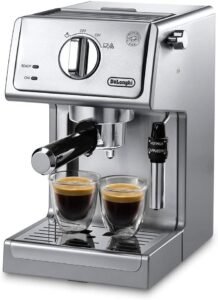
20-Bar Compact Espresso Machine Review: Brew & Steam Guide
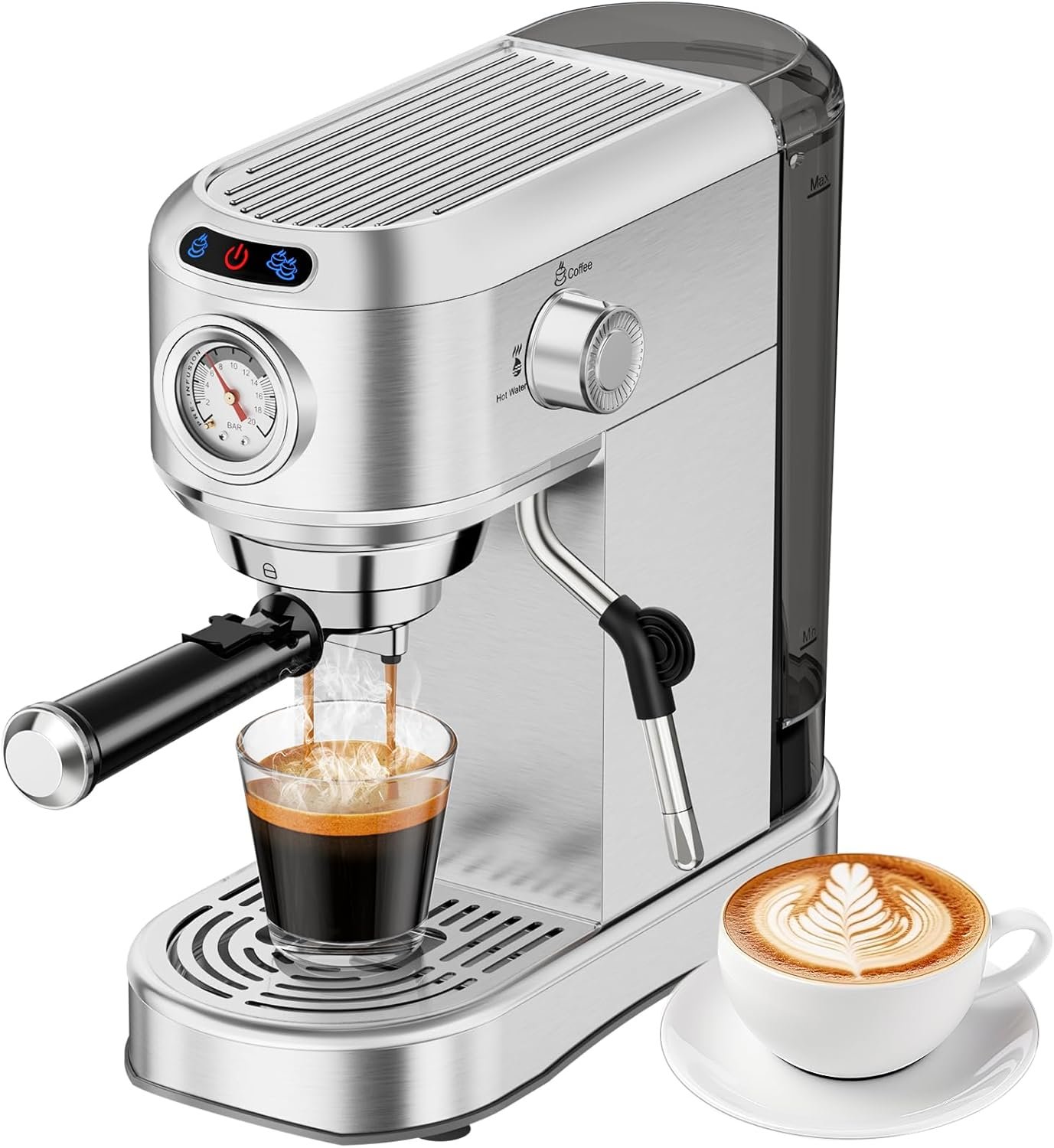
Choosing the Right Compact Espresso Machine
Selecting an espresso machine for home or small-office use hinges on matching brewing goals with machine capabilities. For users prioritizing espresso-based drinks, a semi-automatic pump machine with a steam wand and removable reservoir can offer the balance of control and convenience suited to lattes, cappuccinos, and short espresso shots. Compact footprint and stainless steel construction influence kitchen fit and durability, while included accessories—portafilter, single/double baskets, and tamper—affect workflow and consistency. Pressure ratings, heating power, and clear manufacturer guidance on cooldown procedures inform expectations around extraction quality and duty cycle. Buyers who measure performance by shot consistency, temperature stability, and the ability to produce microfoam should review pump specifications, heating elements, and user workflow. Ease of cleaning and maintenance also affects long-term value, particularly for daily use in households or small shared spaces. This review focuses on how the product specifications and design choices align with brewing science principles—grind and dose control, extraction, temperature, pressure, and milk texturing—so decision-making is grounded in appliance characteristics rather than experiential claims.
Quick Overview
| Feature | Details |
|---|---|
| Product category / brewing method | Semi-automatic espresso machine with steam wand (espresso + milk-based drinks) |
| Pressure & heating | 20 bar pump; 1450 W motor/heating system (manufacturer-stated) |
| Water capacity | 34 oz removable water tank |
| Construction & materials | Stainless steel exterior with ABS components; countertop form factor |
| Portafilter & filters | Includes portafilter, single and double cup filters |
| Accessories included | Tamper with spoon, instruction manual |
| Capacity / form factor | Compact; listed capacity 2.1 pounds (manufacturer specification); item weight 3.94 kg |
| Intended users & use cases | Home baristas, small offices, users who want milk-based drinks |
| Warranty | Not specified by manufacturer |
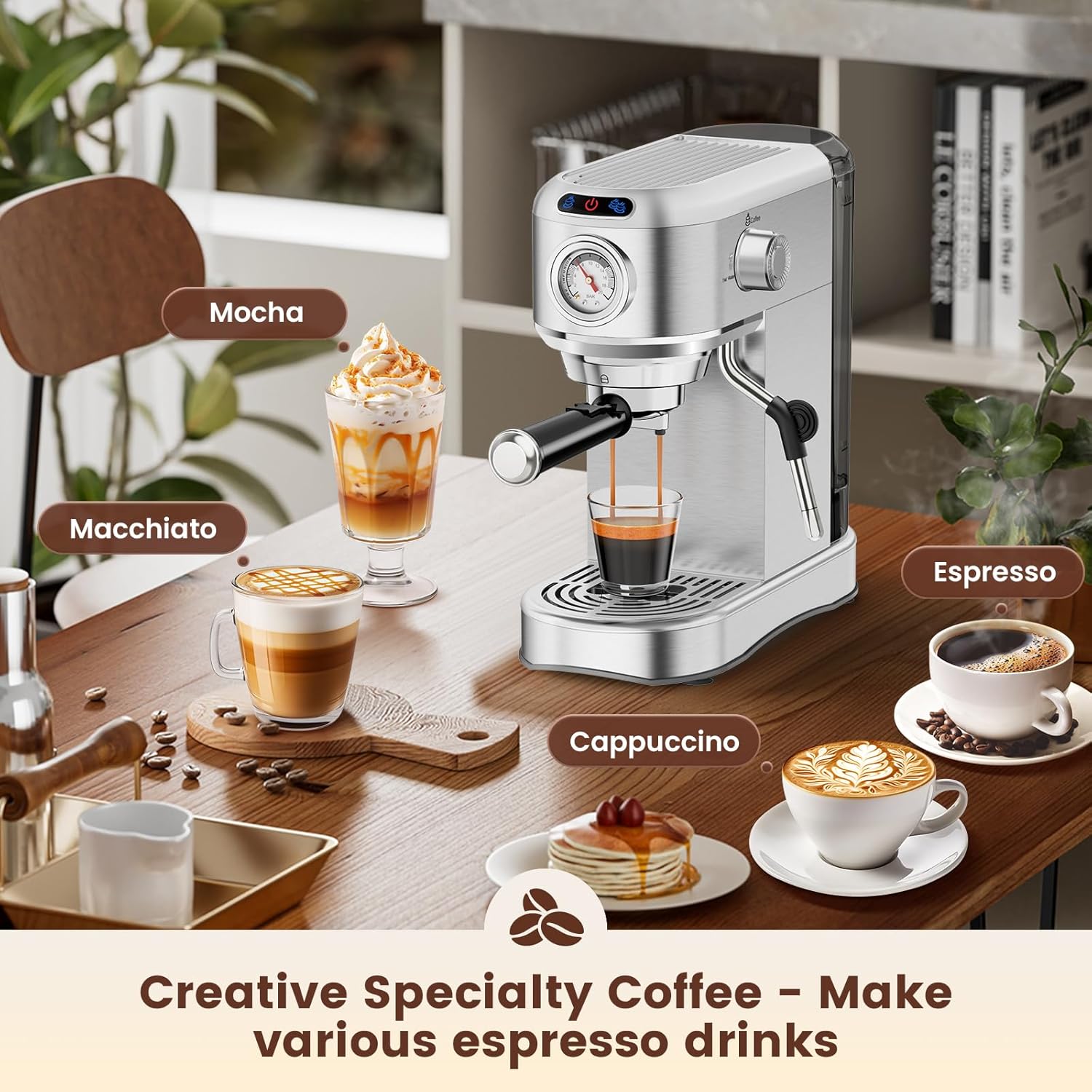
The combination of a 20-bar pump, removable 34 oz reservoir, and basic portafilter accessories indicates a semi-automatic workflow that supports traditional espresso extraction and manual milk frothing. Stainless steel surfaces aid heat retention and durability, while the compact footprint prioritizes counter space. These features collectively shape shot consistency, temperature recovery between steaming and brewing, and day-to-day usability for households or shared-office settings.
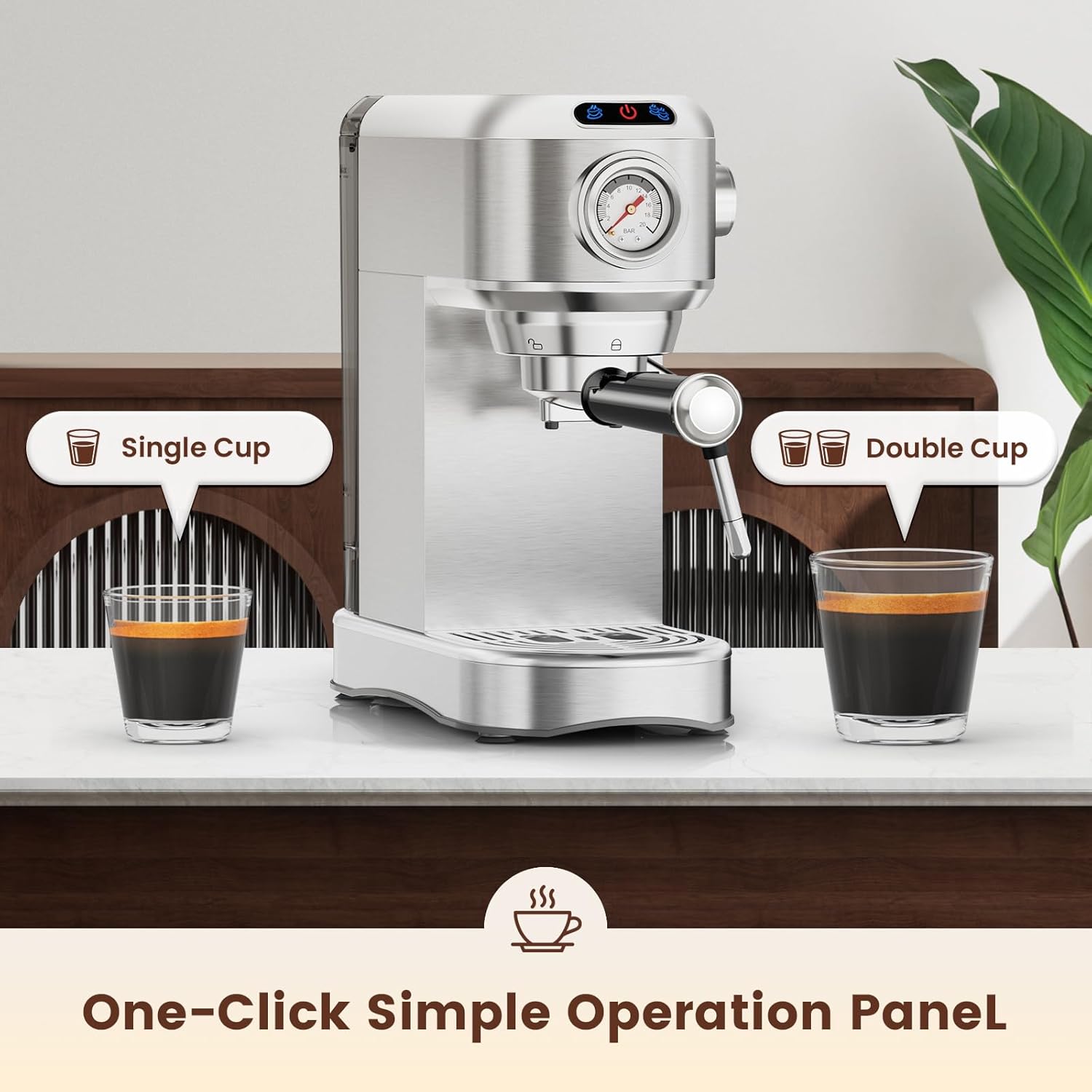
Extraction, Grind Compatibility, and Brewing Method
The machine’s semi-automatic design and portafilter with single/double filters make it compatible with espresso-style brews that rely on fine grind, accurate dosing, and consistent tamping. Grind consistency is the primary controllable variable for achieving target extraction; a uniform fine grind reduces channeling and supports even flow through compact filter baskets. Dose and tamping pressure influence contact time and flow rate, which are central to achieving appropriate extraction and crema development. The included double cup filter enables higher total dose for paired servings, while the single basket supports classic single-shots. Filter basket volume and portafilter diameter impose practical limits on maximum dose, so users seeking higher-volume extractions or alternative methods (e.g., pour-over) will need separate equipment. Overall, the machine’s design aligns with espresso preparation principles where grind, dose, tamp, and water pressure combine to determine extraction quality.
Grind Size, Consistency, and Recommended Burr Types
Espresso extraction with a compact semi-automatic machine benefits from a consistent, fine grind produced by a quality burr grinder. Blade grinders tend to produce a wide particle distribution that increases the risk of over- or under-extraction; by contrast, conical or flat burr grinders yield a tighter particle-size distribution that supports predictable flow rates and crema. Because the portafilter and basket volumes are constrained, small changes in grind or dose significantly affect extraction time and flow. Users targeting 25–30 second total extraction times for a typical espresso ratio should adjust grind in small increments and note flow behavior. For best results, pair the machine with a dedicated espresso burr grinder that allows precise dialing-in of particle size and distribution.
Dose, Tamping, and Flow Control for Consistent Shots
Consistent dosing and even tamping are critical to controlling flow rate and avoiding channeling during extraction. The included tamper and double/single baskets provide the basic tools for dose control, but the absence of a pressurized—or PID-controlled—brew group means manual technique will heavily influence shot consistency. A consistent dose, leveled distribution, and a flat, uniform tamp promote even water distribution across the puck. Given the 20-bar pump specification, pressure is available to drive extraction; however, actual extraction results depend on flow restriction from grind and tamp. Paired with proper dose and tamp practices, the machine can produce concentrated extractions and deliver crema consistent with typical espresso science expectations.
Pressure System, Pump Performance, and Steam Wand
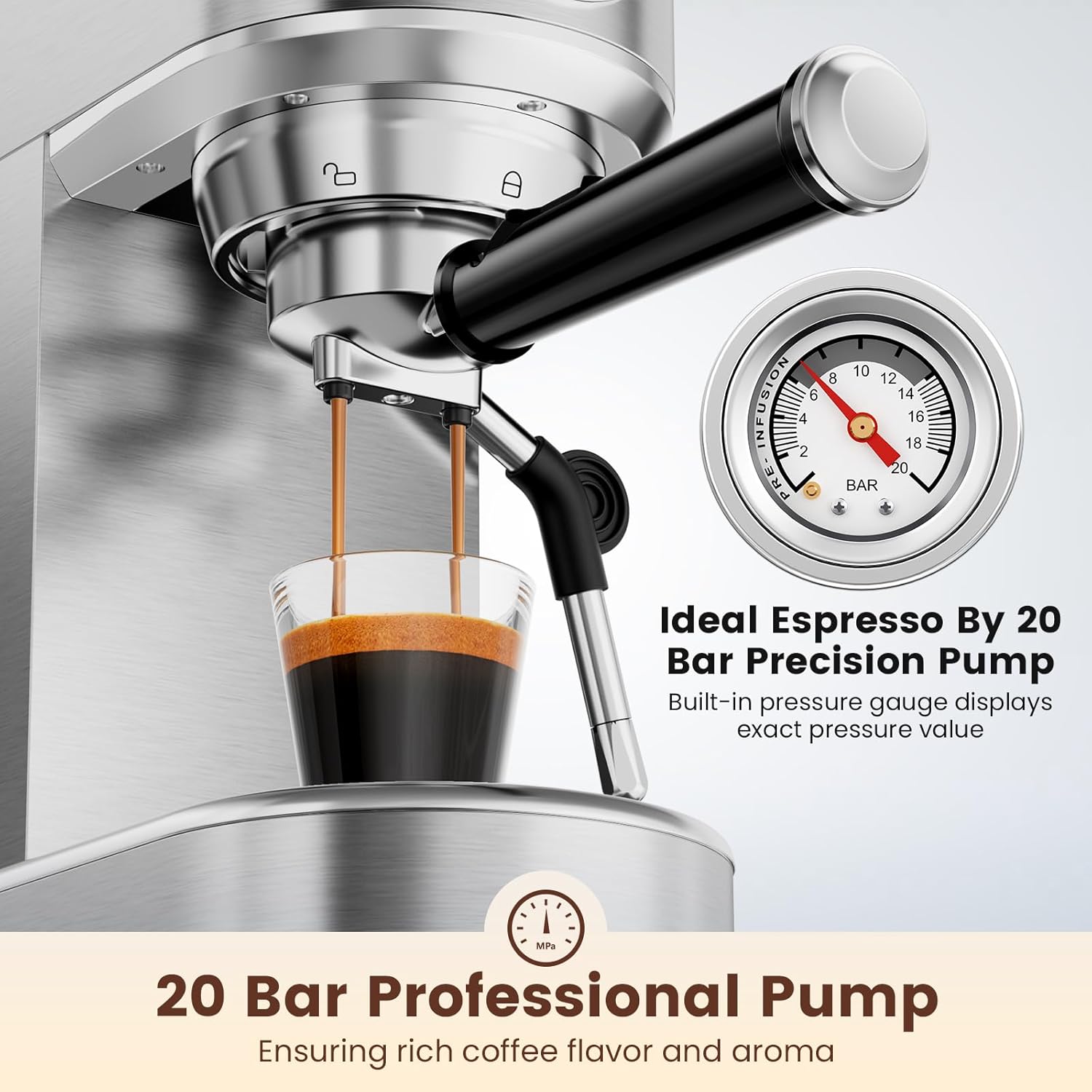
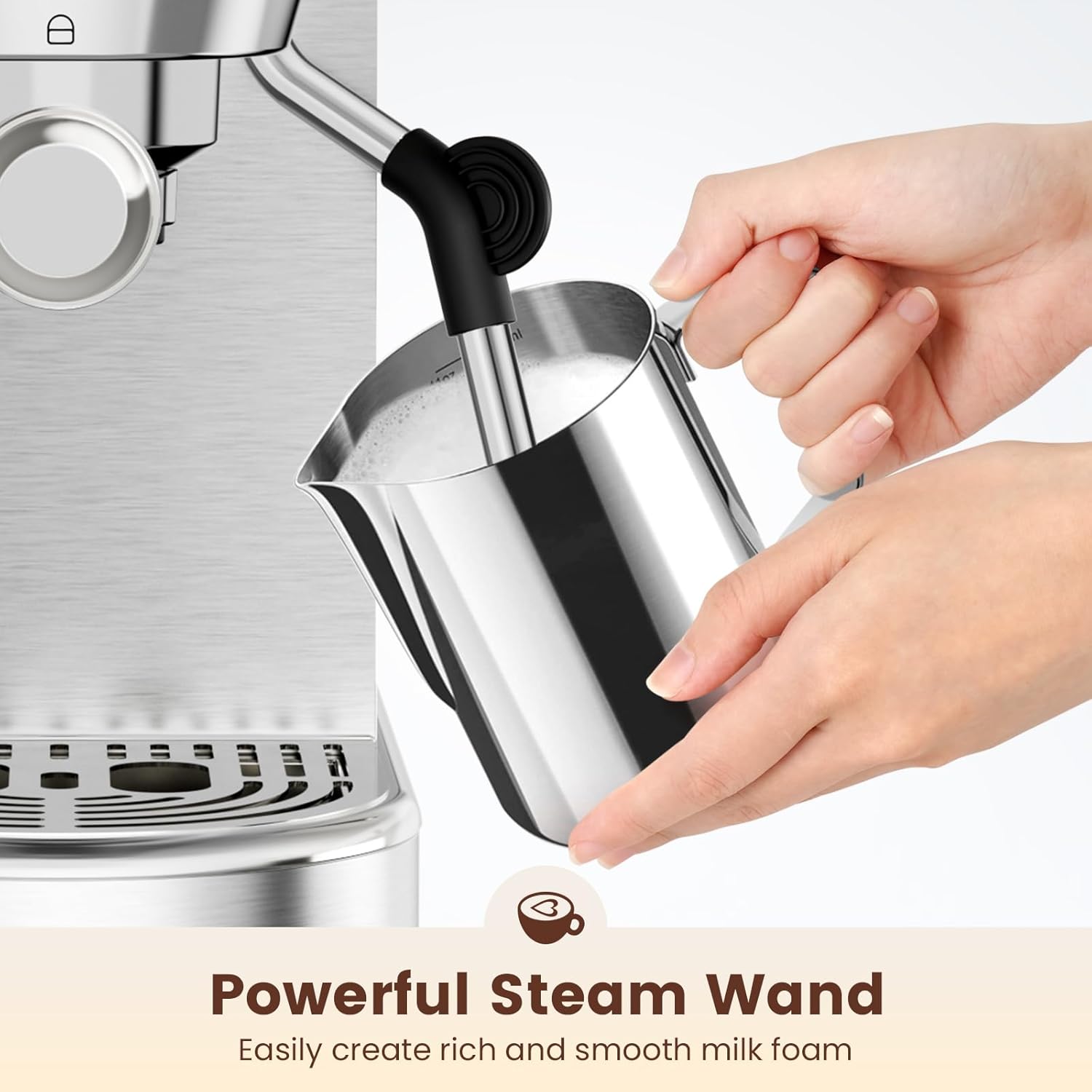
The manufacturer-stated 20 bar pump rating and 1450 W power specification describe peak pump capability and heating capacity rather than continuous brewing pressure delivery. In espresso extraction, effective pump pressure during shot pull typically ranges between 8–10 bar through the puck; higher numerical pump ratings are common marketing conventions to indicate robust pumping capability. The steam wand relies on the machine’s steam generation capacity and the boiler or thermoblock heat delivery; centrifugal or pump-driven steam requires sufficient energy to create stable steam for milk texturing. For microfoam, consistent steam pressure and temperature control determine bubble size and protein denaturation rates, which affect milk texture and sweetness. The instruction to cool the machine after steaming to avoid overheating protection indicates a thermal management system that limits continuous steam cycles.
Interpreting the 20-Bar Rating and Real-World Pressure Needs
A 20-bar specification signals a pump designed to overcome system losses and provide adequate pressure at the group head, but extraction is controlled by puck resistance created by grind and tamp. In practice, building appropriate resistance through fine grind and correct dosing will yield operational brew pressures typically below the peak rating. Pressure profiling is not indicated in the specifications, so pressure modulation will be user-driven via grind and tamp adjustments rather than automated control. For users focused on authentic espresso extraction, the available pump capacity supports achieving required flow rates, but consistent technique and a compatible grinder remain essential to translate pump capability into reliable shot quality.
Steam Wand Functionality and Milk Texturing Considerations
The steam wand’s ability to generate microfoam depends on steam pressure stability and wand design. A standard manual steam wand can produce textured milk when paired with user technique—positioning the tip near the surface, introducing air early, and heating to target temperatures. Because the machine requires cooldown after steaming to prevent overheating protection, steam duty cycles may be limited; this affects throughput in settings where multiple milk drinks are prepared consecutively. Operators who plan to produce several milk-based drinks back-to-back should factor in recovery time. The wand’s capability to deliver hot water also adds flexibility for long drinks or tea preparation, but temperature consistency during extended use is tied to the heating system and thermal management strategy.
Temperature Control and Heat Stability
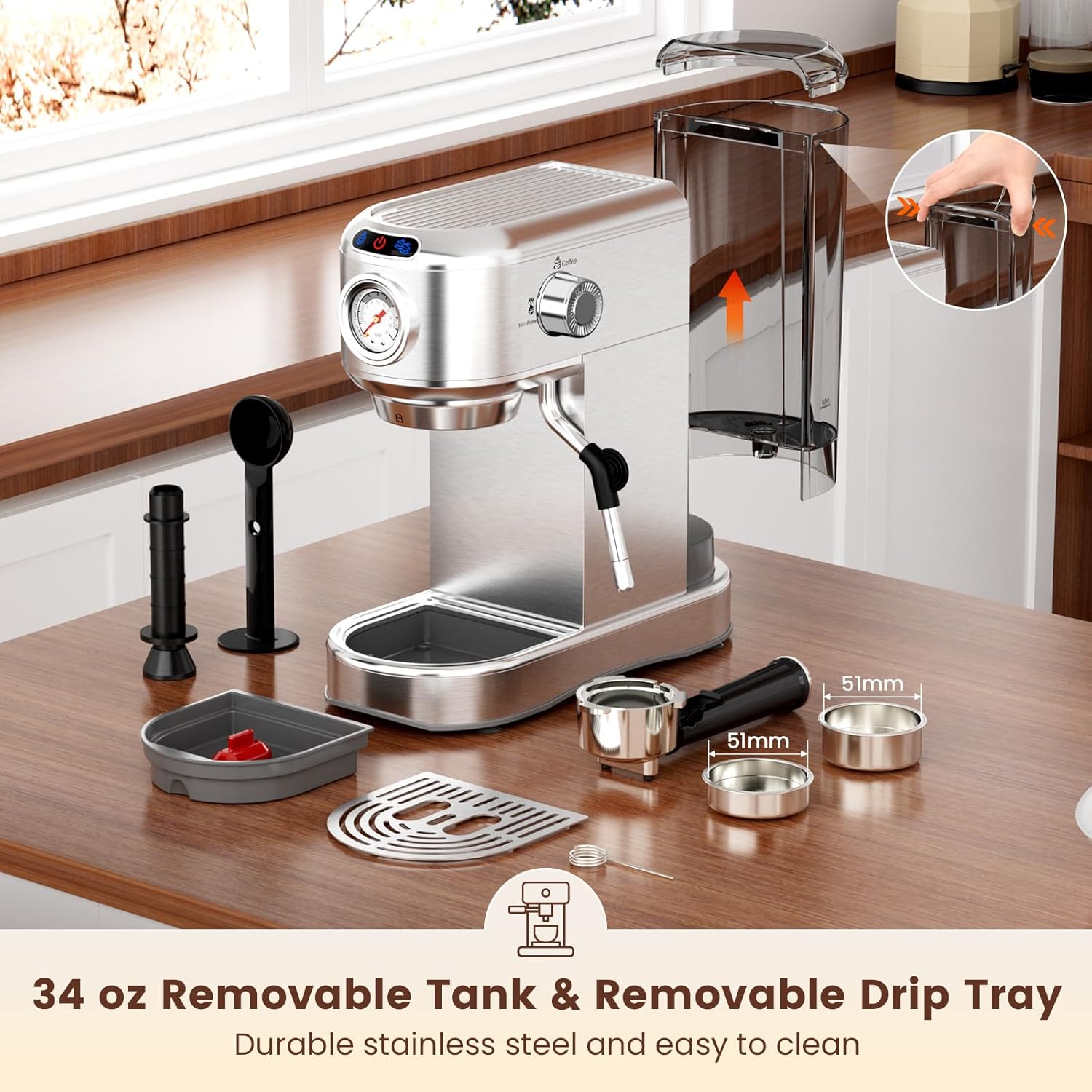
Temperature stability during extraction and steaming is a primary determinant of espresso quality. The listed 1450 W heating specification suggests the machine has sufficient power to heat water and generate steam, but the architecture—whether a boiler or thermoblock—is not specified. Boiler systems generally deliver better temperature stability for sequential brewing and steaming, while thermoblocks heat on demand with quicker recovery but potentially greater temperature fluctuation. The presence of an overheating protection mechanism and a manufacturer instruction to cool before brewing after steaming implies active thermal cutoffs to protect components, which impacts workflow and recovery. For consistent extraction, users should monitor time between steam and brew cycles, allow the group temperature to equilibrate, and anticipate some heat-up or recovery time when preparing multiple drinks.
Implications of Heating Architecture on Extraction
If the machine uses a thermoblock, temperature can change more rapidly with intermittent use, requiring short stabilization pauses between steam and brew. That architecture can be advantageous for low-volume environments because it reduces standby energy use and shortens initial heat-up times. Conversely, a boiler provides larger thermal mass and steadier temperatures across consecutive extractions and steaming sessions. Because the manufacturer details do not specify the internal heating design, buyers should assume a compact machine architecture optimized for household throughput rather than café-level continuous output. Temperature stability can be improved through pre-infusion practices, flushes before pulling shots, and allowing short recovery intervals after intensive steam use.
Recommended Temperature Targets and Brew Ratios
For classic espresso extraction, water temperature in the group head between 90–96°C (195–205°F) supports balanced solubility of coffee compounds; slightly lower temperatures favor acidity preservation, while higher temperatures promote sweetness and body. Standard brew ratios for espresso range from 1:1.5 (ristretto) to 1:2.5 (lungo), with many latte-focused preparations using 1:2 espresso to milk volume frameworks. Given manual control over dose and tamp, users should target consistent puck prep and adjust grind to achieve desired extraction times and yield ratios. Because machine thermodynamics and flow control interact with grind and dose, careful recipe logging (dose, yield, time) facilitates reproducible results.
Capacity, Size, and Daily Workflow
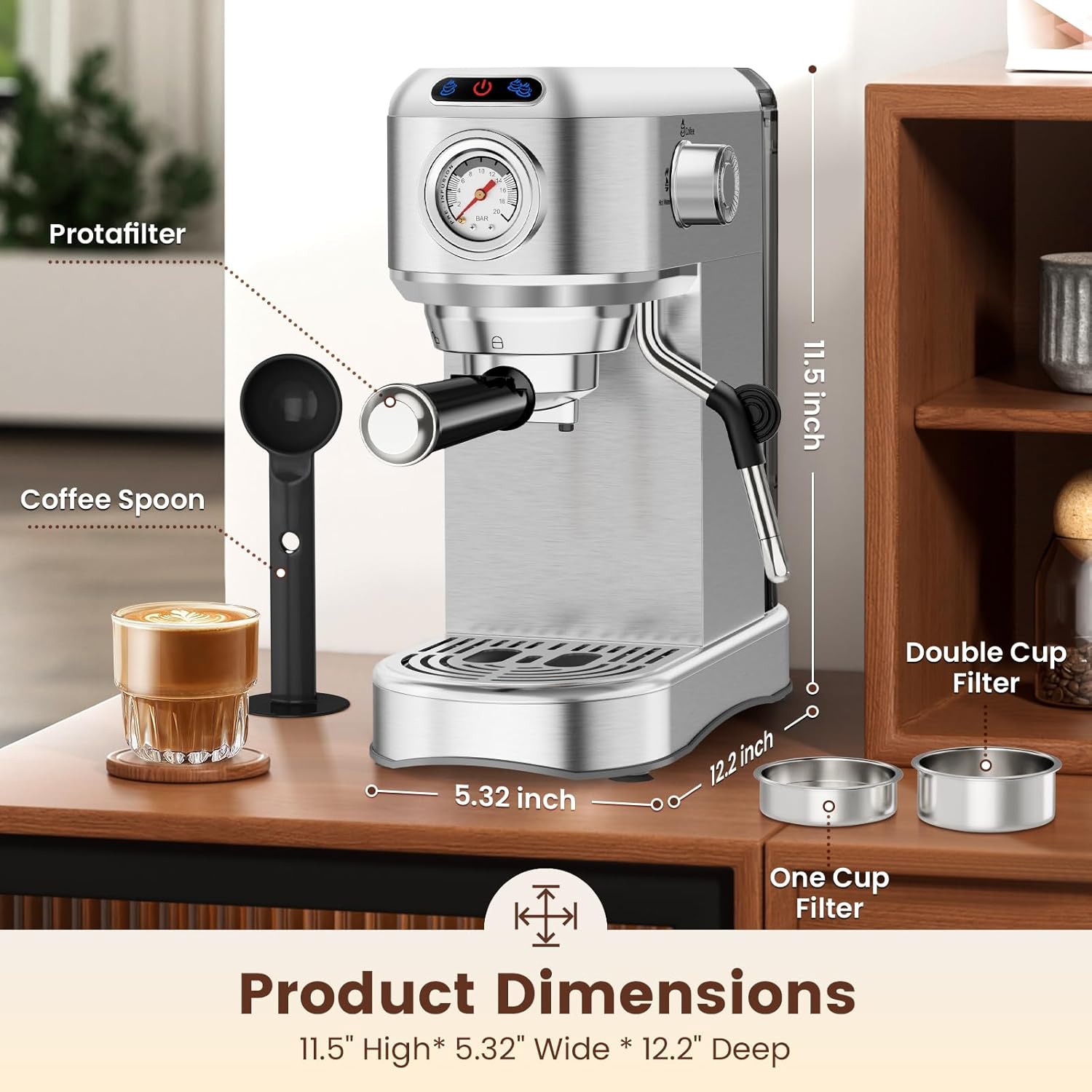
The compact countertop form factor, product dimensions of roughly 7″D x 12.5″W x 14.75″H, and a removable 34 oz water tank suit small kitchens and office corners where counter space is at a premium. The detachable reservoir simplifies refilling and reduces the need to move the entire appliance, which benefits daily workflows. Included accessories—single and double filters, tamper—reduce initial setup complexity, although the absence of a built-in grinder requires a separate dosing solution. The listed mass of 3.94 kg keeps the unit relatively portable within a kitchen, but the compact size also means smaller water and steam capacity compared with prosumer machines. For homes preparing one to three drinks per session, the configuration balances convenience and capability; for higher-volume needs or continuous service, refill frequency and cooldown intervals may become limiting factors.
Serving Flexibility and Tank Management
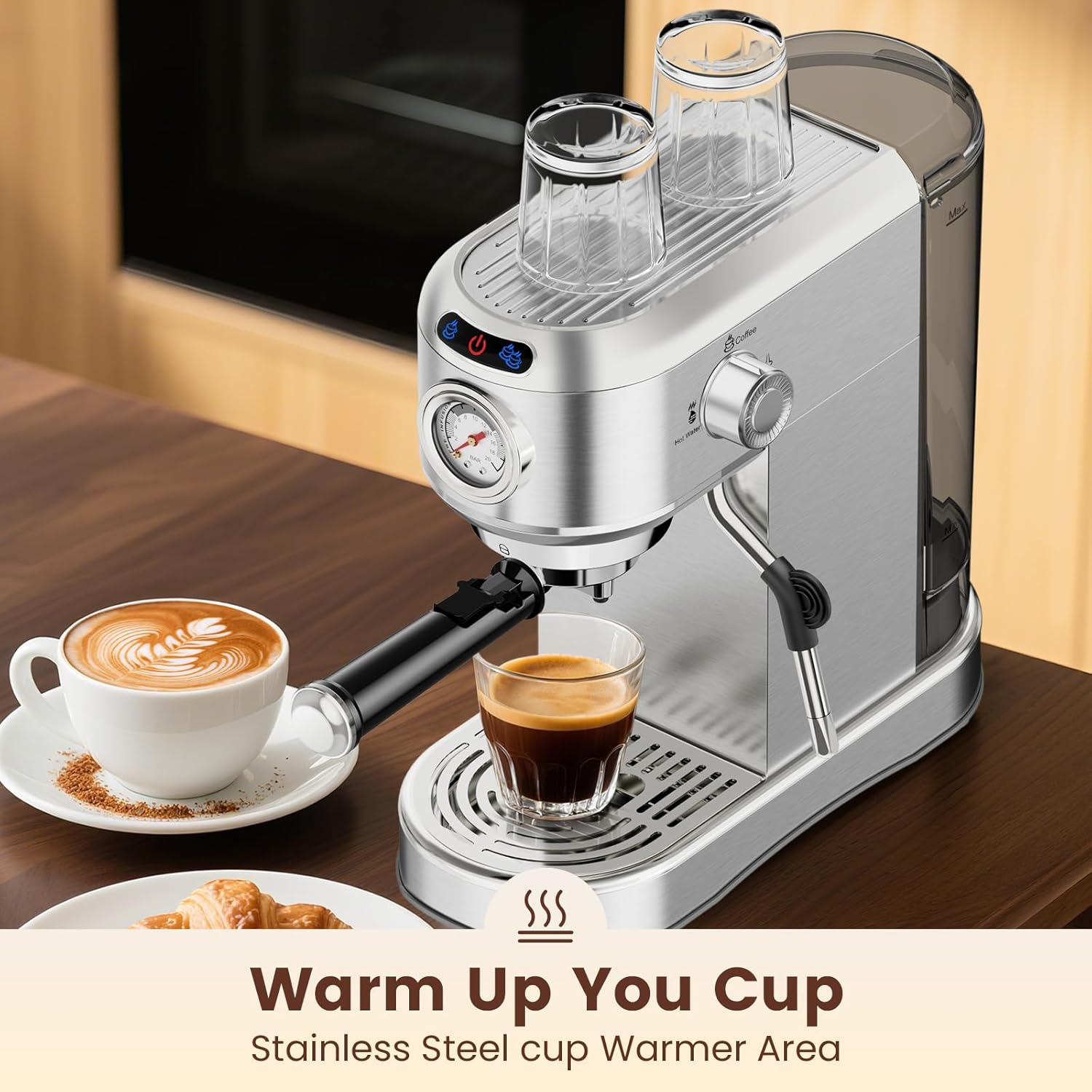
A 34 oz removable tank is adequate for multiple single shots and a few milk drinks in a short session, but users preparing several drinks consecutively should plan refills or have a larger external water source. Removable tanks improve cleaning access and reduce risk of mineral buildup when emptied and dried between uses. The single/double basket options allow flexibility between single-serve precision and double-shot throughput, and the compact footprint enables placement near other beverage equipment. For shared-office environments, routine checks for water level and periodic descaling are necessary to maintain consistent flow and prevent steam performance degradation.
Workflow Tips for Efficient Use in Home Settings
To maximize efficiency, establish a repeatable sequence: preheat machine (or perform an initial flush), prepare and tamp portafilter, purge steam wand briefly before texturing milk, and allow a short recovery period after steaming before brewing to avoid triggering thermal protection. Keeping a dedicated grinder near the machine reduces delays in dosing and helps maintain grind consistency. Because the machine relies on manual controls, layout and ergonomics—space for a knock box, milk pitcher, and cups—affect overall workflow speed and shot consistency. Predictable routines mitigate the limitations inherent in compact, semi-automatic designs.
Cleaning, Maintenance, and Build Reliability
Stainless steel exterior panels and a removable drip tray ease surface cleaning, while the detachable 34 oz reservoir simplifies internal rinsing and reduces scale accumulation points. Included accessories—portafilter, single/double filters, and tamper—are straightforward to disassemble for cleaning; filter baskets should be backflushed with appropriate agents when safe and recommended by manufacturer guidance. The instruction about overheating protection points to built-in safeguards designed to prevent thermal damage, but it also signals that service intervals and duty cycles should be moderated to avoid repeated thermal cutoffs. Long-term reliability in compact machines typically depends on water quality, routine descaling, and adherence to the manufacturer’s cooldown and maintenance recommendations. ABS components reduce weight but may wear faster than full-metal assemblies in high-use scenarios.

Routine Maintenance Tasks and Intervals
Regular tasks include daily rinsing of the portafilter and drip tray, weekly removal and cleaning of the water reservoir, and scheduled descaling depending on local water hardness. Using filtered water reduces mineral buildup and extends the life of heating components and the steam wand. Periodic inspection of gaskets and seals is advisable, as repeated steam cycles and temperature changes can accelerate wear. Because warranty details are not specified, maintaining purchase documentation and following manufacturer maintenance steps helps with potential service or replacement claims.
Durability Considerations for Long-Term Ownership
Stainless steel panels and a compact mechanical design support reasonable durability for typical household use, but ABS parts and a smaller water reservoir signal design trade-offs toward cost and space efficiency rather than heavy commercial duty. Overheating protection indicates that thermal sensors and cutoffs are present to prevent damage, which improves component longevity when cooldown instructions are followed. For users requiring high throughput or commercial-style durability, a machine with a larger boiler and explicit commercial-grade components would be more appropriate. For domestic environments with routine care, the design choices align with expected lifespan expectations of compact semi-automatic appliances.
Pros & Cons
Pros
- Compact stainless steel design fits small countertops and resists surface wear. The stainless exterior contributes to heat retention and a clean appearance while ABS components reduce overall weight for easier placement.
- 20-bar pump and 1450 W power specification indicate adequate pumping and heating capacity. These specifications support the pressure and energy demands of espresso extraction and steam generation when paired with proper grind and dosing.
- Removable 34 oz water tank simplifies refilling and cleaning. The detachable reservoir reduces spillage risk and allows convenient access to water without moving the entire unit.
- Includes essential accessories for espresso preparation. The portafilter, single and double cup filters, and tamper provide the basic tools needed to begin consistent shot-making workflows.
- Steam wand offers milk texturing and hot water function. A manual steam wand increases drink flexibility for lattes, cappuccinos, and hot beverages beyond straight espresso.
- Compact form factor and moderate weight improve placement versatility. The unit’s size and mass make it suitable for home and small-office environments where space is limited.
Cons
- Manufacturer instructions indicate an overheating protection requirement after steaming. This cooldown necessity limits continuous steam throughput and can slow sequential milk drink preparation.
- Internal heating architecture is not specified, creating uncertainty about temperature stability and recovery. Buyers who require precise, repeatable temperature control may find the lack of PID or explicit boiler details limiting.
- No built-in grinder or pressure profiling; results depend on external grinders and manual technique. Achieving consistent extraction requires investment in a quality burr grinder and disciplined dosing and tamping.
- Warranty information is not specified by the manufacturer. Lack of clear warranty terms can create uncertainty around long-term support and service coverage.
- ABS components and compact design may reduce long-term durability under heavy use. For commercial or very high-frequency environments, sturdier industrial components are typically recommended.
Final Verdict: Who This Product Is Best For (and Who Should Skip It)
This compact semi-automatic espresso machine suits home baristas and small offices seeking a counter-friendly unit that supports traditional espresso extraction and manual milk texturing. The included portafilter, single/double baskets, tamper, and removable 34 oz tank enable a classic workflow for lattes, cappuccinos, and basic espresso preparation, provided users pair the machine with a consistent burr grinder and practice dose-and-tamp technique. The 20-bar pump and 1450 W specification suggest sufficient capability for household demand, while stainless steel construction and accessory set reduce initial equipment overhead.
However, those requiring café-level throughput, precise temperature control (PID), or integrated grinders and pressure profiling should consider higher-tier prosumer machines. The machine’s cooldown requirement after steaming, unspecified heating architecture, and ABS components indicate design compromises tailored to space and cost efficiency rather than continuous commercial use. Buyers prioritizing repeatable temperature stability, rapid steam recovery for back-to-back milk drinks, or an extended warranty should evaluate alternatives with explicit boiler systems and robust service support.
Frequently Asked Questions (FAQs)
How does a 20-bar pump affect espresso extraction on a compact machine?
A 20-bar pump rating indicates the pump’s peak capacity to generate pressure, but extraction pressure through the coffee puck depends on grind, dose, and tamp. Typical brew pressure during extraction is controlled by puck resistance and often occurs near 8–10 bar. The higher pump rating helps overcome system losses and ensures sufficient pressure delivery, but consistent shots still rely on a uniform fine grind and steady tamping technique.
Can this machine produce cafe-quality microfoam for lattes and cappuccinos?
A manual steam wand can produce microfoam when paired with stable steam pressure and proper technique: introducing air early, texturing near the surface, and finishing at appropriate temperatures. The machine’s steam performance is influenced by heating capacity and thermal recovery; following manufacturer cooldown recommendations and heating best practices improves steam stability. For frequent high-volume milk drinks, machines with larger boilers typically provide more consistent steaming performance.
What grind and dosing approach works best for consistent shots?
Consistent espresso shots require a fine, uniform grind produced by a quality burr grinder and precise dosing with even distribution before tamping. Users should aim for consistent extraction times (commonly 25–30 seconds) and adjust grind size incrementally to control flow rate. The included single and double baskets set limits on dose volume, so tracking dose, yield, and time supports reproducible results.
How often should the machine be descaled and maintained?
Descale intervals depend on local water hardness and usage frequency. For moderate hardness and household use, descaling every 2–3 months is common; in harder water regions, more frequent descaling may be necessary. Daily cleaning of the portafilter and drip tray, weekly reservoir rinsing, and regular inspection of gaskets help prevent buildup and preserve steam and extraction performance.
Is a removable water tank beneficial for home espresso workflows?
A removable water tank improves refill convenience and cleaning access, reduces spillage risk, and makes it easier to monitor water quality. For households or small offices preparing a few drinks per session, a 34 oz capacity balances refill frequency and compact design. Users who prepare many drinks consecutively should plan for refills or choose larger-reservoir models for reduced interruptions.
Does this machine include a built-in grinder or pressure profiling?
No built-in grinder or automated pressure profiling is indicated in the manufacturer specifications. The machine is a semi-automatic model that depends on external grinders for particle-size control and manual dosing/tamping for flow management. Users seeking integrated grinding or pressure profiling should consider higher-end prosumer machines.
What maintenance practices extend the machine’s service life?
Using filtered water, following scheduled descaling, rinsing removable components regularly, and adhering to the manufacturer’s cooldown instructions reduce wear on heating elements and gaskets. Periodic inspection of seals and cleaning of the steam wand prevent performance degradation. Consistent care and attention to water quality are primary factors in extending component longevity.