Baratza Encore Grinder Review — Best for Home Brewing 2026
Why grinder choice matters for home brewing
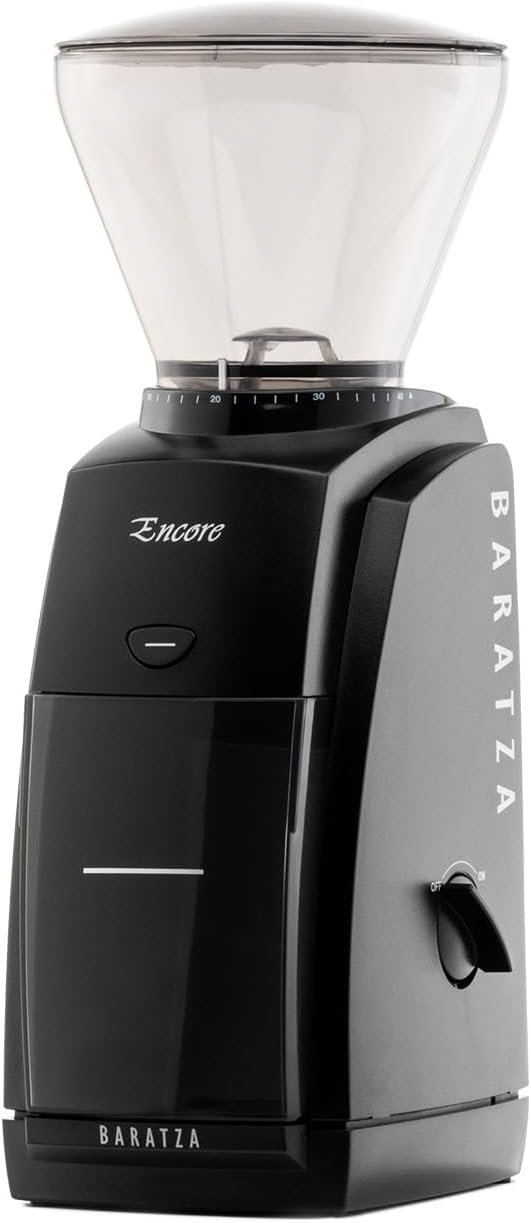
Selecting a grinder is one of the most consequential decisions for home coffee brewing because particle size and distribution directly shape extraction kinetics, flavor balance, and brew repeatability. Home brewers and enthusiasts seeking predictable results need equipment that delivers consistent particle size across a range of settings, minimal heat transfer during grinding, and a workflow that matches routine brewing habits. The Baratza Encore, positioned as an entry-level specialty grinder, targets households and single-cup brewers who prioritize fresh grinding for filter and manual methods. Key characteristics to evaluate include burr geometry and material, motor type and duty cycle, available grind settings, static and retention behavior, and ease of cleaning. These factors influence shot clarity for espresso, body for immersion brews, and clarity for pour-over methods. Understanding how the Encore’s commercial-style conical burrs, 40-step adjustment range, and compact footprint translate to extraction and daily usability helps align purchase choice with brewing goals and household patterns.
Quick Overview
| Feature | Details |
|---|---|
| Product category | Burr coffee grinder for home brewing (automatic operation) |
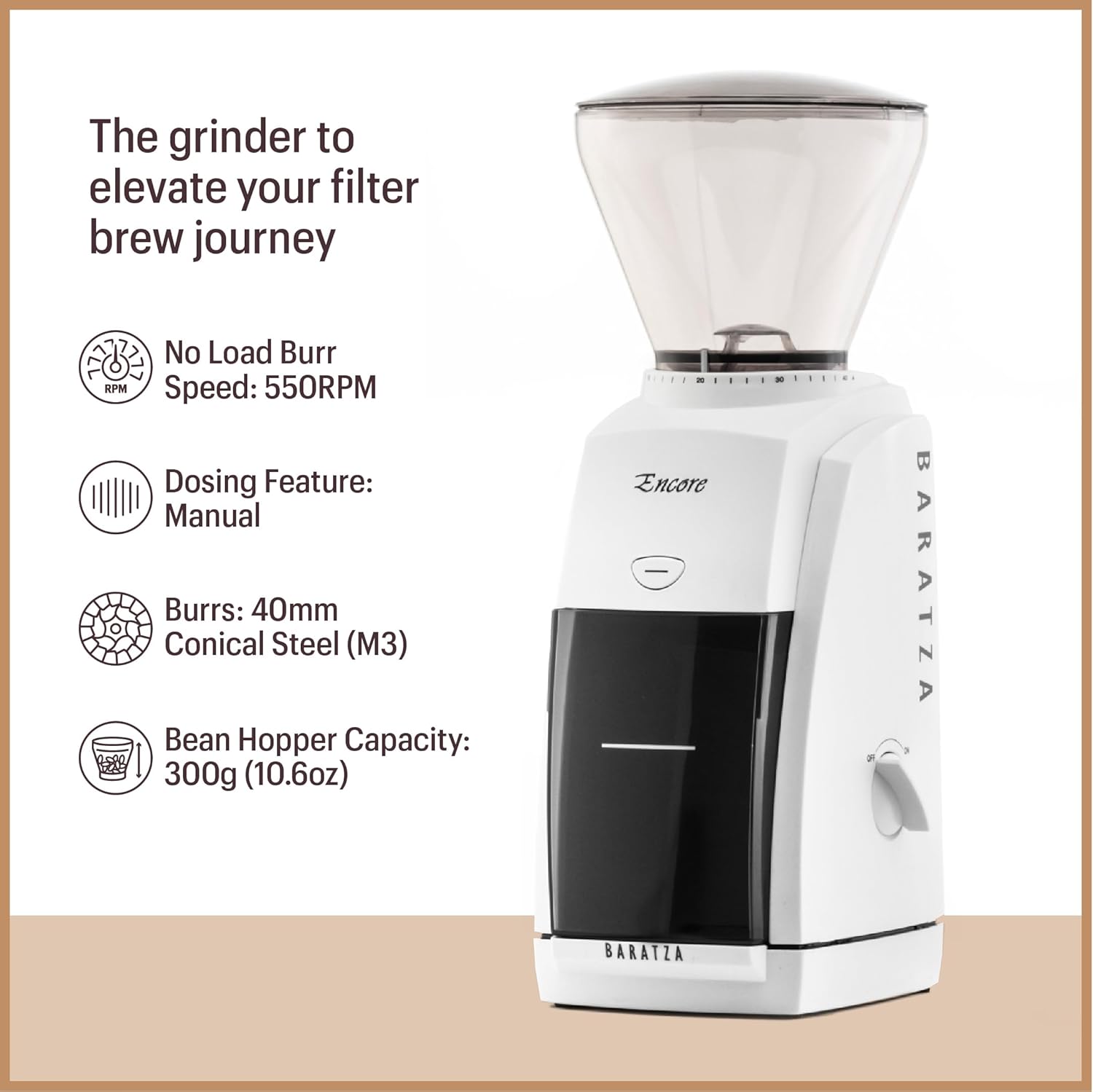
| Grind technology | 40mm commercial-grade conical steel burrs (hardened alloy) |
| Grind settings | 40 stepped settings covering fine to coarse ranges |
| Motor and power | DC motor with front-mounted pulse button and ON/OFF switch |
| Materials & construction | Plastic exterior body, metal burrs manufactured in Liechtenstein |
| Capacity & dimensions | Small-footprint hopper and grounds bin; 5.91″L x 5.12″W x 13.39″H; 5.58 lb |
| Best suited users | Home brewers, filter and immersion enthusiasts, small households |
| Warranty & support | Manufacturer-backed support and a 1 year warranty |
The Encore’s specifications indicate a grinder built around a set of proven design trade-offs: a compact plastic chassis for home counters, durable conical burrs for consistent particle geometry, and a DC motor suited to intermittent domestic use. These elements combine to deliver predictable grind ranges for pour-over, Aeropress, and batch drip while keeping noise, size, and complexity appropriate for daily home workflows.

Grind quality and extraction outcomes
The Encore’s grind system centres on 40mm conical burrs and a stepped adjustment mechanism; those components determine particle distribution and therefore extraction behavior. Conical burr geometry tends to produce a bimodal particle distribution with a concentration of mid-sized particles and fewer fines than some flat burr systems, which supports balanced extraction for manual methods and drip brewers. The 40 stepped settings provide repeatable increments across a broad range from espresso-adjacent to coarse press. Heat transfer is mitigated by the burr size and intermittent DC motor operation, limiting temperature rise during short grind cycles typical of home use. However, particle retention in the grinding chamber and static charge can influence dose accuracy and require consideration for precise brewing ratios. Overall, performance should be evaluated in terms of how particle uniformity and dose stability align with targeted brew methods and extraction goals.

Burr geometry, material, and grind distribution
Baratza specifies hardened alloy steel burrs manufactured in Liechtenstein; material hardness and profile affect wear resistance and cutting characteristics. Conical burrs of this diameter generally deliver predictable central particle sizes with a controlled amount of fines, which aids clarity for pour-over and reduces over-extraction risk in immersion brews. Stepped adjustments limit infinite micro-tuning but improve repeatability: users can return to a setting number rather than estimate a position. Over time, wear will slightly alter distribution, but burr replacement parts and a modular design are provided by the manufacturer to maintain original performance. For grind-critical methods such as espresso, the stepped range may require more trial to reach a stable dial-in compared with stepless systems.
Grind retention, static, and dosing consistency
Aggregated user reports commonly note modest particle retention in the grinding chamber and grounds bin; retained grounds can shift effective dose between sessions if not cleared. Static charge, a common phenomenon with dry-roasted beans and plastic components, can cause clumping and scatter, complicating dosing accuracy for single-cup precision. Pulse-button operation and short grind bursts reduce continuous motor heating and can help limit static buildup, but users aiming for tight dosing tolerances should account for retention when measuring grind weight. Routine simple procedures—tapping the hopper, brief pulses, or using anti-static tools—reduce variance and support consistent brew ratios.
Heat transfer and impact on aroma compounds
The Encore’s DC motor paired with 40mm burrs balances power and thermal mass for typical household duty cycles. Short, intermittent grinds produced by small doses limit temperature rise at the burr interface, reducing the risk of volatile aroma loss and oil smearing compared with prolonged commercial grinding sessions. This thermal behavior is particularly relevant for light-roast coffee where volatile compounds are more sensitive. While motor cooling and duty cycles are suitable for domestic grind loads, continuous heavy use (multiple large batches) can increase burr and motor temperature and marginally affect aroma preservation.
Brewing method compatibility and serving flexibility
The Encore advertises a 40-step grind range intended to span espresso-adjacent to coarse press, positioning it as a versatile home grinder. Practical compatibility depends on the targeted methods: pour-over, Aeropress, Hario V60, Chemex, and French press are directly supported by the burr profile and adjustment span. Espresso-level fineness is theoretically reachable, but stepped settings and particle distribution characteristics may challenge those seeking micro-scale dial-in precision for pressurized espresso machines. Hopper capacity and grounds bin size favor small to medium household servings rather than large batch preparation. The grinder’s footprint and single-dose workflow make it suited for morning single- or double-cup routines, while users who prepare multiple pots or large-volume brews may find throughput and hopper capacity limiting.

Filter and pour-over performance expectations
For pour-over methods, the conical burrs and 40-step range enable controlled extraction by adjusting grind size to match brew time and water flow. Particle distribution from conical burrs typically supports clarity and balanced body in V60 or Chemex pours, with fewer ultra-fines that cause over-extraction. The stepped settings allow repeatable jumps between flow rates, assisting brewers in matching grind to brew ratio and pour tempo. Small hopper capacity encourages grinding immediately before brewing, which helps aroma preservation, but multiple sequential pours require repeated cycles and attention to retention when targeting consistent servings.
Immersion and French press considerations
Coarser settings on the Encore reach sizes appropriate for immersion methods; the stepped clicks help map coarse positions to brew ratios and steep times. Conical burr output tends to create a coarse bed with a controlled amount of fines that can influence mouthfeel; a slightly higher proportion of fines increases body but may introduce sediment in metal-filtered presses. For immersion brews, dosing consistency and rinsing procedure remain more impactful than marginal differences in burr geometry, but the Encore’s grind repeatability supports reliable steep times when maintenance routines keep retention low.
Espresso and pressurized machine compatibility
Although the step range includes settings that approach espresso fineness, the Encore is primarily marketed as a filter and all-purpose home grinder rather than a dedicated espresso workhorse. The stepped adjustment system and conical burr distribution can make micro-adjustments for pressurized-portafilter or beginner espresso setups feasible, but achieving the narrow particle distribution and low fines typical of professional flat-burr espresso grinders is less likely. Users pursuing consistent, high-quality espresso with precise pressure profiling and dose stability may prefer a purpose-built espresso grinder with stepless adjustment and finer burr geometries.
Usability, workflow, and maintenance expectations
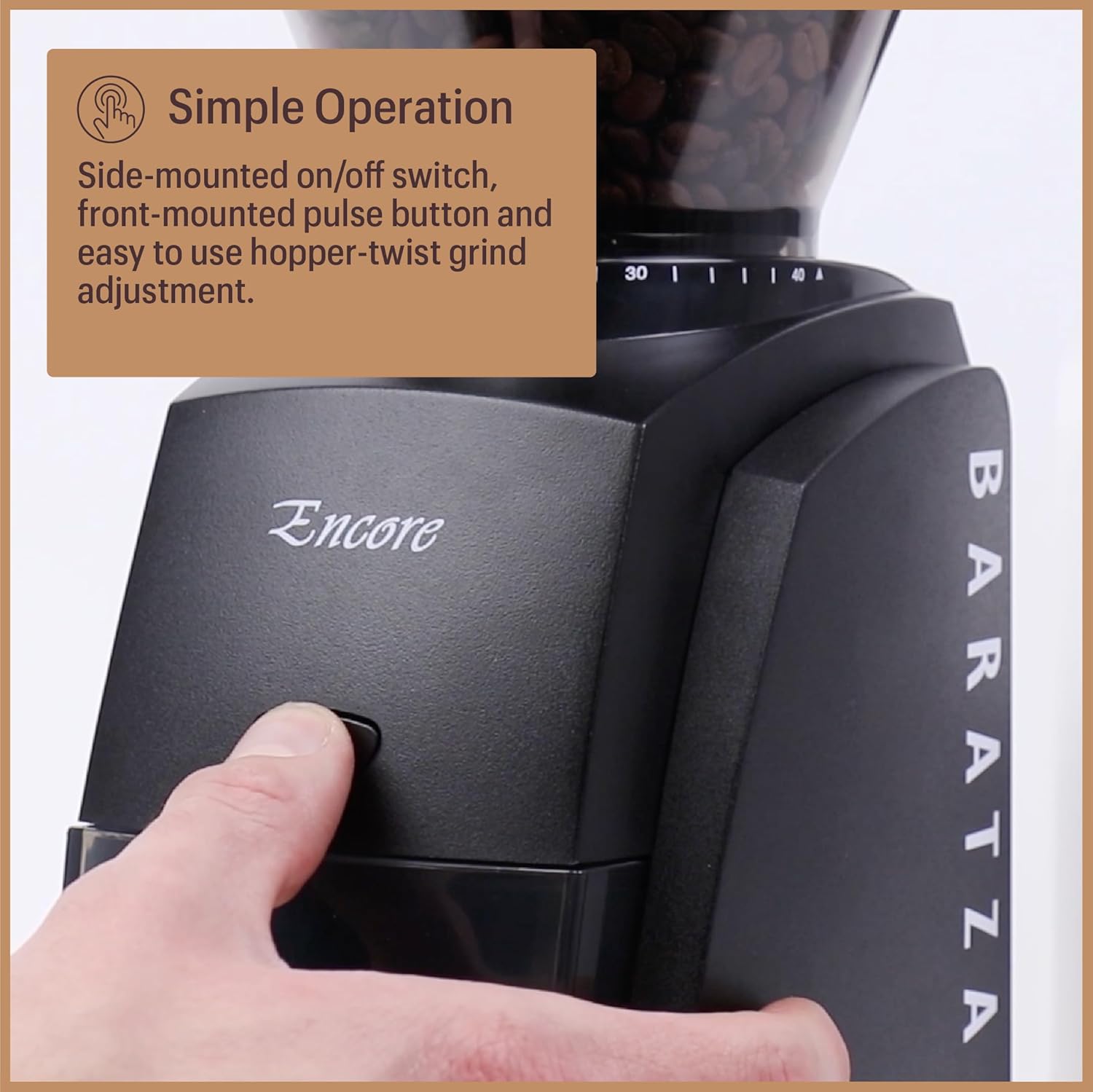
The Encore’s user interface emphasizes a simple workflow: a front-mounted pulse button and an ON/OFF rocker switch for timed manual operation rather than electronic dosing. This minimal control set reduces complexity and supports direct, tactile operation for morning routines. The stepped adjustment ring provides numeric reference points for returning to previous grind settings. Cleaning and maintenance practices are straightforward: burr access for periodic cleaning and replacement is supported by available parts and manufacturer documentation. Plastic exterior panels reduce weight and cost, but surface finishes and hopper attachments demand care to minimize static. Aggregated customer themes praise the straightforward workflow but also recommend scheduled burr cleaning to maintain consistent extraction results over time.

Controls, dosing, and repeatability
The pulse button allows short bursts to avoid overheating and to control dose by time rather than weight. While timed dosing can be repeatable for similar roast levels and beans, weight-based dosing provides higher accuracy for strict brew ratio targets. The 40-step adjustment with positive detents aids repeatability by allowing users to return to specific settings; this is efficient for households switching regularly between filter and coarse methods. For users who require gram-level dosing repeatability, pairing the Encore with an external scale is a common and effective workflow.
Cleaning, burr access, and part replacement
Baratza’s modular approach provides accessible burr removal for routine cleaning and eventual replacement. The plastic body and hopper detachments make basic maintenance manageable without disassembly of the motor housing. Aggregated buyer feedback frequently cites easy access to replacement burrs and supportive manufacturer documentation as factors that extend functional lifespan. Regular brushing, occasional deep cleaning with compressed air or brush tools, and following recommended burr replacement intervals will preserve grind quality and extraction stability.
Noise, footprint, and counter ergonomics
The Encore’s compact footprint and moderate weight suit small kitchen counters; the plastic housing reduces footprint bulk and keeps the unit manageable. Noise levels are typical for household burr grinders and are influenced by grind dose and bean hardness; conical burrs generally produce a different acoustic profile compared with flat burrs but remain within household-acceptable ranges for intermittent use. Ergonomic placement of the pulse button on the front improves single-handed operation and aligns with common morning workflows that include dosing directly into a portafilter or grounds bin.
Build, durability, and long-term reliability
Construction emphasizes durable burrs paired with a plastic exterior, targeting long-term value through replaceable wear components rather than heavycasting. Hardened alloy steel burrs manufactured in Europe suggest attention to material quality for longevity, while the DC motor design and thermal characteristics suit intermittent domestic operation rather than continuous commercial workloads. Warranty coverage and the vendor’s support network address parts availability and repairs, which factors into lifecycle cost. Aggregated customer reports typically praise the grinder’s long service life under household conditions but note that heavy-volume use, attempted commercial service, or attempts to grind oily or flavored beans may accelerate wear and require more frequent maintenance or parts replacement.
Materials, manufacturing, and component serviceability
The pairing of metal burrs with a plastic housing is a common consumer trade-off: the burrs provide the critical cutting interface and wear resistance while the plastic body keeps weight and cost lower. Burrs sourced from an established European manufacturer indicate predictable tolerances and consistent geometry. Serviceability is supported by manufacturer-provided replacement burrs and documentation; users can maintain factory-level performance through scheduled replacement and cleaning, which is more cost-effective than full-unit replacement in long-term ownership scenarios.
Warranty, support, and aggregated reliability themes
The manufacturer-specified one year warranty and advertised support resources address initial defects and routine parts questions. Aggregated review themes show high satisfaction with aftermarket support and availability of spare parts, contributing to perceived long-term reliability. However, some buyers report the need for periodic calibration or burr replacement after extended daily use; this aligns with expected wear curves for domestic grinders and underscores the importance of vendor support and parts availability when evaluating lifecycle expectations.
Who should avoid the Encore based on build and scope
The Encore is not positioned for high-throughput commercial settings or large households that grind many pounds per day; motor duty cycle and hopper capacity are optimized for home use. Users requiring ultra-fine control for competitive or high-end espresso extraction, or those desiring a stepless, micrometric adjustment system, may find the stepped Encore limiting. Additionally, operators who regularly grind oily or heavily flavored beans should expect increased cleaning demands and potential accelerated burr wear, making a commercial or specialized grinder a better long-term choice.

Pros & Cons
Pros
- Consistent, serviceable burrs: Hardened 40mm conical burrs manufactured in Europe provide a stable cutting interface with good wear resistance. This supports predictable particle geometry for filter and immersion methods and a long replacement cycle when maintained.
- Broad grind range for home methods: Forty stepped settings cover a wide span from fine to coarse, enabling pour-over, Aeropress, Chemex, and French press without needing multiple grinders. The stepped adjustments simplify repeatability for routine sessions.
- User-friendly workflow: A front-mounted pulse button and simple ON/OFF switch reduce complexity and make daily grinding straightforward, suitable for quick single-cup or small household routines.
- Compact footprint and manageable weight: The small counter presence and plastic exterior fit most kitchen spaces and reduce the barrier for home use where space is limited.
- Serviceability and parts support: Manufacturer-provided replacement burrs and documented procedures help sustain long-term performance and reduce lifecycle cost compared with non-serviceable units.
- Low thermal impact for short cycles: The DC motor and 40mm burrs limit heat transfer during typical domestic doses, aiding volatile aroma retention for light roasts.
Cons
- Limited appeal for dedicated espresso purists: The stepped adjustment system and conical burr distribution can complicate micro-adjustment required for precision espresso extraction. Users seeking professional-level espresso consistency may prefer a stepless, flat-burr espresso grinder.
- Hopper capacity and throughput constraints: Small hopper and moderate motor duty cycle make the unit less suitable for large-volume households or frequent batch grinding. Multiple sequential grinds increase workflow interruptions.
- Static and retention considerations: Particle retention in the grinding chamber and static charge, especially with dry-roasted beans, can affect dosing repeatability and require simple mitigation steps.
- Plastic exterior trade-offs: While keeping weight and cost low, the plastic housing is less robust than metal-chassis alternatives in heavy-use scenarios and may show wear over many years.
Final Verdict: Who This Product Is Best For (and Who Should Skip It)
The Baratza Encore aligns with its manufacturer positioning as a go-to entry-level specialty grinder for home brewers who prioritize consistent grinds for filter and immersion methods. It is well-suited to single-cup routines, small households, and enthusiasts who value straightforward controls, a compact footprint, and a broad stepped grind range that simplifies repeatability between brew styles. The combination of European-made hardened burrs, accessible maintenance, and a supportive parts ecosystem makes it a pragmatic choice for users seeking long-term value without the complexity of prosumer espresso grinders.
However, the Encore is not the optimal choice for those who require commercial throughput, ultra-precise espresso dialing, or a metal chassis for heavy-duty environments. Households that grind very large daily volumes or users pursuing competition-grade espresso extraction should consider purpose-built alternatives with stepless adjustment, larger burrs, or commercial motor duty cycles. For the majority of home brewers focusing on pour-over, immersion, and drip methods in 2026, the Encore remains a balanced, durable, and serviceable option when matched to realistic brewing workloads and maintenance practices.
Frequently Asked Questions (FAQs)
Is the Baratza Encore suitable for pour-over and drip brewing?
The Encore’s 40mm conical burrs and 40-step adjustment range make it well-suited for pour-over and drip methods. Conical burr geometry tends to produce a particle distribution that supports clarity and balanced extraction for V60 and Chemex styles. Repeatable stepped settings help brewers return to previous grind sizes, enabling consistent flow rates and extraction when paired with stable pour technique and accurate brew ratios.
Can the Encore be used for espresso preparation?
The Encore can reach grind settings approaching espresso fineness, but it is primarily marketed for filter and general home use. The stepped adjustment system and conical burr distribution can complicate micro-adjustments and the narrow particle distribution sought by espresso specialists. Users pursuing consistent, high-quality espresso extraction may prefer a dedicated espresso grinder with stepless adjustment and a burr geometry optimized for low fines and tight distributions.
How easy is it to clean and maintain the Baratza Encore?
Maintenance is straightforward due to the Encore’s modular burr access and manufacturer-supported replacement parts. Routine cleaning involves removing the hopper and burrs to brush out retained grounds, and occasional deeper cleaning to clear buildup. Aggregated user feedback highlights accessible burr replacement and available documentation as strengths; following a regular cleaning schedule preserves grind consistency and extends component life.
What are common limitations users report about the Encore?
Commonly reported limitations include modest grind retention and static charge that can affect dosing consistency, limited hopper capacity for large-batch grinding, and the stepped adjustment system which provides less micro-adjustment than stepless grinders. The plastic exterior is adequate for home use but is less robust for commercial or very heavy-duty environments. These characteristics reflect design trade-offs for cost, size, and serviceability.
How does burr wear affect long-term performance, and can burrs be replaced?
Hardened alloy steel burrs provide good wear resistance, but like all burr systems they gradually change profile with extended use, which can subtly impact particle distribution. The manufacturer supplies replacement burrs and documentation for service, so maintaining near-original performance over years is feasible through scheduled burr replacement. Regular cleaning and avoiding excessively oily or flavored beans help maximize burr lifespan.
Is the Encore suitable for large households or frequent batch grinding?
The Encore is optimized for household throughput rather than large-volume batch grinding. Its hopper size and motor duty cycle are designed for intermittent domestic use; continuous heavy grinding or frequent large batches can increase thermal stress and accelerate wear. Large households that require frequent multi-cup grinding or commercial users should consider models with larger hoppers, higher duty-cycle motors, or commercial-grade construction.
Does the Encore retain grounds between sessions and how does that affect dosing?
Some particle retention in the grinding chamber and grounds bin is typical and has been noted in aggregated user reports. Retained grounds can slightly alter effective dose between sessions if not cleared, affecting brew ratios. Simple mitigations such as brief purge pulses, tapping the grinder to dislodge retention, or weighing grounds on a scale help maintain dosing accuracy for precise brewing.
What workflow additions improve consistency with the Encore?
Pairing the Encore with a gram-scale for weight-based dosing enhances repeatability compared with timed pulses. Implementing a short purge or tapping routine to clear retained grounds before measuring reduces dose variance. Regular burr cleaning and scheduling replacement per manufacturer guidance also preserve consistent particle distribution, enabling repeatable extraction across brewing sessions.