BLACK+DECKER CM2046S Review: Thermal Drip Coffee Guide 2026
Why equipment choice matters for home drip brewing
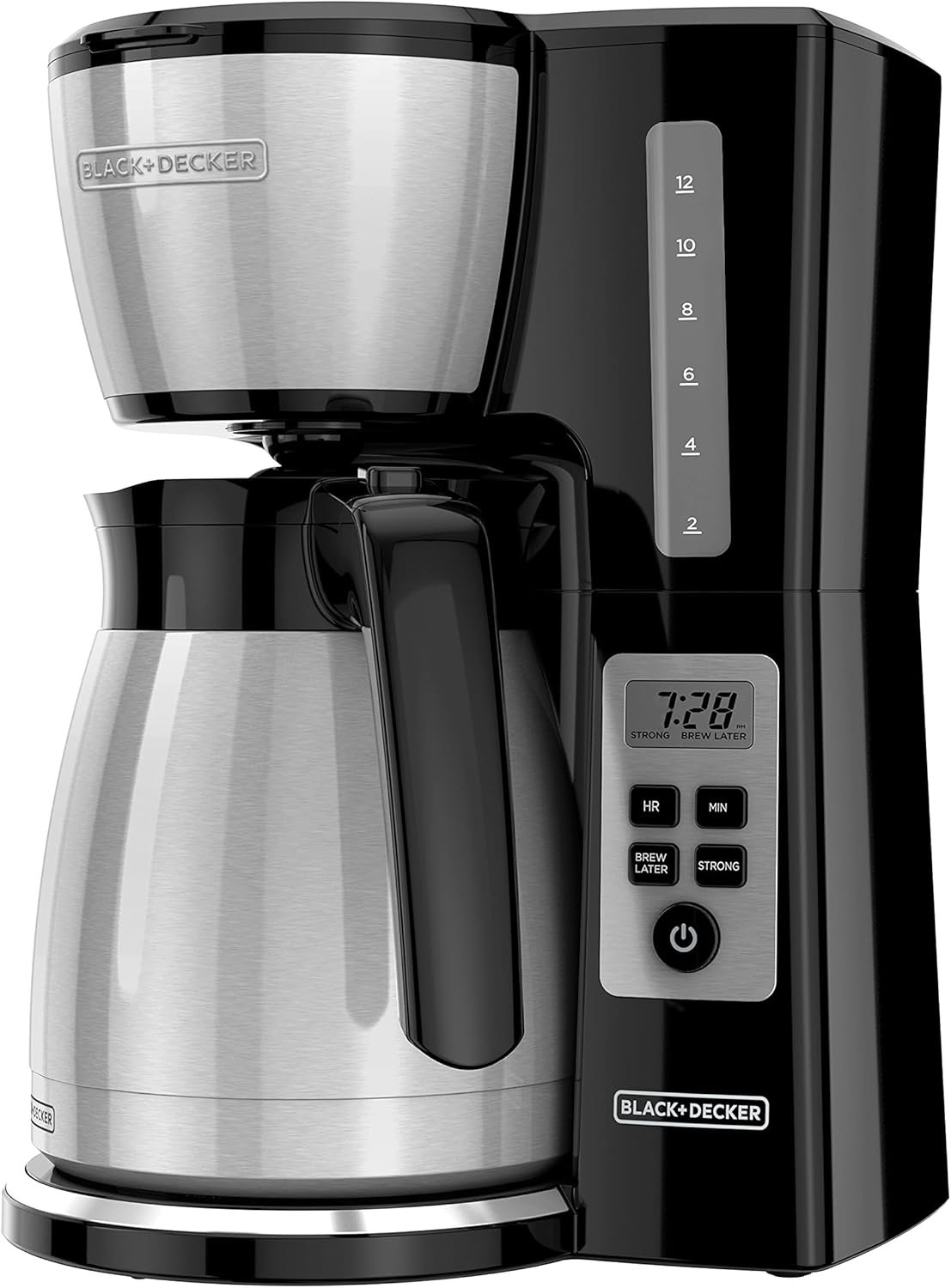
Choosing the right coffee maker matters because equipment drives the variables that determine extraction: water temperature, contact time, grind compatibility, and consistent flow. For everyday home brewers and household use, a programmable 12-cup thermal drip machine aims to balance convenience with repeatable results. The BLACK+DECKER 12-Cup Thermal Programmable Coffeemaker with VORTEX Technology positions itself for users who prioritize a hot, ready batch and minimal hands-on time. Key product characteristics—thermal carafe construction, multi-hole showerhead, brew-strength selector, and programmable delay—affect how water hits grounds, how long extraction runs, and how heat is retained after brewing. Those who prepare coffee for multiple people, prefer batch brewing over single-serve rituals, or value an always-warm carafe will assess this model for how well it preserves temperature without continuous heating and whether its extraction method aligns with preferred roast and grind profiles.
Quick Overview
| Feature | Details |
|---|---|
| Product category and brewing method | Drip coffee maker using ground coffee and basket filter (#6) |
| Capacity and output | 12-cup thermal carafe; manufacturer cup = ~5 oz |
| Materials and construction | Metallic exterior finish; double-walled 4-layer vacuum thermal carafe |
| Heating system | Standard resistance heating element with programmable auto-brew and auto-shutoff |
| Brewing technology | VORTEX showerhead design for even saturation |
| Controls and interface | Digital LCD, delay timer, brew-strength selector (STRONG), fresh-brew timer up to 120 minutes |
| Filter compatibility | #6 cone or basket-style paper/reusable filters (manufacturer references) |
| Best suited users | Households, office kitchens, users wanting batch brewing and thermal retention |
| Intended use cases | Daily batch brewing, scheduled auto-brew, multi-cup serving |
| Warranty | Manufacturer limited warranty (refer to manufacturer for terms) |
The summary above shows how this machine combines an emphasis on thermal retention with a showerhead-style water distribution and programmable features. Those design decisions influence extraction dynamics, heat stability, and routine workflow: the VORTEX showerhead aims to improve evenness, the thermal carafe eliminates a hotplate for heat retention, and programmable timing supports early-morning scheduling for batch service.

Brewing method compatibility and grind/filter considerations
The machine is designed for standard drip brewing using pre-ground coffee or freshly ground beans matched to drip grind sizes. Compatibility with #6 basket-style filters supports both paper and reusable options; grind coarseness should be medium for balanced extraction with the VORTEX showerhead. Extremely fine or espresso-range grinds will clog the filter and over-extract, while very coarse grinds can under-extract and produce weak flavor. The VORTEX-style showerhead distributes water across the bed, so uniform particle distribution and consistent particle size are more important than with single-point pour methods. For best results, use a burr grinder set to a medium grind consistent with typical 1:15 to 1:17 brew ratios and avoid oily, very dark grounds that can accelerate filter clogging and channeling.

Filter types, grind size, and extraction balance
Paper filters remove more oils and fines, producing a cleaner cup with less sediment, while reusable mesh filters allow more body and oils through; both are compatible with #6 sizing. A medium grind—roughly between table salt and coarse sand—optimizes surface area for balanced extraction in a 4–6 minute contact window typical of automatic drip. Grind distribution consistency from a quality burr grinder reduces the chance of channeling, which can cause uneven extraction even with a multi-hole showerhead. Adjusting grind slightly finer compensates for under-extraction; coarser grinds compensate for over-extraction or bitter notes.
Water quality, temperature input, and preheat practices
Water composition and inlet temperature influence extraction kinetics; neutral-tasting filtered water with balanced mineral content supports flavor clarity and proper solubility. The manufacturer recommends preheating the carafe with hot water before brewing to reduce heat loss during the initial pour and help approach optimal extraction temperature. Filling the reservoir with hot (not boiling) water shortens the time to reach recommended extraction range, but users should avoid introducing boiling water that can damage seals. Consistent water-to-coffee ratio and preheating reduce variability across batches.
Temperature control and heat stability
Temperature behavior is driven by two complementary systems: the machine’s heating element that brings water to brewing temperature and the thermal carafe that retains heat post-brew. The CM2046S uses a standard resistance heater calibrated for drip extraction temperatures, combined with a four-layer vacuum-sealed thermal carafe to maintain serving temperature up to two hours. The manufacturer states the carafe will keep coffee 154°F or hotter up to two hours when preheated, which aligns with beverage temperature targets for most consumers who prefer hot cups without a hotplate. Because automatic drip machines do not typically offer PID-style temperature management, expectations should be based on the machine reaching optimal brewing range at the showerhead and the carafe preserving heat rather than actively reheating.

Thermal carafe design and heat-retention principles
The four-layer vacuum-sealed carafe uses multiple insulating layers to minimize conductive and convective heat transfer, keeping internal liquid temperatures from dropping quickly. Vacuum insulation is effective because it removes air that would otherwise transfer heat; additional reflective or insulating layers reduce radiative losses. As a passive system, thermal retention depends on initial brew temperature and limiting heat transfer during decanting. Users who pour frequently or leave the lid open will see faster heat loss; preheating the carafe and minimizing headspace improve performance.
Brewing temperature, extraction chemistry, and manufacturer claims
Optimal extraction generally occurs between roughly 195–205°F at the coffee bed; drip machines aim to approach this range at the showerhead. The CM2046S’s VORTEX design and heating system target that zone by delivering water evenly at near-optimal temperatures, but the machine lacks active PID feedback for tight ±1°F control. The carafe claim of maintaining 154°F or hotter relates to post-brew serving temperature rather than extraction temperature; therefore, extraction quality depends on the heating element and initial thermal management while the carafe helps preserve that profile for subsequent servings.
Brew consistency and extraction quality: VORTEX Technology explained
VORTEX Technology refers to the showerhead geometry that increases even water distribution over the coffee bed, aiming for consistent saturation across the grounds. Even saturation reduces channeling and promotes uniform extraction across the bed surface, which is particularly beneficial when grind size and dosing are consistent. The brew-strength selector labeled STRONG modifies flow rate or pause patterns to lengthen contact time, producing a fuller-bodied cup with more dissolved solids. Because automatic drip systems control many variables mechanically, repeatable brew quality depends on consistent dosing, grind distribution, water temperature, and how evenly the showerhead wets the bed during the initial bloom and subsequent pours.

How showerhead design affects flow dynamics and extraction
Showerhead designs with multiple outlets break the single stream into many small jets, creating more uniform wetting and reducing preferred flow channels. Uniform wetting increases the chance that all particles participate in extraction, smoothing out flavor and reducing sour or under-extracted pockets. Even with a multi-hole head, particle size uniformity and proper dosing remain critical; the showerhead mitigates but does not eliminate the impact of inconsistent grind size. Slower flow or staged pour cycles, simulated by the machine’s internal flow control, will increase extraction efficiency.
Brew-strength selector and contact time principles
The STRONG mode functions by altering contact time—either via slightly slower flow or modifying internal pause timing—so more soluble solids can dissolve into the brew, yielding perceived strength without necessarily adding more coffee. This aligns with extraction chemistry: longer contact time and finer grind increase total dissolved solids but also raise the risk of over-extraction and bitterness if not balanced. Users seeking richer flavor can use STRONG alongside small grind adjustments and modestly higher brew ratios to avoid excessive bitterness while increasing body.
Brew ratios, serving size, and practical recommendations
Standard drip brew ratios range from 1:15 to 1:17 (coffee to water by mass) depending on desired strength. For a machine-defined cup of ~5 oz, adjusting the overall dose for a 12-cup carafe should be done by weight rather than scoop volume to maintain consistency. Because the machine batches the brew, planning doses for full or half carafe volumes ensures predictable extraction. Consider measuring coffee by grams per desired yield to align with the machine’s batch output and the STRONG setting for repeatability.
Capacity and serving flexibility for households
A 12-cup thermal carafe targets households, small offices, and situations where multiple cups are consumed over a period. The manufacturer’s cup definition—about 5 ounces—means a full carafe yields approximately 60 actual fluid ounces by that measurement. The thermal carafe permits serving without a hotplate, reducing the risk of burnt flavor from sustained heating. While ideal for group service, the batch format is less suited to single-cup, on-demand grinding and brewing preferences. Users who prioritize single-cup customization or high-frequency single servings may find batch brewing less flexible, whereas those who need ready, hot coffee for several people or intermittent refills will appreciate the carafe’s retention.

Full-carafe versus single-serve trade-offs
Batch brewing scales well for consistent cups over time but sacrifices the micro-adjustability of single-serve pour-over or espresso. A thermal carafe preserves hot beverage without reheat, but the entire batch shares the same extraction profile; individual variation is not possible within the same carafe. For households that require one strong cup in the morning and lighter cups later, brewing a separate smaller batch or adjusting the brew ratio for a partial carafe are practical workarounds.
Serving logistics and capacity planning
The carafe size supports common breakfast and office cycles; however, headspace, repeated pouring, and lids left open will accelerate cooling. When planning for extended service beyond two hours, consider insulated carafes retained in closed systems or brewing smaller fresh batches. The no-drip pour spout helps reduce spills and mess during refills, improving usability in busy service scenarios.
Ease of use, workflow, and control interface
The CM2046S uses a button-driven human interface with an LCD display, a 24-hour programmable delay, and a fresh-brew timer that counts up to 120 minutes. These features support scheduling for consistent morning readiness and allow users to monitor how long coffee has been sitting. The STRONG selector provides one-touch strength adjustment, while the pause-and-serve function permits a brief pour before brewing completes. Workflow for daily use follows a familiar sequence: fill the reservoir, load a #6 filter with measured grounds, program if desired, and start. The lack of overly complex menus caters to users seeking straightforward automation rather than granular temperature or flow programming.

Programming, fresh-brew timer, and user routines
The programmable auto-brew and 24-hour timer enable planned brewing for predictable daily routines, which benefits shift-based environments or morning schedules. The fresh-brew timer displays elapsed minutes up to 120, providing visibility into age-related flavor change, which helps users decide when to discard older batches. While programmable, the control set does not provide advanced parameter logging or multi-stage brew profiles, keeping the user experience simple and approachable for non-technical operators.
Pause-and-serve, pour design, and operational ergonomics
The no-drip Perfect Pour spout and pause-and-serve capability reduce interruptions and spills during typical household use. The carafe is designed to stay cool to the touch externally due to vacuum layers, improving handling safety. Filling, cleaning, and filter replacement follow common top-access patterns, which fit existing user habits and reduce the learning curve compared to machines with proprietary access paths.
Cleaning, maintenance expectations and durability considerations
Cleaning and maintenance for this unit follow manufacturer guidance: the thermal carafe and filter basket are removable but not dishwasher-safe per manufacturer notes, requiring hand washing to preserve seals and vacuum properties. Regular descaling of the heating chamber and reservoir is recommended where hard water is present to maintain flow rates and prevent mineral buildup that can impair extraction and heating efficiency. Exterior metallic finishes clean with a damp cloth, and routine inspection of the reservoir, lid seals, and carafe gasket helps identify wear. Materials—plastic housing, metallic finish, and glass-free thermal carafe—support a moderate lifespan when maintained; however, repeated thermal cycling and abrasive cleaning agents can degrade finishes and seals over time.

Recommended cleaning intervals and descaling practices
Weekly removal of used grounds and rinsing of the filter basket and carafe prevents stale flavors and bacterial growth. Monthly descaling is advised in medium-to-hard water areas; frequency should increase as mineral content rises. Use manufacturer-recommended descaling solutions or a mild acid solution following guidance to avoid damage. Avoid dishwasher use for the carafe and any vacuum-insulated components to protect vacuum integrity and cosmetic finish.
Materials, build quality indicators, and expected longevity
The machine uses common home-appliance materials: injection-molded plastics for internal housings, stainless or metallic exterior trim, and a vacuum-insulated stainless or multi-layer carafe assembly. The absence of glass plates reduces breakage risk, while mechanical buttons and a standard heating element represent replaceable parts in many service scenarios. Longevity depends on usage patterns, water quality, and maintenance diligence; with proper care, the design aligns with typical service lives for mid-range consumer drip coffeemakers.
Pros & Cons
Pros
- Thermal retention without a hotplate supports flavor preservation for up to two hours when preheated. This reduces continuous heating that can accelerate bitterness and allows safe countertop service without active reheating.
- VORTEX showerhead design promotes more even saturation of the coffee bed. Even wetting reduces channeling and can improve extraction uniformity when paired with consistent grind and dosing.
- Programmable 24-hour auto-brew and fresh-brew timer enhance routine automation. Scheduling capability and elapsed-time visibility support predictable mornings and help users monitor coffee age.
- STRONG brew selector offers an accessible way to increase body and perceived strength without changing dose. This provides a one-button alternative to altering grind or recipe for everyday use.
- No-drip pour spout and thermal carafe ergonomic design reduce mess and improve serving safety. The carafe’s cool-to-touch exterior and secure lid facilitate multi-serve contexts.
- Uses common #6 filter compatibility for paper or reusable options. Standard filter sizing simplifies supply replacement and allows filter-type experimentation for clarity or body.
Cons
- No PID temperature control or active reheating limits fine-grain temperature stability during extraction. Users seeking single-degree control for specialty roasts may prefer machines with closed-loop temperature management.
- Thermal carafe is not dishwasher-safe and requires hand washing to protect vacuum seals. This increases maintenance time compared with dishwasher-safe glass carafes and can be inconvenient for some households.
- Batch brewing reduces single-cup customization and limits in-batch variety. Users who prefer individualized cups or frequent single-serve brewing may find the format restrictive.
- Manufacturer temperature claims rely on preheating and typical conditions; actual retained temperature will vary with ambient conditions and pouring frequency. Expectations should be managed around passive retention rather than active reheating.
Final Verdict: Who This Product Is Best For (and Who Should Skip It)
The BLACK+DECKER CM2046S suits households and small offices that prioritize batch brewing, hot ready-to-serve coffee, and simple programmable automation. Its thermal carafe and VORTEX showerhead target users who want even saturation across the coffee bed without daily attention to hotplates or complex programming. The STRONG setting and program timer make it attractive for those who value one-touch adjustments and scheduled brewing. It also fits users who prefer the convenience of #6 filter compatibility and a no-drip pour spout for clean serving.
This model is less appropriate for users who require single-cup customization, espresso-style extraction, or precision temperature control for specialty beans. Those who rely on dishwasher-safe components or who need multi-profile brewing will find the CM2046S limiting. Compared with other consumer drip makers available in 2026, it offers a reliable balance of thermal retention and even saturation for everyday batch brewing but does not replace machines designed for precision temperature management or individualized single-serve workflows.
Frequently Asked Questions (FAQs)
What grind size works best with the BLACK+DECKER CM2046S for even extraction?
A medium grind—roughly between table salt and coarse sand—works best for automatic drip machines like this model. That particle size balances surface area for a typical 4–6 minute contact window and minimizes clogging risks. Consistent particle size from a quality burr grinder reduces channeling and complements the VORTEX showerhead’s even saturation for a more uniform extraction.
How long will the thermal carafe keep coffee hot after brewing?
The manufacturer indicates the four-layer vacuum-sealed carafe keeps coffee at around 154°F or hotter for up to two hours when the carafe is preheated. Heat retention depends on initial brew temperature, ambient conditions, and how often the carafe is opened or poured from. Preheating the carafe with hot water and minimizing pouring frequency will maximize retention.
Can the carafe be cleaned in the dishwasher safely?
The thermal carafe and certain components are not dishwasher-safe according to the manufacturer, and hand washing is recommended. Dishwashing can degrade vacuum seals and finishes, so manual cleaning with warm water, mild detergent, and non-abrasive cloths preserves insulation and aesthetics.
What does the STRONG button do to the brew process?
The STRONG selector increases perceived brew strength by altering extraction dynamics—typically by increasing contact time or modifying flow behavior. This allows more soluble solids to dissolve without changing dose substantially, producing a fuller-bodied cup. Careful balance with grind size and brew ratio helps avoid over-extraction and bitterness.
Is the CM2046S suitable for single-cup brewing or specialty coffee experimentation?
This model is optimized for batch drip brewing rather than individualized single-cup customization. While partial carafes can be brewed to produce fewer cups, the machine’s design and preset functions make it less flexible for single-serve micro-adjustments or specialty pour-over techniques commonly used by espresso or specialty coffee enthusiasts.
How often should the machine be descaled and maintained?
Descale frequency depends on water hardness but monthly descaling is generally recommended in areas with moderate mineral content, with more frequent descaling in hard-water regions. Weekly rinsing of the filter basket and carafe prevents stale flavors, while periodic inspection of seals and reservoir cleanliness helps maintain flow and heating efficiency.
What filter types are compatible with the BLACK+DECKER CM2046S?
The machine accommodates #6 basket-style filters, allowing the use of standard paper filters or compatible reusable mesh filters. Paper filters provide a cleaner, sediment-free cup, while reusable filters allow more oils and body through; both options are standard and readily available.