Breville Barista Touch Impress Review — Espresso Quality
Why equipment choice matters for home espresso
Selecting espresso equipment shapes daily brewing results, workflow, and long-term enjoyment for home baristas and households. For milk-based drinks and straight espresso, machine features such as integrated grinders, heating architecture, and automated milk systems influence consistency and convenience. Machines with assisted tamping and guided extraction reduce variables around puck density and dose, while heating systems and boiler design determine temperature stability and steam power. Materials and serviceability affect longevity and maintenance cadence; stainless steel surfaces and removable water reservoirs change cleaning expectations. This review frames the Breville Barista Touch Impress around common buyer needs: compatibility with espresso and milk drinks, workflow simplicity for busy routines, control over extraction variables, and practical maintenance for regular use. Readers seeking a machine that combines an integrated grinder with automated milk texturing and quick heat-up should consider how each specification aligns with brewing method compatibility, extraction science, and household serving patterns before purchasing.
Quick Overview
| Feature | Details |
|---|---|
| Product category | Semi-automatic home espresso machine with integrated grinder |
| Brewing method | Espresso and milk-based drinks (automatic milk wand) |
| Capacity | 67.6 fluid ounce water reservoir |
| Heating system | ThermoJet rapid-heat heating system (3-second heat-up claimed) |
| Grinder & dosing | Integrated conical burr grinder with intelligent dosing; assisted 22 lb tamping |
| Portafilter & baskets | 54 mm stainless steel portafilter; single and dual wall filter baskets |
| Milk system | Auto MilQ automatic steam wand with adjustable temperature and texture; 480 ml milk jug included |
| Materials & finish | Brushed stainless steel exterior; stainless steel internal steam components |
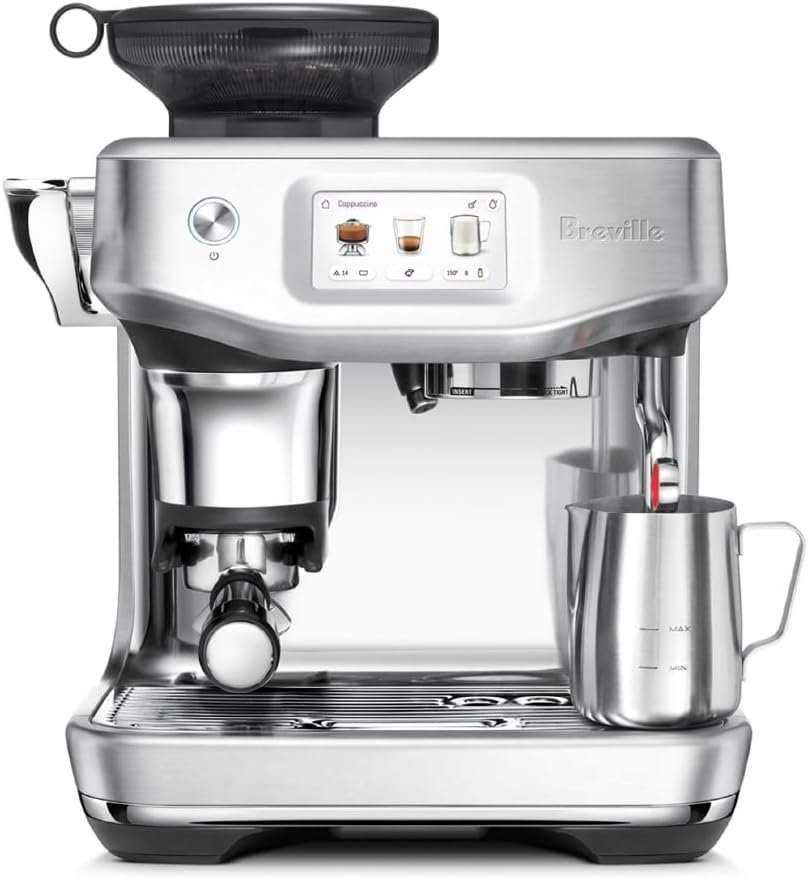
| Controls | Touchscreen human interface with step-by-step guidance and Impress Puck System feedback |
| Dimensions & weight | 13.62″ D x 14.09″ W x 16.42″ H; approximately 24.2 pounds |
| Intended users | Home enthusiasts, households who value convenience and milk drinks |
| Included accessories | Razor trimming tool, cleaning tablets and tools, water filter holder, milk jug, 1 & 2 cup baskets |
The feature set emphasizes a hybrid of automation and manual control: an integrated grinder with dosing guidance and assisted tamping reduces user variability, while the ThermoJet heating architecture and Auto MilQ aim to shorten wait times and simplify milk texturing. These features together affect extraction repeatability, milk microfoam quality, and the time-to-cup for routine use.

Brewing method compatibility and drink variety
The machine is positioned to support a range of espresso-centric beverages, with design choices that prioritize milk-based drinks and single-serve espresso. The integrated grinder, dual-wall baskets, and 54 mm portafilter align with typical home espresso workflows, enabling both easier single-serve extraction and more experienced adjustments via grind and dose. Auto MilQ targets milk texturing for lattes, cappuccinos, and alternative-milk beverages with calibrated air injection profiles, while the ThermoJet heat source reduces idle time between brewing and steaming. Buyers should assess compatibility with preferred beans, preferred milk types, and the degree of manual control desired; while the system automates key steps, grind settings and dosing still play a central role in extraction outcome and flavor balance.

Espresso and milk-based drink priorities
Espresso extraction demands a consistent dose, appropriate particle size distribution, and stable temperature. The machine’s integrated grinder and assisted tamping aim to deliver reproducible puck formation, which is especially relevant for single-shot workflows and milk drinks that require microfoam. Auto MilQ’s alternative milk settings attempt to optimize air introduction and temperature for soy, oat, and dairy variants, which affects sweetness perception and crema integration. For users prioritizing cappuccinos or latte art, steam wand power and texture control—paired with the supplied stainless steel milk jug—are critical. Those who prefer manual latte art practice or precise shot profiling should confirm that grinder step increments and dosing behavior meet their expectations.
Ground coffee and bean selection considerations
Grind consistency and particle distribution from the integrated burrs determine the machine’s ability to extract evenly across different roast levels. Medium to medium-dark single-origin beans and blends commonly used in home settings respond well to the dosing and tamping automation, but very light roasts or oily beans may require more frequent burr adjustment and cleaning. Dual-wall baskets provide more forgiveness for users experimenting with grind settings, while single-wall baskets expose extraction nuances that experienced users monitor. Compatibility with whole-bean input only means a separate grinder is not required, but users who alternate frequently between bean types should plan for routine grinder calibration and occasional dosing adjustment to maintain extraction balance.
Ease of use and workflow complexity
The machine is designed around guided operation and automation to simplify repetitive steps for home use. A touchscreen human interface offers step-by-step barista guidance and real-time feedback from the Impress Puck System, streamlining dosing, tamping, and milk texturing. Assisted tamping with a programmed 22 lb compression target and an automated correction algorithm reduces inconsistent puck preparation, which shortens the learning curve for new users. The integrated grinder and single-button or touchscreen selections reduce manual coordination between grinding and extraction, while the ThermoJet aims to eliminate the warm-up wait commonly associated with heat exchangers. Despite automation, workflow complexity remains for users who want to dial in extraction parameters manually; the machine preserves adjustable grind settings and milk texture controls for that purpose.

Touchscreen guidance and user experience
A capacitive touchscreen replaces many physical switches, consolidating grind, dose, shot volume, milk type, and temperature settings into a single interface. Guided prompts from the Impress Puck System outline dosing and tamping steps and provide feedback designed to help users adjust settings over time. This reduces the number of manual micro-adjustments required during routine brewing but also means that firmware behavior and menu logic shape the daily workflow; users accustomed to purely manual interfaces should assess whether the on-screen options offer the necessary granularity. Touchscreen responsiveness, menu clarity, and the presence of shortcuts for frequently used drink profiles will directly affect daily throughput in a household setting.
Integrated grinder and assisted tamping impact on workflow
Combining an integrated conical burr grinder with intelligent dosing and assisted tamping consolidates grinder-to-portafilter workflow into fewer steps. Intelligent dosing automates portioning, and the assisted 22 lb tamp aims to standardize puck consistency across cycles. This reduces operator variability, particularly in multi-user households or when preparing drinks quickly. However, the integration also centralizes potential maintenance points—grinder cleaning, burr replacement, and tamp calibration—and means that any grinder-related issues can affect the entire espresso workflow. Users should plan for routine grinder maintenance and keep spare accessories, like the included Razor trimming tool, to maintain consistent dosing and extraction.
Temperature control and heat stability
Temperature stability is a core determinant of extraction quality and flavor balance. The ThermoJet heating system is engineered to reach optimal extraction temperature quickly, minimizing idle warm-up time and facilitating near-instant readiness for a pull. Rapid heat-up benefits households that value time-to-cup, but temperature stability during sequence pulls and milk steaming depends on the machine’s ability to maintain setpoint under load. The Auto MilQ steam circuit introduces additional thermal demand during milk texturing; a heating architecture that recovers swiftly after steam cycles preserves shot-to-shot consistency. Buyers focused on precise temperature control should weigh how ThermoJet’s rapid recovery characteristics align with multiple successive brews and heavier steam usage common in group servings.

ThermoJet heating system characteristics
ThermoJet is a rapid-heat technology that prioritizes fast readiness rather than large thermal mass. The approach reduces warm-up delay and typically enables stable extraction temperature for an initial shot. Thermal recovery between shot and steam cycles is a crucial performance aspect: a quick-recovery heater supports consecutive milk drinks by minimizing temperature drift. However, systems with smaller thermal buffers can be more sensitive to ambient temperature and sequence length, which can require slightly longer recovery pauses during heavy use. Consumers should consider typical usage patterns—single morning drinks versus serving multiple beverages back-to-back—when evaluating whether rapid heat-up outweighs large thermal mass stability.
Steam performance and milk texture stability
Steam power and the auto steam wand’s ability to control air introduction and temperature define microfoam quality and texture consistency. Auto MilQ’s calibrated settings for different milk types adjust air injection time and target temperatures to produce silky microfoam suitable for latte art and balanced milk sweetness. The steam circuit’s pressure, wand design, and milk jug geometry cooperate to integrate foam and liquid milk smoothly. For users who prioritize professional-level latte art or very dense microfoam for cappuccinos, the responsiveness of steam pressure and the ability to make fine manual adjustments remain important considerations despite automated profiles.
Brew consistency and extraction quality
Extraction quality is the product of grind uniformity, dose accuracy, puck preparation, temperature stability, and pressure control. The Impress Puck System addresses puck formation and dosing by providing real-time feedback on tamping and automatic correction for subsequent doses, which can reduce channeling and uneven extraction. A 54 mm portafilter and conical burr grinder provide industry-appropriate hardware for home-focused extraction, while dual- and single-wall baskets support both forgiving and precise brewing approaches. Pressure dynamics are determined by pump architecture and basket type; while the machine is semi-automatic, the combination of dosing guidance and temperature management aims to improve repeatability for users across skill levels.

Impress Puck System and dosing effects on extraction
The Impress Puck System is engineered to standardize puck density through assisted tamping and dose correction logic. Consistent puck density reduces voids and channels during water percolation, improving uniformity of extraction across the coffee bed. Intelligent dosing reduces shot-to-shot weight variance, which directly influences brew strength and balance. While automated puck formation simplifies consistent extraction, the system does not eliminate the need for appropriate grind setting and dose selection; users must still calibrate grind size and dose to match bean roast profile and basket type to achieve optimal flavor extraction.
Pressure, flow control, and shot timing considerations
Semi-automatic espresso machines rely on pump pressure and basket resistance to control flow rate; this machine’s pump architecture combined with basket type impacts extraction timing and pressure profile. Dual-wall baskets provide built-in resistance and are forgiving when grind consistency is variable, whereas single-wall baskets reveal finer extraction dynamics and require more precise grind and dose control. Shot timing, measured as total extraction time, interacts with grind and dose to shape soluble extraction percentage and flavor balance. For users focused on espresso clarity and body, monitoring flow rate and adjusting grind steps is essential when moving between basket types or bean origins.
Capacity, cleaning, and durability considerations
Capacity and serviceability influence suitability for household routines and long-term ownership. A 67.6 fluid ounce removable water reservoir and a 480 ml milk jug support multiple drinks between refills, while the machine’s approximately 24.2 pound build paired with brushed stainless steel surfaces suggests durable styling for counter use. Cleaning expectations include daily rinsing of milk components, regular backflushing with provided cleaning tablets, and periodic burr cleaning for the integrated grinder. Accessories included—such as cleaning discs, brushes, and descaling powder—reflect manufacturer guidance on maintenance. Durability considerations hinge on build quality, frequency of heavy steam cycles, and adherence to cleaning schedules to reduce wear on seals, valves, and burrs.

Water reservoir, serving flexibility, and throughput
A 67.6 fluid ounce reservoir accommodates several single-serve espresso or milk-based drinks before refilling, suitable for small households or moderate daily use. Removability simplifies refilling and access to the water filter holder. Throughput for successive drinks is influenced by ThermoJet recovery time and how frequently milk steaming is required; serving multiple milk drinks back-to-back places greater thermal and steam-system demand on the machine. Users planning frequent entertaining or sustained multi-cup service should factor in recovery pauses and possibly pre-steaming intervals to maintain consistent milk texture and shot temperature.
Cleaning regimen and parts longevity
Routine maintenance includes rinsing and purging the steam wand after each use, regular backflushing with supplied cleaning tablets for the group head, and periodic descaling as recommended by manufacturer disclosures. The integrated grinder requires burr cleaning and possible replacement over extended use to maintain grind consistency. Stainless steel exterior surfaces and included stainless components resist corrosion but still require regular cleaning to maintain finish. Adherence to the maintenance cadence preserves performance and reduces the likelihood of premature wear on seals, gaskets, and moving components.

Pros & Cons
Pros
- Guided extraction and user interface reduce learning curve: The touchscreen and Impress Puck System provide step-by-step prompts and feedback for dosing and tamping, which helps standardize puck preparation and reduces variability between users.
- Rapid heat-up with ThermoJet shortens time-to-cup: The rapid heating system is designed to make the machine ready quickly, supporting routine morning use where wait time reduction improves convenience.
- Integrated grinder with intelligent dosing streamlines workflow: Built-in conical burrs and automated dosing minimize the need for a separate grinder and consolidate the grind-to-portafilter workflow.
- Auto MilQ supports alternative milk profiles: Calibrated air injection and temperature presets for different milk types produce consistent microfoam suitable for milk-based drinks.
- Robust materials and accessory set included: Brushed stainless steel exterior, a stainless steel portafilter, and supplied cleaning tools and milk jug increase perceived durability and readiness for maintenance tasks.
- Dual- and single-wall baskets provide flexibility: Included basket types enable forgiving extraction for beginners and more precise brewing for users refining technique.
- Assisted 22 lb tamping increases puck consistency: A programmed tamp force and corrective dosing logic promote repeatable puck density across cycles.
Cons
- Integrated grinder centralizes maintenance needs: The built-in grinder simplifies setup but concentrates potential failure points; burr cleaning and occasional calibration are required and can impact overall uptime.
- Automated systems reduce manual control granularity: While guided presets enhance convenience, they may limit fine-grain manual adjustments desired by experienced users seeking precise shot profiling.
- Thermal buffer considerations for heavy throughput: Rapid-heat architectures with smaller thermal mass can be more sensitive to repeated steam cycles, potentially requiring short recovery pauses during multi-drink service.
- Touchscreen-dependent workflow may not suit all users: The menu-driven interface replaces many physical controls, which may be less appealing to those preferring tactile knobs and direct manual overrides.
Final Verdict: Who This Product Is Best For (and Who Should Skip It)
The machine is a compelling option for household and enthusiast users seeking a balance between automation and manual control. It is well suited to home baristas who prioritize quick readiness, integrated grinding, and consistent milk texturing for daily lattes, cappuccinos, and single espresso shots. The guided tamping and dosing, paired with touchscreen instruction, lower the learning curve and help multi-user households achieve repeatable results without an additional grinder. For buyers who serve multiple drinks in rapid succession or who demand full manual profiling and the largest thermal mass for extreme temperature stability, a machine with a larger boiler or separate grinder may be more appropriate. Those who prioritize replaceable, high-capacity commercial components or who prefer fully manual steam wands should consider alternatives. Overall, this machine fits home users wanting streamlined workflows, reliable milk steaming, and integrated features that simplify consistent espresso and milk-based beverages.

Frequently Asked Questions (FAQs)
How does the ThermoJet heating system affect warm-up and shot-to-shot stability?
ThermoJet is a rapid-heat architecture designed to minimize warm-up time and deliver near-instant readiness for brewing. Fast heat-up reduces initial wait time, but absolute shot-to-shot temperature stability also depends on thermal recovery after steaming. For multiple consecutive milk drinks, brief recovery periods may be advisable to maintain consistent extraction temperature and steam pressure.
Can the integrated grinder provide consistent grind sizes for different roast levels?
Integrated conical burr grinders are capable of producing a useful range of grind settings for most home espresso applications. Consistency across roast levels depends on burr maintenance, regular cleaning, and calibration. Very light roasts or oily beans may require more frequent adjustments and cleaning to maintain consistent particle distribution and extraction performance.
Is the Auto MilQ system suitable for alternative milks like oat and almond?
Auto MilQ includes calibrated settings intended to adjust air injection and temperature for common alternative milks, helping achieve silky microfoam suitable for lattes and cappuccinos. Texture and sweetness can vary by milk formulation, so some manual adjustment or tamp-to-milk timing may still be necessary to reach preferred mouthfeel.
What maintenance is required to keep extraction quality consistent?
Routine maintenance includes daily steam wand purging and cleaning, regular backflushing of the group head with cleaning tablets, periodic descaling according to water hardness and use, and grinder burr cleaning. Consistent maintenance preserves grind uniformity, pump and valve performance, and reduces the risk of flavor deviation caused by scale or residual oils.
How does assisted tamping influence puck preparation and extraction?
Assisted tamping applies a consistent compression force intended to standardize puck density and reduce channeling risks. Combined with intelligent dosing and puck feedback, it improves repeatability for users who may otherwise vary tamp force. However, proper grind size and dose selection remain essential to achieve balanced extraction.
What serving capacity and throughput can be expected from the machine for household use?
The removable 67.6 fluid ounce water reservoir and 480 ml milk jug support several single-serve drinks between refills, making the machine suitable for households and moderate daily use. Throughput for back-to-back milk drinks depends on thermal recovery and steam demand; heavier consecutive service may require brief intervals to maintain consistent milk texture and shot temperature.
Are dual-wall filter baskets helpful for beginners?
Dual-wall baskets offer built-in resistance that can compensate for grind and dose variability, making extraction more forgiving for less experienced users. They simplify shot preparation and reduce visible channeling, but single-wall baskets reveal finer extraction nuances and are preferred when aiming for precise control and higher clarity in flavor.