Breville Smart Grinder Pro Review — Precision Grinds for Home
Why grinder choice matters for home brewing
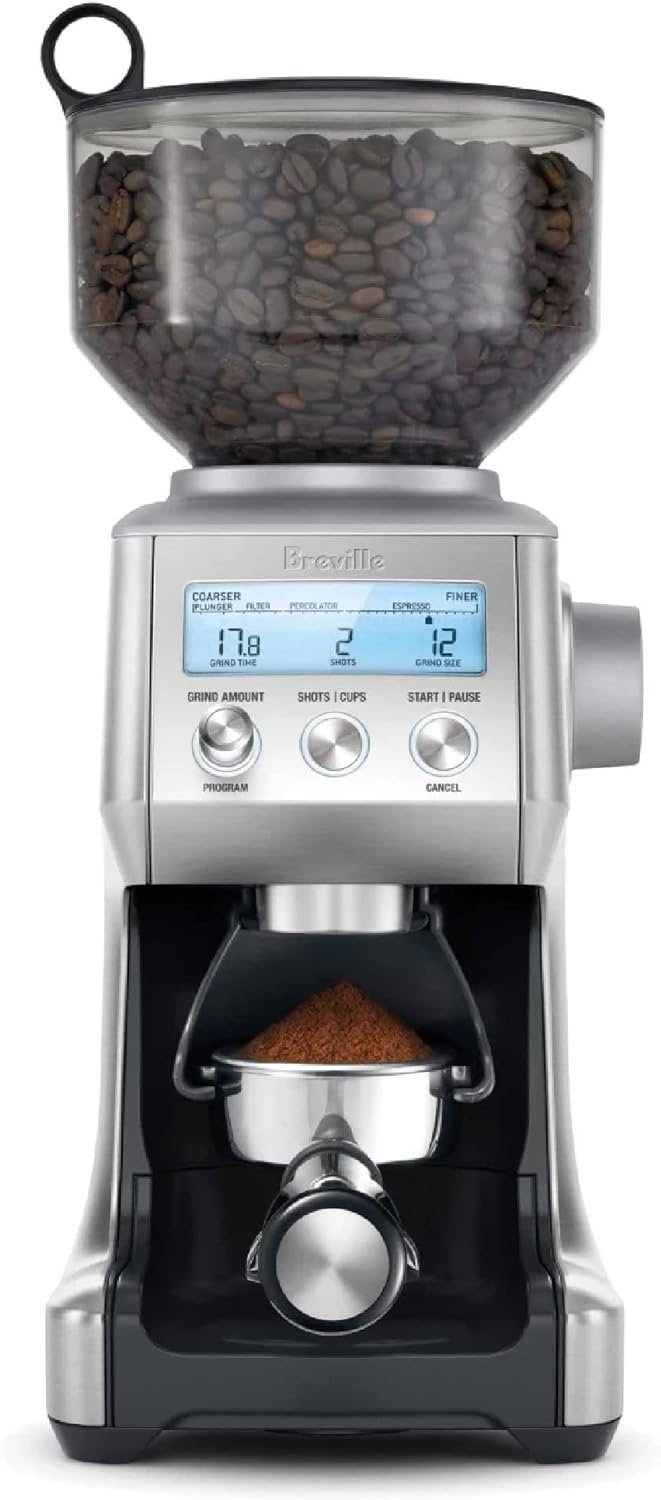
Choosing the right grinder shapes coffee and tea outcomes more than nearly any other single appliance decision. Grind particle distribution, dose accuracy, and repeatable settings are core determinants of extraction balance, crema quality for espresso, and clarity for filter brews. Home brewers and enthusiasts benefit from a grinder that offers a wide grind range, predictable dosing, and durable components that preserve bean flavor over time. For households serving multiple brewing methods, a grinder that can switch cleanly between fine espresso and coarse immersion settings without lengthy recalibration lowers friction and improves consistency. The Breville Smart Grinder Pro positions itself as a versatile option with 60 stepped grind settings, conical burrs, digital dosing control in 0.2 second increments, and multiple dispense options, aimed at consumers who want dialed-in grinds without aftermarket modification or a dedicated commercial unit.
Quick Overview
| Feature | Details |
|---|---|
| Product category | Precision conical burr grinder for home coffee and espresso |
| Grind range | 60 stepped grind settings covering espresso to French press |
| Dosing system | Digital timer dosing (Dosing IQ) adjustable in 0.2 second increments |
| Dispense options | Grind to portafilter, airtight container, or paper/gold-tone filter |
| Burr type | High-quality stainless steel conical burrs |
| Hopper capacity | 18 oz bean hopper |
| Power & voltage | 165 Watts, 110-120 Volts |
| Materials & construction | Brushed stainless steel exterior with polymer components; included portafilter cradles |
| Included accessories | Portafilter cradles (50–54mm and 58mm), grind container with lid, cleaning brush |
| Warranty | 2 Year Limited Product Warranty |
These specifications affect daily usability and brew quality by balancing grind versatility and user control. The stepped grind wheel and sizable hopper support multiple brew styles without constant refilling, while the digital dosing and portafilter compatibility streamline workflow for espresso preparation and batch brewing. Materials and included accessories indicate a design intended for routine home use with moderate servicing.

Grind quality and extraction potential
Grind particle control determines extraction rate, surface area exposure, and ultimately cup balance; the Breville Smart Grinder Pro’s conical stainless steel burrs and 60 stepped settings provide a broad mechanical range that supports both fine espresso and coarse immersion grinds. The stepped adjustment system simplifies repeatability, offering users the ability to return to a known setting for a given bean and brewing method. Conical burr geometry tends to generate a bimodal particle distribution that can be favorable for espresso and general home use, while material choice and burr sharpness influence retention and heat transfer. Together these elements set realistic expectations for extraction performance in a domestic setting, where consistency must be achieved without professional calibration tools.

Burr geometry, material, and retention
Conical stainless steel burrs, as specified by the manufacturer, prioritize durability and a moderate heat transfer profile during grinding. Conical profiles generally shed fewer fines at coarser settings and produce a particle mix that can emphasize body and sweetness in immersion methods while still enabling fine tuning for espresso. Burr retention — the amount of ground coffee that remains trapped in the grinder — is affected by hopper and burr housing design; stepped grinders often show predictable retention levels tied to setting and grind coarseness. For workflows where dose accuracy is critical, understanding and accounting for retention is necessary when switching between brewing modes or when precise single-dose grinding into a portafilter is required.
Grind distribution and extraction implications
A 60-step adjustment range provides relatively fine mechanical control across the grind spectrum, allowing incremental changes that influence extraction time and solubility. For espresso, small step changes translate to measurable changes in flow and extraction; for coarser methods, larger step differentials enable coarse, open-pore profiles needed for French press or cold brew. The stepped interface helps maintain reproducibility between sessions, but users should anticipate that grind distribution characteristics—fines percentage and particle variance—will remain dependent on burr condition, bean age, and roast level. Consistent dosing combined with repeatable grind settings supports predictable extraction behavior within home-brewing tolerance levels.
Brewing method compatibility and versatility
Versatility is essential for households that prepare multiple brew styles; compatibility depends on both grind range and dispense flexibility. The Smart Grinder Pro’s 60-step settings, coupled with the ability to grind directly into a portafilter, airtight container, or filter basket, enable transitions between espresso, pour-over, drip, and immersion methods without major hardware changes. While stepped adjustments are user-friendly for repeatability, precise espresso micro-adjustments can be more granular on stepless grinders; however, for many home users the balance of simplicity and range is preferable. The inclusion of portafilter cradles and dosing presets supports typical espresso workflows, while coarse settings and container dispense suit batch brewing and manual filter systems.

Espresso readiness and portafilter workflow
Grind-to-portafilter capability and a dedicated portafilter cradle simplify espresso preparation by allowing grounds to be delivered directly into a 50–54mm or 58mm portafilter. Digital dosing in small increments helps target consistent doses, reducing the need for manual tamp weight compensation between shots. Still, stepped settings may require trial-and-error for dialing in a specific espresso shot because micro-adjustments are grouped; users seeking razor-fine step control for high-pressure extraction may find limitations compared to commercial or stepless home grinders. For routine home espresso workflows that value speed and repeatability, the integrated dosing and physical cradles improve throughput and reduce mess.
Coarse and filter brewing suitability
At the other end of the spectrum, the grinder’s upper-step settings produce particle sizes suitable for immersion and manual filter methods, with the hopper capacity supporting larger batch grinds. Grinding directly into an airtight container preserves aromatics for filter or batch use, and the stepped range enables repeatable coarse settings without recalibration. Particle distribution on coarser settings tends to favor body retention for French press while maintaining enough uniformity for consistent pour-over extraction when paired with appropriate brew ratios and grind adjustments. For cold brew and large-batch filter preparations, the combination of a large hopper and wide stepped range offers practical advantages for household use.
Usability, controls, and workflow efficiency
User interaction points — hopper access, grind adjustment, dosing controls, and display feedback — shape daily workflow speed and error rates. The Smart Grinder Pro includes an LCD showing grind setting, grind time, and shot/cup selections, and permits programming of dose time in 0.2 second increments, which supports precise time-based dosing. The stepped grind ring is indexed for repeatable adjustments, and the multiple dispense modes reduce the need to transfer grounds manually. Operational ergonomics also include removable grounds containers and portafilter cradles that stabilize the toolchain. Overall, control simplicity is balanced with enough programmability for most home users, though those who prioritize adaptive grind-by-weight dosing or silent operation may find these features absent.

Digital dosing (Dosing IQ) and time-based accuracy
The manufacturer’s digital dosing system measures dose by time, adjustable in 0.2 second increments, which allows high-resolution control of output for a given grind setting and bean. Time-based dosing provides consistent mass flow only if bean density and roast change minimally; variables like bean oiliness, roast degree, and humidity can alter mass-per-second throughput, requiring periodic recalibration. Time dosing simplifies repeatable workflows where weight scales are not used; however, achieving absolute mass accuracy requires either frequent calibration or pairing with scale verification. For routine home use the time-based dosing feature dramatically improves speed and repeatability compared with untimed, manual grinding.
Interface, presets, and day-to-day ergonomics
The LCD and preset shot/cup options give immediate feedback on selected outputs, reducing cognitive load during busy preparation. Portafilter cradles reduce spillage and stabilize the filter basket during dosing; the included sizes reflect common home espresso basket diameters. Hopper removal and the grind chute design influence cleaning speed and spillage control, while control button placement and menu simplicity affect how easily users switch between presets. The Smart Grinder Pro emphasizes a straightforward user experience that supports frequent switching between brewing modes without advanced menu navigation, an advantage for household routines with multiple beverage types.
Capacity, heat, and motor characteristics
Capacity and motor design determine throughput, heat generation, and the appliance’s suitability for group brewing or continuous operation. An 18 oz bean hopper supports multiple servings before refilling, which suits households and small gatherings. At 165 Watts, the motor provides adequate torque for domestic grinding tasks while limiting size and power draw. Wattage and burr type are factors in heat buildup; higher duty cycles can increase burr temperature, which may influence volatile retention and grind particle dynamics. For most home use patterns—short bursts of grinding between shots or daily batches—the motor and burr system are aligned with maintaining thermal stability, but extended continuous grinding should be avoided to reduce heat-related flavor drift and to preserve burr life.

Hopper capacity and serving flexibility
An 18 oz hopper enables preparation of multiple cups or shots before requiring a refill, improving convenience for households that prepare several beverages consecutively. The capacity also supports batch grinding into an airtight container for pour-over or immersion brewing. For single-dose espresso workflows, however, larger hoppers can contribute to bean staling over longer periods if exposed to air; users focused on small-batch freshness may prefer to store beans separately and refill the hopper only when needed. The option to grind directly into a container or portafilter mitigates some trade-offs between capacity and freshness by allowing controlled transfer and storage.
Motor power, heat generation, and temperature stability
A 165 Watt motor is typical for domestically oriented conical burr grinders and balances grinding speed with manageable thermal output. Conical burrs generally dissipate heat moderately well compared with high-speed flat burr setups, reducing volatile loss during short grinding cycles. Nevertheless, repeated extended grinding cycles increase burr and bean temperature, which can alter extraction characteristics through increased solubility and aroma volatility. For maintaining temperature stability and predictable extraction, recommended home workflows include grinding in short bursts, allowing cool-down periods for the burr assembly, and avoiding continuous long runs that would be more typical in commercial settings.
Cleaning, maintenance, and expected longevity
Maintenance expectations hinge on access to burrs, the ability to clear retained grounds, and replacement part availability. The grinder includes a cleaning brush and removable grounds container; conical burrs are accessible for routine brushing and inspection, but complete disassembly for deep cleaning should follow manufacturer guidance. Burr replacement intervals depend on usage patterns, bean abrasiveness, and roast profiles; stainless steel burrs typically offer several years of service under normal home use before replacement is necessary. The 2 Year Limited Product Warranty and the prevalence of replacement parts in the aftermarket support medium-term reliability, but expected longevity is also influenced by cleaning frequency, exposure to oily beans, and the duty cycle imposed by the household.
Cleaning access and routine procedures
Routine cleaning includes emptying the hopper, brushing the burrs and chute to remove lodged grounds, and wiping external surfaces to prevent buildup. The presence of a removable grind container and a brush simplifies day-to-day maintenance and reduces cross-contamination between different bean varieties. For deeper maintenance, periodic disassembly to access the burrs may be necessary to clear accumulated fines and oils; following manufacturer instructions ensures reassembly tolerances and safety. Regular maintenance helps maintain consistent grind distribution and reduces wear-related drift in grind settings.
Materials, construction, and long-term reliability
Brushed stainless steel exterior elements combined with polymer internals balance durability and cost for home appliances. Stainless surfaces resist corrosion and provide a stable chassis, while internal polymer parts reduce noise and manufacturing complexity. Long-term reliability depends on burr condition, motor wear, and user maintenance habits. The two-year limited warranty provides a baseline manufacturer-backed period of coverage, and replacement accessories such as portafilter cradles and burrs are commonly available through authorized channels. Users should anticipate servicing or parts replacement after several years of frequent use, particularly if high-volume grinding or oily beans are routine.
Pros & Cons
Pros
- Wide grind range and repeatability: 60 stepped settings provide a broad spectrum from espresso-fine to French-press-coarse, enabling consistent returns to prior settings and supporting multiple brewing methods without frequent recalibration.
- Precise time-based dosing (Dosing IQ): Digital dosing adjustable in 0.2 second increments allows fine control over output volume and repeatable dosing for both shot-based and cup-based workflows when mass-per-second throughput is stable.
- Versatile dispense options: Ability to grind directly into a portafilter, airtight container, or filter basket reduces transfer steps and supports both single-dose espresso and batch-brew workflows.
- Quality conical burrs and durable materials: Stainless steel conical burrs and a brushed stainless exterior combine long-wearing cutting surfaces with a corrosion-resistant housing suitable for household environments.
- User-friendly interface and accessories: An LCD with shot/cup presets, included portafilter cradles (50–54mm and 58mm), and a cleaning brush streamline everyday use and maintenance.
- Generous hopper capacity: An 18 oz hopper reduces refill frequency for multi-cup households and supports batch grinding for pour-over and immersion methods.
Cons
- Stepped adjustment limits micro-tuning: While stepped settings aid repeatability, they do not allow the continuous micro-adjustments available on stepless grinders, which may be noticeable for advanced espresso dialing.
- Time-based dosing vs. weight accuracy: Dosing by time is convenient but sensitive to bean density and roast variability; achieving consistent mass requires periodic recalibration or weight verification.
- Heat and retention with heavy use: The motor and burr system are optimized for typical home duty cycles; extended continuous grinding can raise burr temperature and retention, impacting flavor and requiring cooldown periods.
- Replacement parts and long-term servicing: Although burrs are durable, heavy users should anticipate eventual replacement and depend on manufacturer/aftermarket parts availability; polymer internals may show wear sooner than all-metal commercial grinders.
- Stepped grind indexing can feel coarse for specialty espresso: Some specialty espresso users may find step increments too large to achieve ultra-fine dialing for highly specific roast/bean combinations.
Final Verdict: Who This Product Is Best For (and Who Should Skip It)
The Breville Smart Grinder Pro is best suited for home coffee enthusiasts and multi-method households seeking a balance of versatility, repeatability, and approachable controls. Its 60 stepped settings and 0.2 second dosing increments reliably support common brew styles—espresso, pour-over, drip, and immersion—while included portafilter cradles and an 18 oz hopper streamline routine workflows. Users who prize time-efficient, repeatable dosing and don’t require commercial-grade micro-adjustments will find the feature set aligns with household needs and casual espresso preparation. The grinder’s materials and warranty indicate an expected lifespan appropriate for domestic use when combined with routine maintenance.
This grinder is less appropriate for users who require the ultimate in espresso micro-tuning or those who depend on precise weight-based dosing for professional or high-volume work. Specialty baristas and heavy-volume commercial environments should consider stepless, high-torque designs with dedicated cooling and rapid burr replacement programs. Additionally, buyers seeking completely silent operation or integrated scales will need to evaluate alternative models. For most home brewers in 2026 seeking reliable grind control across multiple brewing methods, the Smart Grinder Pro offers a practical, feature-rich compromise between simplicity and performance.
Frequently Asked Questions (FAQs)
How fine can the Breville Smart Grinder Pro grind for espresso?
The grinder’s 60 stepped settings cover a range that includes fine settings suitable for espresso. Stepped adjustments allow users to return to a repeatable index setting for espresso, but the discrete steps mean the smallest increment change is fixed rather than continuously adjustable. For most home espresso workflows this provides adequate control, though specialty users seeking micro-adjustments might prefer stepless designs.
Does the Breville Smart Grinder Pro allow grinding directly into a portafilter?
Yes. The product includes portafilter cradles for both small (50–54mm) and large (58mm) baskets, enabling direct grind dispensing into a portafilter. This reduces transfer losses and simplifies workflow for espresso preparation. Stabilizing the portafilter during dosing helps minimize spillage and supports faster shot routines.
Is the dosing system weight-based or time-based?
The dosing system uses time-based digital control (Dosing IQ), adjustable in 0.2 second increments. Time-based dosing delivers consistent output when bean density and roast are stable; however, mass-per-second throughput can change with different beans, requiring periodic recalibration or use of a scale when absolute weight precision is needed.
How easy is the Breville Smart Grinder Pro to clean and maintain?
Routine cleaning is straightforward: the hopper can be emptied, the burr area brushed, and the removable grind container wiped. The included cleaning brush aids in removing lodged grounds. For deeper maintenance, partial disassembly to access burrs may be required per manufacturer instructions. Regular cleaning helps maintain consistent grind distribution and extends component life.
Will the grinder get hot during extended use?
The grinder is designed for domestic duty cycles and uses a 165 Watt motor with conical burrs that moderate heat generation. Short, intermittent grinding typical of home use minimizes temperature transfer to grounds. Extended continuous grinding can raise burr temperatures and may alter volatile retention, so allowing cool-down periods during heavy use is recommended to maintain flavor stability.
How suitable is this grinder for batch brewing like French press and cold brew?
The 60-step grind range includes coarse settings appropriate for immersion methods such as French press and cold brew, and the 18 oz hopper supports batch quantities. Grinding into an airtight container preserves aroma for later brewing. Particle distribution at coarse settings tends to retain body while allowing predictable extraction when paired with proper grind adjustments and brew ratios.
What is the expected longevity and warranty coverage for the Smart Grinder Pro?
The grinder features stainless steel conical burrs and a brushed stainless exterior with polymer internals designed for home durability. The manufacturer provides a 2 Year Limited Product Warranty. Longevity in daily use depends on factors such as cleaning frequency, bean oiliness, and grinding volume; burr replacement may be needed after several years of frequent use.
Is the stepped grind adjustment a problem for dialing in specialty espresso?
Stepped adjustments enhance repeatability but limit continuous micro-adjustment compared to stepless grinders. For many home users, the step resolution combined with time-based dosing is sufficient to achieve consistent espresso extraction. However, specialty users pursuing ultra-precise dialing for specific beans and roasts may prefer a stepless grinder for finer control.