Chefman CaféMaster Pro Review: Espresso Quality & Ease Guide
Why equipment choice matters for home espresso and who this machine suits
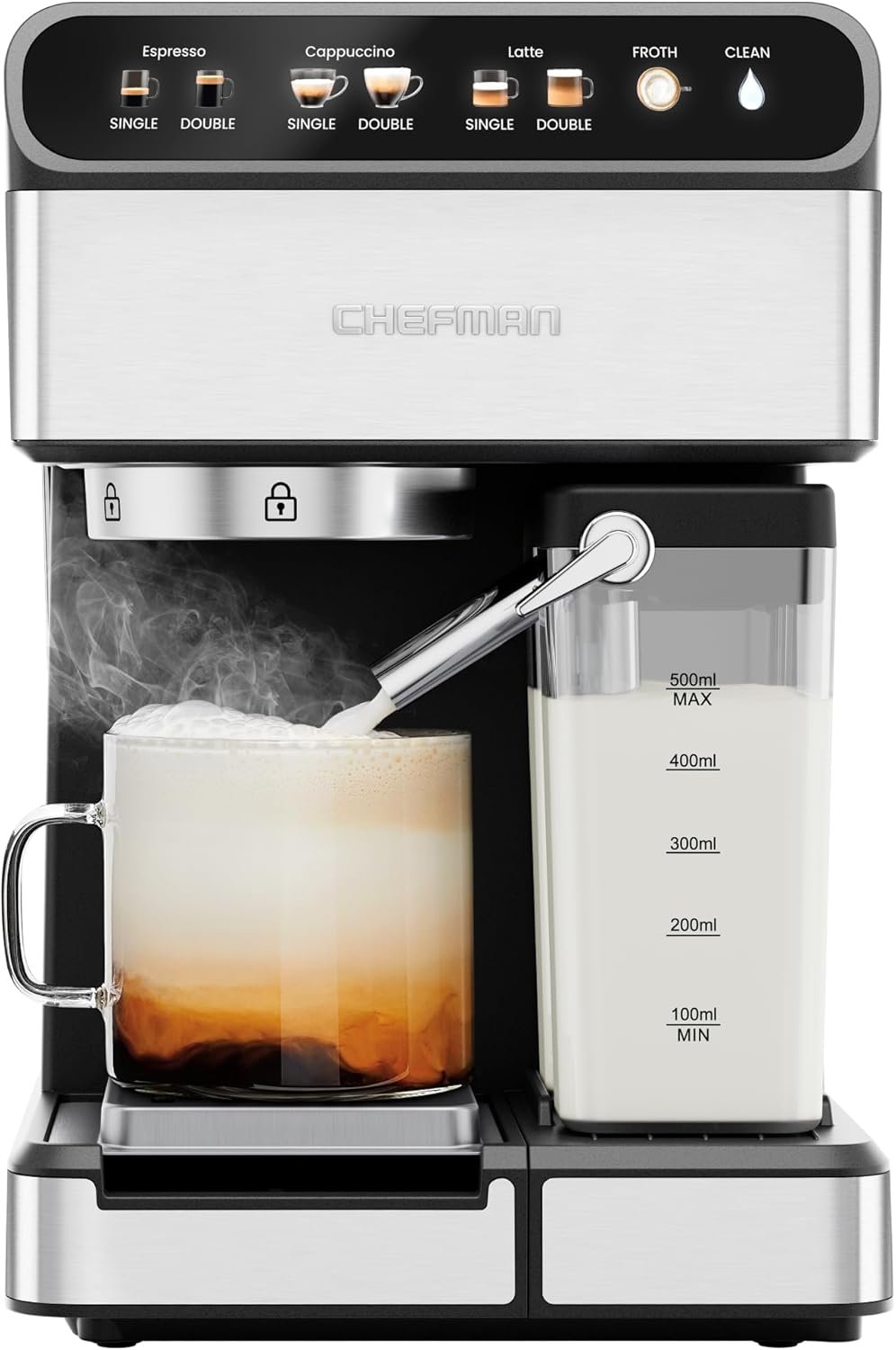
Selecting espresso and milk-steaming equipment profoundly affects brew results, workflow, and daily usability for home brewing. The Chefman CaféMaster Pro targets users seeking a compact, semi-automatic pump espresso machine with integrated milk frothing and a large removable water reservoir. Buyers should weigh extraction control, heat and steam stability, and component materials against the convenience of one-touch drink selection and automatic frothing. For households that serve cappuccinos and lattes, the combination of a 15-bar pump, a built-in milk frother that dispenses steamed milk directly into the cup, and a 1.8-liter reservoir speaks to throughput and convenience. Decision factors include grind and dose control, portafilter compatibility, and maintenance needs—each directly tied to extraction quality and long-term durability. This review focuses on specification-driven evaluation, brewing science, and aggregated user feedback to clarify who benefits from this design and which workflows require more advanced equipment.
Quick Overview
| Feature | Details |
|---|---|
| Product category | Pump espresso machine (semi-automatic) |
| Brewing method | Ground coffee espresso via 15-bar pump |
| Capacity | 1.8-liter removable water reservoir |
| Materials & construction | Stainless-steel exterior with plastic components and removable drip tray |
| Heating & pressure | 1350 Watts, 120 Volts; 15-bar pump; single boiler heating system inferred |
| Grind/filter compatibility | Ground coffee only; single and double shot baskets included |
| Best suited users | Home espresso enthusiasts, households making milk drinks, beginner-to-intermediate users |
| Intended use cases | Single/double espresso shots, cappuccinos, lattes, steamed milk beverages |
| Warranty & safety | cETL approved; 1-year manufacturer assurance |
The table highlights core hardware and intended uses that influence brewing performance. The 15-bar pump and included single/double shot baskets enable typical espresso extraction when combined with appropriate grind, dose, and tamping. The sizable removable reservoir supports multiple back-to-back drinks, while stainless-steel surfaces and a semi-automatic control scheme affect cleaning workflows and the level of manual control over extraction.

Brewing method compatibility and beverage range
The machine is engineered for traditional ground espresso brewing combined with automated milk steaming and dispensing for milk-forward drinks. The 15-bar pump provides the mechanical pressure source required for espresso extraction, while the included single and double shot baskets indicate standard dose ranges and portafilter workflow. Compatibility is limited to ground coffee—no capsule or pod integration is available—so grind consistency and dose control become primary determinants of shot quality. The automatic milk frother that dispenses steamed milk directly into the cup expands beverage variety toward cappuccinos and lattes, but the system’s preconfigured milk flow and steam profile will define attainable microfoam texture. For buyers prioritizing manual brewing methods such as lever or piston systems, this product’s semi-automatic, pump-driven architecture emphasizes convenience over granular pressure profiling.

Ground coffee compatibility and grind recommendations
Successful espresso extraction from a pump machine depends on consistent particle size, dose, and tamp. The CaféMaster Pro accepts ground coffee placed in the portafilter baskets; grind size should be tuned to deliver a 20–30 second extraction for a single shot at typical espresso brew ratios (roughly 1:1.5 to 1:2.5 beverage-to-dose by weight depending on taste). Because built-in grinders are not included, external burr grinders that provide uniform fines are recommended to achieve consistent flow and avoid under- or over-extraction. The machine’s pressure system reacts to puck resistance and flow rate, so small grind adjustments will significantly change shot balance. Users relying on pre-ground retail espresso blends may encounter variable results unless grind and dose are matched to the machine’s extraction behavior.
Milk frothing, automatic dispensing, and beverage variety
The built-in steam wand and automatic milk dispenser enable a range of milk-based drinks with simplified workflow. The machine’s design includes a removable frother that steam-heats and then automatically dispenses steamed milk into the cup, which shortens the sequence to prepare cappuccinos and lattes. Milk texture and temperature are governed by steam pressure, wand geometry, and internal control logic; therefore, microfoam quality will depend on steam stability and user technique where manual intervention is possible. Removability of the frother allows refrigerated storage between uses and makes hygiene management easier, though repeated use patterns and heat exposure can influence material wear. The automatic milk dispense feature prioritizes consistency and speed over full manual steam control sought by latte-art-focused users.
Ease of use and workflow complexity
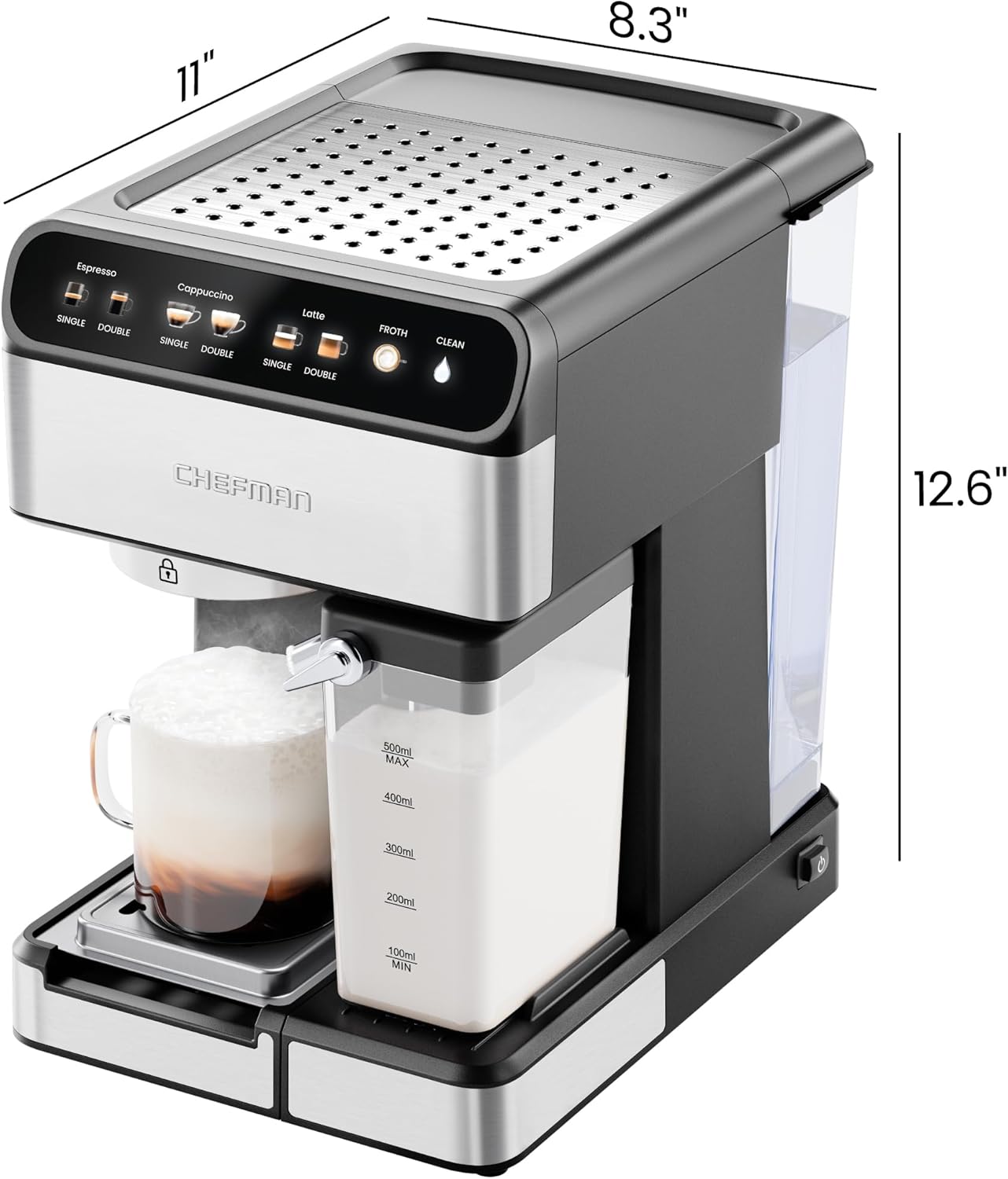
Operational simplicity is a key selling point for many users assessing this machine. A touchscreen human interface and one-touch options reduce the number of manual steps required for routine drinks, combining semi-automatic shot initiation with automated milk dispensing to shorten preparation time. The included tamper and scoop standardize dose preparation, while the removable components such as the water reservoir and drip tray simplify filling and cleanup. However, the semi-automatic classification means some tasks—grinding, tamping, dosing, and timing—remain manual, requiring basic skill and consistency to achieve repeatable results. For households prioritizing minimal learning curve, the CaféMaster Pro balances automation with hands-on elements; for users seeking complete programmable control over individual brew parameters, a higher-end prosumer model would offer more adjustable options.
Interface, controls, and portafilter workflow
The machine’s touchscreen interface is intended to streamline selection between single and double shots and to trigger automatic frothing cycles. Touch controls reduce button complexity but can limit direct adjustment of shot variables such as pre-infusion time or volumetric shot size if those settings are not exposed. The portafilter-based workflow mirrors traditional espresso machines: dose grounds into the included basket, tamp, lock the portafilter into the group head, and initiate extraction. Portafilter size, basket depth, and provided tamper dimensions influence the ease of achieving consistent puck compression. Semi-automatic machines rely on operator discipline for dosing and tamping, and the interface primarily supports clarity and speed rather than in-depth parameter tuning.
Preparation steps and typical cycle times for a cup
Typical preparation cycles for an espresso-plus-milk drink on a semi-automatic integrated machine involve grinder-to-portafilter dosing, tamping, preheat and extraction, and automated milk frothing. Heat-up time for boiler and steam readiness is an important workflow factor; while explicit warm-up durations are not published, devices with single-boiler systems and 1350 Watts typically require a few minutes to reach stable extraction temperatures. The automated milk frother shortens milk steaming and pouring steps by combining steaming and dispensing, reducing active user time. However, successive drinks can require short cooldowns or repeated steam cycles; throughput considerations become important for multi-cup service during gatherings or brunch.
Temperature control and heat stability
Temperature stability directly influences extraction consistency and flavor balance; espresso extraction is sensitive to water temperature, with ideal inlet temperatures typically in the 195–205°F range for conventional espresso theories. The CaféMaster Pro’s heating specifications (1350 Watts) and single-boiler design suggest a compact thermal mass that heats efficiently but may present more temperature variance under heavy use compared with larger heat-exchange or dual-boiler systems. Steam generation for milk frothing competes with brew temperature demands in single-boiler architectures, so simultaneous steaming and extraction is generally not possible without trade-offs. Aggregated user reports often highlight adequate heat for standard shots but note that extended back-to-back brewing and frequent steam cycles can produce small temperature dips, which are characteristic of compact single-boiler pump machines.

Boiler, heating system characteristics, and implications for stability
A single-boiler system with 1350 Watts of power typically provides quicker initial warm-up and lower idle energy draw, but the smaller boiler volume holds less thermal reserve than dual-boiler systems. The practical result is that temperature recovery after steam use or repeated shots can be slower, and the machine may cycle heating elements more frequently to maintain setpoints. For home users making intermittent drinks, this configuration is efficient and well-matched to typical daily patterns. For users needing precise, repeatable temperature across long multi-cup sessions or simultaneous steam and brew, equipment with independent brew and steam boilers would offer stronger stability and less recovery time between functions.
Steam wand performance and milk temperature control
Steam generation for milk texturing depends on pump pressure, steam tip design, and boiler pressure management. The CaféMaster Pro’s steam wand and automatic frother are designed to produce steamed milk and dispense it automatically, which simplifies milk drink preparation. Achievable milk temperature and foam quality are governed by steam pressure stability and wand aeration capability; with compact boilers, steam pressure can fluctuate during repeated cycles. Users seeking fine-grained milk temperature control for latte art or precise microfoam may find manual steam-only systems with adjustable steam valves and greater boiler capacity more appropriate. For typical cappuccinos and lattes, automatic dispensing plus a stable steam profile will deliver acceptable temperature and texture for most home drinkers.
Brew consistency, extraction quality, and flow control
Extraction quality hinges on the interaction of pressure, water temperature, contact time, grind, dose, and puck integrity. The 15-bar pump provides the mechanical capacity to reach necessary pressures, but effective espresso extraction depends on stable pressure delivery across the shot and proper flow resistance from the puck. The machine’s included single and double shot baskets define dose envelopes and require matching grind and tamping technique to achieve target flow rates. Flow control is primarily passive here—determined by the puck—rather than actively modulated by pressure profiling. Aggregated feedback indicates reasonable shot-to-shot consistency when users control grind and dosing well, but inconsistent results occur when pre-ground coffee or inconsistent tamping are used. Understanding extraction principles helps optimize the CaféMaster Pro’s capabilities within the limits of its semi-automatic pump architecture.

Pump pressure, pressure profile, and impact on shot extraction
A 15-bar pump is the common specification for consumer pump espresso machines; effective extraction depends on the pump’s ability to stabilize at an operational pressure that produces ideal flow through the coffee puck. Pressure control influences the rate at which solubles dissolve and how flavors are extracted. Because the CaféMaster Pro is a semi-automatic device without advanced pressure profiling, pressure is applied in a relatively fixed manner—suitable for classic espresso shots but not for staged pressure techniques like pre-infusion ramps used to refine extraction. Proper dose, uniform tamping, and correct grind setting are therefore the primary levers to achieve balanced shots and consistent crema, while the pump supplies the necessary mechanical force.
Grind, dose, tamping, and their practical effects on extraction
Grind particle distribution and dose accuracy are critical to establishing the flow resistance needed for consistent espresso. The CaféMaster Pro provides portafilter baskets and a tamper, which translate operator steps into the necessary puck preparation. A uniform, fine grind and a consistent dose produce predictable resistance and extraction time; conversely, uneven grind sizes or variable tamp pressure cause channeling and irregular flow, yielding under- or over-extracted flavors. Since the machine lacks an integrated grinder, pairing it with a reliable burr grinder and measuring doses by weight will most effectively leverage the pump and boiler system. Training in tamping technique and simple timing routines can substantially improve everyday consistency.
Capacity, cleaning expectations, and durability considerations
Capacity, maintenance, and build quality determine fit for home routines and long-term ownership. The 1.8-liter removable water reservoir supports multiple successive drinks and simplifies refilling; however, a larger removable tank often requires adequate cabinet clearance for removal and reinstallation. The stainless-steel exterior suggests robust visual durability, while many functional components (drip tray, internal tubing, certain structural parts) incorporate plastic for weight savings and cost control. Cleaning convenience is aided by removable parts and an internal cleaning function, but milk-system hygiene remains a critical requirement: the removable frother must be disassembled and cleaned regularly to prevent residue buildup. Aggregated user feedback mentions generally satisfactory durability for the price and typical home usage patterns but notes that repeated heavy use and infrequent maintenance can accelerate wear on seals and frothing components.

Water reservoir capacity, serving flexibility, and throughput
A 1.8-liter reservoir is larger than many compact home machines and supports several espresso-based drinks before refilling, making it practical for small household entertaining or morning routines. Removability enables sink filling and simple descaling access. Throughput during multiple back-to-back drinks will be influenced by the single-boiler heating cycle: while reservoir volume supports quantity, thermal recovery after steaming or repeated extraction affects continuous performance. For users who regularly prepare many milk drinks in quick succession, scheduling short pauses or allowing brief heat recovery will maintain brew temperature and steam quality. For occasional entertaining, the reservoir size reduces refill interruptions and streamlines the service flow.
Cleaning, maintenance cadence, materials, and long-term reliability
Removable drip tray, portafilter baskets, and detachable frother simplify daily cleaning; the internal cleaning function further assists with descaling and general sanitation. Milk lines and frothing tips require frequent cleaning after each use to prevent milk residues and bacterial growth—removability of the frother helps facilitate this. Materials such as stainless-steel exterior panels resist staining and simplify wipe-downs, while internal plastic parts and seals may require replacement over time. Aggregated user reports typically cite acceptable longevity for household use when routine cleaning and descaling schedules are followed, but some users note that neglecting milk-system hygiene or skipping periodic descaling accelerates wear and can reduce steam performance.

Pros & Cons
Pros
- Compact semi-automatic pump design with milk-dispensing frother: The integrated steam wand and automatic milk dispenser reduce preparation steps for cappuccinos and lattes, delivering consistent milk-forward beverages with less manual technique required. This appeals to users prioritizing speed and convenience.
- 15-bar pump suitable for espresso extraction: The specified 15-bar pump provides the mechanical pressure necessary for espresso-style extraction when paired with proper grind, dose, and tamp, making it compatible with standard espresso practice.
- Large 1.8-liter removable reservoir: The sizable detachable tank supports multiple drinks between fills, easing use in households and during small gatherings while simplifying refill and cleaning routines.
- Touchscreen interface and one-touch options: A simplified human interface reduces complexity for routine drinks and helps streamline the drink-selection process for beginners and casual home users.
- Stainless-steel exterior and removable components: Metal surfaces resist staining and provide visual durability; removable drip tray and frother improve daily cleaning access and hygiene management.
- Included accessories for brewing: Supplied scoop, tamper, and single/double baskets enable immediate setup without sourcing additional portafilter tools.
Cons
- Ground coffee only, no integrated grinder or pod compatibility: Lack of an onboard grinder places responsibility for grind consistency on a separate appliance; pre-ground coffee requires careful matching to avoid extraction issues.
- Single-boiler architecture limits simultaneous steam and brew stability: Compact boilers may show temperature and steam pressure variance during back-to-back use, affecting consistency for extensive multi-cup sessions.
- Milk system hygiene demands and wear potential: The automatic frother simplifies use but requires thorough disassembly and cleaning; plastic components in milk pathways can show wear over time if not maintained.
- Limited pressure profiling and programmable control: Semi-automatic operation and touchscreen controls prioritize ease of use over advanced extraction tweaking, which may frustrate users seeking granular adjustment of pressure and pre-infusion settings.
Final Verdict: Who This Product Is Best For (and Who Should Skip It)
The Chefman CaféMaster Pro fits home users who prioritize convenience for milk-based espresso drinks and who accept some manual steps for dosing and tamping. It is well-suited for households that prepare cappuccinos and lattes regularly and value a removable large water reservoir, a simplified touchscreen interface, and integrated milk dispensing to streamline morning routines. Paired with a reliable external burr grinder and consistent dosing habits, the CaféMaster Pro can deliver satisfying espresso-based beverages for beginner-to-intermediate home baristas who do not require advanced pressure profiling or dual-boiler temperature separation.
This machine may be less appropriate for users seeking prosumer-level control, precise temperature management across long multi-cup sessions, or integrated grinding. Those focused on latte art at a professional level, strict temperature repeatability during high-throughput service, or who demand programmable pressure curves should consider higher-end dual-boiler or heat-exchange machines. For its category in 2026, the CaféMaster Pro offers a balance of accessible automation and traditional portafilter workflow that meets the needs of many home espresso drinkers while exposing limitations inherent to compact single-boiler, semi-automatic designs.
Frequently Asked Questions (FAQs)
Can the Chefman CaféMaster Pro use coffee pods or does it require ground coffee?
The CaféMaster Pro is designed for ground coffee and includes single and double shot portafilter baskets. There is no native capsule or pod compatibility, so users must supply ground espresso and pair the machine with a separate grinder for optimum consistency.
How does the built-in milk frother work and is it easy to clean?
The machine uses a steam wand and an automatic frothing/dispenser assembly that steams milk and dispenses it directly into the cup. The frother is removable for refrigeration and cleaning; regular disassembly and cleaning of milk pathways after each use is necessary to maintain hygiene and prevent residue buildup.
Does the 15-bar pump guarantee high-quality espresso shots?
A 15-bar pump supplies the pressure required for espresso extraction, but shot quality depends on stable pressure delivery combined with correct water temperature, grind consistency, dose, and tamping. The pump is a necessary element but not the sole determinant of cup quality.
Is temperature stability suitable for back-to-back drinks and steaming?
The machine’s single-boiler architecture and 1350 Watts of power provide efficient warm-up for typical home use, but temperature and steam pressure can vary during consecutive extractions and repeated steaming cycles. Allowing short recovery intervals between heavy use sessions helps maintain more consistent results.
What maintenance and descaling schedule is recommended?
Routine maintenance includes daily cleaning of the portafilter, drip tray, and removable frother components, and regular descaling as indicated by local water hardness and frequency of use. Following a manufacturer-recommended descaling cadence and thoroughly cleaning milk-contact parts after each session supports longevity and consistent performance.
Is this machine suitable for someone learning espresso basics?
Yes. The semi-automatic format with one-touch options and included accessories supports beginners learning fundamentals like dosing, tamping, and extraction timing. However, pairing the machine with a quality burr grinder and practicing puck preparation will be essential to achieve repeatable, balanced shots.
Can the CaféMaster Pro produce microfoam suitable for latte art?
The integrated steam system is intended to create steamed milk suitable for cappuccinos and lattes, but perfectly controlled microfoam for advanced latte art typically requires manual steam techniques and greater steam stability than compact single-boiler systems usually provide.
What components are likely to require replacement over time?
Wear-prone items commonly include rubber seals, steam tip nozzles, and certain plastic internal fittings exposed to repeated heating and cleaning. Regular maintenance, careful cleaning of milk pathways, and periodic inspection reduce the likelihood of premature replacement.