Chefman Temperature-Control Electric Kettle for Tea & Coffee
Why kettle selection matters for home tea and coffee brewing
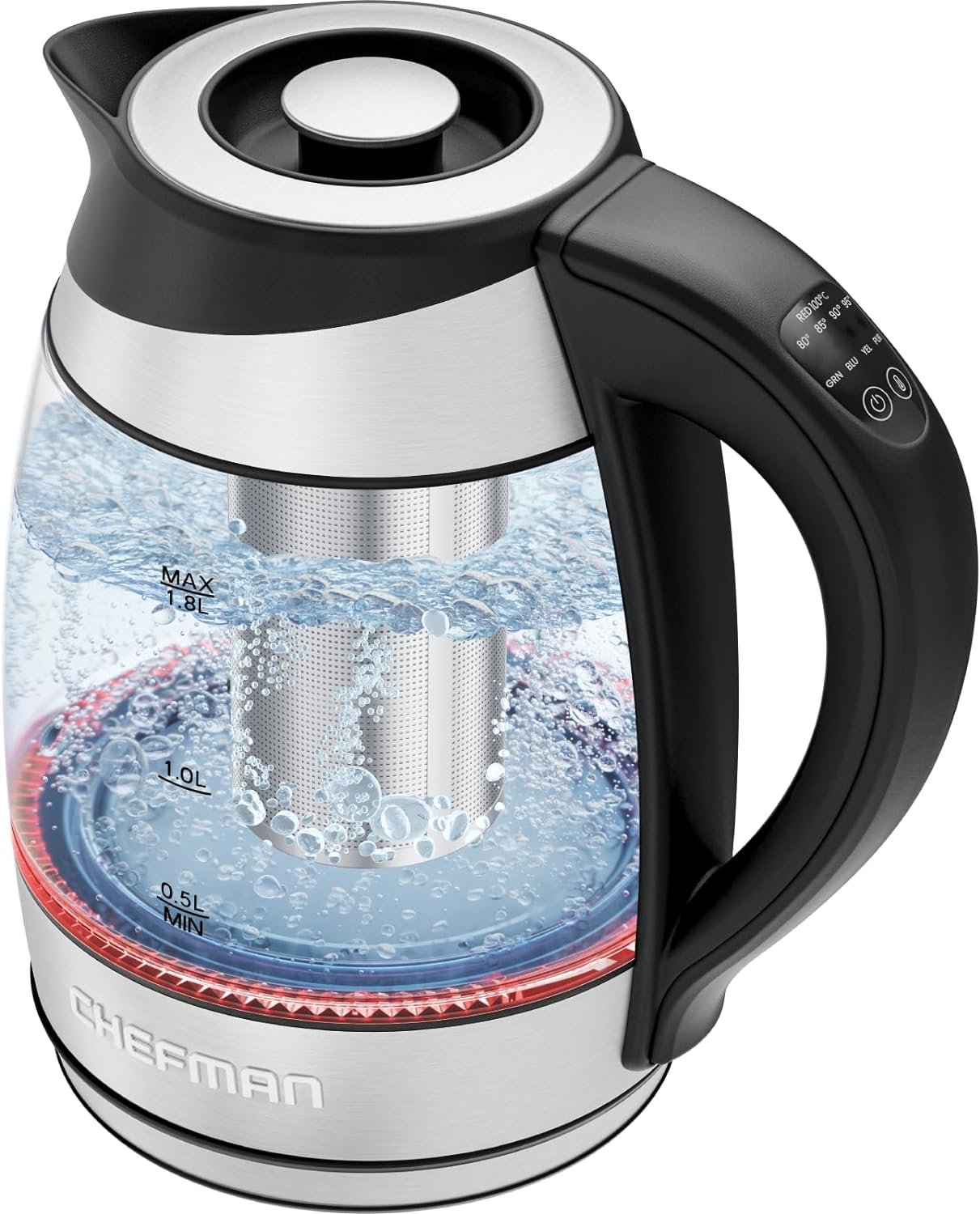
Selecting an electric kettle shapes brew outcomes for tea and many coffee preparation styles because water temperature, stability, and delivery influence extraction and flavor. Home brewers, tea enthusiasts, and households seeking repeatable results benefit from equipment that offers precise temperature control, rapid heating, and ease of cleaning. The Chefman Electric Kettle with temperature control and a removable infuser positions itself as a multi-use appliance for steeping loose-leaf tea, preheating devices for pour-over coffee, and preparing hot beverages for several people. Key considerations for purchasers include how the kettle’s material choices affect heat retention and thermal shock resistance, the range and usability of temperature presets for different tea types and coffee needs, and how the removable infuser integrates into batch steeping workflows. Operational features such as cordless pouring, a 360-degree swivel base, automatic shut-off, and boil-dry protection impact daily convenience and long-term reliability. Evaluating these functional characteristics alongside capacity and cleaning requirements helps determine whether this kettle matches specific brewing goals.
Quick Overview
| Feature | Details |
|---|---|
| Product category and brewing method | Electric temperature-controlled kettle; suitable for loose-leaf tea steeping, preheating for pour-over coffee, and general hot-water tasks |
| Capacity and output | 1.8 liters (approx. multiple cups per fill) |
| Materials and construction | Borosilicate glass body with stainless steel accents and concealed stainless steel heating element/base |
| Heating or control system | Variable temperature control with manufacturer-listed preset range 160–212°F; tri-color LED indicators; keep-warm/steep mode; rapid-boil capability and automatic shut-off |
| Filter and accessory compatibility | Removable stainless-steel tea infuser included; suitable for bagged or loose-leaf tea |
| Best-suited users | Households, tea enthusiasts, light pour-over coffee users, and small-group entertaining |
| Intended use cases | Brewing loose-leaf tea by the pot, preheating pour-over gear, instant beverages, and general kitchen hot-water needs |
| Warranty and manufacturer notes | Warranty details not specified by manufacturer materials; consult seller or manufacturer for current coverage |
This summary highlights the kettle’s core capabilities and constraints. The borosilicate glass body supports clarity and thermal shock resistance for visible steeping, while temperature presets and a keep-warm function target tea-specific extraction needs; the included infuser and 1.8-liter capacity prioritize batch steeping over single-cup immersion methods, and rapid-boil features shorten wait time at the expense of faster scale buildup in hard-water areas.

Temperature control and heat stability
Temperature control is a primary decision factor for buyers who target specific extraction ranges for different tea types and for preheating water for coffee methods that require sub-boiling temperatures. The Chefman unit provides a manufacturer-listed temperature range between 160 and 212 degrees Fahrenheit via preset options and a keep-warm mode, together with tri-color LED feedback to indicate status. Heat stability is influenced by the kettle’s glass construction and the presence of a keep-warm function: borosilicate glass has lower thermal mass than thick stainless-steel kettles, so water will approach set temperatures quickly but will also lose heat to the environment sooner without an insulated carafe or lid seal. Boil-dry protection and automatic shut-off protect internal components and support consistent operation across repeated heating cycles.

Preset temperatures, extraction ranges, and practical implications
Preset temperatures target common extraction needs: lower ranges (around 160–175°F) align with delicate green and white teas to avoid over-extraction and grassy bitterness, mid-range temperatures (near 185–195°F) suit oolongs and some specialty greens, and near-boil temperatures (200–212°F) work for black teas, herbal infusions, and preheating for pour-over coffee. Accurate extraction depends on hitting and holding the intended temperature long enough for infusion or brew preparation; the appliance’s presets simplify selection but do not provide laboratory-grade calibration information in manufacturer disclosures, so users prioritizing precise degree-to-degree control should pair the kettle with a separate thermometer for validation or select kettles that publish measured stability data.
Heat retention, glass construction, and thermal trade-offs
Borosilicate glass offers clarity and resistance to thermal shock, which aids visible steeping and long-term durability under rapid temperature changes. However, glass has a lower thermal mass and poorer insulation compared with double-walled stainless steel or vacuum-insulated kettles, resulting in faster ambient heat loss after reaching set temperature. The kettle’s removable lid and single-wall glass profile make it suitable for quick heating and visible brewing but less optimal for long-term heat retention. For users who require extended hold times, the keep-warm feature mitigates immediate cooling but will still be less energy-efficient than insulated alternatives.
Brewing method compatibility and extraction quality
Compatibility with brewing methods hinges on temperature control, flow profile when pouring, and the included tea infuser. The kettle is suited to batch loose-leaf tea steeping with the removable infuser and to preparing hot water for pour-over coffee and instant beverages; it is not designed for pressure-based espresso extraction. Flow control during pour impacts pour-over techniques: the kettle’s spout and pour stability influence flow rate, which affects extraction uniformity in manual coffee methods. Extraction quality for tea depends on reaching a target temperature and steeping for an appropriate duration, while coffee preheating benefits from stable temperature and the ability to pre-rinse filters and warm servers — functions achievable with this kettle’s rapid-heat and temperature-hold capabilities.

Loose-leaf tea steeping and infuser performance
The included stainless-steel removable infuser allows batch steeping and accommodates whole-leaf and broken-leaf teas. For large-leaf varietals that expand significantly, the infuser’s capacity limits how much leaf can be used without crowding, which can restrict full expansion and even extraction; users should observe recommended leaf-to-water ratios and consider multiple steep cycles or a larger standalone infuser for very bulky leaves. The infuser’s material (stainless steel) resists staining and flavor retention but requires routine cleaning to avoid trapped oils and aromas that can influence subsequent brews.
Pour-over preparation and preheating considerations
Temperature accuracy and the ability to hold temperatures in the 195–205°F zone are useful for preheating pour-over equipment and for rinsing paper filters to remove papery tastes while warming vessels. The kettle’s quick-boil capability reduces wait time between heating cycles, and the cordless kettle with a 360-degree base makes transferring to a carafe or dripper convenient. However, precision pour-over techniques benefit from a gooseneck spout to control pour rate and flow consistency; the Chefman design provides general-purpose pouring but does not feature a dedicated gooseneck, so pour-over practitioners seeking fine flow control should account for that limitation in their workflow.
Limitations for pressure-based coffee and specialty methods
This electric kettle is not designed to deliver the pressure profiles required for espresso or stovetop moka pot extraction; those methods require pumps or specialized brewing chambers to achieve high-pressure extraction. Additionally, temperature stability over extended extraction windows and pour control for very precise pour-over recipes may not match professional-grade, temperature-stable kettles with gooseneck spouts and insulated bodies. For users focused primarily on espresso production or microlot pour-over precision, the kettle functions mainly as a hot-water source rather than a specialty brewing tool.
Ease of use and daily workflow integration
Operational simplicity and integration into a kitchen routine are important for frequent brewers. The Chefman kettle emphasizes straightforward controls with preset temperature selection, tri-color LED feedback indicating standby/heating/keep-warm states, and a removable lid for easier filling and cleaning. Cordless convenience on a 360-degree swivel base supports ambidextrous placement and serving away from the power source. The kettle’s user interface and visual indicators reduce the need for constant monitoring, while automatic shut-off and boil-dry protection add safety to daily use. However, material choices and the single-wall glass body demand more careful handling than insulated metal units, and the recommended hand-wash care adds steps to cleaning compared with dishwasher-safe designs.

Controls, LED indicators, and preset workflow
Preset selection simplifies common tasks by matching temperature targets to beverage types, reducing steps in a typical brewing routine. Tri-color LEDs provide visual confirmation: white for standby, red while heating, and green when in keep-warm or steep mode, which helps users identify status at a glance even in busy kitchens. The control layout is designed for one-touch selection and requires minimal setup. For users who follow strict brew recipes or require minute-by-minute adjustments, the absence of a display showing exact degrees may necessitate external verification tools, but the presets and indicator system serve most household workflows effectively.
Pouring ergonomics, lid design, and fill workflow
The removable lift-out lid provides a larger fill opening than hinged lids, facilitating easy water filling and access for cleaning. The kettle’s handle and cordless base support mess-free pouring and serving, with the 360-degree base allowing placement in multiple orientations. Pouring ergonomics depend on spout shape and handle balance; while the kettle focuses on general-purpose pouring, users accustomed to narrow gooseneck spouts for controlled pours may find the flow broader and require technique adjustment. The lid’s complete removal eases adding loose leaf to the infuser and clears larger debris during maintenance.
Safety features and unattended operation
Automatic shut-off and boil-dry protection reduce risks associated with forgetting the kettle on the base or running it with insufficient water. These protections are important for households and communal settings where unattended boiling might occur. The glass body and stainless-steel heating components require attention to exterior temperature during heating cycles; users should avoid placing the kettle within reach of children during operation and follow manufacturer guidance on placement and operation to maintain safe use.
Capacity, serving flexibility, cleaning, and durability expectations
Capacity and maintenance considerations are central when selecting a kettle for household routines. The 1.8-liter capacity supports multiple servings per brew, making the product suitable for small gatherings and family use; however, larger groups or commercial situations may require repeated heating cycles. Borosilicate glass offers stain resistance, clarity, and thermal shock resistance, but manufacturer care instructions recommend hand washing, and mineral scaling from hard water necessitates periodic descaling to maintain heating efficiency and sanitary conditions. Removable components, such as the tea infuser and lift-out lid, simplify cleaning and reduce trapped residues, but long-term durability depends on handling, correct cleaning practices, and adherence to boil-dry protection to prevent element damage.

Serving flexibility, batch brewing, and brew ratios
A 1.8-liter capacity allows brewing multiple cups or a full pot of tea with consistent temperature across the volume; recommended leaf-to-water ratios should be applied for large-batch steeping to maintain expected strength. For coffee preparation, the kettle provides enough water to brew several small pour-over servings or to preheat larger pour-over setups, but sequential brews may be required for serving many guests. For those who prefer single-cup precision, the volume may be overcapacity and require pouring and rewarming or using smaller measured fills to match brew ratios.
Cleaning practices, descaling, and component care
Hand washing is recommended by manufacturer materials, and the removable infuser can be rinsed or soaked to remove oils and trapped particles. Borosilicate glass resists staining but will show mineral scale buildup over time in hard-water areas; periodic descaling with manufacturer-approved agents or mild acidic solutions restores heating efficiency and reduces off-flavors. The concealed heating element and stainless-steel base reduce exposed metal contact with water, but mineral accumulation at the element interface can reduce thermal transfer efficiency if not addressed on a routine schedule.
Durability, common wear patterns, and longevity indicators
Durability is influenced by material robustness and operational protections. Borosilicate glass resists thermal shock better than standard glass, but impact resistance remains lower than metal alternatives; careful handling reduces risk of breakage. Stainless-steel accents and a concealed heating element support corrosion resistance in contact areas, and built-in safety features such as boil-dry protection extend component life by preventing damage from dry operation. Long-term reliability typically correlates with proper cleaning, avoidance of knocks or drops, and adherence to manufacturer-recommended operation.

Pros & Cons
Pros
- Precise temperature range and presets: Manufacturer-listed temperature presets covering roughly 160–212°F address common extraction windows for green, oolong, black teas, and serve as a useful preheat source for coffee, reducing guesswork about target temperatures.
- Visible borosilicate glass body: The glass construction provides clarity to observe steeping and full-leaf expansion, and borosilicate glass offers better thermal shock resistance than standard glass.
- Included removable stainless-steel infuser: The infuser facilitates batch loose-leaf steeping for multiple servings and is easy to remove for cleaning or to switch to bagged teas.
- Cordless pouring with 360° swivel base: The cordless design supports convenient serving and ambidextrous placement; the swivel base simplifies lift-and-replace actions during multi-task workflows.
- Safety features: Automatic shut-off and boil-dry protection reduce the risk of damage and improve safety during unattended heating cycles.
- Rapid-boil capability: Faster heat-up times reduce wait and make the kettle useful for quick beverage prep and preheating brewing gear.
- Tri-color LED indicators: Visual feedback (standby/heating/keep-warm) helps users confirm operational status at a glance, improving ease of use.
Cons
- Single-wall glass limits heat retention: The lack of insulation means hot water cools faster than in double-walled or vacuum-insulated kettles, reducing hold times for extended serving.
- Not optimized for precision pour-over control: The spout design and absence of a gooseneck limit fine flow-rate control desired by pour-over purists focused on microchannel extraction control.
- Hand-wash recommended and scale maintenance required: Manufacturer care instructions favor hand washing, and mineral buildup in hard-water areas demands periodic descaling to preserve performance.
- Infuser capacity and leaf expansion limits: The removable infuser may be restrictive for very large whole-leaf teas that require more space to expand fully for even extraction.
Final Verdict: Who This Product Is Best For (and Who Should Skip It)
The Chefman Electric Kettle with temperature control and removable infuser suits households and tea-focused users seeking a visible, batch-capable steeping solution with accessible temperature presets. It is appropriate for tea enthusiasts who brew multiple servings, for casual pour-over coffee users who need reliable hot water for rinsing and preheating, and for families that value cordless serving, automatic shut-off, and rapid-boil convenience. The borosilicate glass body and included infuser make it particularly relevant for those who prioritize visible steeping and straightforward batch preparation.
Users who should skip this model include pour-over specialists requiring precise flow control via a gooseneck spout, espresso-focused users needing pressure-based extraction tools, and buyers whose primary priority is extended heat retention and insulated transport. Additionally, environments with very hard water and users seeking dishwasher-safe components may prefer alternatives with fully stainless-steel construction or explicit dishwasher compatibility. Compared with comparable electric kettles available in 2026, the Chefman unit balances batch steeping convenience, visible brewing, and temperature versatility while trading off advanced pour control and long-term insulation for ease and clarity of use.
Frequently Asked Questions (FAQs)
What temperatures are appropriate for different tea types and does this kettle cover them?
Different teas require different steep temperatures: delicate green and white teas generally perform best around 160–175°F to avoid bitterness, oolongs near 185–195°F for balanced extraction, and black or herbal teas near boil (200–212°F). Manufacturer disclosures indicate this kettle offers presets within a roughly 160–212°F span, which covers common tea extraction ranges and supports most household tea preparation needs.
Is the Chefman kettle suitable for pour-over coffee brewing?
The kettle supplies hot water at adjustable temperatures suitable for preheating pour-over equipment and rinsing filters, which aids extraction consistency. However, it lacks a dedicated gooseneck spout for fine flow-rate control, so users who require precise pouring for advanced pour-over techniques may find the flow less controlled than specialty gooseneck kettles.
How should the kettle be cleaned and how often should descaling be performed?
Manufacturer care instructions recommend hand washing and removing the stainless-steel infuser for cleaning. Descaling frequency depends on local water hardness; in hard-water areas, descaling every few weeks to a couple of months maintains heating efficiency and prevents mineral buildup. Mild acidic solutions or manufacturer-approved descalers are appropriate for routine maintenance.
Does the glass construction affect heat retention and durability?
Borosilicate glass provides clarity and improved thermal shock resistance compared with ordinary glass, making it suitable for rapid heating and visible steeping. However, single-wall glass has lower insulation than double-walled or vacuum-insulated kettles, so hot water will cool faster. Durability against impacts is lower than metal-bodied kettles, so careful handling is recommended.
Can the kettle be used to sterilize baby bottles or heat water for infant use?
The kettle brings water to high temperatures suitable for sterilization tasks such as preparing hot water for bottle sterilization, assuming manufacturer safety guidelines are followed. Users preparing water for infant feeding should follow pediatric guidance on temperatures and cooling practices and confirm that no residual cleaning agents or mineral buildup remain in the kettle prior to use.
Are there safety features to prevent damage if the kettle runs dry?
Yes, manufacturer materials list automatic shut-off and boil-dry protection as built-in safety features. These mechanisms are intended to prevent damage to heating elements and reduce fire risk if the kettle is activated with insufficient water. Relying on these protections does not replace safe operation practices; users should avoid operating the kettle empty whenever possible.
How much tea can the included infuser hold and is it suitable for whole-leaf teas?
The included stainless-steel infuser facilitates batch steeping but has a limited internal volume compared with standalone full-size infusers. It performs well for many loose-leaf and broken-leaf teas, but very large whole-leaf varieties that expand substantially may require smaller leaf portions or multiple steep cycles to avoid crowding and ensure even infusion.