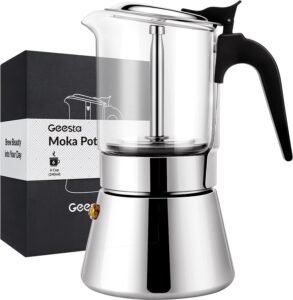
Coffee Gator Moka Pot Review — Stovetop Espresso Guide 2026

Why equipment choice matters for stovetop espresso
Selecting the right stovetop espresso maker shapes daily brewing results, kitchen workflow, and long-term ownership costs. Different brewing appliances control extraction variables—temperature, contact time, pressure, and flow—in distinct ways; a stovetop percolator like the Coffee Gator Moka Pot emphasizes pressure-driven percolation and concentrated extraction rather than the high-pressure, pump-driven extraction of commercial espresso machines. The intended user profile includes home brewers who prioritize a compact, manual ritual and concentrated, espresso-style coffee for milk drinks or strong black coffee. Key considerations for this product are heat source compatibility, materials (aluminum body with included stainless-steel cups), capacity (about 350 milliliters / six 60ml servings), and a manual workflow that places responsibility for grind size, stove settings, and timing on the user. These variables affect crema formation, perceived strength, and extraction balance; understanding them helps set realistic expectations for brew quality and consistency from a stovetop percolator.
Quick Overview
| Feature | Details |
|---|---|
| Product type | Stovetop espresso maker (Moka pot) / percolator |
| Capacity & output | 350 milliliters — marketed as six 60ml cups (approx. 12 ounces) |
| Construction materials | Matte grey aluminum body; stainless-steel cups (vacuum-layer insulated) |
| Heating & pressure system | Steam pressure from stovetop heating; includes safety pressure relief valve |
| Grind compatibility | Ground coffee input; recommended finer-than-drip grind (filter size: #4) |
| Best suited users | Home brewers, campers, households seeking compact manual brewing |
| Intended use cases | Home stovetop, camping, portable brewing; manual operation |
| Care & warranty notes | Not dishwasher safe; manual cleaning recommended; manufacturer disclosures apply |
This table gathers objectively stated specifications and manufacturer disclosures. The materials, pressure mechanism, and capacity determine how the unit behaves on various hobs, what grind and brew ratios perform best, and what maintenance steps are necessary to preserve extraction quality and durability.

Brewing method compatibility and heat-source fit
The Coffee Gator Moka Pot uses classic Moka percolation: base water heated on a hob generates vapor pressure that forces water through a ground coffee basket into the upper chamber. Compatibility with gas, electric, and induction hobs is highlighted in manufacturer descriptions, but induction compatibility typically requires an iron or magnetic base; the model number suggests an induction-capable design, so confirming the specific unit base or compatible hob plate is prudent when matching to induction cooktops. Heat-source characteristics—direct flame, electric coil, glass-top radiant, or induction—affect ramp rate and temperature stability; faster, higher-heat ramps produce faster percolation and may increase channeling or bitter extraction if grind and heat are not adjusted accordingly. Users with variable burner sizes should match the pot base to the burner to avoid uneven heating at the sidewalls, which can impact extraction and may stress the aluminum body over time.

Gas and electric stovetops: flame and coil considerations
Gas flames provide direct convective and radiant heat with fast responsiveness; the Moka pot responds quickly to flame adjustments but requires careful monitoring to prevent overheating or scorching. On coil or radiant glass-top electric stoves, slower heat ramp-up changes the percolation timeline, often extending pre-infusion and contact time. Because aluminum conducts heat rapidly, mismatched burner size or excessive flame height can concentrate heat on the handle and gasket area, increasing wear. Matching burner diameter to the pot base and using medium heat with attentive supervision supports repeatable extraction across these common home stove types.
Induction compatibility and portable use cases
Manufacturer indications of induction compatibility suggest a ferritic or induction-ready base; when present, induction offers more rapid, controllable heating with improved temperature stability compared with open flame. For camping or portable scenarios, the pot’s manual operation and compact profile suit fuel stoves and portable induction cooktops, provided the base is compatible. For users relying on induction, verifying the model’s base construction against the hob’s magnetic requirements avoids performance surprises and ensures the claimed rapid heat response and controlled percolation behavior.
Ease of use and workflow complexity
This Moka pot follows a simple three-part manual workflow: fill the lower boiler with water, place ground coffee into the filter basket (level but not tamped), assemble and heat. Simplicity of components—boiler, filter basket, and collecting chamber—reduces mechanical failure points, but the manual nature places control of key variables (grind size, water level, burner heat, and timing) in the user’s hands. The included cool-touch handle and safety valve mitigate handling and pressure risks, while the lack of automation requires users to learn the percolation stages—simmer, active percolation, and decanting—to avoid over-extraction. For users seeking low-effort, push-button consistency, this percolator introduces workflow complexity compared with electric pod machines or pump espresso machines; for those who value ritual and manual control, the straightforward disassembly and limited moving parts can be attractive.

Grind preparation and dosing workflow
Grind size and dose are pivotal in the Moka pot workflow: a grind slightly finer than drip but coarser than true espresso is commonly recommended to balance flow resistance and extraction time. Using the specified #4 filter size and dosing to the basket capacity without compression supports even flow; tamping is discouraged as it increases pressure and can cause over-extraction or safety valve activation. Because the unit lacks a built-in timing mechanism or temperature gauge, visual and auditory cues—sound of steady percolation and reduced sputtering—guide users to remove the pot from heat. A predictable dosing and grind routine improves repeatability but depends on external tools: a burr grinder for consistent particle size and a scale for dose control.
Assembly, storage, and travel workflow
Assembly is straightforward: screw the top and bottom chambers together, ensuring the rubber gasket and filter plate are seated correctly; the safety valve must remain unobstructed. The included stainless-steel cups add portability for single-serve situations, and the compact dimensions favor packing for travel or camping. Routine pre- and post-brew steps (checking the gasket, wiping the threads, and ensuring the valve is clear) are part of a reliable workflow. Because parts are manual and separable, storage and replacement of wearable items like the gasket and filter plate are simple, but maintaining these routines preserves seal integrity and safe pressure behavior over time.
Temperature control and heat stability
In stovetop percolation systems, temperature control is indirect; heat source selection and burner modulation are the primary means to influence brew temperature and kinetic energy of extraction. The aluminum body conducts heat quickly, enabling fast water ramp-up but offering limited thermal mass to stabilize temperature against burner fluctuations. This means percolation temperature swings can be more abrupt than with heavier stainless-steel or electric-boiler systems. The safety valve and the recommended practice of removing the pot from heat near the end of percolation together manage peak temperatures and reduce prolonged exposure of grounds to very high temperatures, which can produce bitterness. For users prioritizing narrow temperature windows, pairing the pot with a burner that allows fine heat reduction or using a heat diffuser can improve thermal stability and extraction control.

Role of aluminum construction in heat transfer
Aluminum’s high thermal conductivity translates to rapid heating and responsive changes when burner power adjusts; this benefits quick starts but reduces passive heat buffering, so small changes in heat produce noticeable changes in percolation rate. Aluminum also cools faster once removed from heat, helping stop extraction quickly if the pot is transferred to a cooler surface. The matte finish and overall wall thickness influence thermal inertia; thinner-walled pots will be more reactive and demand closer attention to burner settings. Users should account for the pot’s quick response when aiming for balanced extraction and plan to reduce heat before the final sputtering phase.
Practical steps to manage temperature stability
Because the unit lacks active temperature control, users can adopt practices to stabilize extraction: start on medium heat to avoid a sudden surge, lower heat once percolation begins to lengthen contact time without overheating, and remove the pot just before aggressive sputtering to limit aerosolized overheating. For glass-top or induction cooktops, small incremental adjustments provide tighter control. Using preheated water in the base may shorten the time to percolation and reduce prolonged exposure on the heat source, but that approach requires careful monitoring of valve and gasket seals due to preheated pressure conditions.
Brew consistency and extraction quality
Extraction quality from a Moka pot depends on particle size distribution, dose, brewing contact time driven by percolation rate, and uniform water flow through the puck. The Coffee Gator model accommodates ground coffee input and notes a #4 filter size; grind consistency from a burr grinder yields narrower particle distribution, reducing channeling and aiding uniform extraction. Because the system relies on building steam pressure within the lower chamber to push water upward, the resulting pressure is lower than pump espresso machines and produces a concentrated, full-bodied cup rather than true espresso crema. Reproducible results emerge when grind, dose, and heat control are standardized—consistent dosing, a repeatable burner setting, and visual cues at finish can produce similar cups across sessions.

Grind profile and particle size effects
Particle size controls flow resistance and surface area for extraction. A grind too coarse will allow rapid percolation and under-extraction, yielding weak, acidic flavors. A grind too fine increases resistance, slowing flow and risking over-extraction or channeling that produces bitter, harsh notes. The most consistent approach is a medium-fine grind calibrated for the specific filter basket volume, with adjustments in small increments when changing beans or roast levels. Using a burr grinder and weighing dose can materially improve consistency over time, addressing the Moka pot’s sensitivity to particle size variance.
Assessing crema-like foam and perceived strength
Moka pots can produce a crema-like foam due to emulsified oils and colloids pushed through the spout during percolation, but this differs from pump-generated espresso crema in texture and stability. Concentration and perceived body depend on dose relative to water volume; the marketed six 60ml cup yield reflects concentrated servings suitable for milk-based beverages or strong short black servings. Balancing roast level, freshness, and grind helps manage body and extraction balance: darker roasts yield more soluble oils and a heavier mouthfeel, while lighter roasts may highlight acidity unless brew parameters are adjusted to compensate.
Capacity, cleaning, and durability considerations
The 350 milliliter capacity, designed to produce approximately six 60ml servings, aligns with household and small-group use but may be limited for larger gatherings. Construction from aluminum provides light weight and rapid heat response, while included stainless-steel vacuum-layer cups offer insulated drinking vessels. Cleaning and maintenance protocols are driven by materials: the manufacturer discloses that the pot is not dishwasher safe, and aluminum cookwear benefits from gentle, hand-wash care to avoid detergent-induced discoloration or oxidation. Wear items—rubber gasket, filter plate, and the pressure valve—are maintenance touchpoints; periodic replacement preserves sealing and safety. Long-term durability will depend on consistent care, avoidance of abrasive cleaners, and attention to valve and gasket condition.

Routine cleaning and maintenance steps
Manufacturer guidance notes hand-washing and avoiding dishwasher use. After brewing, disassemble the top, basket, and base, rinse with warm water, and remove residual grounds; dry components thoroughly to limit oxidation. The rubber gasket should be inspected for flattening or cracking, and the filter plate checked for clogging; both are common replacement items in stovetop percolators. Avoid soaking in strong detergents or using steel wool on aluminum surfaces; mild detergents and soft brushes preserve the matte finish and structural integrity.
Long-term reliability and parts replacement
Aluminum offers good thermal properties but can show surface wear or darkening over time; this is largely cosmetic if internal integrity remains. The safety pressure relief valve is a critical safety component and must remain unobstructed and functional. Because gasket and filter plate wear is expected with use, easy availability of replacement gaskets and parts supports long-term reliability. For buyers prioritizing decades-long durability with minimal maintenance, heavier stainless-steel boilers or electric automation may offer advantages; for those seeking lightweight, portable brewing with replaceable small parts, this Moka pot balances trade-offs.
Pros & Cons
Pros
- Compact, traditional stovetop brewing: The three-part Moka design is simple, portable, and dependable for concentrated coffee; its small footprint suits countertops, camping, and compact kitchens. The included stainless-steel insulated cups add portability and immediate serving convenience.
- Rapid heat response and efficient extraction: Aluminum construction provides fast heat transfer, which reduces time to percolation and supports quick brewing sessions when paired with an appropriate burner. This responsiveness helps produce concentrated extraction suitable for milk-based drinks.
- Manufacturer safety and usability features: A visible safety pressure relief valve and a cool-touch handle are included, addressing common stovetop percolator safety and handling concerns described in user patterns.
- Straightforward maintenance of wearable parts: The unit’s simple mechanical construction (gasket, filter plate, valve) makes common replacements accessible, supporting long-term ownership if routine maintenance is followed.
- Indicated induction compatibility: Manufacturer texts highlight use on induction hobs, which—if the unit contains an induction-capable base—offers more controllable heating for repeatable extraction.
- Portable and giftable packaging: The compact size and included cups make it practical as a travel or camping item and an easy gift option for manual-brewing enthusiasts.
Cons
- Manual control demands technique: Reproducible results require consistent grind, dose, and attention to heat; consumers seeking automated or push-button consistency may find the workflow demanding.
- Aluminum requires careful cleaning: The pot is not dishwasher safe and benefits from gentle, hand-wash care to avoid oxidation or finish damage; this increases maintenance compared with stainless-steel or sealed electric units.
- Limited capacity for larger groups: At roughly 350 milliliters total, the pot suits small households but requires multiple cycles for larger gatherings, adding time and management.
- Pressure and crema differ from pump espresso: The Moka method generates lower extraction pressures than pump espresso machines; perceived crema and espresso quality will not match high-pressure machines, so expectations should align with stovetop percolate characteristics.
- Replacement parts dependency: Long-term reliability depends on periodic replacement of gaskets and filter plates; availability of compatible parts affects sustained use and ownership costs.
Final Verdict: Who This Product Is Best For (and Who Should Skip It)
The Coffee Gator 6-cup Moka Pot is best for home brewers who prefer a compact, manual stovetop method to produce concentrated, espresso-style coffee without a pump-driven machine. It suits households seeking portable, ritualized brewing for milk-based drinks like cortados and cappuccinos or for strong black coffee in small servings. Users who already own a burr grinder and who are comfortable managing grind size, dosing, and burner modulation will extract consistent results from the aluminum body and simple three-part workflow. The included insulated stainless-steel cups add convenience for travel or quick service.
Those who should skip this product include users who prioritize push-button automation, precise built-in temperature control, or true high-pressure espresso extraction; single-button pod systems or pump espresso machines provide different convenience and pressure profiles. Similarly, buyers who dislike manual cleaning or who require large-volume output for frequent entertaining may prefer larger-capacity or electric alternatives. For buyers aligned with manual stovetop brewing and willing to maintain gasket and valve items, this Moka pot offers a balanced combination of portability, traditional extraction characteristics, and manageable upkeep compared with other stovetop options in 2026.
Frequently Asked Questions (FAQs)
How should grind size be adjusted for the Coffee Gator Moka Pot?
Grind size for a Moka pot is typically finer than drip but coarser than espresso. A medium-fine grind supports balanced flow through the #4 filter basket without excessive resistance. Using a burr grinder and adjusting in small steps helps find the ideal particle size for specific beans; if percolation is too fast and the cup tastes weak, grind slightly finer. If flow is very slow and the cup tastes bitter, move slightly coarser.
Is the Coffee Gator Moka Pot safe to use on induction cooktops?
Manufacturer materials and the unit’s model name indicate induction compatibility in marketed descriptions; however, induction performance requires a magnetic or ferritic base layer. For buyers using induction hobs, confirm the specific unit base includes an induction-capable plate. When compatible, induction provides faster, more controllable heating, improving repeatable percolation compared with open flame.
How should the Coffee Gator Moka Pot be cleaned and maintained?
The product is not dishwasher safe; the recommended practice is to hand-rinse components after each brew, remove grounds from the filter basket, and dry parts thoroughly to limit oxidation. Inspect and replace wearable components—rubber gasket and filter plate—when signs of cracking, flattening, or clogging appear. Avoid abrasive cleaners and steel wool on aluminum surfaces to preserve the matte finish and structural integrity.
What type of coffee does a Moka pot produce compared with an espresso machine?
A Moka pot yields a concentrated, full-bodied coffee that is espresso-style in intensity but uses lower pressure than pump espresso machines. It can produce a crema-like foam from emulsified oils, but this is different from stable, high-pressure espresso crema. The brew is well-suited for milk-based beverages or strong short black servings, while those seeking true pump-powered espresso should consider a machine with a built-in pump and higher bar pressure.
Can the Coffee Gator Moka Pot be used for camping and travel?
Yes; the compact three-piece design and included insulated stainless-steel cups support portable use on camping stoves or portable induction cooktops—assuming the hob matches the pot’s base. The manual operation and light weight make it practical for travel, but users should pack replacement gaskets and keep cleaning supplies accessible to maintain valve and seal function while away from home.
What capacity and serving sizes should be expected from this Moka pot?
The manufacturer lists a capacity of about 350 milliliters, marketed as six 60-milliliter servings (approximately twelve ounces total). This volume suits small households and short, concentrated servings; larger gatherings will require multiple brewing cycles. Dose and grind should be adjusted to match the basket volume to achieve consistent strength per serving.
How does the safety pressure valve affect operation and maintenance?
The safety pressure relief valve is a critical component that prevents overpressure in the lower boiler; it must remain clear and unobstructed. Routine inspection for residue or clogging is important, and cleaning should avoid damaging the valve. If the valve shows signs of malfunction, replacement or servicing is necessary to maintain safe percolation behavior.