De’Longhi Magnifica Start: Fresh-Grind Super-Auto Espresso
Why Equipment Choice Matters for Home Espresso
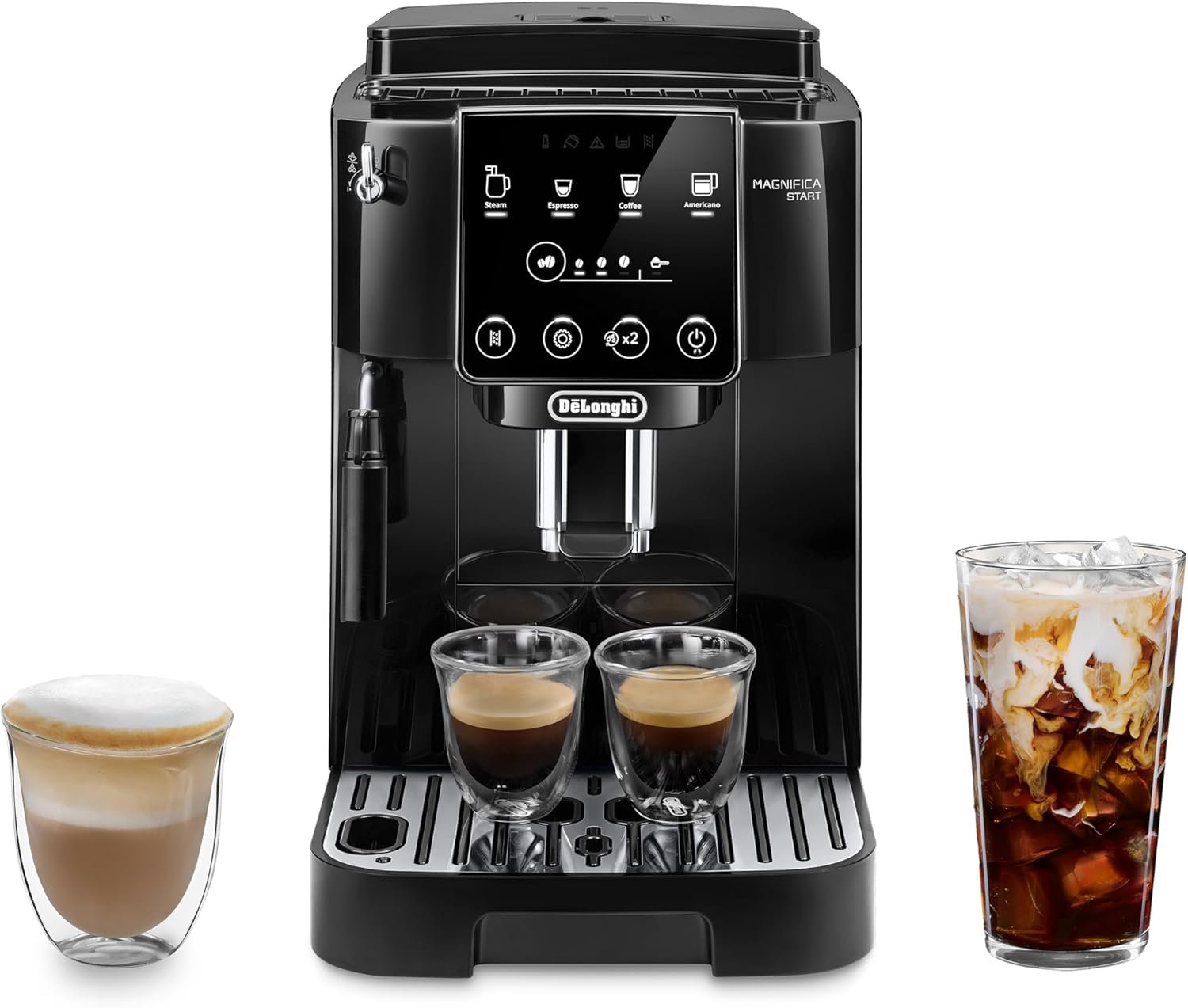
Selecting the right espresso appliance shapes daily brewing outcomes, workflow, and the range of drinks a household can reliably produce. For home brewers and small households, machine choice balances grind-to-brew integration, temperature management, and milk-texturing capabilities—each element influences extraction, crema quality, and cup temperature. The De’Longhi Magnifica Start positions itself as a compact super-automatic solution with an integrated conical burr grinder, three one-touch recipes, and a manual milk frother. These characteristics affect grind consistency, grind-to-dose repeatability, and the level of control over extraction variables such as brew ratio and shot volume. Buyers should evaluate whether a machine that automates dosing and brewing while leaving milk texturing manual meets their priorities for convenience versus control, and whether the water capacity, interface, and maintenance demands align with household routines and beverage expectations.
Quick Overview
| Feature | Details |
|---|---|
| Product category & brewing method | Super-automatic espresso machine; pump-driven espresso with built-in conical burr grinder |
| Water tank capacity | 60 fluid ounces |
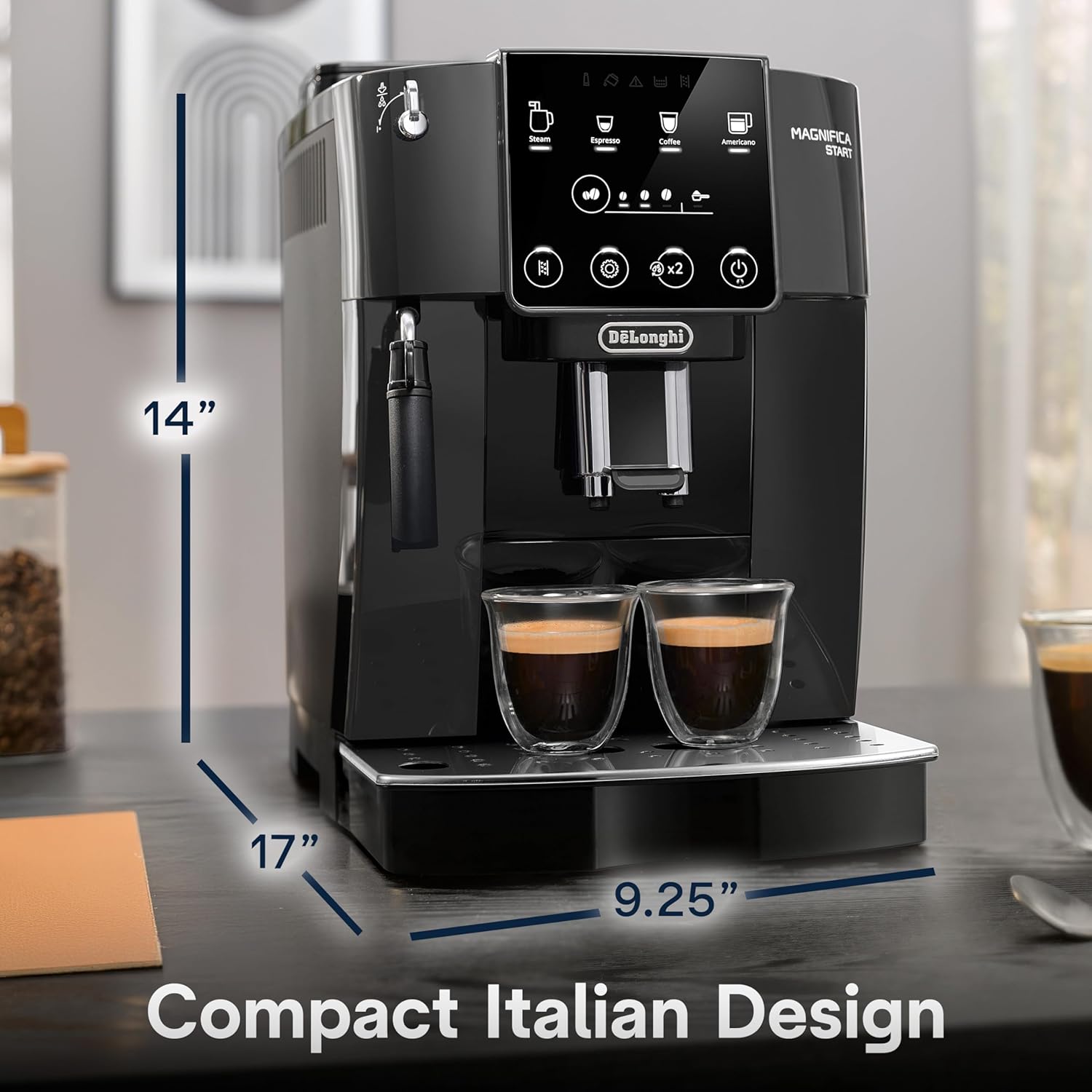
| Materials & construction | Painted black exterior; compact footprint (17″D x 9.25″W x 14″H); removable dishwasher-safe parts |
| Heating & pressure system | 15 bar pump with adjustable coffee temperature |
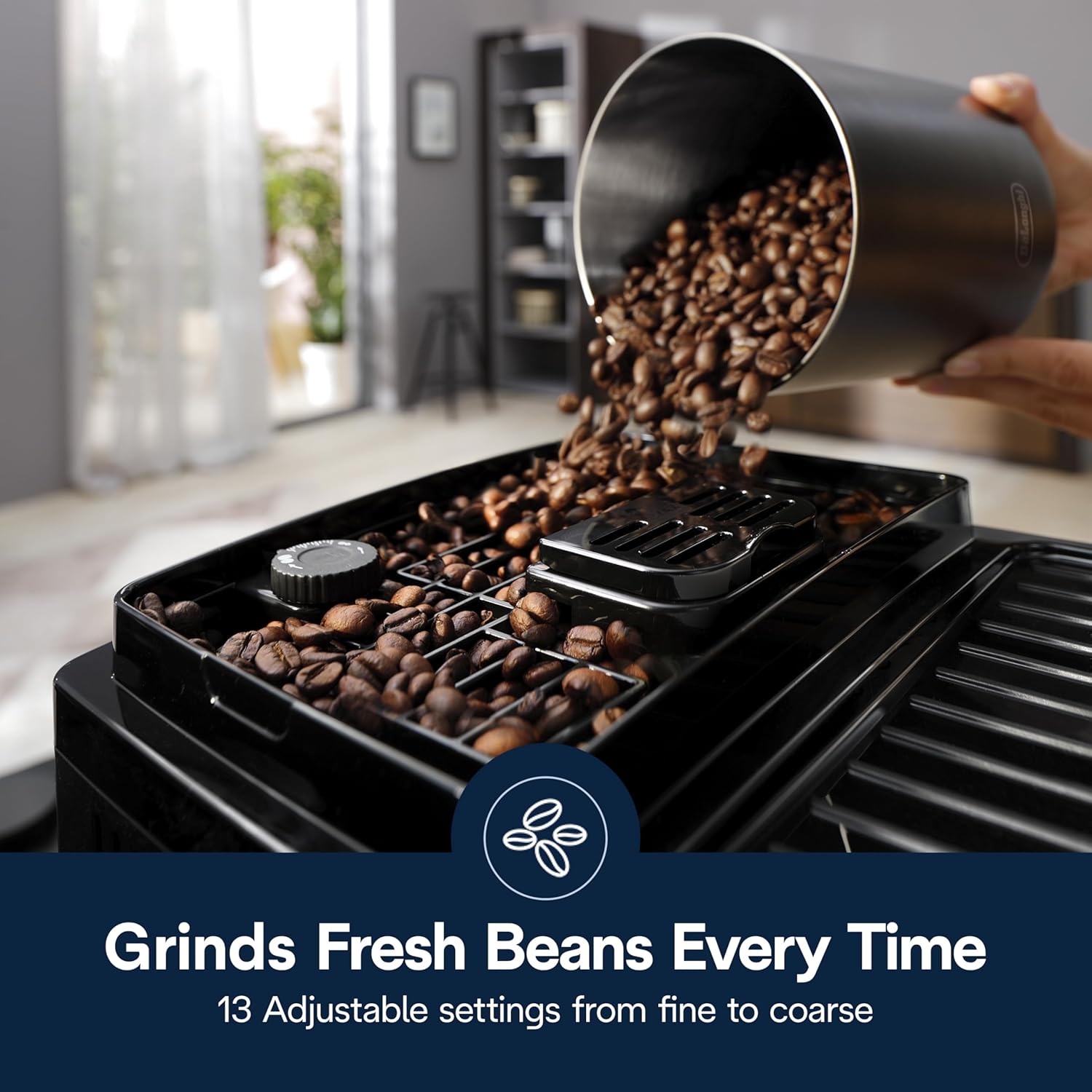
| Grinder & grind compatibility | Conical burr grinder with 13 grind settings; accepts whole bean and ground inputs |
| Control interface | Touchscreen with 3 one-touch recipes (Espresso, Coffee, Americano); adjustable brew strength |
| Milk system | Manual frother (steam wand-style) for milk and milk alternatives |
| Intended users & use cases | Home brewers and households seeking fresh-grind espresso, milk-based drinks, and a simplified bean-to-cup workflow |
| Included components | Machine, measuring scoop, total water hardness test |
| Power & operation | Fully automatic operation mode; 120V |
The combination of a conical burr grinder, adjustable grind settings, and an integrated brewing unit provides repeatable dosing and grind-to-brew handoff, which supports consistent extraction and crema development. The 60-ounce tank and touchscreen presets reduce refill and programming frequency, while the manual frother preserves flexibility for milk-based drinks but requires technique to achieve fine microfoam.
Grinder and Extraction Consistency
An integrated conical burr grinder with 13 grind settings directly impacts extraction by controlling particle size distribution and dose consistency prior to the brewing unit. For espresso-quality extraction, a narrow particle-size distribution and stable dose volume reduce channeling and uneven flow, improving solubles yield and crema. The Magnifica Start’s grinder-to-brew unit design aims to minimize retention between grind and extraction, which helps maintain bean freshness at the point of brew. Buyers prioritizing repeatable single-shot or double-shot routines should consider how grind setting range, burr quality, and dose repeatability interact with brew ratios and tamping/compaction methods inherent to super-automatic brewing units.

Grind settings, burr design, and particle distribution
Conical burr geometry tends to produce bimodal particle distributions that are favourable for espresso because larger particles contribute to flow pathways while smaller fines increase surface area for extraction. The 13-step adjustment range provides incremental control over mean particle size, enabling adaptation across bean roast levels and origins. For darker roasts, coarser settings can reduce over-extraction and channeling; for lighter roasts, finer settings increase soluble yield. Dose consistency depends not just on grind setting but also on hopper capacity, retention, and the machine’s dosing mechanism; machines that consistently deliver repeatable doses reduce the need for manual dosing adjustments and support stable brew ratios such as 1:1.5 to 1:2.5 for traditional espresso profiles.
Grinding-to-brew handoff and extraction outcomes
Minimizing retention between grinding and brewing reduces exposure of freshly ground coffee to oxygen, preserving aromatic compounds and volatile oils that contribute to crema and flavor intensity. The presence of a dedicated brewing unit means the ground dose is metered and delivered to a compact extraction chamber designed for short contact times and high pressure. Flow control through the puck and the machine’s internal water dispersion affect uniformity of extraction: even water distribution and consistent pump pressure (noted here as 15 bar nominal) support predictable soluble extraction when combined with appropriate grind and dose. Users aiming for shot-to-shot consistency should consider beans, grind setting, and routine cleaning of the grinder path to limit retention variability.
Temperature Control and Heat Stability
Temperature control influences extraction kinetics and solubles dissolution rates; stable water temperature at the brewing interface helps achieve predictable flavor balance across shots. The Magnifica Start includes adjustable coffee temperature, which allows users to match brewing temperature to roast and extraction preferences—lower temperatures can temper perceived bitterness on darker roasts, while higher temperatures aid extraction of denser, lighter-roasted beans. Heat stability depends on the machine’s heating architecture and thermal mass; consistent temperature through the brew cycle reduces shot-to-shot variance. For milk drinks, simultaneous steam and brew temperature coordination affects final cup temperature and milk texture, so buyers should assess whether the machine’s heating and recovery align with expected drink throughput for their household.
Adjustable temperature settings and extraction impact
Adjustable temperature settings enable a degree of control over extraction rate and flavor balance. Coffee solubles extraction follows temperature-dependent kinetics: higher temperatures accelerate solubles dissolution and highlight acidity and brightness in lighter roasts, while lower temperatures can mute harsh tannins in darker roasts. Because super-automatic machines typically implement preset beverage volumes, achieving desired brew ratio often requires pairing temperature adjustments with grind and strength settings. Consistent water temperature throughout the entire pump cycle is more important than peak temperature alone; uneven temperature during pre-infusion, ramp-up, or steady-state flow can create under- or over-extracted regions within an extraction.
Heat stability, recovery, and cup temperature management
Heat stability and recovery rate determine how well a machine supports back-to-back brewing and milk steaming. Machines with greater thermal mass or efficient heaters maintain stable temperature across successive cycles, reducing variability in extraction and crema. For single-cup household use, recovery time may be less critical than for multi-serve environments, but it still affects the ability to produce a hot milk drink immediately after a shot. External factors such as ambient temperature, cup preheating, and water hardness also influence final cup temperature and perceived aroma. The included water hardness test helps align descaling intervals with local conditions to protect heating elements and maintain thermal performance over time.
Ease of Use and Daily Workflow
Workflow considerations center on how the grinder, one-touch recipes, manual frother, and cleaning access fit into daily routines. A touchscreen with three pre-set recipes (Espresso, Coffee, Americano) streamlines common beverage preparation with minimal input, while 13 grind settings and adjustable brew strength offer customization without complex programming. The machine accepts both whole beans and pre-ground coffee, allowing alternate workflow options for decaf or specialty doses. The manual frother introduces a deliberate step for milk texturing that requires technique, which separates boiler control from automated milk delivery. Buyers should weigh the balance between automation for black coffee and manual control for milk drinks when assessing overall usability for household members with varying skill levels.

Setup, daily operation, and user experience
Initial setup typically includes filling the water tank, adding beans, adjusting grind setting, and performing a water hardness test to program descaling intervals. Daily operation for standard recipes involves selecting a one-touch preset and allowing the grinder and brewing unit to complete automated dosing and extraction. Accepting both whole-bean and ground inputs enables flexibility for single-serve decaf or specialty roasts. The presence of a removable water tank and dishwasher-safe parts simplifies refill and cleaning steps, helping integrate the machine into busy kitchen workflows. The physical footprint and power requirements fit most kitchen counters in typical household settings.
Controls, customization, and learning curve
Touchscreen controls and pre-set recipes reduce the barrier to consistent results, while adjustable brew strength and grind settings offer a path to incremental refinement. The manual frother requires practice to generate fine microfoam, so users seeking consistent barista-level milk texture should allocate time for skill development. The machine’s automated dosing and built-in grinder remove the need for separate grinder calibration, but fine-tuning still relies on understanding basic extraction variables: grind size, dose, and brew ratio. For households with multiple users, saved preferences are useful; however, machines with limited programmability require repeated minor adjustments to dial in specific bean profiles.
Milk Frothing, Texture, and Beverage Versatility
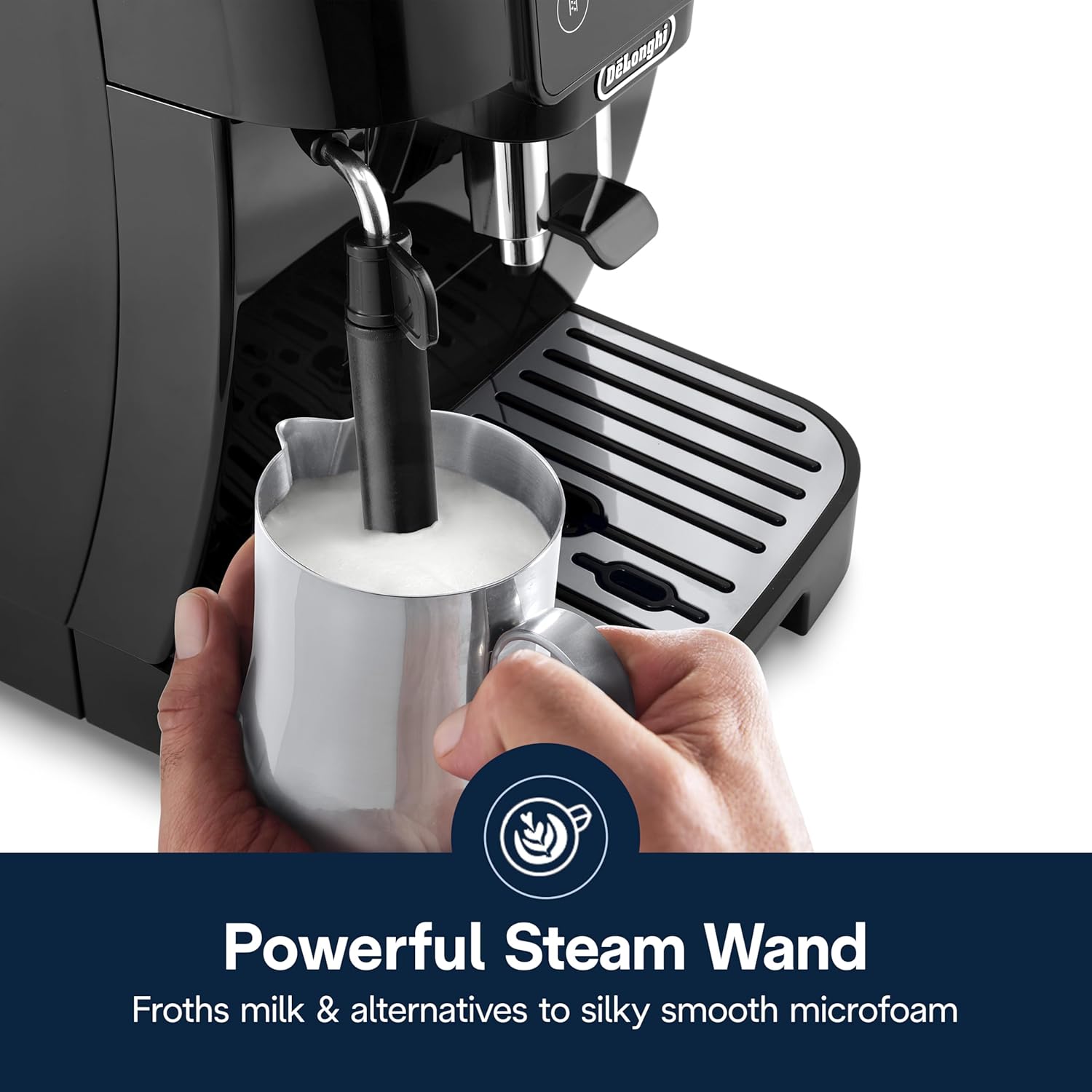
A manual frother provides tactile control over steam application and foam development, supporting a wide range of milk-based drinks when paired with appropriate technique. Manual frothing allows adaptation to dairy and plant-based alternatives—oat and soy often require slightly different texturing temperatures and aeration to reach stable microfoam. The trade-off versus automatic milk systems is flexibility versus consistency: manual frothers do not automate steam pressure profiles, so milk texture depends on operator skill and steam pressure recovery. For households focused on lattes, cappuccinos, and macchiatos with hands-on milk preparation, this configuration delivers versatility; for users prioritizing fully automatic milk extraction and dispensing, an integrated automatic milk system may better match needs.
Manual frothing technique and achieving microfoam
Manual steam wands require control over wand position, pitcher angle, and steaming time to produce microfoam. Effective technique involves introducing air early in the steaming process for cappuccino-style foam, followed by submerging the wand to create a rolling vortex that polishes foam texture. Milk alternatives differ in protein composition and viscosity—oat milk often yields stable foam with controlled aeration, while almond milk can be more challenging. Consistent steam pressure and rapid heat recovery support repeatable milk texturing; therefore, understanding the machine’s steam capacity and allowing short recovery intervals between steaming cycles are important for multi-drink preparation.
Beverage range and recipe flexibility
The three one-touch recipes cover common beverage categories: Espresso, Coffee, and Americano, which suits users seeking simplified preparation of core drinks. Manual frothing extends the machine’s repertoire to lattes, cappuccinos, and mochas through user-applied texture control. Adjustment options—grind setting, brew strength, and temperature—enable tailoring of extraction and mouthfeel across different beans and roast profiles, expanding the machine’s capacity to handle single-origin espresso, dark-roast blends, and milk-dominant recipes. For cold preparations like iced coffee, control over brew volume and strength paired with manual milk handling supports basic iced beverage workflows.
Cleaning, Maintenance, and Durability Expectations
Cleaning and maintenance influence long-term performance and flavor stability. The Magnifica Start offers removable and dishwasher-safe parts, which reduces manual scrubbing for components that contact coffee oils and milk residue. The inclusion of a water hardness test kit supports proactive descaling scheduling, which protects internal heating elements and preserves thermal performance. Durability depends on materials, build quality, and maintenance routines—regular cleaning of the grinder path, emptying grounds containers, and following descaling intervals mitigates wear and helps maintain consistent dosing and extraction. Buyers should plan for periodic parts replacement and potential service considerations typical of super-automatic machines.

Daily, weekly, and periodic cleaning expectations
Daily tasks typically include emptying the grounds container, rinsing the drip tray, and wiping steam wand surfaces after each milk use to prevent protein buildup. Weekly or biweekly routines often involve deeper cleaning of removable brew-group components and hopper inspection for oil buildup that can affect grind flow. Dishwasher-safe parts reduce labor for some components, but heat-sensitive items and seals should follow manufacturer care instructions to avoid degradation. Using the water hardness test to schedule descaling prevents limescale accumulation that can impede heating efficiency and pump performance over time.
Materials, build quality, and long-term reliability indicators
The painted black exterior and compact chassis reflect a design optimized for home counters; internal components such as burrs, pump, and seals determine long-term robustness. Conical burrs are generally durable but will gradually blunt with use and require replacement intervals depending on total grind volume and bean hardness. Pump and heating element longevity correlates strongly with adherence to descaling and maintenance recommendations. For buyers prioritizing extended service life, attention to water quality, routine cleaning, and monitoring of grinder retention are practical measures that support consistent performance across years of household use.
Pros & Cons
Pros
- Integrated conical burr grinder with 13 settings provides a wide range of particle-size control for different roast levels, improving extraction adaptability. This supports dialling in grind size without a separate grinder and reduces countertop clutter.
- Three one-touch recipes simplify preparation of Espresso, Coffee, and Americano, making consistent results accessible to users with limited brewing experience. Preset beverage volumes paired with adjustable brew strength deliver quick, repeatable cups.
- Manual frother supports milk and milk alternative texturing, offering flexibility for lattes, cappuccinos, and other milk-based beverages. The approach gives users direct control over foam density and temperature.
- Removable, dishwasher-safe parts and included water hardness test streamline maintenance, reducing friction around cleaning tasks and helping protect internal components from scale buildup.
- A 60-ounce water tank reduces refill frequency in typical household use, increasing convenience for multi-cup mornings. The compact footprint fits most kitchen counters where space is limited.
- Adjustable coffee temperature and brew strength allow users to tune extraction for a range of beans, improving the machine’s ability to handle light to dark roast profiles.
- Accepts both whole beans and ground coffee, providing flexibility for specialty doses or decaffeinated options without changing the hopper.
Cons
- Manual frothing requires technique to achieve consistent microfoam, which may be a barrier for users seeking fully automated milk texturing. The absence of an automatic milk circuit reduces convenience for users who prioritize one-touch latte preparation.
- Limited programmability beyond three presets may constrain users who want to save multiple custom recipes or fine-tune shot volumes and pre-infusion timing. Advanced users may find the customization options modest compared with higher-end super-automatic models.
- Grinder capacity, burr size, and long-term burr wear are not specified in manufacturer literature, so replacement intervals depend on usage patterns and are a maintenance consideration. Regular cleaning of the grinder path is necessary to prevent retention and flavor carryover.
- While 15 bar pump rating is standard, actual brewing pressure and flow control dynamics in the extraction chamber determine espresso quality; nominal pump pressure alone does not guarantee optimal extraction without proper grind, dose, and water temperature management.
Final Verdict: Who This Product Is Best For (and Who Should Skip It)
The De’Longhi Magnifica Start targets home users and households seeking a compact, bean-to-cup super-automatic that combines a built-in conical burr grinder, simple touchscreen presets, and manual milk steaming capability. It suits buyers who value fresh-ground espresso with repeatable dosing, a reduced learning curve for black-coffee recipes, and flexibility to texture milk manually for lattes and cappuccinos. Households that prioritize counter space efficiency, a larger water tank, and dishwasher-safe parts for easier maintenance will find the machine aligns with routine kitchen workflows.
This machine is less appropriate for users who demand fully automatic milk systems, extensive recipe programmability, or professional-level steam consistency out of the box. Advanced enthusiasts seeking complete control over every extraction variable may prefer a separate high-quality grinder and a machine with more nuanced brewing controls. For typical home use in 2026, the Magnifica Start balances simplicity and basic customization, delivering fresh-grind convenience while requiring some user skill for premium milk-textured beverages.
Frequently Asked Questions (FAQs)
How does the built-in conical burr grinder affect espresso quality?
A conical burr grinder produces a controlled particle-size distribution that supports consistent extraction and crema formation. The 13 grind settings allow adaptation across roast levels; finer settings increase surface area for extraction while coarser settings promote even flow. Reduced retention between grinding and brewing helps preserve volatile aromatics, improving cup freshness. Consistent dosing and regular cleaning of the grinder path are required to maintain stable results.
Can the Magnifica Start handle both whole beans and pre-ground coffee?
Yes. The machine accepts whole beans via the integrated grinder and also supports pre-ground coffee input. This flexibility enables using specialty single-origin doses or decaffeinated grounds without modifying hopper contents. When using pre-ground coffee, attention to grind size and dose is necessary to match expected extraction parameters for espresso or Americano recipes.
Is the manual milk frother suitable for plant-based milks like oat or almond?
The manual frother can texture dairy and many plant-based alternatives, but results vary due to differences in protein and fat composition. Oat milk tends to produce stable microfoam with proper technique, while almond milk may require slower aeration and temperature control. Consistent steam pressure and practiced frothing technique are key to achieving desired foam quality across milk types.
How important is temperature stability for espresso extraction on this machine?
Temperature stability is critical because extraction kinetics are temperature-sensitive. The machine’s adjustable coffee temperature helps match brewing conditions to bean roast and density. Stable water temperature throughout the pump cycle supports consistent soluble extraction; uneven temperature can create under- or over-extracted flavors. Regular descaling and adherence to maintenance routines help preserve heating efficiency and thermal stability.
What cleaning and maintenance should be expected for long-term reliability?
Daily tasks include emptying the grounds container, rinsing the drip tray, and wiping the frother after milk use. Periodic cleaning involves rinsing removable parts and inspecting the grinder path for oil buildup. Using the included water hardness test to schedule descaling protects internal heating elements. Following manufacturer maintenance guidelines and cleaning intervals supports pump and grinder longevity.
Who should consider alternative machines instead of the Magnifica Start?
Users seeking fully automatic milk systems, extensive recipe programmability, or pro-level steam consistency may prefer machines with automatic milk circuits and advanced control options. Advanced enthusiasts who demand separate, high-end grinders for maximum grind control and machines with highly adjustable pressure profiling may find more suitable alternatives among higher-tier super-automatic or semi-automatic espresso machines.