17-Setting Electric Burr Grinder for Espresso & Home Drip
Choosing the right electric burr grinder for home brewing
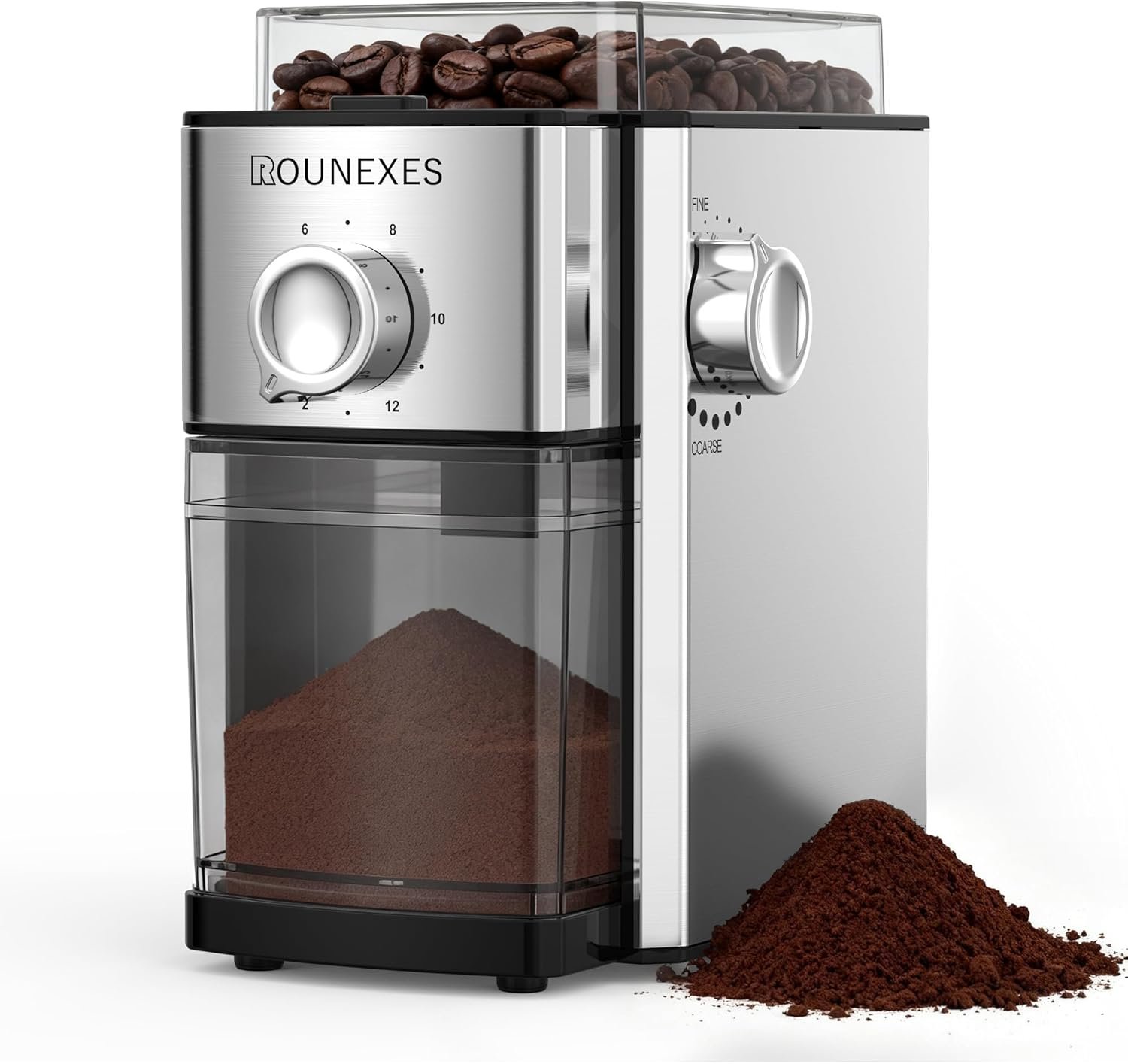
Selecting the right grinder is a pivotal decision for home brewers, because grind size and consistency drive extraction, flavor balance, and repeatability. A compact electric burr grinder with a stepped selector—like the model described here—targets households and travel-savvy users who need straightforward dosing, a variety of grind sizes, and a small footprint. This profile suits espresso beginners dialing in tamping and shot timing, drip coffee makers seeking uniform medium grounds, and immersion brewers that benefit from coarser, stable particles. Design choices such as stainless-steel burrs, an 8.82oz transparent hopper, removable grounds container, and one-touch auto-stop influence workflow speed, static control, and cleaning frequency. Buyers prioritizing precise micro-adjustments, commercial-level production, or high-volume daily grinding should compare commercial conical or flat burr machines. The following analysis focuses on brew-method compatibility, extraction implications of grind distribution, heat generation during grinding, dosing and capacity, maintenance expectations, and durability considerations relevant to typical U.S. home and travel use.
Quick Overview
| Feature | Details |
|---|---|
| Product category | Electric burr coffee grinder (stepped settings) |
| Grind settings | 17 discrete settings from fine to coarse |
| Burr material | Stainless-steel burrs (removable) |
| Hopper capacity | 8.82 oz (transparent bean hopper) |
| Dosing & operation | One-touch grinding with auto-stop, removable grounds container with lid |
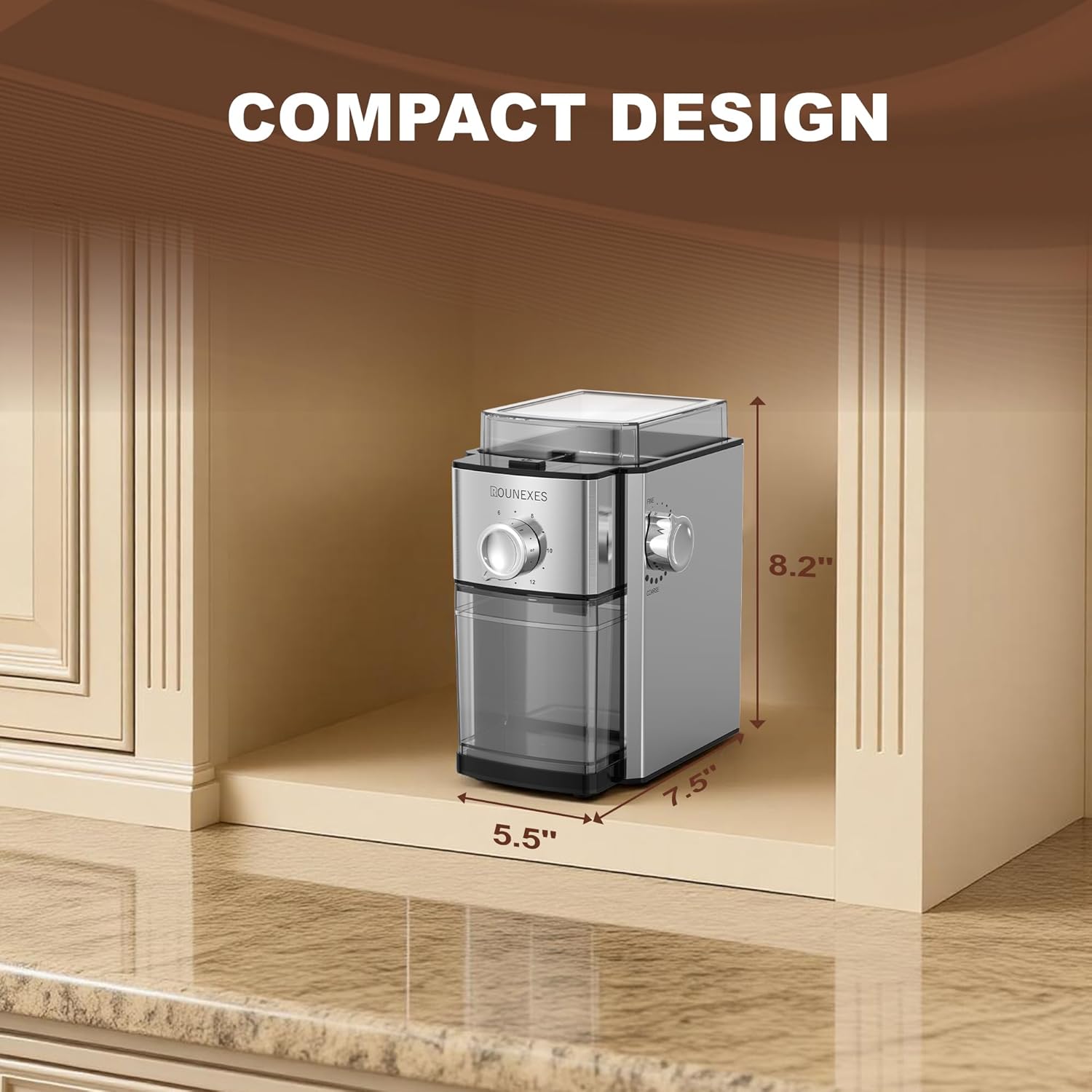
| Dimensions & design | 7.5″L x 5.5″W x 8.2″H; compact, silver housing |
| Best suited users | Home brewers, travel users, beginners, small households |
| Intended brew methods | Espresso (basic dialing), drip, pour-over, French press, travel brewing |
| Cleaning & maintenance | Removable burrs, wipeable housing |
| Warranty | Not specified by product listing |
These specifications map directly to expected brewing outcomes: 17 stepped grind positions provide broad coverage for multiple brew methods but limit micro-adjustment precision. Stainless-steel burrs and a removable grounds container facilitate cleaning and odor control, while the compact dimensions and 8.82oz hopper balance daily capacity with portability. One-touch auto-stop simplifies workflow but introduces dependence on pre-set grind times for dosing.

Grind range and particle consistency
A grinder’s stepped 17-setting range determines the discrete options available to match extraction targets across methods. Stepped settings simplify selection for novices but can make fine-tuning extraction more iterative for experienced users who rely on fractional adjustments. Stainless-steel burrs typically produce a bimodal particle distribution that is acceptable for many home brewing methods: uniformity improves with slower burr speeds and well-designed burr geometry. This model’s removable burrs indicate a serviceable design, though flatness, sharpness, and alignment tolerances inherent to cost-focused grinders may yield slightly wider particle distribution than higher-end flat- or conical-burr machines, affecting shot clarity and brew body.

Espresso dialing and fine settings
For espresso, particle size uniformity and distribution are critical to achieve balanced extraction within short contact times. The grinder’s finest stepped settings can reach espresso-range particle sizes, but stepped increments mean adjustment jumps may be more pronounced than with stepless systems. Wider particle distribution or occasional fines can accelerate flow and increase channeling risk; therefore, pairing this grinder with consistent dosing, proper tamping technique, and careful shot timing mitigates variability. Users seeking micro-adjustments for pressure profiling or single-dial-in precision may find the 17-step resolution limiting for repeatable micro-variations.
Coarse settings for immersion and manual methods
The coarsest settings accommodate French press and cold-brew styles where larger particle sizes and lower fines are desirable. For immersion brewing, particle uniformity reduces over-extraction of fines and helps maintain clarity. Stepped coarse positions help novices pick reliable starting points, but extraction balance still depends on brew ratio, contact time, and agitation. The removable grounds container allows direct dosing into a press or travel brewer, while the hopper size supports multiple small batches without frequent refills.
Brewing method compatibility and recommended use cases
Compatibility with brew methods is primarily determined by grind range, consistency, and dosing control. This grinder’s spectrum—from fine to coarse across 17 steps—covers common household methods: espresso, drip, pour-over, and French press. One-touch operation and a transparent hopper support convenience for households and travel. However, users requiring professional espresso performance, single-dose precision, or ultra-fine espresso microlines should consider higher-tier machines. For drip and pour-over, the stepped settings and stainless-steel burrs typically deliver acceptable medium-fine textures; pour-over brewers with flow-control devices may benefit from slightly more uniform particle distribution offered by higher-end conical burrs.
Espresso and pressurized portafilter systems
When used with pressurized portafilters or pods, grind uniformity is less critical; the grinder’s fine settings can perform adequately. For non-pressurized, classic espresso baskets, extraction relies heavily on even tamping and consistent particle size. Slightly wider distribution or higher fines can increase crema variability and alter extraction yield. The grinder’s one-touch dosing simplifies fill consistency, but stepped adjustments may require trial-and-error to lock in the correct step for a given roast and tamping routine.
Pour-over, drip, and immersion considerations
Pour-over and drip methods tolerate a broader distribution of particle size, though uneven grind can lead to under- or over-extraction pockets. For manual pour-over, adjusting brew ratio and pour tempo compensates for modest distribution variance. Immersion methods like French press benefit from the coarser settings where fewer fines prevent excessive turbidity. The transparent hopper and removable grounds container ease transitions between methods during a single session, supporting households that alternate brewing styles.
Ease of use, dosing workflow, and capacity
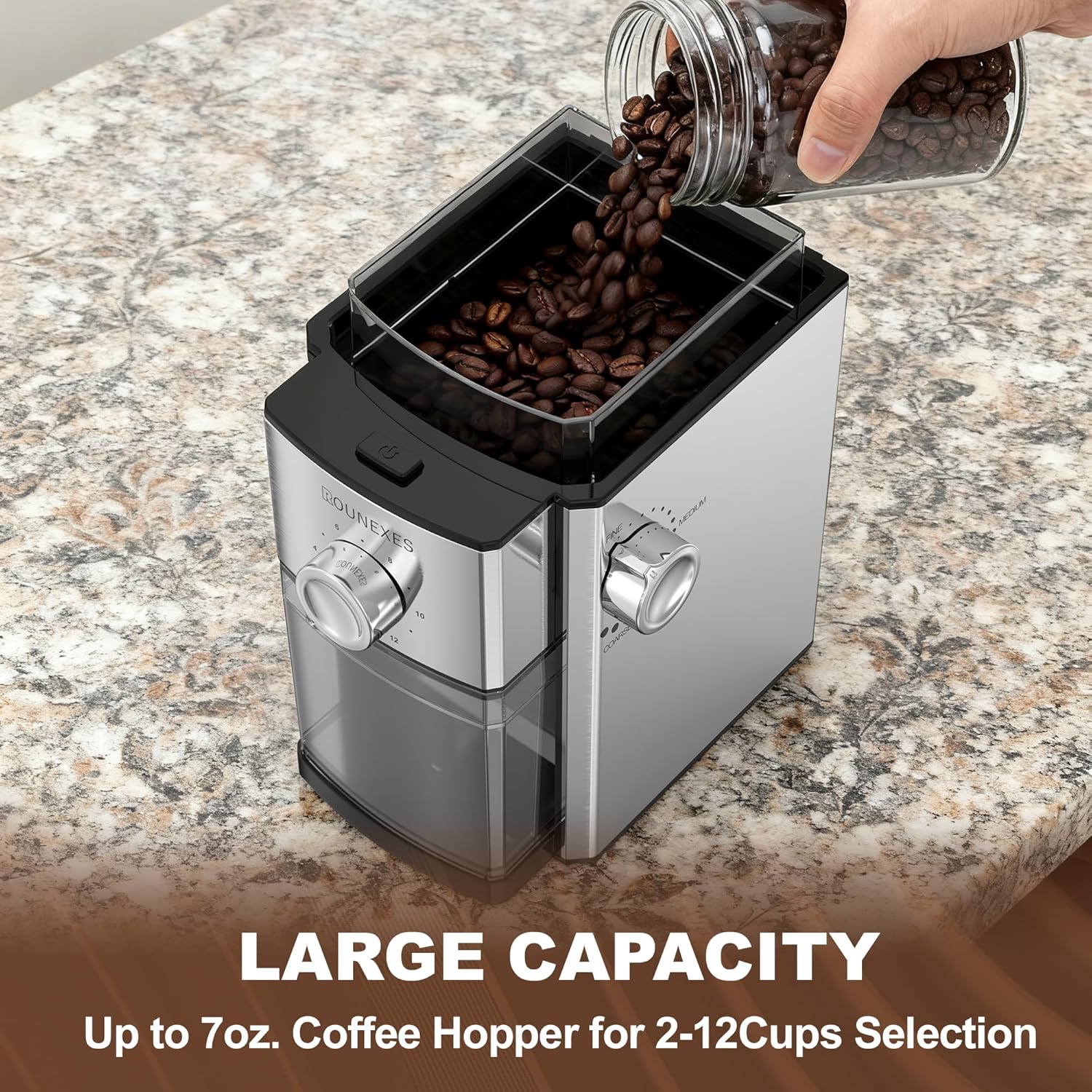
Workflow matters in everyday brewing—especially for multi-person households and travel. The one-touch start and auto-stop remove the need for a separate timer, making the grinder approachable for newcomers. The 8.82oz hopper offers enough beans for several morning cycles without being bulky, and the removable grounds container with lid supports transfer to portable brewers. However, stepped settings and the lack of a digital timer or weight-based dosing mean reliance on time-based doses and manual observation for exact output. For users seeking absolute repeatability by weight, the absence of integrated scales or stepless adjustment increases dependence on consistent beans and operator technique.
Dosing accuracy and portion control
Auto-stop functionality stops grinding after a fixed cycle or when the grounds container is full, which simplifies dosing but may not correlate exactly to ideal gram-based recipes. Time- or count-based dosing can vary with bean density, roast level, and burr wear. The removable grounds container allows pre-measured transfers with a scale externally, which helps achieve consistent brew ratios. For precision-driven espresso workflows, external scales and a consistent tamping routine will compensate for the grinder’s lack of built-in weight measurement.
Capacity, portability, and small-batch brewing
The 8.82oz hopper balances daily capacity and travel convenience: it can store enough beans for a few days in a single-cup household and remains compact enough for packing. The lightweight housing and removable grounds container support brew-on-the-go workflows. For high-volume households or commercial settings, the hopper and motor duty cycle may limit continuous grinding capacity and require more frequent refills. Portability trade-offs favor compactness over heavy-duty longevity under continuous heavy use.
Heat generation, temperature stability, and extraction implications
Grinder-generated heat affects bean temperature and volatile retention, which in turn influences extraction and flavor. Stainless-steel burrs spinning at moderate to high speeds can create heat at the grinding surfaces; in small, short grinding cycles this effect is often minimal, but sustained grinding increases bean surface temperature and can slightly accelerate degassing. Heat-related changes matter most for precise espresso workflows and freshly roasted beans where volatile aromatics are prominent. The product’s compact motor design suggests short-cycle operation intended for small batches, reducing cumulative heat buildup; nonetheless, awareness of duty cycle and intermittent grinding is advised to preserve flavor integrity.

Static, clumping, and humidity effects
Static and clumping are common with dry grounds and lightweight plastic housings. Finer settings tend to exacerbate static cling and cause scatter during transfer, which affects dosing consistency. The removable grounds container with lid helps trap grounds and reduce scatter. Environmental humidity and bean roast level also influence static and clumping behavior; practices like occasional gentle tapping of the grounds container or using a short anti-static device can mitigate these issues and support consistent dosing during home use.
Impact on extraction and brewing temperature
Although the grinder does not control brew temperature, grind quality affects how quickly water extracts soluble compounds. Excess fines can increase perceived body and bitterness, while larger particles slow extraction leading to under-extraction and sour notes. Maintaining appropriate grind size for the chosen brew temperature and ratio is essential: coarser grinds pair with longer contact times or higher water temperature to reach target extraction yields. A grinder that reliably produces similar particle distributions across sessions eases maintaining desired brew temperatures and consistent cup profiles.
Cleaning, maintenance, and build quality expectations
Removable stainless-steel burrs and a wipeable housing support routine maintenance, dust removal, and periodic deep cleaning. Regular cleaning reduces oil buildup, stale aromas, and burr wear rate. The grounds container lid supports scent control between uses. However, replacement part availability for aftermarket burrs or motor components depends on manufacturer support. Build material choices—stainless-steel burrs paired with a compact consumer-grade motor and plastic housing—suggest a balance between performance and affordability; long-term reliability hinges on maintenance habits, duty cycle, and alignment tolerances of burr assemblies.

Routine maintenance schedule and procedures
Routine maintenance for home grinders typically includes weekly removal of loose grounds, monthly deeper brushing of burrs and feed chute, and occasional disassembly for thorough cleaning. The removable burrs enable standard brushing and inspection for chips or uneven wear. Lubrication is rarely required for burr assemblies, but ensuring the motor and hopper are free of oil and debris prolongs operational life. Users should follow manufacturer cleaning guidance to avoid damage to burr surfaces or motor components.
Durability signals and expected service life
Stainless-steel burrs are wear-resistant compared to low-grade alternatives, but they still dull over time depending on grind volume and bean hardness. A compact consumer motor is designed for intermittent domestic use; heavy daily loads accelerate wear. The presence of removable burrs and a simple mechanical stepped collar suggests repairability is moderate, with potential replacement burrs and support dependent on brand service channels. Buyers prioritizing multi-year high-volume durability should compare commercial-grade burrs, DC motors with lower RPMs, and stepless adjustment systems.
Durability, long-term reliability, and who should avoid this grinder
Durability is a function of materials, motor design, and intended duty cycle. Stainless-steel burrs and a removable container point to practical durability for small households and travel use. However, stepped adjustments and compact motor architecture indicate trade-offs against continuous use in shared kitchens or light commercial settings. Long-term reliability depends on consistent maintenance, moderate daily throughput, and avoidance of overloading the motor with high-volume grinding. Users who prioritize micro-adjustment, heavy daily throughput, or professional espresso-level consistency may prefer more robust grinders with stepless adjustment, heavier-duty motors, and serviceable parts readily available.
Signs this grinder is not ideal for certain users
This model is not optimized for high-volume cafes, users who require ultra-fine micro-adjustments, or baristas implementing advanced pressure profiling and single-origin espresso extraction where particle uniformity and stepless control are critical. Additionally, those who demand integrated weight-based dosing or built-in anti-static technology may find the feature set limiting. For such users, investing in a mid- or high-tier grinder with a stepless collar, larger duty-cycle motor, and documented burr replacement parts is advisable.
Pros & Cons
Pros
- Compact and portable design supports travel and small-countertop kitchens. The small footprint and lightweight construction make it easy to store and transport for single-serve and travel brewing workflows.
- Broad 17-step grind range covers common methods from espresso to French press. The discrete settings simplify selection for households that switch between brew styles.
- Stainless-steel removable burrs enable routine cleaning and reduce long-term odor retention. Removability simplifies maintenance and inspection for wear.
- One-touch grinding with auto-stop streamlines the brewing workflow. This feature lowers the operational barrier for beginners and those seeking quick daily use.
- Transparent 8.82oz hopper allows visual monitoring of bean supply. A mid-size hopper reduces frequent refills while preserving portability.
- Removable grounds container with lid reduces scatter and preserves grounds between sessions. It supports direct dosing into portable brewers and helps control aromas.
- Wipeable housing simplifies surface cleaning. External surfaces are easy to maintain for neat home kitchens.
- Suitable for multi-method households that alternate between drip, pour-over, and immersion. Versatility makes it a practical starter device for varied brewing preferences.
Cons
- Stepped adjustment limits micro-tuning compared with stepless grinders. Users seeking fine-grain espresso dialing may encounter larger jumps between settings and need more trial-and-error.
- Time-based dosing and auto-stop lack integrated weight measurement. This increases reliance on external scales for gram-accurate recipes and consistent extraction yields.
- Potential for wider particle distribution than higher-end models. Consumer-grade burr geometry and alignment tolerances can produce slightly more fines or larger particles, affecting extraction uniformity.
- Motor and duty cycle not specified for commercial-grade continuous use. Heavy daily grinding in shared households or small cafes may accelerate wear.
- Static and clumping at fine settings can affect dosing consistency. Fine espresso grinds are more prone to scatter and cling without anti-static measures.
Final Verdict: Who This Product Is Best For (and Who Should Skip It)
This electric burr grinder is best suited to home brewers prioritizing convenience, portability, and multi-method flexibility. The 17 stepped grind settings, stainless-steel removable burrs, and one-touch auto-stop provide a straightforward path to consistent daily brewing for households, dorm rooms, and travel setups. It aligns well with users who alternate between drip, pour-over, and immersion methods and who prefer a compact appliance that reduces countertop clutter while providing an acceptable level of grind control and ease of cleaning.
Those who should skip this model include high-volume users, serious home baristas seeking stepless micro-adjustments for advanced espresso dialing, and small cafés requiring robust duty-cycle motors and commercial-grade burrs. For enthusiasts in 2026 focused on precision espresso development, integrated weight-based dosing, or minimal particle distribution, higher-tier grinders with stepless adjustment and documented replacement parts offer more suitable long-term performance. This grinder occupies a practical niche between basic blade mills and premium conical- or flat-burr machines, delivering balanced features for everyday home use when paired with disciplined dosing and maintenance.
Frequently Asked Questions (FAQs)
What grind sizes does a 17-setting burr grinder cover for home brewing?
A 17-step burr grinder typically spans a range from espresso-fine to French-press-coarse. Each step provides a discrete grind size suitable for common methods: the finest steps target espresso-range particles, mid-steps match drip and pour-over, and the coarsest steps are useful for immersion methods. Exact particle distribution depends on burr geometry and speed; achieving consistent extraction may require small workflow adjustments such as modifying brew ratio or contact time.
Can a compact electric burr grinder produce espresso-quality grounds?
Compact consumer burr grinders can reach espresso-range particle sizes, but stepped adjustments and consumer-grade burr tolerances may limit micro-adjustment precision. For pressurized portafilters or novice espresso workflows, the grinder is often adequate. For advanced, non-pressurized espresso baskets and precision extraction, a stepless grinder with very uniform particle distribution and a heavier-duty motor is typically preferred.
How does grinder heat affect coffee extraction and flavor?
Grinding generates frictional heat that can raise bean temperature and affect volatile aromatics. Short grinding cycles on a compact grinder generally produce minimal temperature change, but sustained or repeated grinding can increase temperature and slightly alter flavor profiles. For best results, grind in small batches, allow short rests between long sessions, and avoid continuous high-volume grinding to minimize heat-related changes.
Is a removable grounds container helpful for cleaner dosing?
Yes. A removable grounds container with a lid reduces static and scatter during transfer and allows direct dosing into travel brewers or manual devices. It also enables easier measurement with an external scale. While it does not replace integrated weight-based dosing, the container supports cleaner workflow and reduces mess in multi-method brewing routines.
How often should the burrs and chute be cleaned?
Routine cleaning includes weekly removal of loose grounds and monthly deeper brushing of burrs and the feed chute, depending on usage. Occasional full disassembly for a thorough cleaning is recommended every few months. Regular maintenance prevents oil buildup and stale flavors, and helps maintain consistent grind performance over time.
Will this grinder produce a lot of static and clumping at fine settings?
Fine settings can increase static and clumping because smaller particles cling to surfaces and scatter more easily. The removable grounds container with lid helps contain scatter. Environmental factors, roast level, and humidity also influence static behavior. Simple mitigation methods include tapping the container, using an anti-static tool, or grounding the device during transfer.
How does stepped adjustment compare to stepless for dialing in espresso?
Stepped adjustment offers predefined increments that simplify selection and repeatability for many users, but each step jump can be larger than desired for precision espresso dialing. Stepless systems allow micro-adjustments for incremental changes in particle size, which benefit advanced espresso tuning and pressure profiling. For home users seeking straightforward operation, stepped systems remain practical and easier to use.
Is the 8.82oz hopper size suitable for daily home use?
An 8.82oz hopper balances capacity and portability for small households and single-cup routines. It stores enough beans for multiple daily brews without frequent refilling, while remaining compact for countertop or travel use. High-volume households or small commercial settings may require a larger hopper and a motor designed for continuous operation.