CM8050P Espresso Machine Review: Grind, Heat, Steam Guide
Why equipment choice matters for at-home espresso and milk-based drinks
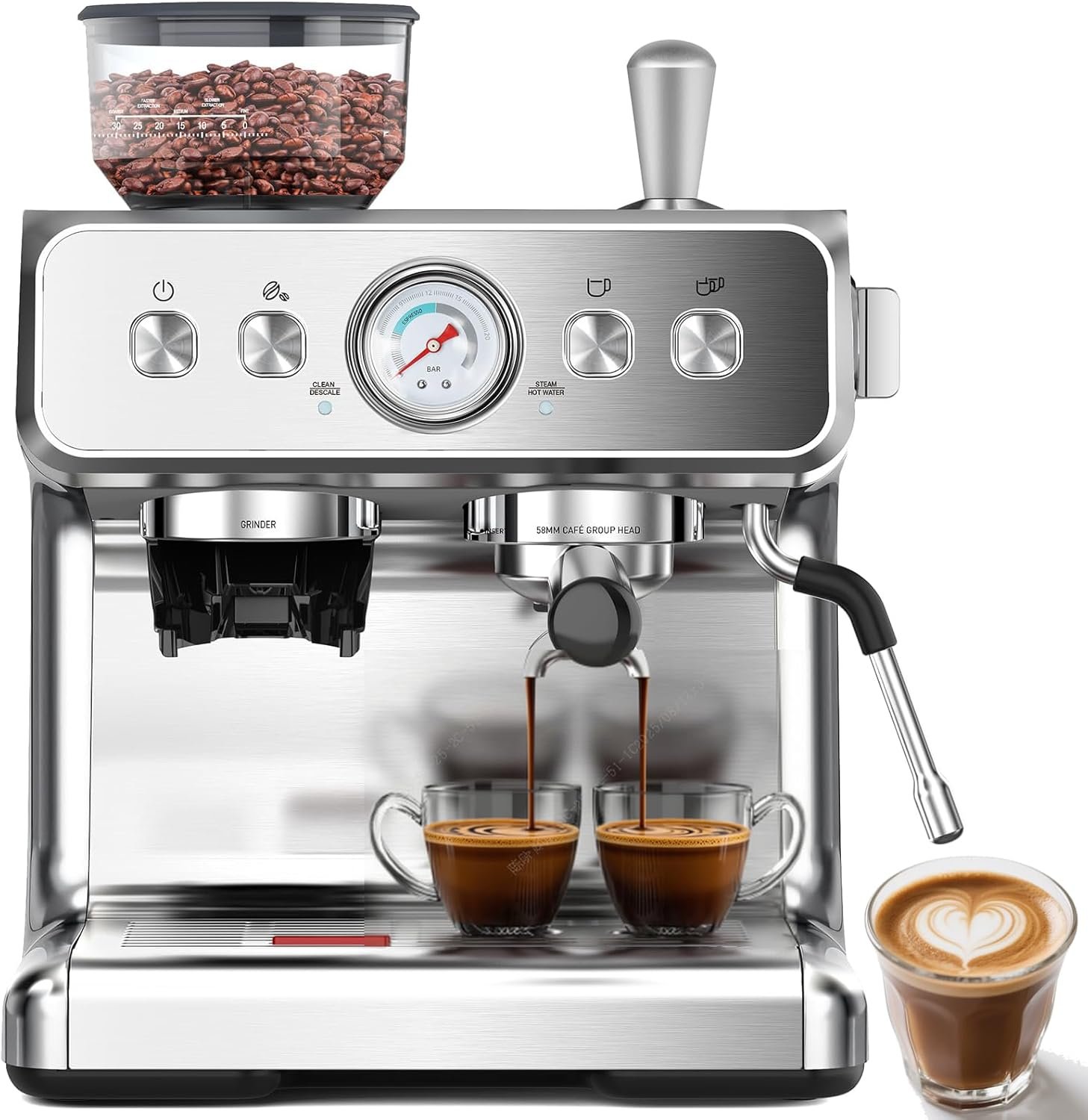
Choosing an espresso machine shapes what can be brewed, how consistent extraction will be, and how repeatable café-style milk texturing becomes. Home brewers and small‑café operators benefit from understanding how integrated components — grinder, boiler, and steam wand — interact to affect shot quality, crema, and milk microfoam. The CM8050P targets semi-automatic users who want built-in grinding, PID temperature control, and a professional-style 58mm portafilter without requiring a commercial footprint. Evaluating this model requires attention to grind size range and consistency, pressure profile (including the impact of pre-infusion), heat system stability, and workflow ergonomics for single-operator production. Cleaning, routine maintenance, and component materials influence longevity and daily reliability. For purchasers deciding between modular components or an all-in-one unit, the CM8050P’s integrated grinder and removable water tank position it for convenience but also raise questions about serviceability and user control over each brewing parameter.
Quick Overview
| Feature | Details |
|---|---|
| Product category | Semi-automatic espresso machine with integrated grinder |
| Brewing method | Pump-driven espresso with pre-infusion and steam wand |
| Pressure system | Rated 20 bar pump (operational extraction depends on brew group dynamics) |
| Temperature control | PID-based temperature regulation |
| Grinder | Integrated conical burr grinder with 30 grind settings |
| Portafilter size | Commercial-style 58mm portafilter included |
| Capacity & footprint | Removable water tank; product dimensions 13.03″D x 11.5″W x 16.1″H; 4.9 lb bean capacity listed |
| Materials & components | Metal portafilter, stainless steam wand, plastic chassis elements |
| Included accessories | Milk pitcher, tamper, multiple filter baskets, cleaning brush, cleaning kit |
| Intended users | Home enthusiasts, small households, light commercial/home-café use |
| Maintenance features | Removable water tank, programmable features, not dishwasher-safe |
These specifications combine to shape shot extraction and daily usability. The integrated grinder enables dose-to-dose freshness but requires calibration to align grind distribution with the CM8050P’s portafilter, while the PID and pre-infusion features are aimed at improving temperature stability and extraction uniformity. Physical footprint and removable tank make the unit suitable for kitchen counters and occasional café settings where space and serviceability matter.

Brewing performance and extraction quality
The CM8050P’s extraction approach centers on a pump-driven pressure system, a pre-infusion stage, and PID temperature control intended to reduce thermal drift during shots. Pre-infusion at low pressure helps wet the puck evenly, which reduces channeling risk and supports more uniform solute extraction across common espresso roast profiles. Grind size range across 30 settings allows dose adaptation for single and double baskets, but consistent particle distribution is dependent on burr geometry and calibration. The 58mm portafilter and included precision filters enable appropriate puck depth and surface area for standard espresso recipes. Extraction outcomes will vary with bean type, roast degree, and tamp consistency; the machine’s components favor operators who can match grind, dose, and tamp to the machine’s flow characteristics for repeatable results.

Grinder, grind consistency, and dosing considerations
The integrated conical burr grinder offers 30 preset grind sizes designed to bridge coarse-to-fine needs for espresso-focused brewing. Grind consistency for conical burrs typically yields a tighter fines profile than blade grinders, improving shot uniformity and reducing over-extraction risk when set correctly. Dosing control depends on the hopper capacity, dose chute design, and whether the grinder features stepless adjustment or indexed stops; listings indicate 30 presets which suggest indexed steps, affecting micrometric adjustment precision. Matching grind setting to the included 58mm portafilter and chosen basket—single, double, or precision—will be necessary to achieve target extraction yields. For optimal results, adjust grind and dose incrementally, monitor shot time and flow, and use visual cues like flow stability and color change to guide refinement.
Pressure profile, pre-infusion, and PID impact on extraction
The machine lists a 20 bar pump rating; however, typical extraction pressures at the puck are determined by pump regulation, group dynamics, and any internal pressure profiling. Pre-infusion introduces a low-pressure wetting phase that reduces channeling and supports fuller solute extraction from unevenly packed pucks. PID temperature control stabilizes boiler or thermoblock output, which helps maintain consistent solubility rates for acids, sugars, and bitters across multiple shots. Stable temperature reduces shot-to-shot variance in extraction yield, especially for medium and dark roasts where temperature sensitivity is pronounced. When combined with an appropriate grind and dose, these features cohere to produce more balanced espresso but require user calibration and understanding of extraction science to maximize potential.
Usability and daily workflow
Workflow considerations include grinder integration, control layout, programming options, and access for routine tasks like filling the tank, emptying the drip tray, and changing filter baskets. An integrated grinder shortens the steps between dosing and tamping but can complicate cleaning and isolation of grinder-related wear. Button-based human interface input and programmable features suggest a moderate learning curve: basic shots are achievable quickly, while program customization requires reading the manual and trial. The removable water tank eases refills in tight spaces but internal plumbing and grinder access determine how straightforward maintenance and partial disassembly will be. For households prioritizing quick single-operator workflows, the CM8050P combines multiple tools into one unit; for users seeking modular customization of grinder and brew group, the integrated design imposes trade-offs between convenience and component-level control.

Integrated grinder workflow and ergonomics
Built-in grinders improve convenience by aligning grind-to-portafilter proximity and reducing countertop clutter. The CM8050P’s hopper and chute placement affect how easily ground coffee is delivered into the 58mm portafilter and whether a doser or on-demand dosing system is present. Hopper capacity and static generation can influence clumping and dosing repeatability, particularly with oily, dark-roasted beans. Ergonomic aspects such as tamping station clearance, portafilter handle angle, and drip tray height impact how comfortably skimming, tamping, and inserting the portafilter into the group occur. For higher-frequency use, clear access to the grind chute and a removable dosing tray simplify cleanup and reduce cross-contamination between roast profiles.
Controls, programmability, and learning curve
Button-based controls and programmable shot volumes reduce cognitive load for repeat recipes but require an initial setup to align shot time, flow, and temperature with personal taste. PID controllers commonly allow fine temperature adjustment; however, interface simplicity determines how readily temperature, pre-infusion length, or pump activation profiles can be changed. Semi-automatic operation implies manual shot initiation and termination options alongside programmable presets, striking a balance between direct barista control and automation for consistency. Newer home enthusiasts may require a period of calibration — matching grind setting, dose, and tamp to the machine’s programmed volumes — while experienced users can use the programmability to store preferred parameters for different bean lots.
Temperature control and steam performance
Temperature stability is central to consistent extraction and milk texture. The CM8050P’s PID control is intended to reduce thermal drift during brewing, which supports predictable solubility rates across repeated shots. Heating architecture (single boiler vs. heat exchanger vs. thermoblock) influences simultaneous steaming and brewing capability; documentation indicates a single-boiler arrangement with a fast-recovery steam capability suitable for household and light-café workloads. Steam wand design, tip type, and boiler pressure capacity determine milk heating speed and steam quality. For milk-based drinks like lattes or cappuccinos, a steam wand that produces fine, consistent microfoam improves texture and sweetness perception; however, steam power and boiler recovery affect how many consecutive drinks can be prepared without a cooldown period.

PID behavior and heat system implications
PID-based regulation compensates for temperature swings by adjusting heating element cycles to maintain setpoints more precisely than thermostat-only systems. In practice, this reduces variations that cause sour or bitter shot shifts when brewing multiple beverages. The underlying heat source—whether a small boiler or thermoblock—defines recovery time and temperature homogeneity. Single small boilers can achieve stable brew temperatures but may require a brief pause between steaming and brewing for temperature recovery, whereas heat-exchanger systems allow simultaneous actions at the cost of more complex plumbing and higher energy use. For the CM8050P, PID support suggests a priority on shot consistency, but capacity limitations inherent to compact home boilers should be considered when planning high-volume service.
Steam wand design and milk texturing expectations
A stainless steam wand capable of manual texturing allows skilled operators to produce velvety microfoam and varied milk temperatures for lattes, cappuccinos, and flat whites. Steam power and tip design influence how quickly milk heats and how much air can be incorporated without large bubbles. Microfoam quality is also affected by the wand’s articulation and operator technique; a robust wand with sufficient steam pressure will produce finer foam more quickly, which is helpful for latte art and consistent drinks. Boiler pressure and recovery rate determine how many successive milk drinks can be prepared at the same texture level; in smaller boilers, recovery pauses may be required after several steaming cycles to maintain steam performance.
Capacity, footprint, and serving flexibility
Physical dimensions and component capacities determine the CM8050P’s fit in kitchens and small service environments. The unit’s listed footprint and removable water tank position it as suitable for home countertops and compact café stations. Bean hopper capacity and portafilter basket options affect how many drinks can be produced before refilling or dosing changes are needed, while the commercial-style 58mm portafilter enables compatibility with a wide range of aftermarket baskets and tampers for customization. Serving flexibility also depends on boiler recovery and steam power for milk drinks, and on the grinder’s ability to maintain consistent doses across roast changes. For households and small groups, the machine balances compact size with professional-standard components to enable a range of drink styles without occupying a commercial footprint.

Water tank, drip tray, and daily throughput considerations
A removable water tank simplifies refilling where under-counter plumbing is not present but its volume determines how many back-to-back shots are possible before a refill is needed. Drip tray and waste capacity influence how often spent puck and drip management must be addressed during service, particularly when producing several milk drinks in short succession. For occasional home use, modest tank and tray sizes reduce unit size without significant inconvenience; for light café use, frequent refills and emptying may interrupt workflow. Understanding expected daily throughput and matching it to tank and waste capacities will reduce interruptions during peak periods and help maintain consistent brew temperatures and steam pressure.
Portafilter and basket versatility for serving options
A 58mm commercial-style portafilter broadens compatibility with aftermarket baskets (single, double, precision) and accessories like bottomless portafilters, which aid shot diagnostics. Multiple precision filters included with the machine expand the range of brew styles — from ristretto to lungo — and allow tailoring puck depth and flow for different recipes. This versatility benefits users who prepare diverse drinks for varying preferences. However, achieving consistent results across different baskets relies on careful alignment of grind setting, dose, and tamp pressure, and operators should plan for initial calibration when switching basket types or bean profiles.
Cleaning, maintenance, and durability expectations
Cleaning and serviceability determine long-term reliability and performance retention. Removable water tank and accessible drip tray simplify daily rinses, but integrated grinders require separate cleaning attention to prevent stale oils and fines buildup. Regular backflushing with suitable detergents and periodic descaling (depending on local water hardness) preserve group sealing, boiler efficiency, and steam quality. Materials such as a metal portafilter and stainless steam wand offer durability against mechanical wear, while plastic chassis elements may show cosmetic wear earlier; component replacement and availability of spare parts influence long-term maintenance costs. Overall reliability depends on adherence to cleaning schedules and treating the integrated grinder and internal plumbing as serviceable parts rather than sealed components.

Routine cleaning steps and expected intervals
Daily maintenance should include knocking out spent pucks, rinsing the portafilter, wiping the steam wand after each use, and emptying the drip tray. Weekly or biweekly tasks include backflushing with a cleaning tablet or powder for the brew group and brushing the grinder’s chute and burr chamber to remove oils and fines. Descaling frequency depends on water hardness; a filtered water supply reduces scale formation and extends the lifespan of heating elements and flow paths. Following manufacturer-recommended maintenance intervals preserves PID accuracy and steam performance and reduces the likelihood of pressure or flow anomalies caused by deposits.
Component materials, serviceability, and expected lifespan indicators
Commercial-style components such as a 58mm portafilter and stainless steam wand are durable choices that typically outlast consumer-grade plastic parts. Wear points for integrated machines often include burr wear in the grinder, seals and gaskets around the brew group, and the pump. Availability of replacement parts, straightforward access to consumables, and clear cleaning procedures are indicators of easier long-term servicing. Machines with user-replaceable filters and accessible internal components generally provide lower lifetime maintenance costs than fully sealed units. For the CM8050P, the presence of included cleaning tools and a removable tank suggests manufacturer attention to serviceability, though integrated systems inherently centralize multiple wear items in a single chassis.
Pros & Cons
Pros
- Integrated grinder and 58mm portafilter enable compact, all-in-one brewing and a professional interface. This reduces countertop clutter while offering compatibility with standard commercial baskets and tampers.
- PID temperature control and pre-infusion improve extraction stability and reduce shot-to-shot thermal variance. These features support more balanced flavor profiles when grind and dose are optimized.
- Multiple precision filter baskets and included tamper allow recipe flexibility across ristretto, espresso, and lungo styles. Users can adapt puck depth and surface area for different roast profiles.
- Stainless steam wand and professional-style portafilter materials enhance durability and milk-texturing capability. Robust steam performance supports quality microfoam when boiler recovery is adequate.
- Removable water tank and programmable buttons simplify daily operation and make the machine suitable for home kitchens and light café usage. Ease of refilling and preset storage support repeatability.
- Compact footprint and included accessory set reduce the need for immediate aftermarket purchases. The package approach provides necessary tools for initial calibration and cleaning.
Cons
- Integrated grinder limits independent upgrade paths and complicates grinder-specific servicing. Burr wear or motor issues require unit-level maintenance or specific part replacement rather than independent swapping.
- Indexed grind presets (30 steps) may not offer the stepless micro-adjustment preferred by advanced users seeking ultra-precise dialing. This can increase tuning time when switching bean lots or roast types.
- Single-boiler-style thermal limitations can restrict back-to-back steaming and brewing performance. Boiler recovery time may require pauses during sustained milk drink preparation.
- Plastic chassis components can affect perceived long-term robustness compared with full-metal commercial machines. Cosmetic wear and impact susceptibility may be greater over multi-year use.
- Integrated systems concentrate failure modes; if the grinder or pump fails, the whole unit’s functionality can be compromised. This increases dependency on manufacturer support and parts availability.
Final Verdict: Who This Product Is Best For (and Who Should Skip It)
The CM8050P is best suited to home espresso enthusiasts and small household baristas who prioritize an integrated, space-conscious package that combines an adjustable burr grinder, PID temperature control, pre-infusion, and a professional 58mm portafilter. Buyers seeking a single unit to produce café-style lattes and cappuccinos with controllable extraction parameters will find the combination of programmable settings and included accessories helpful. The machine addresses core needs for brew consistency, milk texturing, and recipe retention while fitting on domestic counters where space is limited.
This unit is not ideal for users who require heavy commercial throughput, stepless grinder precision, or fully modular systems where independent upgrades and easy serviceability of grinder and brew group are priorities. High-volume cafés and pro baristas should prefer machines with dedicated commercial boilers or separate grinder setups that allow simultaneous brewing and steaming and simpler component replacement. For households and light-café operations seeking a balance of convenience and control, the CM8050P provides a feature set that aligns with mid-level performance expectations in 2026.
Frequently Asked Questions (FAQs)
How does the integrated grinder affect shot consistency?
An integrated conical burr grinder improves convenience by reducing the distance between grind and tamp, which can reduce static and retention. Consistency depends on burr quality, calibration, and indexed versus stepless adjustments. Regular cleaning of the chute and burrs minimizes retention and flavor transfer. For consistent shots, match grind setting, dose, and tamp pressure to the machine’s flow characteristics and make incremental adjustments when switching beans or roast levels.
Can the CM8050P brew and steam at the same time without temperature loss?
Temperature behavior depends on the internal heating architecture and boiler capacity. PID control helps maintain stable brew temperatures, but smaller single-boiler systems typically prioritize either steaming or brewing at any given moment. This can require brief recovery periods between consecutive steam cycles and extractions. For light household use, recovery time is usually acceptable, whereas continuous high-volume steaming may reveal limitations in sustained steam power.
What maintenance routines are necessary to keep extraction consistent?
Daily maintenance should include knocking out spent pucks, rinsing the portafilter, and wiping and purging the steam wand after each use. Weekly backflushing with an appropriate cleaner preserves group seals and flow paths, and periodic burr brushing prevents oil buildup in the grinder. Descaling intervals depend on local water hardness, and using a water filter reduces scale formation and extends the life of heating elements and valves.
Is the CM8050P suitable for small café or light commercial use?
The unit’s compact footprint and integrated features make it viable for small-scale or light commercial settings where throughput is modest. However, for sustained high-volume service, a machine with larger commercial boilers and separate commercial grinders is preferable. The CM8050P fits environments that balance occasional service bursts with space and cost constraints rather than continuous peak-hour demand.
How important is the 58mm portafilter for home espresso setups?
A 58mm portafilter is the commercial standard and increases compatibility with aftermarket baskets, tampers, and performance accessories. It supports more stable puck geometry and makes it easier to source replacement baskets and diagnostic tools. For home users seeking a professional interface and upgrade potential, a 58mm portafilter is advantageous compared with smaller proprietary sizes.
Will the indexed 30-step grinder settings allow precise dialing?
Indexed settings provide repeatable reference points that simplify returning to prior settings, but they may not allow the micro-adjustments that stepless grinders offer. For many users, 30 steps offer adequate control to dial in extraction for different beans and roast levels; advanced users requiring ultra-fine tuning might prefer a stepless or higher-resolution grinder to reduce iterative adjustment time.
What accessories and parts should be kept on hand for maintenance?
Keep cleaning brushes, backflush detergent, replacement group gaskets, and a basic set of spare filter baskets on hand. For grinder maintenance, a burr cleaning tool and brush help remove residual oils, and a small vacuum or retained-dust scraper can reduce hopper buildup. Having commonly replaced wear items available minimizes downtime and maintains consistent brew performance.
How does pre-infusion affect cup quality with this machine?
Pre-infusion wets the coffee puck at low pressure before full pump pressure is applied, which helps reduce channeling and promotes a more even extraction across the puck. This can produce smoother flavor balance and improved crema, particularly with uneven tamping or variable grind distributions. When paired with a stable brew temperature from PID control, pre-infusion contributes to more consistent shot profiles.