Hamilton Beach FrontFill 12-Cup Review: Brew Quality & Ease
Why Equipment Choice Matters for Home Brewing
Selecting the right drip coffee maker affects extraction consistency, temperature stability, and daily workflow in a household or small office. For home brewers who value convenience and predictable brewed coffee, appliance design choices such as water reservoir access, brew basket layout, warming plate behavior, and programmable controls determine how reliably a machine delivers an expected cup. Appliances that emphasize front-fill access, a swing-open brew basket, and reminder-driven maintenance reduce friction in routine use, while features like brew-strength selectors and 1–4 cup modes influence extraction by altering contact time and flow dynamics. Material choices—plastic housing, glass carafe, stainless-steel internal tubing—also affect heat retention and long-term durability. For readers deciding between counter space, capacity, and control, understanding how these product characteristics influence grind compatibility, brewing ratios, and temperature stability will clarify whether a compact 12-cup programmable drip maker is the right tool for their brewing needs.
Quick Overview
| Feature | Details |
|---|---|
| Product category | Programmable drip coffee maker (12-cup) |
| Brewing method | Drip / pour-through using ground coffee and #4 paper or reusable filters |
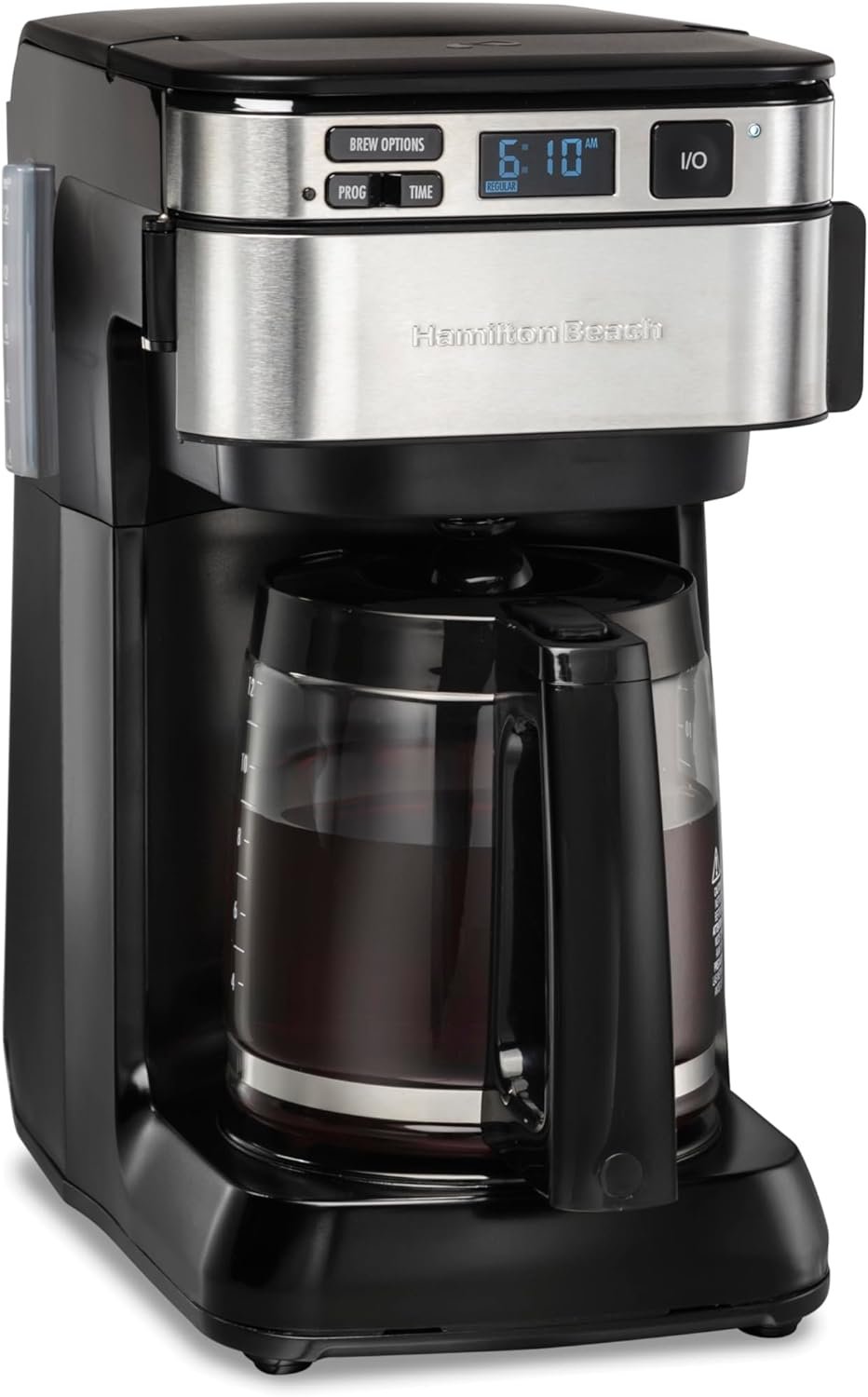
| Capacity & output | 12-cup glass carafe; 1–4 cup setting for smaller batches |
| Materials & construction | Plastic housing, swing-open front brew basket, glass carafe, stainless-steel internal components (manufacturer disclosures) |
| Heating & hotplate | Internal heating element with 2-hour keep-warm auto shutoff |
| Controls & interface | Digital clock, programmable 24-hour timer, Select-a-Brew strength selector, Auto Pause & Pour |
| Filter compatibility | #4 cone or basket paper filters; ground coffee input only |
| Best suited users | Households, small offices, users who prioritize convenience and compact footprint |
| Intended use cases | Daily brewed coffee for multiple servings; scheduled wake-up brewing |
| Warranty | Manufacturer warranty details available from Hamilton Beach |
The listed features directly influence everyday brewing: front-fill access and a swing-out brew basket streamline refilling and cleanup, the 1–4 cup and brew-strength settings change flow rate and extraction time, and the hotplate plus auto shutoff affect how long brewed coffee stays near serving temperature. For buyers, these trade-offs matter more than aesthetic choices when prioritizing consistent extraction and simple workflow.

Brewing method compatibility and limits
The Hamilton Beach FrontFill is built for standard drip brewing with ground coffee and #4-sized filters. This approach uses a shower or single-point water delivery into a brew basket; extraction relies on contact time, grind size, and water temperature. The machine is not designed to produce espresso, steam, or pressurized beverages—pressure-based extraction requires dedicated pumps and portafilters absent here. Compatibility with paper and reusable basket filters means grind distribution should be medium-coarse to medium for balanced flow; overly fine grounds risk slower flow, over-extraction, and clogging. For users relying on fresh grinding, consistent grind calibration will directly affect extraction yield and flavor clarity when used with this machine.

Filter and grind compatibility
Filter size and grind range are key to predictable extraction. The FrontFill accepts #4 filters and a removable brew basket, so a medium grind—similar to standard drip grind—is recommended to maintain a steady flow rate through the bed of grounds. Coarser grinds will shorten contact time and under-extract, producing weak cups, while finer grinds increase resistance and risk over-extraction or channeling in a drip basket. Consistent particle distribution from a burr grinder will help avoid uneven extraction; paper filters remove fines and oils differently than permanent filters, so filter choice will subtly change mouthfeel and clarity without altering basic brew ratios.
Brewing method limits and alternatives
This unit targets traditional drip brewing and scheduled batch preparation. It will not reach the temperature or pressure regimes needed for espresso, nor will it directly support immersion methods like French press without transferring brewed water separately. Users who prefer pour-over control, immersion extraction, or espresso-level pressure should consider dedicated pour-over kettles, immersion brewers, or espresso machines. For those who want a straightforward automatic brewer that fits under cabinets and handles multiple servings, this FrontFill model aligns with standard drip workflows and daily batch brewing rather than specialized extraction techniques.
Ease of use and workflow complexity
Hamilton Beach designed the FrontFill around front-access convenience and simplified daily interaction. The front-facing water reservoir and swing-open brew basket reduce the need to move the machine under low cabinets, enabling refills and grounds placement from the front. The digital clock and 24-hour programmable timer allow scheduled brewing; Auto Pause & Pour interrupts flow momentarily for a serviceable cup during brewing. Controls use tactile buttons and a Select-a-Brew selector to toggle strength or 1–4 cup mode, limiting menu complexity. This workflow favors users seeking low cognitive load routines—refill, add grounds, program, and go—while still offering basic customization. The trade-off is limited advanced control compared with pour-over or manual methods that adjust pour profiles and pulse timing.

FrontFill reservoir and swing-open basket workflow
Front-fill designs change daily ergonomics by moving the water-filling interface to the machine’s front, which is advantageous in tight counter-to-cabinet clearances. A swing-open brew basket simplifies access for adding grounds and removing a used filter, reducing spills and reaching over the top. From a maintenance perspective, front access also shortens the time required to inspect the basket or clear blockages. For households with restricted overhead clearance, this layout reduces friction in routine use and supports faster preparation without repositioning the brewer—factors that encourage regular cleaning and consistent brewing behavior.
Programmable controls and Auto Pause & Pour
The programmable 24-hour timer supports scheduled brewing aligned with morning routines, which is useful for consistent daily output. Auto Pause & Pour is a common convenience that temporarily halts flow so a cup can be retrieved before the full carafe is complete; that behavior slightly alters final brew volume dynamics when used mid-cycle, so intermittent pouring may yield minor temperature and extraction variation. The Select-a-Brew strength selector adjusts water flow or contact time indirectly by changing brew dynamics; while not a substitute for manual pour technique, it provides lightweight customization to suit milder or bolder preferences within an automated drip framework.
Temperature control, heat stability, and extraction quality
Temperature governs extraction kinetics; the ideal brewing range for drip coffee typically lies between 195–205°F at the brew head. This FrontFill model uses an internal heating element and hotplate to reach and maintain serving temperature, with a two-hour keep-warm function and auto shutoff for safety. Without a PID or explicit advertised brew temperature specification, heat stability will depend on internal heating design, water volume, and thermal losses through plastic housing and the glass carafe. The Select-a-Brew and 1–4 cup modes indirectly influence extraction by changing flow rate and contact time rather than temperature. Users seeking precise temperature control or thermal retention beyond the hotplate window may consider insulated carafes or machines with explicit temperature thermostats.

Heating system, hotplate behavior, and safety features
The machine combines a heating element for bringing water to brew temperature and a hotplate to keep the glass carafe warm after extraction. Hotplates maintain drinkable temperatures but can accelerate flavor decline and increase volatile loss over time; the two-hour auto shutoff balances heat retention with safety and flavor preservation. Plastic housing and exposed glass carafes contribute to heat dissipation faster than stainless-steel insulated systems. For consistent flavor across multiple cups, prompt serving or transfer to an insulated carafe will preserve aromatic compounds better than extended warming on a hotplate.
Impact on extraction and Select-a-Brew strength control
Extraction balance is a product of temperature, contact time, and grind. Select-a-Brew provides three main modes—regular, bold, and 1–4 cup—that alter effective flow dynamics and therefore extraction yield. Bold typically means longer contact time or slightly slower flow, encouraging more solubles to dissolve for fuller body; the 1–4 cup mode modifies water flow for smaller batch volumes to avoid weak cups. Because this model does not offer direct temperature adjustment, these modes are the primary in-unit tools for changing perceived strength. To refine extraction further, users can adjust grind size or brew ratios externally while using the machine’s built-in settings.
Capacity, footprint, and serving flexibility
The FrontFill packs a 12-cup glass carafe in a compact footprint (approximately 12.9″D x 7.95″W x 13.9″H), designed to fit beneath typical cabinetry while preserving a 12-cup output. This capacity is useful for families or small office settings where multiple servings are required at once, and the 1–4 cup mode provides partial-batch optimization to reduce over-extraction or thin cups when producing small quantities. The glass carafe is compatible with standard warming plates; however, glass provides less thermal insulation than double-walled carafes. The compact design reduces counter space consumption but still supports full-batch preparation, making it appropriate for users balancing serving flexibility with limited counter depth.

12-cup carafe design and serving considerations
A 12-cup glass carafe is effective for batch service but requires attention to timing and serving temperature. Brewing a full 12-cup batch results in a larger headspace and longer total brew time, which can slightly affect final temperature and extraction profile compared with smaller batches. Glass carafes allow visual monitoring of volume but lose heat faster than insulated alternatives, so serving immediately or transferring to an insulated vessel preserves optimal flavor. For environments where multiple people serve themselves over an extended period, the hotplate and two-hour auto-shutoff offer a practical compromise between readiness and safety.
1–4 cup mode and small-batch optimization
Small-batch brewing often suffers when machines designed for full-carafe volumes underdose or overheat water. The 1–4 cup mode adjusts water delivery and flow to maintain adequate extraction when preparing smaller amounts. This helps keep strength and flavor within acceptable ranges for fewer servings, but grind adjustment remains important: slightly finer grind and careful coffee-to-water ratio will offset reduced thermal mass and contact time. Users frequently brewing single-serve quantities should monitor grind and dose adjustments to ensure consistent cups from the 1–4 cup setting.
Cleaning, maintenance expectations, and durability indicators
Maintenance features include a digital cleaning reminder and compatibility with an inline water filter, both of which support long-term flavor stability by reducing scale and off-flavors from mineral buildup. The swing-open brew basket simplifies access for emptying grounds and rinsing, but the model’s plastic exterior and glass carafe require care to prevent staining and thermal shock. Dishwasher safety is not indicated for the unit as a whole; the carafe and components may be hand-wash recommended per manufacturer guidance. Durability expectations hinge on build materials—plastic housing with stainless-steel internal parts is common for this class, balancing cost and longevity. Proper descaling, filter changes, and regular basket cleaning will extend operational reliability.

Self-clean reminders, water filter, and descaling
A built-in cleaning cycle reminder serves as a prompt for descaling, which is important for maintaining flow rates and heat transfer in machines on hard water. Use of a compatible inline water filter reduces mineral load and can extend intervals between descaling. Descaling frequency depends on local water hardness and use patterns; following manufacturer guidance preserves pump and heating element function. Neglecting scale control can lead to slower heating times, altered brew temperatures, and, eventually, mechanical stress—so cleaning prompts help mitigate performance drift over long-term ownership.
Build materials, footprint, and long-term reliability
The combination of a plastic exterior with a glass carafe and stainless internal components reflects a design balance aimed at affordability and serviceability. Plastic housings minimize weight and allow compact designs that fit under cabinets, while stainless internals protect water pathways from corrosion. Glass carafes are economical and visually transparent but present breakage risk; replacement carafes are a practical spare. Durability expectations for this class of brewer are moderate: regular maintenance, avoidance of thermal shock, and adherence to descaling schedules will help sustain consistent function over years of household use.

Pros & Cons
Pros
- Front-fill reservoir and swing-open brew basket improve accessibility and reduce the need to move the machine under low cabinets. These design choices streamline the refill and grounds placement workflow, reducing spills and user effort.
- Programmable 24-hour timer enables scheduled brewing so a fresh batch can be ready at a set time. Scheduled brewing supports repeatable routines without manual intervention each morning.
- Select-a-Brew strength selector and 1–4 cup mode provide basic customization for brew strength and small-batch optimization. These modes adjust flow dynamics to better match user preferences and batch size.
- Auto Pause & Pour allows a cup to be retrieved mid-brew without needing to wait for the full carafe. This feature increases convenience for intermittent serving.
- Compact footprint fits under standard cabinetry while still producing up to 12 cups, combining space efficiency with batch capacity appropriate for families and small offices.
- Cleaning reminder and water filter compatibility help manage scale and flavor over time. Built-in prompts encourage scheduled maintenance to preserve extraction consistency.
Cons
- Lack of explicit brew-temperature specification limits the ability to evaluate thermal performance precisely. Without a published brew temperature or PID control, users cannot confirm adherence to ideal extraction ranges.
- Glass carafe and hotplate combination retains heat less effectively than insulated alternatives, which can accelerate flavor degradation when coffee is warmed for extended periods.
- Plastic exterior and some non-dishwasher components may require careful handling; not all parts are dishwasher safe per manufacturer notes. This increases manual cleaning time compared with fully dishwasher-safe units.
- The machine is not suitable for pressure-based extraction or espresso-style brewing. Buyers seeking espresso or steam capability must choose a different appliance class.
Final Verdict: Who This Product Is Best For (and Who Should Skip It)
The Hamilton Beach FrontFill 12-cup programmable drip coffee maker targets households and small offices that prioritize straightforward, predictable brewed coffee with convenient front-access operation and basic customization. It is a strong fit for users who value easy refills under low cabinets, a swing-open brew basket for faster maintenance, and programmable scheduling for morning routines. The Select-a-Brew strength selector and 1–4 cup mode give useful, low-complexity control over extraction behavior without demanding manual pour techniques or advanced temperature management. Those seeking a compact machine that delivers consistent batch brewing with modest customization will find the design and feature set aligned with routine home use.
This model should be avoided by buyers who require precise temperature control, insulated thermal retention, or espresso/pressure-based brewing. Enthusiasts wanting fine-grained control over pour profiles, brew temperature, and extraction nuances will prefer dedicated pour-over setups, espresso machines, or brewers with explicit temperature regulation. For most households and office scenarios in 2026, this FrontFill model offers a balanced combination of usability, capacity, and maintenance aids suitable for daily drip coffee needs.
Frequently Asked Questions (FAQs)
Can the Hamilton Beach FrontFill brew espresso or steam-based drinks?
No. The FrontFill is a programmable drip coffee maker designed for pour-through extraction with ground coffee and #4 filters. Espresso and steam-based drinks require high-pressure pumps, boilers, and portafilters that are not part of this appliance class. Users seeking espresso should select a dedicated espresso machine or pressure-capable brewer.
What grind size works best with the #4 filter and brew basket?
A medium to medium-coarse grind typically performs best with a #4 paper or basket filter in a drip brew basket. This grind size balances flow rate and extraction; finer grinds can slow flow and risk over-extraction, while coarser grinds may under-extract. Consistent particle size from a burr grinder improves extraction uniformity.
How does the Select-a-Brew strength selector affect brewing?
Select-a-Brew modifies flow dynamics and contact time rather than changing water temperature directly. The bold setting generally slows flow or increases contact, extracting more solubles for a fuller body, while regular favors standard flow. The feature provides lightweight in-unit customization for perceived strength.
Is the carafe insulated and dishwasher safe?
The included carafe is a glass carafe, which is not insulated like double-walled steel carafes; glass allows visual monitoring but loses heat faster. Dishwasher safety for components varies by manufacturer guidance; many parts require hand washing, so adherence to care instructions is recommended to avoid damage or staining.
How often should the machine be descaled or cleaned?
Descale frequency depends on local water hardness and usage patterns. The model includes a cleaning reminder to prompt maintenance; regular descaling every few months is common in harder-water areas, while softened-water use will extend intervals. Using an inline filter reduces mineral load and helps maintain flow and heating performance.
Does the hotplate preserve flavor for several hours?
A hotplate keeps the glass carafe at serving temperature but also accelerates volatile loss and flavor decline over time. The FrontFill has a two-hour keep-warm with auto shutoff to balance readiness and quality. For longer retention of aroma and flavor, transfer brewed coffee to an insulated carafe.
Can the FrontFill handle small-batch brewing effectively?
Yes. The 1–4 cup setting is designed to optimize flow for smaller volumes, helping maintain extraction quality when brewing fewer cups. To achieve consistent small-batch results, slight adjustments to grind and dose are recommended because thermal mass and contact time differ from full-carafe brews.
Is the FrontFill suitable for office use?
The 12-cup capacity, programmable timer, and front-fill access make it suitable for small offices that require multiple servings. The compact footprint and cleaning reminders support shared use, though large offices or high-turnover environments may prefer commercial-grade brewers with higher throughput and insulated dispensing options.