Nespresso VertuoPlus De’Longhi: Precise Capsule Brewing
Why equipment choice matters for at-home coffee and espresso
Selecting a home coffee or espresso system shapes daily beverage quality, workflow, and long-term convenience for households and light enthusiasts. Brewing method, capsule or ground compatibility, temperature behavior, and extraction consistency determine how closely a machine can deliver predictable cups. This product profile targets users seeking single-serve convenience with capsule-controlled extraction—households, shared kitchens, and those prioritizing speed and minimal grinding or dosing. Important selection factors include the machine’s brewing technology, supported cup sizes, milk-frothing integration, maintenance needs, and compatibility with a capsule ecosystem. For buyers comparing automated capsule systems to manual espresso or pour-over setups, emphasis should be placed on how barcode-driven brewing, capsule sizing, and milk-frother design affect crema formation, beverage strength, temperature retention, and the overall repeatability of espresso and larger coffee preparations.
Quick Overview
| Feature | Details |
|---|---|
| Product category | Single-serve capsule coffee and espresso machine (Vertuo system) |
| Brewing method | Centrifusion barcode-driven capsule extraction (up to 7,000 RPM) |
| Cup sizes | Five automatic sizes: 14 oz (Alto), 8 oz (Coffee), 5 oz (Gran Lungo), 2.7 oz (Double Espresso), 1.35 oz (Espresso) |
| Capsule compatibility | Nespresso Vertuo capsules (multiple diameters for size-specific brewing) |
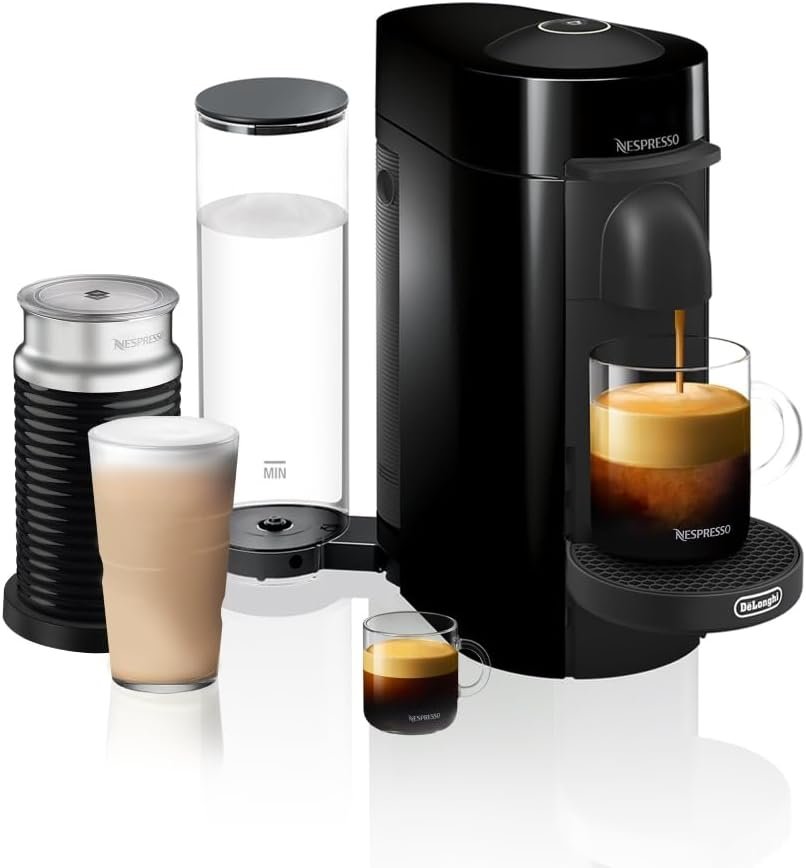
| Included components | De’Longhi machine body and Aeroccino milk frother |
| Operation mode | Fully automatic, button-operated with rapid heat-up (~25 seconds) |
| Construction and dimensions | Ink Black finish; Product dimensions: 12.81″D x 16.2″W x 12.8″H; Item weight ~15.73 lb |
| Best suited users | Households and users seeking fast, consistent single-serve espresso and mug-sized coffee with integrated frothing |
The features above influence daily use and brewing outcomes: barcode-guided Centrifusion automates flow profile and extraction for repeatable crema and cup strength across capsule types, while predefined cup volumes enable convenient switching between espresso and larger coffees. The included Aeroccino frother expands milk-based beverage options but introduces additional cleaning steps. Compact dimensions suit kitchen counters where a balance of footprint, speed, and convenience is prioritized.

Capsule system and brewing method compatibility
The capsule-based Vertuo system centers on capsule-specific brewing parameters with barcode recognition and Centrifusion technology, enabling consistent, automated extraction across multiple capsule formats and cup sizes. Compatibility is limited to Nespresso Vertuo capsules that match the machine’s barcode-read profiles; this supports five programmed volumes from espresso to Alto mug servings and removes manual pressure profiling and dosing. Buyers must weigh the trade-off between closed-system convenience and capsule selection constraints. For those prioritizing variety, the Vertuo ecosystem offers a range of blends and intensities, but third-party capsule or refillable options are restricted compared with open-portafilter machines. The system suits users who value repeatability and low operational complexity over grind-and-tamper control.

Capsule sizing, barcode control, and extraction parameters
Vertuo capsules are deliberately sized—small for espresso, medium for Grand Lungo and Double Espresso, larger for Coffee and Alto—so the machine’s barcode reader identifies each capsule and applies a preprogrammed extraction profile. The Centrifusion system spins the capsule up to 7,000 RPM to mix water and ground coffee while managing flow and contact time; this mechanical approach replaces manual pressure profiling. As a result, extraction variables such as flow rate and infusion duration are effectively pre-set, delivering predictable crema and cup concentration across capsules. The trade-off is reduced opportunity for manual adjustment of extraction time, pressure, or flow, which is a consideration for users focused on high-level brewing experimentation.
Compatibility constraints and capsule ecosystem implications
Use is confined to Nespresso Vertuo capsule formats; pods designed for other Nespresso lines or third-party refillable capsules are not universally compatible due to barcode and capsule geometry requirements. The closed ecosystem simplifies sourcing and ensures each capsule delivers its intended profile, but it limits raw-bean-to-cup experimentation and local-roaster integration. For consumers who value a broad range of origins and home-blending, this system requires reliance on the Vertuo capsule lineup and any authorized third-party Vertuo options. This model is better suited to consumers prioritizing convenience and consistency rather than those prioritizing full control of brew variables via fresh-ground dosing.
How capsule-driven brewing affects buying decisions
Choosing a barcode-driven capsule machine favors buyers who want minimal daily setup, fast warm-up, and consistent results without grinding, dosing, or tamping. The predefined cup sizes and automated extraction reduce user error and speed workflow, particularly for shared kitchens or morning routines. Conversely, advanced home baristas or small-batch roaster enthusiasts who prioritize manual pressure profiling, tamping, and grind adjustments should consider that the Vertuo approach limits those manual levers. Long-term costs and capsule availability should also factor into the purchase decision for high-volume households.
Ease of use and workflow complexity
Operational simplicity is a primary selling point, with one-touch brewing, automatic capsule recognition, and a rapid heat-up time simplifying daily workflow. Users interact via buttons rather than complex menus, and capsule insertion, ejection, and cup-size selection are handled automatically. The included Aeroccino frother provides single-button frothing for hot and cold milk preparations, which reduces the need for separate manual steaming. However, routine tasks such as emptying the capsule bin, refilling the water reservoir, and periodic descaling are still required. Ergonomics such as the water tank location and access to the capsule compartment affect workflow cadence; buyers should evaluate kitchen placement to minimize bending or reaching during routine operations.

Daily operation: capsule handling and button flow
The machine’s button interface and automatic capsule ejection streamline single-serve preparation: insert capsule, close head, and press the cup-size button indicated by the barcode-read program. The one-touch approach minimizes steps and shortens the user learning curve, which is beneficial for multi-user environments. Routine cadence is influenced by the capsule bin capacity—frequent users may need to empty the waste bin regularly—and water reservoir fill frequency depends on household consumption. These routine interactions shape the overall user experience and determine how seamlessly the machine integrates into morning or shared kitchen workflows.
Setup and app/support interactions
Support and order management are available through manufacturer channels and the Nespresso app and website, which assists with capsule reordering and troubleshooting. Initial setup requires basic placement, electrical connection, and first-time rinsing cycles per manufacturer guidance; configuration is otherwise minimal. For users who wish to manage capsule inventory or access warranty and customer support, the app can simplify ordering and replenishment. Those seeking integrated smart-home control or advanced scheduling should verify the specific connectivity features available for the exact model and region before purchase.
Workflow trade-offs for different household types
Households with multiple daily users will benefit from consistent one-touch operation and fast heat-up, while single users who enjoy manual brewing rituals may find the automation less engaging. Office environments or shared apartments appreciate the low-skill barrier to produce acceptable espresso and mug-sized coffee quickly. Higher-frequency use will increase maintenance cadence for bin emptying and descaling, so prospective buyers should factor in these recurring tasks when comparing convenience against machines designed for direct-ground input with larger water capacities and industrial-grade components.
Temperature control, heat stability, and milk frothing
Temperature management influences extraction efficiency and cup taste—ideally brewing water should be near optimal espresso extraction ranges for small-volume shots and stable temperatures for larger mug pours. The VertuoPlus model advertises ~25-second heat-up, which prioritizes rapid readiness; however, day-to-day heat stability depends on internal heating elements, thermal mass, and how quickly the system dissipates heat during cooling cycles. The included Aeroccino milk frother provides hot and cold froth with a sealed heating mechanism that is separate from the brewing circuit; this supports milk-based drinks without introducing milk into the brew head. Buyers should consider the thermal mass of the machine and pre-warming routines for cups to preserve temperature during extraction and serving, particularly for larger cup sizes that are more sensitive to heat loss.

Heat-up speed versus sustained temperature stability
A rapid 25-second heat-up delivers quick availability, which is beneficial for users prioritizing speed. Sustained temperature stability during consecutive extractions depends on element duty cycle and internal heat management; high-frequency back-to-back brewing may see modest temperature variation unless the machine’s design compensates with thermal buffering. For consistent extraction, preheating cups and allowing a brief idle period between very hot milk frothing and small espresso shots can help. Prospective buyers should weigh the advantage of fast readiness against the importance of sustained thermal stability for repeated or sequential serving scenarios.
Aeroccino milk frother: design and froth performance considerations
The Aeroccino frother is a standalone, closed-unit design that offers both hot and cold frothing by agitating milk with a dedicated whisk while heating on demand. This separation of milk handling from the coffee circuit reduces cleaning complexity associated with integrated steam wands and limits milk residues within the brew head. Froth texture depends on milk type, temperature, and frother speed; whole milk typically produces denser microfoam, while alternatives yield lighter froth. Users seeking latte-art level microfoam or precise milk temperature control might find the standalone frother less flexible than a boiler-and-steam-wand system, but it is easier for routine use and cleaning.
Practical steps buyers should expect for temperature-sensitive brewing
Maintaining ideal beverage temperature benefits from simple practices: rinsing the brew head and running a short pre-infusion without a capsule to stabilize internal temperatures, preheating cups, and timing milk frothing to coincide with extraction. Those preparing larger 8 to 14 oz servings should account for faster heat loss and may prefer cups with thermal retention properties. Users needing professional-grade temperature control and repeatability for small espresso extraction may consider models with PID-regulated boilers or dual-boiler systems instead of a capsule-based machine.
Extraction consistency, crema quality, and serving flexibility
Extraction via Centrifusion combines high-speed rotation with programmed flow rates, producing crema and homogenized extraction profiles that are consistent between capsules. The barcode-reading process aligns water volume, rotational speed, and infusion timing to the capsule’s intended profile, which supports predictable crema appearance and cup strength for each capsule type. Serving flexibility is strong on volume selection—ranging from ristretto-like espressos to Alto mug-sized pours—yet customization of pressure, dose, or temperature is limited. For those comparing to pump-driven prosumer machines, the Vertuo methodology offers repeatability and convenience at the cost of manual extractive control and grinder-based experimentation.

How Centrifusion impacts crema and perceived extraction
Centrifusion’s high RPM mixing disperses fines and emulsifies coffee oils into an emulsion layer perceived as crema, which is a different mechanism from pressure-driven crema in traditional pump espresso machines. The result is a stable, aromatic layer atop both espresso and larger coffee servings, contributing to mouthfeel and perceived richness. While this mechanical emulsion promotes consistent appearance, actual soluble extraction percentages depend on contact time, grind size (pre-determined by capsule fill), and water temperature; users who prefer to dial extraction via grind or pressure adjustments will find these levers unavailable in this closed system.
Serving sizes and how volume presets affect extraction balance
Preprogrammed cup sizes adjust water volume and flow to match capsule parameters, but larger volumes inherently dilute solubles compared with espresso shots and rely on capsule-specific grind and dose to maintain flavor. The Gran Lungo, Coffee, and Alto sizes are engineered with capsule-specific profiles to preserve intensity across volumes, yet differences in perceived strength and acidity are expected across sizes. For iced coffee or milk-based beverages, selecting a smaller, more concentrated size for mixing with ice or milk can help retain flavor intensity in the final drink.
Capacity considerations for household and occasional commercial use
The machine’s compact footprint and capsule-focused design suit household and light office use rather than high-volume commercial environments. Capsule bin capacity, water reservoir size, and cooldown periods between successive brews will influence suitability for continuous service. Buyers planning to serve multiple consecutive drinks should verify reservoir volume and plan for regular water refilling and capsule waste removal. For moderate daily use, the design balances convenience and serving flexibility without industrial-scale capacity.

Pros & Cons
Pros
- Automated capsule recognition and Centrifusion technology deliver consistent, repeatable extraction profiles across five programmed cup sizes. This reduces user error and simplifies switching between espresso and mug-sized coffee.
- Rapid heat-up time enables quick readiness for single-serve brewing, supporting fast morning routines and short intervals between power-on and extraction.
- Included Aeroccino milk frother expands milk-based beverage options with separate hot and cold frothing modes, eliminating the need for an integrated steam wand and simplifying milk handling.
- Compact footprint and ink black finish fit common kitchen counters while offering a visually discreet single-serve solution for households and shared spaces.
- Pre-programmed cup volumes (Alto, Coffee, Gran Lungo, Double Espresso, Espresso) provide clear, consistent portion control and make recipe replication straightforward.
- Barcode-driven capsule calibration minimizes the need for manual adjustment of flow or timing and standardizes extraction across certified capsules.
- Manufacturer support and accessory ordering through the Nespresso ecosystem simplify capsule replenishment and customer service interactions.
Cons
- Compatibility is restricted to Nespresso Vertuo capsules, limiting options for fresh-ground experimentation, third-party pods, or refillable solutions common in open-portafilter systems.
- Limited manual control over extraction variables such as pressure, water temperature adjustments, and grind size reduces appeal for advanced home baristas seeking full dial-in capability.
- The closed capsule system incurs recurring capsule waste and ongoing consumable purchases, which may be a longer-term consideration for high-volume users.
- The Aeroccino, while convenient, produces less adjustable steam-based microfoam than a dedicated steam wand; users seeking latte-art-quality microfoam may find it insufficient.
Final Verdict: Who This Product Is Best For (and Who Should Skip It)
The Nespresso VertuoPlus by De’Longhi is well-suited to users who prioritize single-serve convenience, consistent capsule-to-cup repeatability, and integrated milk frothing without the complexity of grinding, dosing, and tamping. Households, small offices, or multi-user environments seeking fast heat-up, one-touch operation, and distinct cup-size options will find the VertuoPlus aligns with those needs. The barcode-driven Centrifusion system reliably produces crema and consistent flavor profiles across Nespresso Vertuo capsules, making it a strong fit for those who value predictable results and minimal daily setup.
Conversely, this machine should be avoided by buyers who prioritize manual extraction control, fresh-ground experimentation, or advanced milk steaming for latte art. Users seeking an open system with full grind, dose, and pressure adjustments, or those who require commercial-level throughput and larger water reserves, may prefer a pump-driven prosumer espresso machine or a traditional espresso setup. Overall, the VertuoPlus is a compelling choice for convenience-focused consumers who accept the trade-offs of a closed capsule ecosystem in exchange for automation and consistency.

Frequently Asked Questions (FAQs)
What capsule types are compatible with the Nespresso VertuoPlus by De’Longhi?
The machine accepts Nespresso Vertuo capsules designed specifically for the Vertuo system. Capsules come in different diameters corresponding to programmed cup sizes—Espresso, Double Espresso, Gran Lungo, Coffee, and Alto—and the machine reads a barcode on each capsule to apply a matching extraction profile. Other Nespresso lines or non-Vertuo capsules are not universally compatible due to size and barcode requirements.
How does Centrifusion technology affect crema and extraction consistency?
Centrifusion spins the capsule at high RPM to mix hot water and coffee while controlling flow and contact time, which emulsifies oils and fine particles to create a stable crema-like layer. Barcode-driven parameters coordinate rotation speed and volume for each capsule type, producing repeatable extraction profiles across servings. This mechanical approach prioritizes consistency over manual control options such as grind size or pressure adjustment.
Is the Aeroccino milk frother suitable for latte art and professional microfoam?
The Aeroccino produces hot and cold milk froth via an enclosed whisk-based system and is designed for convenience rather than advanced milk texturing. It reliably produces smooth froth for lattes and cappuccinos, but it lacks the steam pressure and manual control of a commercial steam wand required for fine microfoam and latte-art precision. Users seeking professional-level milk texture should consider machines with a dedicated steam wand.
What maintenance and cleaning steps are required for the VertuoPlus system?
Routine maintenance includes emptying the capsule container and drip tray, refilling the water reservoir, and periodically descaling per manufacturer instructions. The Aeroccino should be cleaned after use following its care guidelines to avoid milk residue buildup. No parts are dishwasher-safe by default, so manual cleaning with mild detergent and regular descaling cycles are necessary to maintain performance and temperature stability.
How many cup sizes does the VertuoPlus support and what are they?
The VertuoPlus supports five programmed cup sizes: 1.35 oz Espresso, 2.7 oz Double Espresso, 5 oz Gran Lungo, 8 oz Coffee, and 14 oz Alto. Each size correlates to a specific capsule format and barcode that instructs the machine on volume and rotational profile to achieve the intended extraction and flavor concentration.
Who should consider a VertuoPlus and who should choose a different system?
The VertuoPlus is aimed at users who want quick, consistent capsule-based espresso and mug-sized coffee with minimal manual intervention, including households and shared kitchens. Those who prioritize fresh-ground dialing, adjustable pressure and temperature, or pro-level milk steaming for latte art should consider pump-driven espresso machines or manual espresso systems instead, as these offer greater control over extraction variables.
Does the VertuoPlus offer app connectivity for ordering capsules or support?
Manufacturer channels and the Nespresso app and website provide capsule ordering assistance and customer support. While the app simplifies reordering and access to support resources, feature availability can vary by region and model; buyers should check current manufacturer disclosures for specific connectivity and support functions for their region.