Manual Coffee Grinder 48 Settings for Espresso & Pour Over
Why grinder choice matters for brewed coffee and who this manual mill is aimed at
Equipment choice has a direct impact on extraction, flavor clarity, and brewing workflow. For home brewers, commuters, and small households seeking freshly ground beans without an electric grinder, a manual conical-burr grinder is often the best compromise between control, portability, and cost. The 48-adjustment hand mill targets users who need a wide grind range — from fine settings suitable for pressurized espresso devices up through medium-fine for pour over and coarser settings for French press. Key product characteristics such as burr geometry, material selection, bean capacity, and chassis design determine grind consistency, heat transfer during grinding, and ease of cleaning. These factors influence dose repeatability, particle distribution, and ultimately cup balance. This review focuses on the grinder’s specification-derived strengths and limitations so prospective buyers can align the tool with their brew methods, travel needs, and maintenance expectations.
Quick Overview
| Feature | Details |
|---|---|
| Product category and brewing method | Manual conical-burr coffee grinder for espresso, pour over, French press and general-purpose grinding |
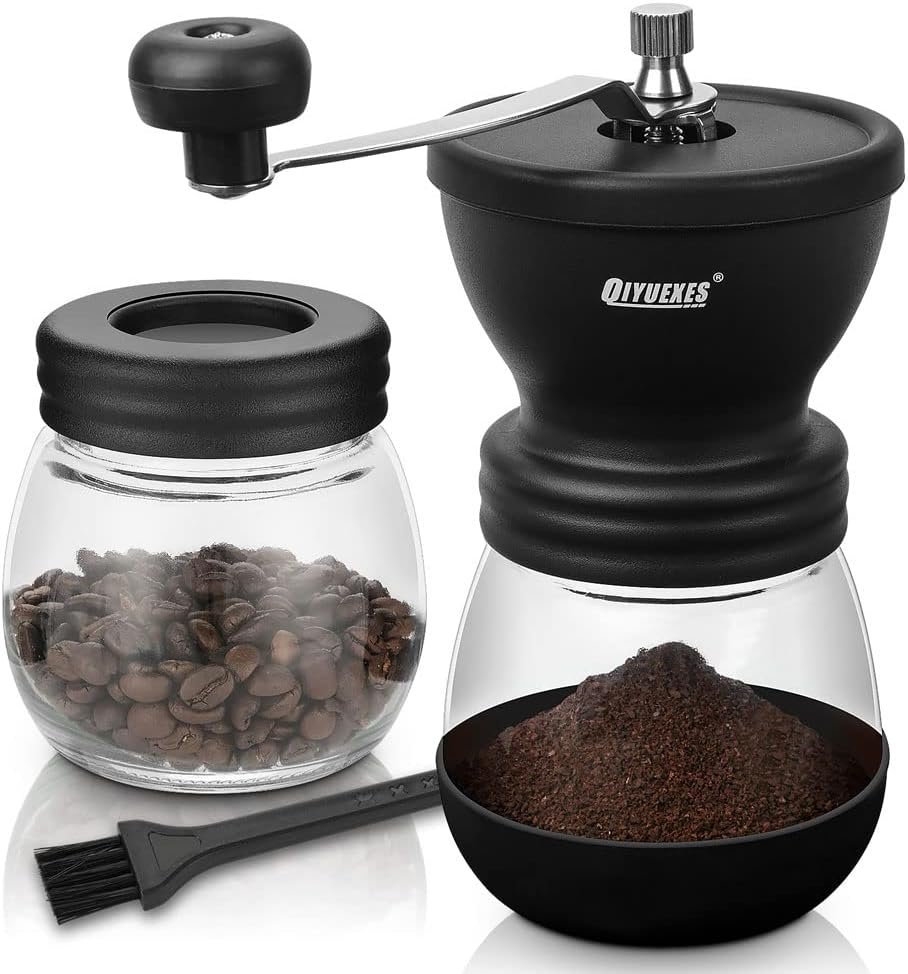
| Capacity and output | 80-gram bean hopper capacity with two included glass jars for ground collection |
| Materials and construction | Ceramic conical burr, glass jars, plastic exterior components, stainless steel fasteners |
| Heating or pressure system | Manual hand-crank operation; no heating or pressurization components |
| Grind compatibility | 48 adjustable grind settings covering fine to coarse ranges for multiple brew methods |
| Best suited users | Travelers, campers, home brewers, office users, and enthusiasts seeking portability and grind control |
| Intended use cases | Home espresso (non-commercial), pour over, AeroPress, French press, travel preparation, multi-use for spices |
| Warranty | Not specified by the manufacturer in the provided listing |
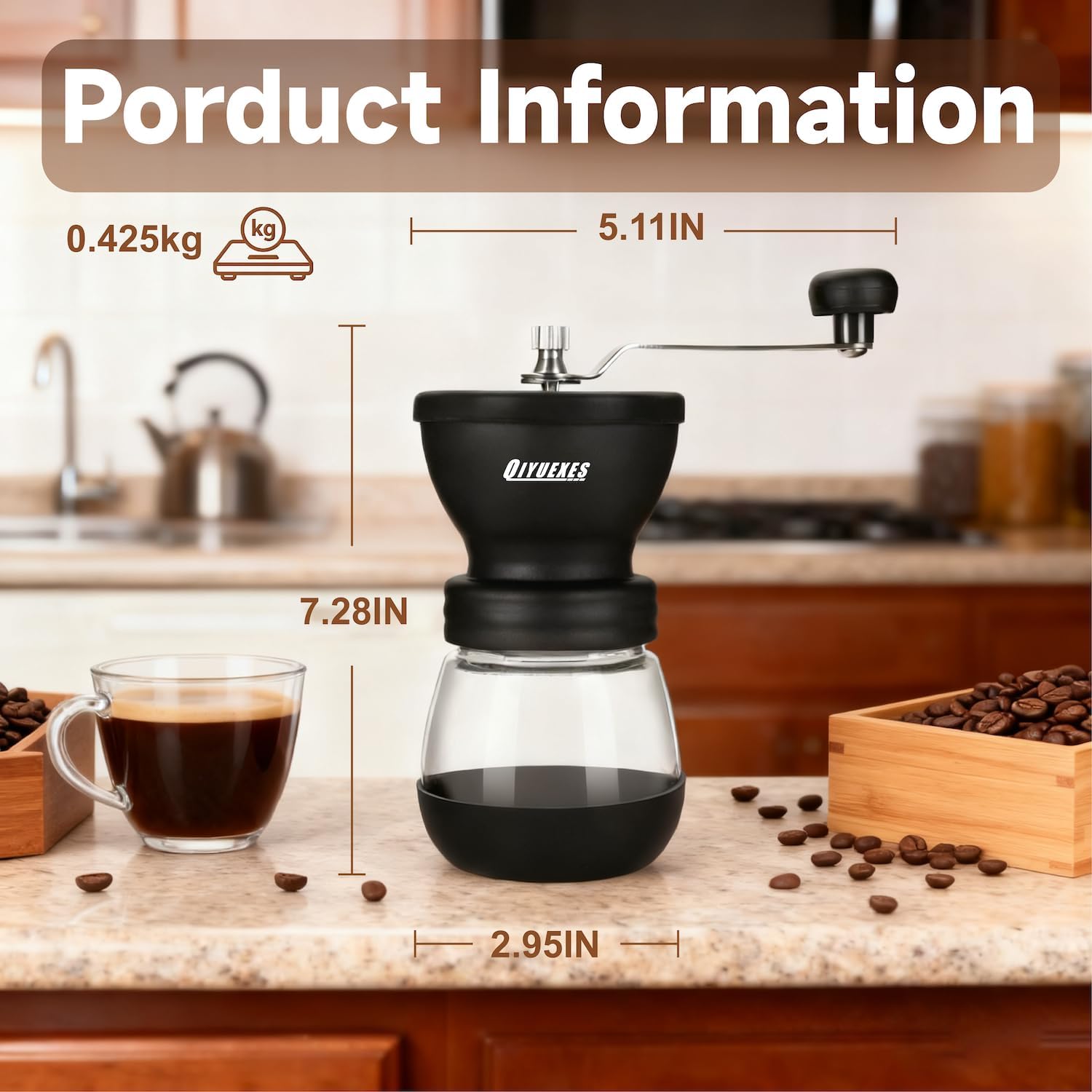
The specification table summarizes how the grinder is positioned: a portable, manual milling option with a broad grind range and small-batch capacity. The ceramic conical burr and adjustable ring prioritize particle uniformity and low heat transfer during grinding, while the 80g hopper and included jars shape how many servings can be prepared in one session and how the device fits into a daily workflow or a travel kit.
Grind range and extraction consistency
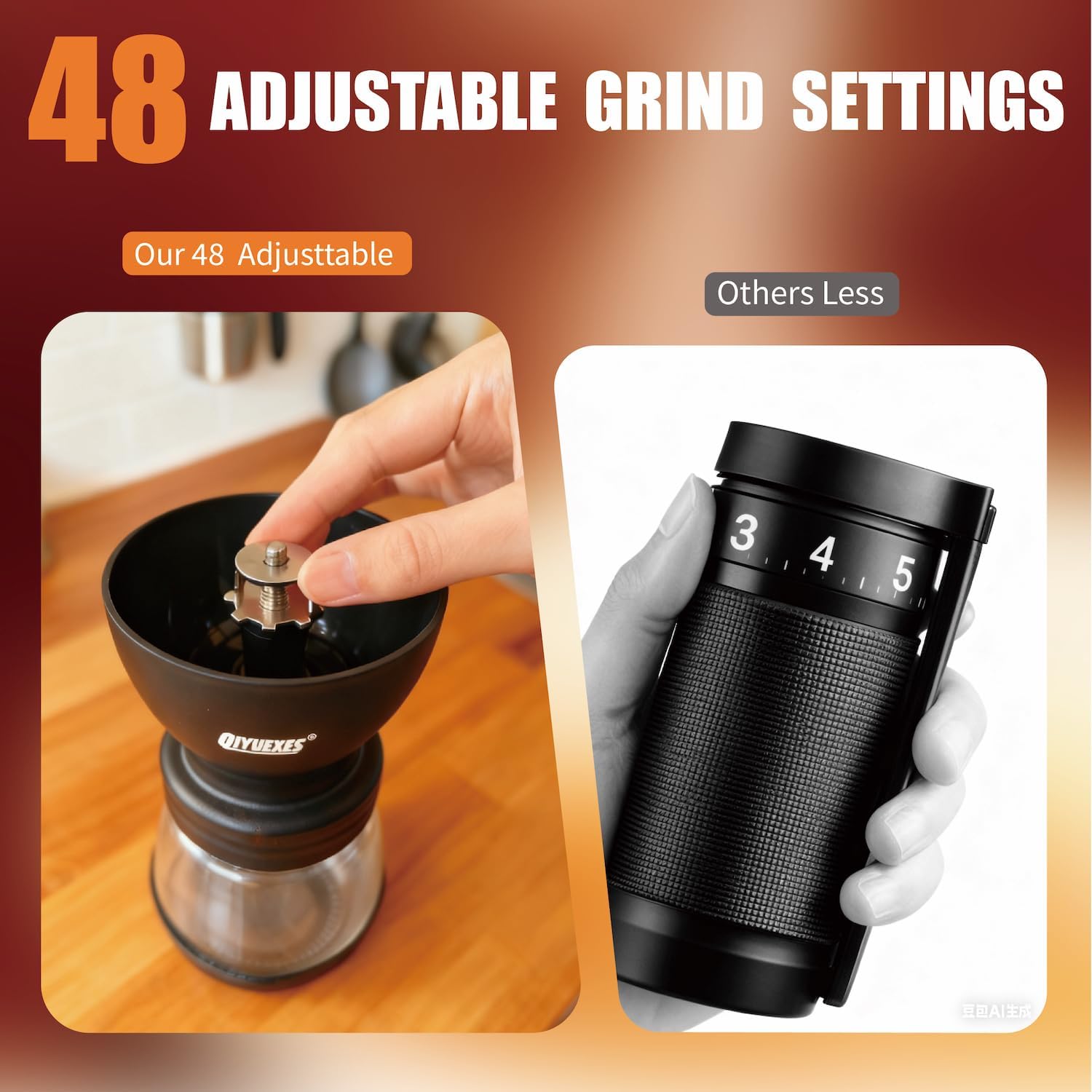
The grinder’s 48-step adjustment ring is designed to provide granular control across a broad spectrum of particle sizes, enabling finer settings suitable for pressurized home espresso and very fine pour-over techniques while also supporting coarser grinds for immersion methods. Grind range alone does not guarantee extraction consistency; burr geometry and the stability of the adjustment mechanism determine whether dialed-in settings repeat reliably between sessions. The conical ceramic burr reduces heat transfer and can produce a narrower particle distribution than blade grinders, which supports predictable extraction curves and clearer flavor separation. For users aiming at precise brew ratios and consistent shot timing, the adjustment detents and tactile feedback of the ring affect repeatability and the ability to reproduce a target setting.
How the 48-step adjustment affects espresso and pour-over
A high number of adjustment steps allows smaller incremental changes in average particle size, which is useful when tuning extraction for espresso or pour-over where small changes have outsized impacts on flow rate and extraction yield. For espresso-style brewing, small changes to particle size alter pressure-driven flow and contact time; finer incremental control helps dial in shot times without changing dose. For pour-over, micro-adjustments influence flow rate and slurry permeability, affecting body and clarity. The practical benefit depends on the adjustment mechanism’s stability—if the ring drifts under load or after reassembly, repeatability is compromised irrespective of step count.
Ceramic conical burr influence on uniformity and heat
Ceramic conical burrs are harder and less thermally conductive than many stainless steel burrs, which reduces heat transfer during grinding and preserves volatile aromatics. Ceramic tends to hold sharpness well for many consumer use cases but can be more brittle if mishandled or dropped. The conical profile favors a distribution with fewer ultra-fine fines relative to some flat burrs, which helps reduce over-extraction risk in pour-over and immersion brews. For espresso, uniform particle size supports stable pressure profiles and a more even puck, but the ceramic material’s wear characteristics and alignment precision determine long-term consistency.
Real-world extraction implications from grind uniformity
Grind uniformity influences channeling risk, puck resistance under pressure, and soluble extraction. A grinder that reduces fines while yielding a tight medium particle distribution enables cleaner cups and more repeatable dosing. For pour-over and AeroPress, consistent granularity promotes predictable drawdown times and clarity. For espresso, consistent grinds support stable pressure build-up and a balanced extraction where sweetness and acidity can be better preserved. Users should pair the grinder with controlled brew ratios and temperature-stable equipment to translate mechanical consistency into cup-level improvements.
Capacity, portability, and serving flexibility
At 80 grams of bean capacity, the grinder accommodates multiple single-serve doses or one to two standard home-serving doses depending on roast density and target brew size. This capacity balances the needs of travelers and small households by reducing the frequency of refills while keeping overall dimensions compact for transport. The unit’s listed weight and dimensions position it as a travel-friendly mill for camping, RV use, or office storage where electric grinders are impractical. Serving flexibility also depends on whether the included jars allow direct dosing into brewer equipment or require transfer. For users who prepare multiple beverages sequentially, the grinder’s hopper-to-jar workflow determines how quickly successive doses can be handled and how much manual effort is required per session.

How 80g capacity maps to typical servings
An 80g hopper covers several single-cup servings: for standard home pour-over ratios (about 1:15–1:17), 15–18 grams per cup is common, meaning the hopper supports roughly four to five cups per fill. For espresso doses (single or double), 7–18 grams per shot are typical, so the hopper covers multiple shots before refilling. For travel and camping, the capacity is sufficient for daily use without frequent refills, but not suited to high-volume household use where continuous grinding is needed.
Portability trade-offs: size, weight, and material choices
Compact dimensions and modest weight make the grinder convenient to carry, but portable designs often use lighter plastics that may affect perceived robustness versus heavier metal-bodied mills. Glass jars provide inert contact surfaces for grounds but add breakage risk during transport unless packed carefully. The absence of an integrated case or protective sleeve increases the need for careful packing. For users prioritizing minimal kit weight and small footprint, this grinder’s specifications align with those needs; durability expectations should be calibrated to the materials used.
Workflow considerations for travel and multi-user use
Included dual jars allow pre-grinding into a sealed container or separating grind targets for different brew methods, streamlining multi-user mornings. The manual crank workflow is inherently slower than electric alternatives, so planning batch sizes ahead of high-demand periods improves experience. For single users or small groups, the balance of capacity and portability is advantageous; for larger households or commercial contexts, an electric grinder with larger throughput is more appropriate.
Materials, build quality, and long-term reliability
The grinder combines ceramic (burr), glass (collection jars), plastic (housing and lid), and stainless steel fasteners. Ceramic burrs offer low thermal conductivity and good edge retention for many consumer scenarios, but they can chip or crack if foreign objects enter the grinder or if the unit is dropped. Glass jars are inert and do not retain oils or odors, which preserves flavor clarity, yet they are more fragile than metal catchments. Plastic exterior components reduce weight and cost but raise questions about wear points—threads, the adjustment ring, and the crank interface are common stress areas in manual mills. Stainless steel fasteners and fittings help mitigate corrosion risk but do not compensate for plastic component wear over long-term heavy use.

Ceramic burr longevity and wear characteristics
Ceramic burrs maintain cutting edges for extended periods when grinding roasted coffee only; however, they are more brittle than steel and can fracture on impact or if contaminants like small stones are present. Ceramic’s resistance to heat helps limit flavor degradation during grinding. Users should inspect beans for defects and avoid hard particulates. Over long-term use, a gradual change in grind behavior may signal burr wear or misalignment rather than material failure, and replacement options depend on manufacturer availability.
Glass jars versus plastic catchments for flavor and durability
Glass offers neutral contact surfaces that do not absorb oils, which benefits flavor preservation when switching roast profiles. It also provides visual feedback on grind size and volume. Glass requires protective packaging for travel to avoid breakage. By contrast, plastic catchments reduce breakage risk but may develop surface scratches where oils can accumulate, possibly affecting flavor neutrality over time.
Structural wear points and assembly robustness
Common longevity concerns for manual grinders include the stability of the adjustment ring, the sturdiness of the crank-to-spindle interface, and the resilience of hopper and lid connections. Plastic threads can strip with repeated assembly or overtightening; metal inserts or reinforced fittings reduce this risk. The listed combination of materials suggests a design optimized for portability and light-to-moderate use rather than heavy daily commercial workloads.
Ease of use, cleaning, and maintenance expectations
The unit’s simple three-piece breakdown (plus lid) is consistent with designs intended for straightforward cleaning and minimal tools. Detachable burrs and accessible collection jars make routine maintenance feasible using a small brush or dry cloth as recommended. Manual operation requires consistent ergonomics: crank length, handle grip, and mounting stability affect required effort and user fatigue. Cleaning frequency depends on roast oiliness and grind fineness: darker roasts and espresso-grade fines often necessitate more frequent brush-outs to prevent buildup that can shift flavor between sessions. Knowing how to reassemble the adjustment ring to a repeatable reference point is important for maintaining consistent grind settings over time.

Disassembly and cleaning workflow
A simple disassembly sequence that exposes the burr surfaces simplifies removal of trapped fines and bean oils. Dry-brushing is the preferred cleaning method for ceramic burrs to avoid moisture exposure that could affect seals or corrode metal components. If deeper cleaning is needed, brief contact with a dry, lint-free cloth or manufacturer-recommended procedures is safe; immersion of metal or plastic components risks degrading adhesives or finishes.
Ergonomics and grinding effort for daily use
Manual grinding requires human energy: crank leverage, burr sharpness, roast hardness, and grind target determine required effort and time per dose. Finer settings and darker roasts increase resistance. A compact crank with good mechanical engagement reduces perceived effort. For routine daily use, a grind session for a single cup should remain comfortable, but repeated multi-cup sessions can become fatiguing compared to electric grinders.
Maintenance schedule and replacement parts availability
Maintenance primarily consists of periodic burr cleaning and inspection for alignment. Ceramic burr replacement availability is a practical consideration for longevity; if spare burrs or kits are not readily available from the manufacturer or third-party suppliers, long-term consistent performance may be impacted. Fast-moving plastic components such as lids or adjustment rings are wear items; ease of replacement supports long-term value.

Pros & Cons
Pros
- Wide grind range with 48 adjustments: The large number of settings enables fine incremental control for espresso and pour-over tuning, improving the ability to hit target flow rates and extraction yields without swapping equipment. Repeatability depends on the stability of the adjustment mechanism.
- Ceramic conical burr reduces heat transfer: Ceramic material limits temperature rise during grinding and helps preserve volatile aromatics, which supports better flavor clarity compared with high-speed blade alternatives. Ceramic burrs also tend to hold edges for extended home use.
- Portable, compact form factor: Small dimensions and modest weight make the grinder suitable for travel, camping, office use, or small kitchens where electric grinders are impractical. The included jars allow sealed storage of ground coffee for short periods.
- 80g capacity supports multiple servings: The hopper size accommodates several cups or multiple espresso doses between refills, which is useful for small households or multi-cup mornings.
- Simple disassembly and easy cleaning: Limited component count streamlines routine maintenance using a brush or dry cloth, keeping the workflow straightforward for users who prioritize quick cleanup.
- Glass jars for neutral storage: Glass collection jars are non-reactive and do not retain oils or odors, preserving taste when switching between roasts or brew methods.
- Multi-use compatibility: Listed suitability for coffee and spices offers flexibility in travel or campsite contexts where a single grinder may be used for different ingredients.
- Included accessories reduce immediate needs: The presence of two jars and a brush helps users start using the grinder without sourcing additional containers.
Cons
- Plastic exterior components limit long-term robustness: Lightweight plastics used in the housing and adjustment interfaces may wear faster under heavy daily use and are more vulnerable to thread stripping or cracking if mishandled.
- Ceramic burr brittleness risk: While ceramic offers good flavor-preserving properties, it is more brittle than steel and can chip if foreign particles are present or the unit is dropped. Replacement parts availability affects long-term viability.
- Manual effort and throughput limitation: Manual grinding requires physical effort and is slower than electric alternatives, which can be a drawback in multi-cup or high-demand situations.
- Glass jar breakage potential during travel: The included glass jars are beneficial for flavor neutrality but introduce breakage risk in mobile use unless packed with protection.
- Adjustment repeatability depends on mechanism stability: The practical benefit of 48 settings relies on a stable and precise adjustment ring; any play or drift reduces reproducibility between sessions.
Final Verdict: Who This Product Is Best For (and Who Should Skip It)
This manual conical-burr grinder best suits home brewers, travelers, and campers who prioritize portability, low-heat grinding, and fine-grain adjustment control across multiple brew methods such as pour-over, AeroPress, and home espresso setups that tolerate manual pre-grind dosing. The 80g capacity and included glass jars make it convenient for small households and on-the-go users who value flavor neutrality and compact gear. Brewing outcomes will improve when paired with temperature-stable kettles or machines, precise brew ratios, and consistent dosing habits that leverage the grinder’s granular adjustment range.
Those who should consider other options include high-volume households, commercial settings, or users seeking effortless daily throughput—electric grinders with larger hoppers and higher RPM motors provide much faster, less labor-intensive operation. Buyers requiring heavy-duty durability and metal-bodied construction for long-term intensive use may prefer models with steel burrs and reinforced housings. Finally, users who are uncomfortable with manual effort, or who need guaranteed burr replacement channels, should verify spare-part availability before committing to a ceramic-burr manual mill.
Frequently Asked Questions (FAQs)
How fine can a 48-setting manual grinder be adjusted for espresso?
A 48-step adjustment system allows relatively fine incremental changes to average particle size, making it feasible to reach espresso-range fineness for many home machines. Actual espresso performance depends on burr alignment and stability: small changes in setting should translate to predictable changes in flow rate only if the adjustment mechanism holds position under load and reassembly.
Is a ceramic conical burr better than a stainless steel burr for flavor preservation?
Ceramic burrs have lower thermal conductivity than steel, which can reduce heat transfer during grinding and help preserve volatile aroma compounds. Ceramic also resists some types of corrosion and maintains edge retention in typical consumer use. However, ceramic is more brittle than steel, so care is required to avoid impacts or hard contaminants.
Will an 80g hopper be enough for daily household use?
An 80g capacity covers multiple single-cup servings—typically enough for several pour-over cups or multiple espresso shots before refilling. For single users or small households it is generally sufficient, but high-volume mornings or shared kitchens may prefer a larger-capacity electric grinder for convenience and throughput.
How often should a manual ceramic-burr grinder be cleaned?
Routine dry-brushing after each use keeps fines and oils from accumulating; deeper cleaning can be performed weekly to monthly depending on roast oily-ness and frequency of use. Ceramic burrs should generally not be soaked; a dry, lint-free cloth or a brush is recommended to preserve materials and finishes.
Is the included glass jar safe for travel use?
Glass jars provide neutral storage for grounds but are more susceptible to breakage during transport. For travel, packing the jar with protective padding or using a secondary plastic container for transport mitigates breakage risk while retaining the grinder’s portability advantages.
Can this grinder be used for spices or peppercorns?
The grinder is listed as suitable for coffee and spices; however, grinding very hard spices or peppercorns can accelerate burr wear and increase the risk of contamination between uses. If multi-use is intended, thorough cleaning between ingredient types is advised and users should be prepared for slightly faster wear with non-coffee materials.
What are common durability concerns with this type of manual grinder?
Durability concerns typically center on plastic adjustment rings and hopper fittings that can wear or strip, ceramic burr brittleness if impacted, and glass jar breakage during transport. Stainless steel fasteners mitigate corrosion risk, but long-term durability depends on usage patterns, careful handling, and availability of replacement parts.
Does a manual grinder produce less heat during grinding than an electric grinder?
Manual grinding generally produces less heat because it operates at lower rotational speeds and typically uses conical burr geometries that dissipate heat more effectively. The ceramic material of the burr further reduces heat transfer, helping preserve delicate flavor compounds compared with high-speed electric blade grinders.