SOWTECH 38-Setting Burr Grinder — Versatile Home Grind Guide
Why grinder choice matters for home brewing
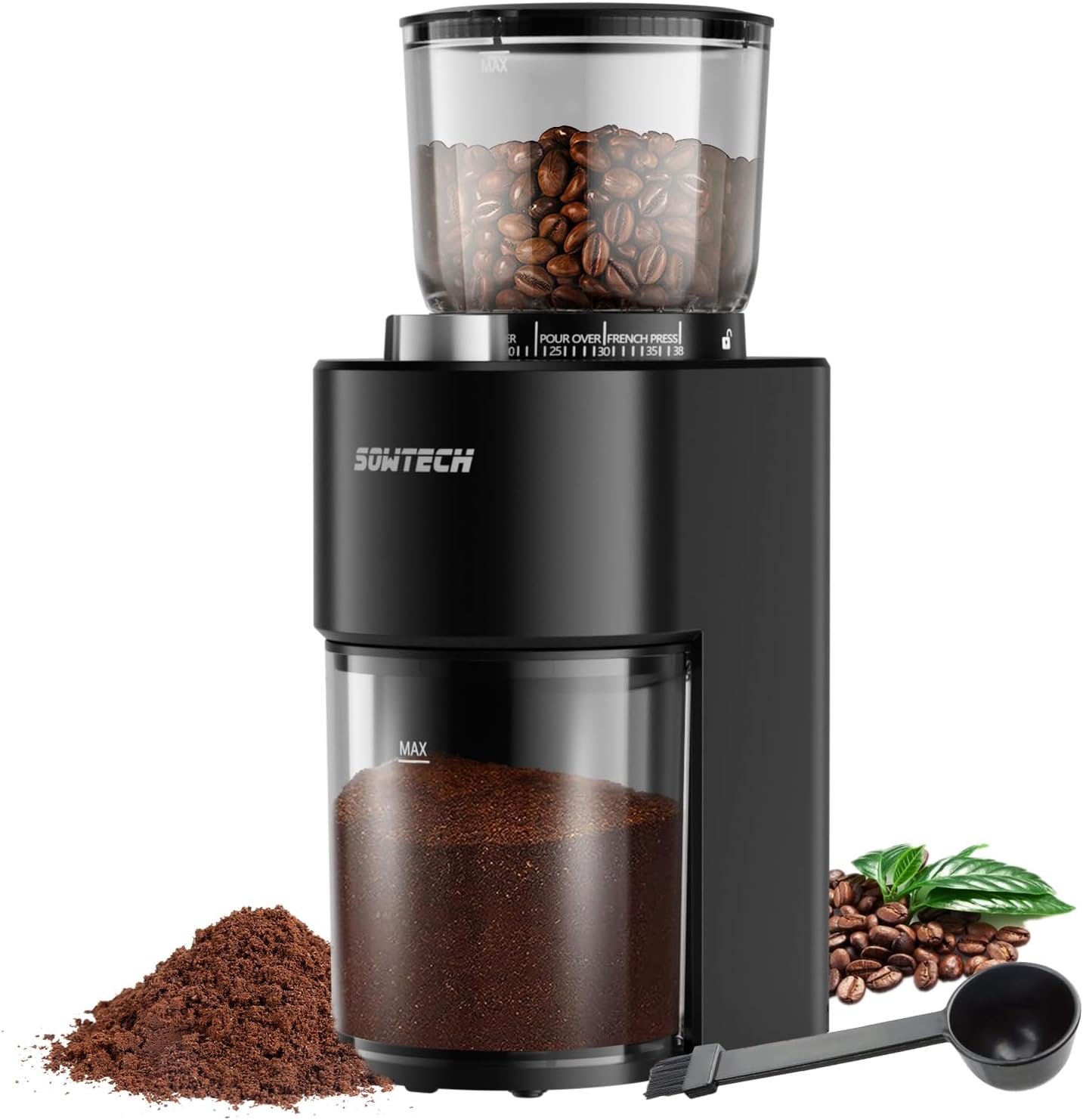
Selecting a grinder is a foundational decision for home coffee quality because grind size, uniformity, and dose consistency directly shape extraction and flavor. This review focuses on the SOWTECH Conical Burr Coffee Grinder, a compact electric burr mill with 38 grind settings, an adjustable timer, an anti-static hopper, and an 800W motor. The target user profile is home brewers and household households who prepare multiple brew styles—espresso, drip, and French press—and who prioritize versatility in grind size without a large footprint. Evaluations emphasize how the grinder’s mechanical design and control scheme influence brewing outcomes, including grind consistency for even extraction, dosing repeatability for predictable brew strength, and heat or static management to preserve aroma compounds. Considerations cover ease of integration into daily brewing workflows, cleaning and maintenance expectations based on detachable components, and long-term reliability signals provided by materials and motor specifications.
Quick Overview
| Feature | Details |
|---|---|
| Product category | Conical burr electric coffee grinder |
| Compatible brewing methods | Espresso, drip, pour-over, French press (grind range adjustable) |
| Grind adjustments | 38 discrete grind settings |
| Burr type | Conical burrs (manufacturer-described high-quality) |
| Motor power | 800W (manufacturer specification) |
| Timer and dosing | Programmable timer, 5 to 60 seconds |
| Hopper | Anti-static bean hopper (capacity not specified by manufacturer) |
| Materials and construction | Plastic body with detachable components; burr material described as high-quality by manufacturer |
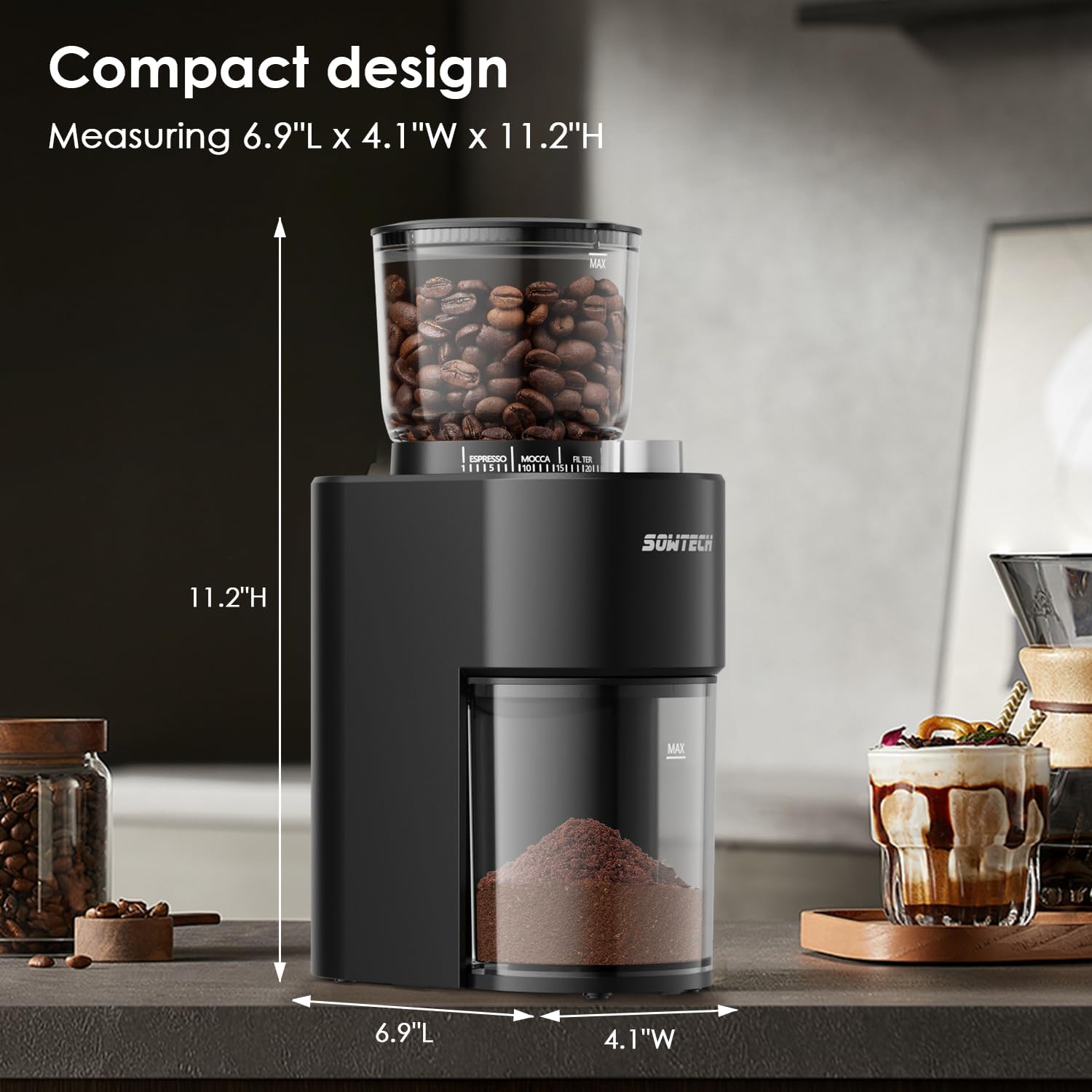
| Size and weight | Compact footprint (~5-inch dimension reported), item weight 3.4 pounds |
| Best suited users | Home brewers seeking flexible grind control in a compact package |
| Warranty/support | Manufacturer-backed after-sales support and stated warranty |
The specification set indicates a grinder engineered for versatility and compact kitchens. The programmable timer and 38 grind steps let users approximate target particle distributions for different brew methods, while the conical burr geometry supports consistent particle sizing compared with blade grinders. The combination of an anti-static hopper, detachable parts, and a relatively powerful motor suggests attention to workflow and maintenance, though material choices and unspecified hopper capacity are practical considerations for daily use.

Grind range and extraction performance
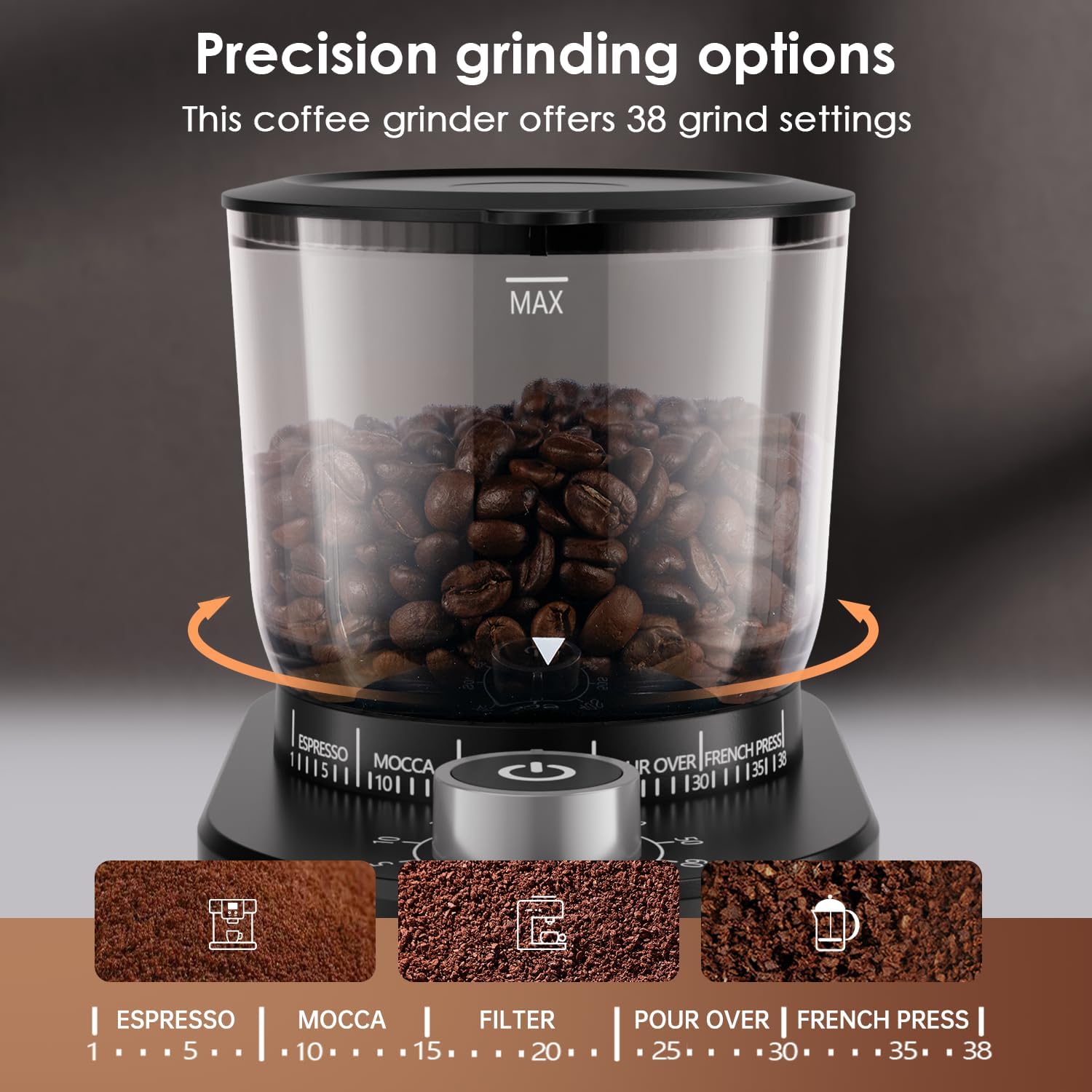
The grinder’s 38 discrete grind settings position it as a mid-range option for users seeking control over particle size distributions that influence extraction rate and flavor balance. A finer grind increases surface area and extraction speed, which is critical for espresso pressure-based systems; coarser settings reduce extraction and favor immersion methods. The conical burr form factor tends to produce a bimodal distribution with tight peak particle sizes if well-manufactured, supporting even extraction and reduced channeling in espresso or balanced extraction in pour-over. The programmable timer provides a way to control dose by time, but time-based dosing interacts with bean density and roast profile, so users should expect to pair timer settings with grind adjustments and weigh doses when precision matters most.

Grind setting precision and range
Thirty-eight settings provide finer resolution than basic stepped grinders and allow incremental tuning between espresso and coarser brews. Finer steps enable a user to dial in small shifts that affect puck resistance and extraction for espresso and allow gradual adjustments for pour-over flow rate. However, the practical resolution depends on the burr geometry and alignment: tightly manufactured conical burrs deliver more consistent particle distributions across settings, while looser tolerances increase variability. Time-based dosing means that the same setting can yield different masses with different beans due to density and oil content, so pairing the 38-step mechanical range with a scale is recommended for repeatable results.
Conical burr design and grind consistency
Conical burrs typically produce less heat and a narrower particle distribution than blade alternatives, which helps preserve volatile aromatics during grinding. The conical shape encourages a consistent shearing action from the outer to the inner burr, reducing fines and large particle outliers when tolerances are tight. Manufacturer descriptions of “high-quality conical burrs” align with the expectation of improved extraction control, but material and machining precision determine ultimate performance. Consistent grind size reduces under- or over-extraction risks by promoting even water contact during brewing; therefore, burr alignment, shaft stability, and housing rigidity are important to maintain particle-size stability over time.
Timer, dosing and dose repeatability
Time-based dosing simplifies operation by letting users set a target run length rather than measuring each dose, which suits routine brewing where convenience is prioritized. The 5-to-60-second range covers small single-dose shots and larger batches for multiple cups, but variability in bean density, moisture and roast level will change mass-per-second rates. For precise extraction control—especially with espresso—time dosing should be paired with weighing or occasional calibration because timer-only dosing cannot account for bean variations. Reviews commonly note that users who pair timer settings with a regular calibration routine or use a scale experience more predictable extraction and reduced shot-to-shot variance.
Brewing method compatibility and serving flexibility
Compatibility across espresso, drip, and French press relies on the grinder’s ability to deliver relevant particle distributions and consistent dosing. Espresso demands a fine, uniform grind to build pressure and avoid channeling; immersion methods tolerate coarser, more variable particles but benefit from well-defined peaks to avoid over-extraction of fines. The SOWTECH unit’s 38-step range and conical burr design suggest it can cover the needed spectrum in principle, but practical performance depends on burr sharpness, step calibration, and timer consistency. Serving flexibility is also affected by hopper capacity and retention: compact models favor single- to small-batch grinding, while larger households or multi-cup routines require more frequent refills. The grinder’s compact footprint targets kitchens where counter space is limited but multiple brew styles are prepared.

Espresso and press compatibility
For espresso, the grinder must produce a fine, narrow particle distribution and allow micro-adjustments that influence puck resistance and extraction yield. A 38-step system provides the mechanical resolution to approach espresso-relevant sizes, but achieving stable, repeatable espresso extraction typically also requires dose control by mass and attention to tamping and machine pressure. French press and immersion methods are more tolerant of particle variance but perform best with a clean coarseness profile and minimized fines to reduce bitterness. In practice, when using a single grinder across multiple methods, users should accept a brief re-tuning process between grind sizes to align with each method’s extraction window.
Drip and pour-over performance
Pour-over and drip set-ups depend on grind uniformity to regulate flow rate and extraction consistency. The SOWTECH burr geometry favors uniformity compared with blade grinders, and mid-range stepped adjustments allow tuning for different filter geometries and pour techniques. Temperature stability from the brewer and consistent flow control are also important; a well-ground bed with few fines reduces clogging and channeling. For single-cup pour-overs, grind retention and static can influence dosing precision—features like an anti-static hopper help keep grounds manageable, which supports cleaner dosing and steadier extraction when preparing manual brews.
Batch size and hopper considerations
Compact grinders often trade hopper volume for smaller footprints, and manufacturer disclosures for this model do not specify hopper capacity. That lack of specification suggests caution for large-batch households or frequent entertaining where continuous throughput is required. Anti-static design helps reduce cling and waste during transfer, improving usability for single-dose workflows. For users who grind directly into a portafilter, dosing cup, or scale, the relatively small dimensions and detachable components enable flexible single-dose operation. Households that routinely grind multiple pounds of beans per week should weigh the convenience of frequent refills versus the space-saving benefits.
Ease of use, workflow, and maintenance expectations
Operational simplicity hinges on control layout, cleaning accessibility, and predictable results from time-based dosing. The SOWTECH grinder’s programmable timer and detachable components are intended to streamline daily workflows: set time, grind, and transfer. Anti-static elements reduce mess, and a compact footprint integrates into small kitchens. Maintenance expectations depend on the ability to remove the hopper and access burrs for routine brushing or rinsing where appropriate—detachable burrs are beneficial for cleaning but require correct reassembly to maintain alignment. Users should expect to incorporate periodic burr inspection for wear, occasional deep cleaning to remove oils and fines, and calibration of time-dose pairing to account for bean variability.

Control layout and workflow
A clear, intuitive control layout reduces cognitive friction in a morning routine; programmable timers with visible increments enable quick selection for common doses. Time-based running means shortcuts for repeated single-cup preparation, and 5-to-60-second range suits a variety of targets. However, a cycle-based user may prefer a grinder with direct mass dosing or stepless adjustment for micro-tuning. Workflows that include weighing the grind will add a small step but substantially improve repeatability. Aggregated review themes indicate users appreciate straightforward timer interfaces but recommend confirming dose mass periodically to lock in consistent extraction.
Cleaning, detachable components, and maintenance
Detachable parts simplify cleaning by allowing access to the burr chamber and catching areas where fines and oils accumulate. Routine maintenance typically includes brushing out the burrs, wiping the hopper, and occasionally disassembling for a deeper clean. Plastic housing reduces weight and resists certain stains but can show wear where mechanical parts meet. Manufacturer guidance on reassembly and burr alignment is important; improper reassembly can affect grind consistency. Regular cleaning schedules preserve flavor clarity and reduce rancidity from trapped oils in the grinding chamber.
Anti-static hopper and mess reduction
Static during grinding causes grounds to cling to surfaces, complicating dosing and cleanup; an anti-static hopper reduces this effect by minimizing charge accumulation on particles. The net result is cleaner transfer from hopper to dosing container, less residue stuck to the chute, and more accurate dosing by time or mass. Anti-static measures do not eliminate retention entirely—some grounds remain in the burr chamber—so periodic tapping or back-blowing and occasional cleaning remain necessary. Customer feedback trends typically highlight anti-static hoppers as beneficial for home workflows that prioritize neatness and predictable dosing.
Build quality, motor characteristics, and long-term reliability signals
Durability and reliability considerations are informed by materials, motor specification, and user-reported themes about longevity. The manufacturer lists a plastic exterior and detachable components, paired with a robust-sounding 800W motor. Higher wattage motors generally provide sufficient torque to grind a range of roast levels without bogging, but heat generation and mechanical wear are important factors—conical burrs and a well-ventilated motor area can mitigate heat transfer to beans. Plastic body construction reduces weight and cost but can compromise rigidity compared with metal housings, potentially affecting burr alignment over time. Warranty and after-sales support offered by the manufacturer are positive signals for addressing defects or replacements.

Materials, body construction, and components
Plastic construction delivers a lighter appliance and protects against surface corrosion, but plastic can flex under mechanical stress. Burr alignment and shaft stability rely on secure mounting points; metal reinforcement in load-bearing areas is advantageous. The manufacturer’s description of detachable components aids maintenance, but long-term wear of plastic fittings, latches, and threads should be expected compared with metal counterparts. Attention to tolerances during assembly helps preserve grind consistency; therefore, materials and manufacturing precision both contribute to dependable operation over time.
Motor, noise profile, and temperature stability
An 800W motor provides notable torque that helps grind denser, darker, or oilier beans without stalling. Motor speed, cooling design and burr geometry influence heat generation: slower-turning conical burrs typically produce less heat and preserve volatile aromatics. Noise is a function of motor type, housing, and burr engagement; manufacturers sometimes claim quiet operation, but actual perceived noise varies with load and roast. Temperature stability during grinding helps maintain aromatic compounds, and reduced heat transfer into the bean mass supports cleaner flavor outcomes; conical burr layouts generally favor lower heat buildup versus high-speed blade designs.
Warranty, support and longevity signals
Manufacturer-backed warranty and after-sales service reduce ownership risk and indicate confidence in the product. Warranty coverage specifics were declared by the seller as part of after-sales support messaging. Users should register products when required and retain purchase documentation. Aggregated customer review themes commonly use warranty responsiveness and replacement part availability as indicators of long-term support, and those factors are important for buyers prioritizing sustained performance in 2026.
Pros & Cons
Pros
- Wide grind range with 38 settings: The stepped adjustment range allows users to move between espresso-fine and French-press-coarse settings without needing multiple grinders. This breadth supports multi-method households and reduces the need for separate dedicated appliances.
- Conical burrs for improved particle consistency: Conical burr geometry generally produces more uniform particles than blade grinders, which helps improve extraction balance and reduce over-extracted fines. This design also tends to generate less heat at comparable grind rates.
- Programmable timer for convenient dosing: The 5-to-60-second timer simplifies repetitive grinding routines and supports single-dose workflows. When combined with occasional weighing, time-based dosing can be a fast path to consistent daily results.
- Anti-static hopper for cleaner transfer: Anti-static characteristics reduce grounds cling and mess during transfer from hopper to dosing container, improving workflow cleanliness and dose accuracy. This is particularly useful for light roasts that tend to produce more static.
- Compact footprint and lightweight body: The small dimensions and low weight make the grinder suitable for limited-counter kitchens or mobile setups where space economy matters. It integrates into compact brewing stations without dominating the workspace.
- Detachable components ease cleaning: Removable hopper and grinding chamber access simplify routine maintenance and contribute to consistent performance by allowing regular removal of fines and oils.
- Manufacturer support and warranty: Stated after-sales support and warranty provision offer recourse for defects and provide a measure of ownership confidence.
Cons
- Plastic construction may affect long-term rigidity: A predominantly plastic exterior is lightweight but can flex over time, which may influence burr alignment and consistent particle sizing compared with metal-bodied units.
- Time-based dosing can be inconsistent across beans: Timer-only dosing does not account for bean density and roast variability, so repeatable mass dosing requires calibration or use of a scale for precision-oriented users.
- Hopper capacity unspecified for larger batches: Manufacturer disclosures do not state hopper volume, which can complicate planning for households that routinely grind for multiple cups or entertaining guests.
- Potential for variable noise and heat under load: While the motor is specified at 800W, noise and heat profiles depend on ventilation and burr engagement; heavier use with oily or dark roasts can increase cleaning frequency and may produce noticeable motor noise.
Final Verdict: Who This Product Is Best For (and Who Should Skip It)
The SOWTECH Conical Burr Coffee Grinder is best suited for home brewers seeking a space-saving grinder with a broad grind range and user-friendly features. It is a practical choice for households that prepare a variety of brew methods—espresso, pour-over, drip, and French press—and value programmable timer convenience, an anti-static hopper, and detachable parts for routine cleaning. Users who perform single-dose routines or who are willing to pair the timer with periodic weighing will find the combination of 38 settings and conical burr geometry adequate for achieving targeted extraction profiles.
This grinder is less appropriate for users who demand metal-bodied commercial durability, uninterrupted large-batch throughput, or stepless micro-adjustments for competitive espresso dialing. Precision-minded baristas or high-volume households that prioritize long-term burr stability and ultimate repeatability should consider professional-grade grinders with metal construction, stepless adjustment, and explicit hopper capacity disclosures. For typical home use in 2026, the SOWTECH unit balances versatility and convenience with sensible maintenance expectations and manufacturer support.
Frequently Asked Questions (FAQs)
How many grind settings does the SOWTECH grinder offer and what does that mean for brewing?
The SOWTECH model offers 38 discrete grind settings. This stepped resolution enables users to move incrementally between fine and coarse particle sizes, which is useful when switching between espresso, pour-over, and French press. The practical benefit relies on burr geometry and alignment; a higher number of settings provides more mechanical flexibility but works best when paired with dose calibration, since time-based dosing alone does not account for bean density and roast variability.
Is the SOWTECH grinder suitable for espresso?
The grinder’s conical burr design and 38-step adjustment make it capable of reaching espresso-relevant particle sizes in principle. Successful espresso use also depends on dose accuracy, tamping, and the espresso machine’s pressure stability. Users seeking highly repeatable, competition-level espresso dialing may prefer a stepless grinder and mass-based dosing, but this model can be effective for home espresso when paired with consistent dosing practices.
Does the anti-static hopper eliminate mess entirely?
An anti-static hopper reduces static cling and helps grounds transfer more cleanly from the hopper to the dosing container, which improves neatness and dosing accuracy. It does not completely eliminate grounds retention or fines in the chute and burr chamber, so routine cleaning and occasional tapping or brushing remain necessary to manage buildup and ensure consistent performance.
How should the programmable timer be used for consistent dosing?
The programmable timer (5 to 60 seconds) offers convenience for routine grinding and single-dose workflows. To improve repeatability, use the timer in combination with occasional weighing to establish a correlation between runtime and mass for specific beans. Because beans vary in density and roast level, periodic calibration—measuring grams produced per second—will minimize dose drift and lead to more consistent extraction outcomes.
What cleaning and maintenance are recommended for this grinder?
Routine maintenance includes removing the hopper and brushing out the burr chamber to clear fines and oils, wiping external surfaces, and periodically disassembling detachable components for deeper cleaning. Avoid immersing the motor housing in water; follow manufacturer guidance for reassembly to preserve burr alignment. Regular cleaning sustains flavor clarity and prevents rancid oil buildup that can affect taste over time.
Is the 800W motor advantageous for home grinding?
An 800W motor provides ample torque to grind a wide range of roast levels and bean densities without stalling under typical home use. Higher power helps maintain consistent performance under load, but motor efficiency, ventilation, and burr speed influence heat generation. The conical burr layout helps reduce heat transfer, which supports preservation of volatile aromatics during grinding.
Who should consider a different grinder instead of this model?
Users who require industrial-grade durability, stepless micro-adjustment for precision espresso dialing, or large hopper capacity for heavy batch grinding may prefer a higher-end, metal-bodied grinder. Those prioritizing absolute mass-based dosing as the primary workflow might select a grinder with built-in scales or known mass-per-second calibration features rather than a timer-only dosing approach.
Are replacement parts and warranty support available?
The manufacturer advertises after-sales support and a warranty for the product. Buyers should register the product if required and retain purchase documentation to access warranty services. Availability of replacement parts can vary by region, and manufacturer support responsiveness is an important factor for long-term ownership.